You’re in a hiring huddle for a senior engineering role. The delivery dates are tight, the tech bar is high, and you also know the team isn’t balanced. You want to broaden who applies,because the same channels keep producing the same shortlist. Then someone says,
Careful. We can’t do anything that looks like discrimination.
That’s the moment most line managers freeze. The intent is good, but the fear is real: “If I run a women-focused event, is that illegal?”
If I say we welcome women applicants, will Legal shut it down?
“If two candidates are close, can we take representation into account?”
As an HR director in a STEM business, my job is to help you move from good intentions to lawful, practical action. In plain language, what is positive action?
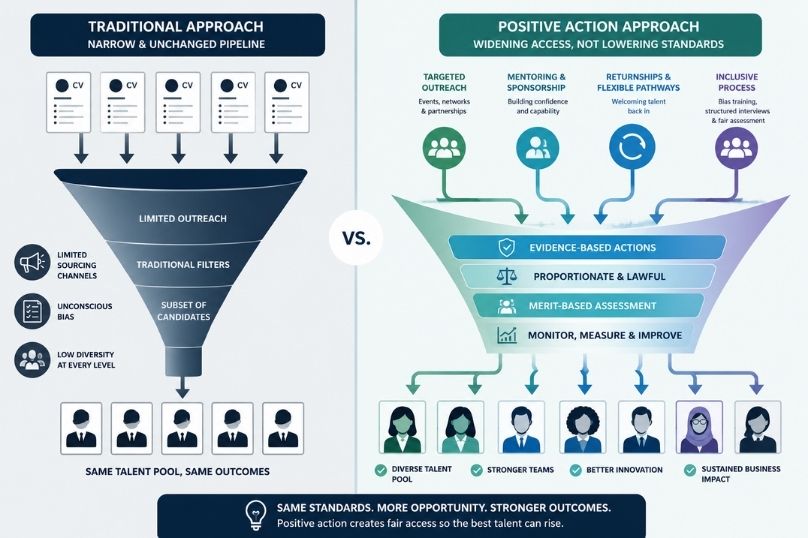
It’s a set of targeted, proportionate steps that help underrepresented groups access opportunity, without lowering standards or handing out roles based on identity alone.
Striving for Balance in STEM Without Breaking the Law
On Monday morning, you open your req tracker and see the same pattern again. Plenty of applications, very few from women for a specialist technical role.
Your team says they “hire on merit” (as they should), but you also know merit only gets a fair shot when the process is reachable, welcoming, and designed for real humans.
In UK STEM, the underrepresentation is measurable. In 2022, women made up just 24% of the UK STEM workforce according to the Office for National Statistics (ONS). If you manage an engineering or product team, that number won’t surprise you. You see it in stand-ups, on-call rotations, and leadership meetings.
The typical manager dilemma
You want to do something practical, but three worries come up fast.
“If we focus on women, are we excluding men?”
“If we support one group, are we admitting our process is unfair?”
“If we talk about diversity in hiring, will candidates think standards are lower?”
Those concerns are normal. They’re also often based on mixing up three different ideas: culture and inclusion work, lawful positive action, and unlawful positive discrimination.
Let’s say you’re hiring a senior embedded engineer.
You notice two friction points:
Women are less likely to apply from your usual sourcing channels.
Women who do apply disproportionately drop out after the first technical screen, often citing poor candidate experience.
A positive-action minded response isn’t “hire a woman regardless.” It’s actions like:
running an information session that demystifies your interview process,
pairing candidates with a trained interview buddy who can answer process questions,
reviewing your job advert for unnecessary “nice-to-haves” that inflate requirements.
Good line-manager instinct: Start by widening access to compete, not by deciding the outcome in advance.
Defining Positive Action Under UK Law
A common STEM scenario makes the legal idea easier to grasp. Your software team wants more women applicants for platform roles. The answer is not to reserve jobs for women. The lawful answer is to remove barriers that make it harder for qualified women to apply, compete, or stay.
The legal definition in the UK
Under the Equality Act 2010, employers can take proportionate steps to address disadvantage linked to a protected characteristic, meet different needs, or increase participation where that group is underrepresented. The main starting point is Section 158.
For line managers, that usually means three checks.
First, what problem are we trying to fix?
Second, what evidence do we have that this group faces a disadvantage, has different needs, or is underrepresented?
Third, is our response proportionate to that problem?
That word proportionate matters. In practice, it means your action should fit the issue you have identified. If women are not applying to your electronics roles because your outreach only reaches the same networks every time, a targeted women-in-engineering careers event may be reasonable. If women returning from career breaks are falling out of process because your skills test assumes recent industry experience, a supported returner pathway or technical refresher may be reasonable too.
This sits comfortably with the wider goal of being an equal opportunity employer. Equal opportunity sets the standard that people should be treated fairly. Positive action gives you some lawful tools to address a specific imbalance when fair treatment on paper is not producing fair access in practice.
What positive action looks like in HR terms
In a UK STEM organisation, positive action often looks practical rather than dramatic.
You might:
advertise engineering roles through networks that reach women in tech and women returners,
run interview workshops that explain how your technical assessment works,
offer mentoring or buddy support for interns, apprentices, or returners from underrepresented groups,
create a return-to-STEM programme for experienced women whose CVs show a career break,
review role criteria that screen people out for reasons unrelated to performance in the job.
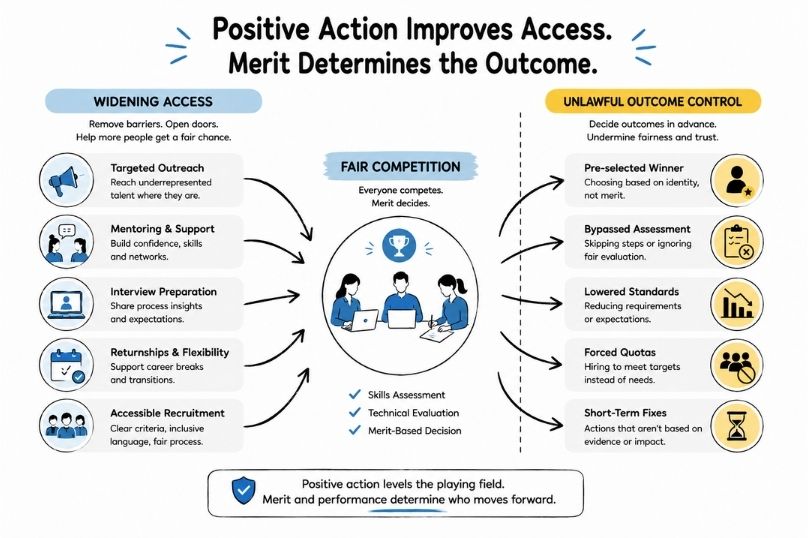
A useful test is this: are you helping people get a fair chance to compete, or are you deciding the result before the assessment happens? Positive action stays on the first side of that line.
Managers also need to know what risk looks like. If you want a clear reference point, this guide to discrimination in the workplace helps clarify the kinds of treatment that cross into unlawful conduct.
Positive action means targeted, evidence-based support that widens fair access. It does not guarantee someone a role.
Positive Action vs Positive Discrimination vs Affirmative Action
Most workplace conflict on this topic comes from one problem: people use the same words to mean different things.
A manager says “affirmative action” when they mean “targeted outreach”. An employee says “positive discrimination” when the company is running mentoring. Then the whole discussion becomes defensive.
Comparing Approaches to Workplace Equality
Concept
Legality in UK
Primary Goal
Example Action
Positive action
Lawful when evidence-based and proportionate
Level the playing field by addressing disadvantage or underrepresentation
Run a women-focused engineering open day to explain the role, hiring process, and skills expectations
Positive discrimination
Generally unlawful (with limited exceptions in specific circumstances)
Guarantee outcomes for a protected group
Hiring someone because they’re a woman even when another candidate is stronger
Affirmative action (US term)
Not the UK framework. Rules vary by jurisdiction and context
Increase representation using legally permitted measures
A US employer may run structured diversity programmes, but the legal boundaries are different from the UK model
Where line managers get caught out
The risky moment is almost always the decision stage.
Lawful intent can become unlawful practice if someone says:
“We need a woman in this team, so let’s pick her.”
“Let’s drop the bar a bit this time.”
“We’ll only interview women.”
Even if the motivation is to fix imbalance, you’re now in territory that can look like less favourable treatment of other candidates.
On the flip side, managers sometimes avoid any targeted action at all and call it “being fair”. That can lock in the status quo.
If you’re building your hiring playbook, it’s also worth understanding what it means to be an equal opportunity employer in practical, operational terms. Not as a slogan, but as a consistent set of behaviours across sourcing, selection, and progression.
A plain-English rule I give engineering leaders
If your action helps people compete, you’re usually in positive action territory. If your action decides who wins regardless of merit, you’re in risky territory.
The Legal Guardrails of the Equality Act 2010
Positive action isn’t a free pass. It has boundaries, and those boundaries are what make it defensible and sustainable.
Two guardrails matter most in day-to-day people management: evidence and proportionality.
Guardrail one: You need evidence, not a hunch
Managers often say, “We don’t get many women applicants.” That may be true, but treat it like an engineering incident.
What does the data say about applicants, interview pass-through, offers, and acceptances?
What do exit interviews and engagement feedback say about why people leave?
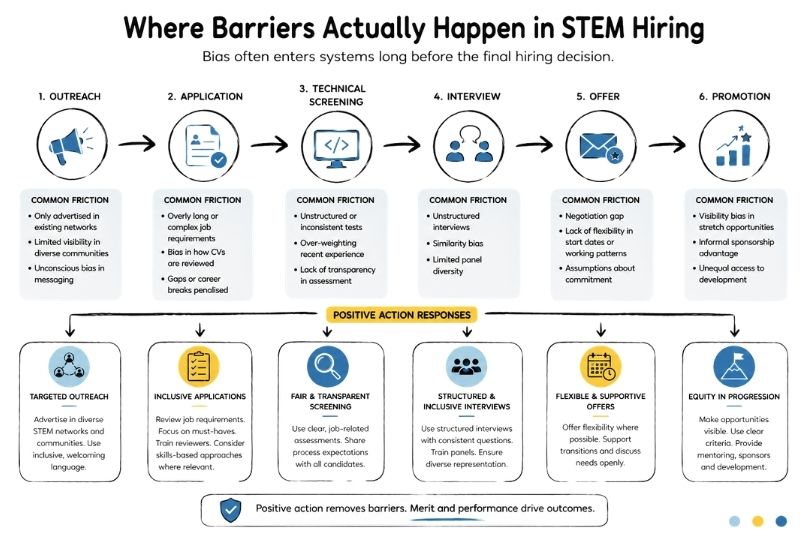
Where, specifically, is the barrier: attraction, selection, progression, retention, or culture?
You’re not hunting for perfect statistics. You’re looking for credible signals that a disadvantage or underrepresentation exists in your context.
Guardrail two: Your action must be proportionate
Proportionate means the action is a reasonable response to the problem you’ve evidenced.
A quick way to sanity check proportionality in a STEM setting:
Is the intervention targeted at a real barrier? Example: If women drop out after a technical screen because it’s inconsistent, fix the screen and train interviewers.
Is there a less intrusive alternative? Example: Before you restrict access to an event, consider whether an inclusive event plus targeted invitations achieves the aim.
Does it stay under review? Positive action should not run on autopilot forever. If the barrier changes, the action should change too.
For managers who want a broader employment-law compliance primer to support discussions with HR and Legal, this resource is practical: A Guide to Complying with Employment Laws.
Reality check: The safest programmes are the ones you can explain simply, evidence clearly, and review routinely.
Positive Action in Practice Examples From the STEM Sector
Here’s what positive action looks like when it’s done well in real STEM workplaces. Not theoretical “initiatives”, but actions you can implement with hiring managers, engineering leaders, and project directors.
Example one: Targeted outreach that widens the applicant pool
If your software team only sources through the same channels, you’ll tend to see the same demographic patterns.
Positive action here can be:
hosting an information session focused on women in engineering,
partnering with women-in-tech communities for distribution (distribution is not selection),
writing job adverts that describe outcomes and real must-haves, not a wish-list.
This is not about guaranteeing an outcome. It’s about getting more of the right people to see themselves as eligible to apply.
Example two: Mentoring and sponsorship for progression
In engineering organisations, the biggest “leaks” often happen at the mid-career stage. People hit the point where technical excellence alone doesn’t translate into promotion, because visibility, sponsorship, and project allocation start to matter more.
A positive action response can include:
a structured mentoring scheme for women in technical tracks,
transparent criteria for promotion readiness (so managers can coach consistently),
sponsorship that focuses on access to high-impact work.
Done well, this reduces the reliance on informal networks.
Example three: Return-to-work support for technical roles
Returners are not “junior”. They’re often experienced engineers who have been away from tooling, codebases, or lab environments for a period.
Positive action can show up as:
a structured returnship that includes refresher training,
a ramp-up plan that avoids throwing someone straight into on-call,
a buddy system for systems access, tooling, and engineering norms.
This is especially relevant in fast-moving tech stacks, where confidence can take a hit even when core capability is strong.
Positive action is also used in education and research pathways. A UKRI 2024 evaluation of over 50 STEM programs found that initiatives using positive action, such as targeted scholarships, led to a 35% increase in female PhD completions between 2019 and 2024 according to UK Research and Innovation (UKRI).
That doesn’t automatically translate into workplace representation. But it does show that targeted, lawful measures can change participation where barriers exist.
Many STEM employers over-invest in hiring and under-invest in the conditions that make people stay. Positive action can cover both.
How to Implement Positive Action in Your STEM Organisation
Positive action works best when you treat it like any other operational change. Define the problem, design the smallest effective intervention, implement consistently, and measure whether it’s still needed.
Step 1: Evidence the barrier in your own system
Start with your own process signals:
Recruitment funnel: who applies, who passes screens, who gets offers, who accepts.
Progression: who gets the stretch projects, who gets promoted, who gets visibility.
Attrition: who leaves and why (exit interviews, stay interviews, engagement themes).
Keep it factual. Document what you find in a short internal note. If challenged, you can show that your actions are grounded in reality.
Step 2: Pick a proportionate action you can run well
In STEM teams, I’d rather see one intervention run consistently than five half-built programmes.
Common starting points that are typically practical:
a targeted outreach event for underrepresented candidates,
a mentoring cohort tied to a technical pathway (not vague “leadership” talk),
a returner ramp-up plan with training and a structured buddy system.
Choose one and set a clear owner. In engineering organisations, “everyone owns it” often means no one does.
Step 3: Communicate clearly so it doesn’t get misread
Most backlash comes from poor explanation.
Say:
what problem you’re solving,
what you’re doing and what you’re not doing,
how selection decisions will still be made on merit.
Avoid corporate language. Engineers and scientists respond better to specificity.
Step 4: Use the tie-breaker approach carefully
If you operate in the UK, the safest position for line managers is simple: don’t try to “rank” people as equal by flattening meaningful differences.
If a decision is a true tie, document:
the job-related criteria used,
why both candidates met them to the same level,
why the tie-breaker aligns with your evidence of underrepresentation.
If it’s not a tie, hire the best candidate.
Step 5: Measure impact and keep it under review
Positive action should be reviewed like any programme:
Is it still needed?
Is it still proportionate?
Is it creating unintended side effects?
Are managers applying it consistently?
This is also where the business case becomes tangible. Firms using positive action have reported a 22% faster promotion rate for women to leadership roles and a 28% higher retention rate for women returning from career breaks according to CIPD.
A retention gain is not abstract in a STEM firm. It means fewer knowledge gaps, fewer delayed projects, and less time spent rehiring.
Before you roll out a new programme, it can help to hear how others frame and implement it in practice.
Manager test: If you can’t explain your positive action in two minutes without buzzwords, it’s probably not ready to launch.
Common Questions and Myths About Positive Action
A line manager in an engineering team interviews two strong candidates for a systems role. One person asks later, "Are we still hiring the best engineer, or are we trying to hit a target?" That question comes up often, and it needs a calm, precise answer.
Positive action is often misunderstood because people jump straight to the fear. The better approach is to deal with the concern underneath it. Are standards changing? Is someone being treated unfairly? Will women in the team be seen as token hires? In STEM organisations, where credibility is tied closely to technical performance, those questions matter.
Myth 1: “Positive action means hiring less qualified people”
Positive action keeps the bar where it is. It changes how people get a fair chance to reach it.
In practice, that might mean advertising a software role through networks that reach women returners, offering a returnship for engineers coming back after caring responsibilities, or checking whether your interview panel is screening out strong candidates because they took a multi-year career break. None of that lowers the standard for the job.
A useful comparison is lab calibration. You do not change the specification for the product. You check whether the process is measuring people accurately.
If someone says standards have slipped, ask for specifics:
Which job requirements changed?
Which assessment was made easier?
What evidence shows weaker performance on the job?
That moves the conversation away from assumption and back to observable facts.
Myth 2: “This is reverse discrimination”
Line managers often use this phrase when they mean, "I am worried someone else is being given an unfair advantage."
Lawful positive action addresses a real disadvantage or a clear pattern of underrepresentation. It does not give blanket preference to one group regardless of merit. For example, a technology firm might offer a mentoring scheme for women in cybersecurity if women are underrepresented in that area. That is different from appointing someone who did not meet the role requirements.
The safest way to explain it is simple. You are correcting for barriers, not handing out jobs.
Myth 3: “Women will feel singled out or stigmatised”
That risk is real if the programme is vague or poorly managed.
Women in technical roles usually spot performative initiatives quickly. A networking breakfast with no follow-up, a leadership scheme with no access to stretch projects, or a returner programme that treats experienced engineers like graduates will damage trust.
You reduce that risk by making the support practical and relevant:
Link programmes to real progression points, such as moving from individual contributor to technical lead
Offer support that matches the job, such as skills refreshers, phased returns, mentoring, or project re-entry plans
Keep standards and selection criteria visible
Train managers to treat participants as capable professionals, not as a diversity problem to solve
That last point matters more than many organisations realise. A good manager can make a return from a career break feel like a professional restart. A poor manager can make it feel like probation, even when the person has ten years of engineering experience.
Myth 4: “We’ve already made progress, so we don’t need this”
Early progress is encouraging. It is not proof that barriers have gone.
Many STEM employers have improved gender balance in graduate hiring but still see a drop-off at senior engineer, principal, and leadership level. Others recruit women successfully, then lose them after maternity leave, after a relocation, or after a career break. That pattern tells you the issue is not just attraction. It is progression and retention as well.
The same applies to visible leadership. As noted earlier in the article, senior representation across UK business still shows a gap. Your own workforce data matters more than any headline figure. If women are joining your software, data, or engineering teams but are less likely to be promoted, less likely to return after extended leave, or concentrated in lower-visibility projects, positive action may still be justified.
Myth 5: “If we treat everyone the same, that’s the fairest option”
Equal treatment sounds fair, but identical treatment can preserve an existing imbalance.
A simple example. If all technical interviews are scheduled at short notice outside school pickup hours, you are "treating everyone the same." You are also making it harder for some strong candidates to take part. If your promotion process depends heavily on informal sponsorship from senior leaders, you may be rewarding visibility rather than capability.
Fairness in STEM hiring works more like good engineering design. You test where the system fails in practice, then fix the failure points.
Fairness needs structure, not just good intentions.
Written by The Women In Stem Network
The Women in STEM Network is a global professional community supporting women across science, technology, engineering, and mathematics.
We bring together networking, mentoring, training, live events, and career opportunities in one place, helping women at every stage of their STEM journey to thrive, progress, and lead.
Built by experts with decades of experience in STEM, WiSN exists to strengthen careers, expand opportunity, and help organisations access and retain outstanding talent.
Our members include students, early-career professionals, senior leaders, and career returners from around the world.
If you would like to go further, consider joining the Women in STEM Network. Membership gives you full access to our mentoring programmes, on demand training, live events, forums, and global networking opportunities. We are a rapidly growing platform and warmly welcome visitors and new members at every career stage. Concessionary rates are available for those on low incomes and for members based in developing countries. Membership fees directly support the growth of the platform and help us build better, more accessible resources for women in STEM.
Explore the latest 2026 gender pay statistics. This guide breaks down global, UK, and STEM data to reveal what the numbers mean…
Manage Consent
To provide the best experiences, we use technologies like cookies to store and/or access device information. Consenting to these technologies will allow us to process data such as browsing behavior or unique IDs on this site. Not consenting or withdrawing consent, may adversely affect certain features and functions.
Functional
Always active
The technical storage or access is strictly necessary for the legitimate purpose of enabling the use of a specific service explicitly requested by the subscriber or user, or for the sole purpose of carrying out the transmission of a communication over an electronic communications network.
Preferences
The technical storage or access is necessary for the legitimate purpose of storing preferences that are not requested by the subscriber or user.
Statistics
The technical storage or access that is used exclusively for statistical purposes.The technical storage or access that is used exclusively for anonymous statistical purposes. Without a subpoena, voluntary compliance on the part of your Internet Service Provider, or additional records from a third party, information stored or retrieved for this purpose alone cannot usually be used to identify you.
Marketing
The technical storage or access is required to create user profiles to send advertising, or to track the user on a website or across several websites for similar marketing purposes.