
Before you even think about scrolling through job boards, the most crucial step in finding your next Tech role is to look inwards. This isn't just about polishing your CV; it's about strategically aligning what you're brilliant at, what you love doing, and where you want to go with a market that genuinely needs your talents. This initial self-assessment is what turns a hopeful, scattered search into a focused, deliberate career move.
Mapping Your Career Path in a High-Demand STEM Landscape
The STEM world is vast and moves at an incredible pace, which can easily leave you feeling a bit lost without a clear direction. That's why the first real action you should take is to build a personal career map grounded in solid self-awareness. Forget just listing qualifications for a moment. This is about building a compelling narrative around your unique professional value.
It’s a process that involves asking some tough but clarifying questions to make sure your job search is proactive, not just a reaction to whatever pops up in your inbox.
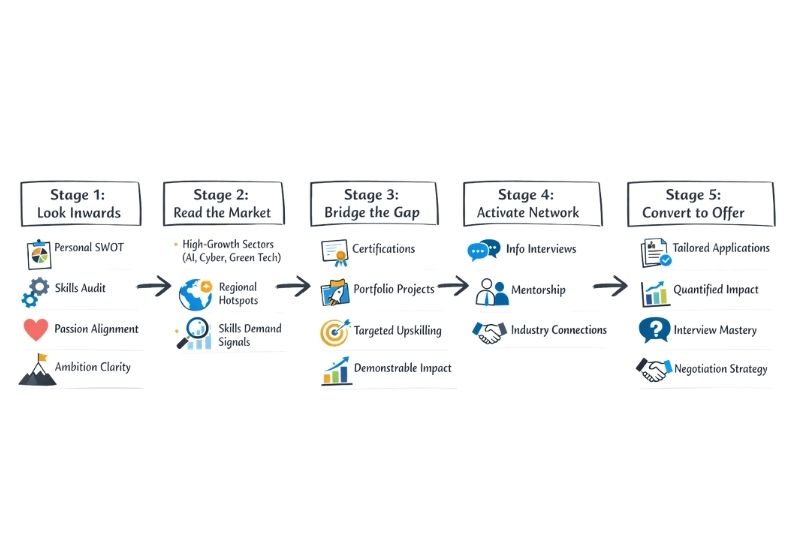
Perform a Personal SWOT Analysis
A SWOT analysis (Strengths, Weaknesses, Opportunities, Threats) might sound like something from a business school textbook, but it's an incredibly practical tool for personal career planning. It gives you a clear, structured way to see your professional standing from all angles.
- Strengths: What are your core technical skills? Are you the go-to Python developer, a razor-sharp data analyst, or an innovative bioengineer? Don’t forget your soft skills—things like managing complex projects or communicating seamlessly across different teams are just as valuable.
- Weaknesses: Let’s be honest, where are the gaps? Maybe you haven’t touched a cloud platform like AWS, or you know your presentation skills could be sharper for client-facing roles. Pinpointing these areas isn't a failure; it’s the first step towards growth.
- Opportunities: What’s happening out there that you can tap into? This could be the explosion in the AI sector, a new certification that employers are clamouring for, or a booming tech hub in your region.
- Threats: What external challenges should you be mindful of? Think about the impact of automation on certain roles, fierce competition for specific positions, or the constant need to upskill just to stay in the game.
Once you’ve done this, you'll have a realistic snapshot of where you are right now. From there, you can build a much more intentional path forward. For a deeper dive, our article on creating a career development plan has some great insights.
Reframe Your Achievements into Compelling Stories
Hiring managers aren't just looking for a list of duties. They want to understand the impact you had. The trick is to reframe your experiences, whether from university projects or previous jobs, as success stories. So, instead of saying you "worked on a data analysis project," explain how your analysis led to a 15% increase in efficiency for the team.
Pick a project you’re genuinely proud of. What was the problem you were trying to solve? What specific actions did you take? And what were the measurable results? Telling a story makes your experience far more memorable and powerful.
Key Takeaway: Your career narrative is your most powerful asset. It's the story of your skills, your impact, and your potential. Craft it with intention to show not just what you've done, but what you are capable of achieving in your next role.
Clarify Your Passions and Long-Term Ambitions
Finding the right job is about so much more than skills and salary. It’s about finding work that aligns with what actually motivates you. Do you get a buzz from fast-paced, collaborative teams, or do you do your best work with deep, focused time alone? Are you passionate about sustainability, healthcare innovation, or fintech?
Knowing the answers helps you filter out the noise and zero in on companies whose missions actually resonate with your own values. For those looking to pivot or start fresh in a popular tech role, having a clear strategy is essential. You can find excellent, practical advice in guides on topics like breaking into product management and other specialist fields. Ultimately, this alignment is the foundation of long-term career satisfaction.
Pinpointing High-Growth Sectors and Roles in STEM
Now that you have a clearer picture of your own goals, the next step is to see where they fit into the bigger picture of the job market. It's about finding that sweet spot where your unique skills and ambitions can make the biggest impact—and where you’ll find the most rewarding next job opportunities.
This isn’t about just picking a broad industry. It means digging into the specific sectors that are really driving innovation and growth right now.
Decoding the High-Demand STEM Landscape
Let's be clear: the STEM industry isn't one giant entity. It's a collection of fast-moving fields, and knowing where the momentum is gives you a serious edge.
Certain areas are seeing explosive growth, creating a huge demand for skilled professionals. Think of the universal push for digital transformation, which has made cloud engineering an absolute necessity for almost every business.
Likewise, our increasing reliance on data has put data science and analytics firmly in the spotlight. Other areas bursting with potential include:
- Artificial Intelligence and Machine Learning: AI has moved from theory to everyday practice, shaping everything from healthcare to finance. Roles are just as varied, from research scientists to AI ethics specialists.
- Cybersecurity: As our digital world gets more complex, the need for people to protect it has become critical. This field offers a massive range of roles, like penetration testers, security analysts, and compliance managers.
- Sustainable Technologies and Green Energy: With the global focus on sustainability, this sector is booming. Opportunities are there for environmental engineers, renewable energy experts, and sustainability consultants who can design and implement real-world, eco-friendly solutions.
A Look at Growth Across Global Tech Hubs
While these are global trends, it’s worth zooming in on regional hotspots. Different parts of the world are becoming powerhouses for tech and engineering talent.
In the United States, for example, employment in computer and mathematical occupations is projected to grow 15% from 2022 to 2032, much faster than the average for all occupations. Meanwhile, the UK needs over 1.9 million new STEM professionals by 2035 to keep up with demand, with AI job postings soaring. In Australia, the tech sector is one of the fastest-growing parts of the economy, expected to contribute over A$250 billion to GDP by 2030. In India, the IT and business services sector is a major global player, projected to reach US$350 billion by 2026, driving immense demand for skilled tech talent.
This data isn't just a number; it's a road sign. It tells you that building skills in AI, machine learning, and data science in these key markets is a smart investment that will pay off in both job security and earning potential.
To give you a better idea of what these roles look like on the ground, here’s a breakdown of some of the most sought-after positions right now.
Emerging High-Demand STEM Roles and Required Skills
| Job Role | Key Responsibilities | Core Technical Skills | Essential Soft Skills |
|---|---|---|---|
| AI/ML Engineer | Designing, building, and deploying machine learning models; running experiments and optimising algorithms. | Python, TensorFlow/PyTorch, SQL, Cloud Platforms (AWS, Azure), Natural Language Processing (NLP). | Problem-solving, analytical thinking, communication, intellectual curiosity. |
| Data Scientist | Analysing complex datasets to extract actionable insights; building predictive models and communicating findings. | Statistics, R/Python, Machine Learning, Data Visualisation (Tableau), Big Data Technologies (Spark). | Critical thinking, storytelling with data, collaboration, business acumen. |
| Cybersecurity Analyst | Monitoring networks for security breaches; investigating incidents and implementing security measures. | Network security, SIEM tools, Penetration Testing, Cryptography, Incident Response protocols. | Attention to detail, ethical mindset, calmness under pressure, strong communication. |
| Sustainability Specialist | Developing strategies to reduce environmental impact; conducting lifecycle assessments and ensuring regulatory compliance. | Environmental science, Data analysis, Project management, Knowledge of sustainability frameworks (GRI, SASB). | Strategic thinking, influencing skills, adaptability, passion for environmental issues. |
| Cloud Engineer | Managing and optimising an organisation's cloud infrastructure; automating processes and ensuring security. | AWS/Azure/GCP, Kubernetes, Docker, Infrastructure as Code (Terraform), CI/CD pipelines. | Systems thinking, problem-solving, collaboration, continuous learning. |
This table is just a snapshot, but it highlights the blend of deep technical knowledge and crucial interpersonal skills that top employers are looking for today.

Finding Companies That Champion Inclusion
Pinpointing the right sector is only half the job. The other half is finding a company that not only leads its field but also fosters an inclusive culture where you can actually thrive. This means looking past the diversity statement on their website.
Here's how to do some real digging:
- Look for Transparency: Do they publish their diversity data? Are women visible in leadership roles on their website and on LinkedIn?
- Check Employee Reviews: Sites like Glassdoor offer candid, unfiltered insights into what it’s really like to work there. Just be sure to read a wide range of reviews to get a balanced view.
- Investigate Partnerships: Do they actively partner with organisations that support women in STEM? This is often a sign of genuine, long-term commitment.
As you map out your next move, consider exploring the top 10 high-paying IT certifications to see which qualifications employers value most. Aligning your job search with both high-growth sectors and genuinely inclusive companies is the surest way to find more than just a job, it’s how you build a lasting career.
For more insights into future-proofing your career path, check out our guide on the top jobs for women in 2026.
Bridge the Gaps with Strategic Upskilling
Spotting a gap between your current expertise and the requirements of your dream job isn’t a setback. Think of it as a roadmap. This moment of realisation gives you a clear direction for growth, turning a potential weakness into a powerful competitive edge.
The key is to treat learning less like a box-ticking exercise and more like a focused strategy. It's about deliberately building the exact capabilities that employers are actively searching for, transforming you from just another job seeker into a sought-after candidate ready to seize the best next job opportunities.
Let Job Descriptions Guide Your Learning Plan
Those job descriptions you've been eyeing are more than just wish lists; they're detailed blueprints for your upskilling journey. Start by gathering five to ten job adverts from companies you admire in your target sector. You’re looking for patterns—recurring skills, tools, and technologies.
Look beyond the obvious qualifications. Is every role asking for proficiency in AWS or Azure? Does Python keep popping up under “essential skills”? These recurring themes are your learning priorities.
Try organising what you find into a simple list:
- Must-Haves: Competencies mentioned in almost every single job description. These are non-negotiable.
- Good-to-Haves: Skills that appear frequently but aren’t always listed as essential. They’ll give you an edge.
- Emerging Skills: Newer technologies or methodologies that hint at where the industry is heading.
This simple analysis provides a personalised curriculum tailored directly to market demand. It ensures every hour you invest in learning delivers a direct career payoff.
Choose a Learning Pathway That Delivers Real Impact
With your skills list in hand, it's time to decide how you'll acquire them. Not all learning methods are created equal, and the right choice often depends on both the skill you’re building and your personal learning style.
Consider these practical pathways:
- Targeted Online Courses: Platforms like Coursera, edX, and Udacity offer specialised courses in everything from machine learning to cybersecurity. Zero in on programmes that include hands-on projects you can add to your portfolio.
- Valuable Certifications: In certain fields like cloud computing (think AWS Certified Solutions Architect) or project management (PMP), official certifications are a powerful signal to recruiters that you have a verified level of expertise.
- Immersive Bootcamps: If you're aiming for a significant career pivot or need to acquire a deep skillset rapidly (like full-stack development), a bootcamp can provide an intensive, structured environment.
- Hands-On Portfolio Projects: This is arguably the most critical step. Whether you build a small web application, analyse a public dataset, or contribute to an open-source project, practical work proves you can apply your knowledge.
The goal isn't just to collect certificates. It's to build a portfolio that tells a compelling story of what you can do and showcases your ability to solve real-world problems.
Turning Global Skills Gaps into Your Opportunity
The demand for specific technical skills isn't just a vague trend; it's an urgent need for employers worldwide. Many strong tech economies are reporting significant talent shortages.
For instance, as of early 2025, there were over 170,000 open engineering and technology roles across the UK. A staggering 73% of engineering businesses there reported struggling to find people with the right technical skills. Similarly, in the USA, a 2024 report by the ManpowerGroup found that IT and data roles were among the top five hardest-to-fill positions, with a 75% talent shortage. These vacancies represent an extraordinary opportunity for women in STEM, as organisations are desperate to fill these critical roles. You can find more on this in the 2026 recruitment reset from Merritt Recruitment.
A Proactive Approach: Frame your learning as a direct solution to a company's problem. When you can say, "I saw that roles like this require cybersecurity skills, so I completed a certification and built a project to demonstrate my abilities," you present yourself as a proactive problem-solver.
By strategically upskilling, you aren't just improving your CV; you are directly addressing the biggest pain points in the current job market. This positions you as an invaluable asset to any team. For a deeper dive into foundational competencies, you can also explore our guide on how to improve your problem-solving skills.
Building Your Network and Finding a Mentor
Your CV and experience will get you in the door, but it’s often your professional network that gets you across the finish line. I know the very idea of 'networking' can feel awkward and a bit transactional, especially if it conjures images of crowded rooms and stilted small talk.
Let’s reframe this. Building a network isn't about collecting contacts; it's about cultivating genuine, supportive connections that can lead you to your next job opportunities. Think of it less as "what can I get?" and more as "what can we build together?". A strong network is a community, one that offers support, shares knowledge, and flags opportunities that never even make it to a public job board.
From Digital Connections to Real Relationships
Platforms like LinkedIn are brilliant tools, but they’re just the starting point. The real value emerges when you move beyond a simple connection request and into a meaningful interaction. Ditch the generic messages and make your outreach personal.
If you’re connecting with someone whose career you admire, be specific about why. For instance, instead of the default "I'd like to connect," try something much more pointed:
"Hello [Name], I was incredibly impressed by your recent talk on sustainable engineering practices. Your point about circular economy design has really influenced my thinking on my current project. I'd be keen to connect and follow your work."
This immediately shows genuine interest and gives you a natural starting point for a proper conversation.
The Art of the Informational Interview
One of the most powerful—and underused—ways to build your network and gather industry intelligence is the informational interview. Don't be put off by the name; these aren't job interviews. They are low-pressure conversations where you get to ask for advice and insights.
Here’s a simple way to approach it:
- Find Your People: Search LinkedIn or specialised communities for professionals in roles or companies that genuinely interest you.
- Keep Your Request Short and Sweet: A brief email or LinkedIn message is perfect. Be clear about why you’re reaching out and, crucially, respect their time. Something like, "I'm a data scientist exploring opportunities in the fintech sector and would be grateful for 15-20 minutes of your time to hear about your experience at [Company Name]."
- Prepare Smart Questions: Don't ask anything you could find with a quick Google search. Focus on their lived experience. "What’s the most challenging part of your role?" or "What skills do you see becoming critical in this field over the next few years?"
These conversations provide fantastic insights and can turn a cold contact into someone who will champion you down the line.
A strong network is your personal board of advisors. It’s a group of peers, mentors, and advocates who can offer diverse perspectives, challenge your assumptions, and champion your growth. Nurture it with authenticity and generosity.
Securing a Mentor Who Can Champion Your Growth
While a broad network is powerful, a mentor provides focused, personalised guidance. A great mentor is more than just a sounding board for advice; they're an advocate who can use their influence and experience to help you navigate hurdles and spot opportunities.
Finding the right mentor comes down to chemistry and shared goals. Look for someone whose career path resonates with your own ambitions and who seems genuinely committed to supporting others. Professional organisations, university alumni groups, and dedicated platforms are excellent places to start your search. The Women in STEM Network, for example, offers structured support for finding the right match. You can learn more by exploring our resources on your mentoring journey.
Once you think you've found a potential mentor, approach the relationship with clarity. Be specific about what you're looking for, whether that's guidance on a specific career transition, help with leadership skills, or strategic advice on securing a promotion. When you show you value their time and expertise, you lay the foundation for a productive and lasting professional relationship that can be instrumental in shaping your future.
Crafting Standout Applications and Mastering the Interview
A powerful application is your key to unlocking an interview. In a crowded market, simply having the right qualifications isn't enough; you have to present them in a way that makes a recruiter stop and take notice. This means getting strategic and moving past the one-size-fits-all CV.
Think of your CV, cover letter, and portfolio as a single, cohesive story about the value you bring. This story needs to be compelling enough to satisfy both the automated systems that do the initial sift and the hiring managers who make the final call.
Tailoring Your Application to Beat the System
Most large organisations rely on Applicant Tracking Systems (ATS) to manage the sheer volume of applications they receive. These software bots scan your CV for keywords and phrases from the job description to decide if you’re a potential match. Send in a generic CV, and you’re almost guaranteed to be filtered out before a human ever sees it.
The good news is, you can work with the system. Here’s how to tailor each application:
- Mirror the Language: Go through the job description with a fine-tooth comb. Pull out the key technical skills, software, and competencies they mention and weave those exact terms into your CV and cover letter.
- Prioritise Relevance: Reorder the bullet points under each role in your work history. You want the achievements most relevant to the job you're applying for to be right at the top.
- Quantify Everything: Don't just list what you did; show the impact you made. Instead of saying you "managed a project budget," specify that you "managed a project budget of $60,000, delivering 10% under cost." Numbers cut through the noise.
This level of customisation is crucial in competitive STEM job markets. For instance, in the UK, while STEM graduates generally have better employment outcomes, a notable gender gap persists. Men are offered 58% of places on graduate schemes compared to 42% for women. In engineering, that gap widens dramatically to 70%-30%. This reality means women need to submit exceptionally strong, targeted applications to secure these high-value next job opportunities.
Showcasing Your Skills Through a Compelling Portfolio
For many roles in STEM, a portfolio is where you can really set yourself apart. It’s your chance to provide tangible proof of your abilities, moving beyond words on a page. Whether it’s a link to your GitHub, a personal website with case studies, or a PDF of your design work, a well-curated portfolio makes your skills undeniable.
When putting it together, focus on quality, not quantity. Choose two or three projects that brilliantly showcase your problem-solving process and technical skills. For each one, explain the challenge you faced, the actions you took, and the final outcome. This narrative approach is far more memorable than a simple gallery of finished products.
Key Insight: Your application isn't just a history of what you've done. It's a proposal for what you can do for a future employer. Every single element should help answer their core question: "Why are you the best person to help us solve our problems?"
Preparing to Ace the Interview
Once your application has done its job and landed you an interview, the preparation really begins. This is your chance to bring your CV to life, show your personality, and confirm that you’re the right fit for the team and their way of working.
Thorough preparation is the foundation of confidence. Start by digging deep into the company. Go beyond their homepage—look at recent projects, read news articles, and check out the LinkedIn profiles of the people who will be interviewing you.
Next, get ready for the two main types of questions you'll likely face:
- Technical Questions: These are designed to test your core knowledge. Brush up on the fundamentals of your field and practise working through problems out loud, explaining your thought process as you go.
- Behavioural Questions: These often start with phrases like, "Tell me about a time when..." They're used to assess your soft skills. The best way to answer is by using the STAR method (Situation, Task, Action, Result) to structure your examples clearly.
Finally, always have some thoughtful questions ready for your interviewers. Asking about team dynamics, project challenges, or company strategy shows you're genuinely interested and turns the interview from an interrogation into a proper two-way conversation. For a deeper dive, check out our guide on how to write a CV that gets noticed.
Frequently Asked Questions About Finding Your Next STEM Job
When you start looking for your next role in STEM, a lot of very specific, practical questions tend to pop up. This is where the big-picture strategy meets the day-to-day reality of a job hunt, and getting clear answers can be the difference between a frustrating search and a brilliant career move.
Let's dig into some of the most common hurdles I see people facing, from breaking into a new specialisation to making sure you're paid what you're really worth.
How Can I Break into a New STEM Specialisation with No Direct Experience?
Pivoting into a hot new field like AI or bioinformatics without a direct track record can feel daunting. It’s easy to feel like you’re starting from zero, but that’s rarely the case. The trick isn't starting over; it's about strategically repositioning the experience you already have and building a bridge with a few new, targeted skills.
First, learn to translate your existing skills. Think about it: a physicist has an incredibly deep foundation in mathematics and modelling, which is a massive asset for anyone moving into data science. The next step is to plug the specific gaps, and the best way to do that is with hands-on projects. Build a portfolio that speaks directly to the job you want—analyse a public dataset, contribute to an open-source cybersecurity tool, or develop a small machine-learning model. This shows initiative and proves you can do the work.
My best advice? Don't underestimate the power of a quick chat. Reach out to people already working in your dream specialisation and ask for 20 minutes of their time to hear about their journey. It's a fantastic way to build your network and get priceless insights into the skills that actually matter on the job.
What’s the Best Way to Negotiate Salary and Benefits?
Let’s be honest, salary negotiation can be one of the most nerve-wracking parts of the whole process. But it's also where you can make a huge impact on your financial future. Preparation is everything here. You should never, ever go into a negotiation without knowing your market value.
Get your data sorted first. Use resources like Glassdoor, Payscale, and industry-specific salary surveys to find out the typical pay range for your role, location, and level of experience. Go in with a clear number in mind for what you want, but just as importantly, decide on your absolute minimum—your walk-away point.
When the offer lands, show your excitement but don't say yes straight away. A simple, confident phrase like, "Thank you so much for the offer, I'm really excited about this opportunity. Based on my research and the value I can bring to the team, I was expecting a figure closer to [Your Target Number]," is all you need to open up the conversation.
And remember, it's not just about the base salary. The total package is what counts.
- Bonus Structure: Is there a performance bonus? How is it actually calculated?
- Pension/Retirement Contributions: What percentage will the employer match? This is a huge long-term win.
- Flexible Working: Can you lock in remote days or more flexible hours?
- Professional Development Budget: Will the company pay for you to keep learning and get certified?
These perks add real value and are often much easier for a company to approve than a straight salary bump.
How Do I Find Companies That Are Genuinely Inclusive?
Finding a company with a genuinely inclusive culture means looking far beyond the diversity statement on their careers page. You have to put on your detective hat and gather clues from a few different places to see if they walk the walk.
Start at the top. Check out their leadership team on their website and LinkedIn, do you see women and people from diverse backgrounds in senior positions? A lack of diversity in the boardroom can be a major red flag. Then, look for tangible actions. Do they partner with organisations that support women in STEM? Do they sponsor relevant conferences or, even better, publish their own diversity data?
Employee reviews on sites like Glassdoor can offer some unfiltered truths, but read them with a critical eye. You're looking for consistent themes, not just one-off complaints.
Finally, the interview is a two-way street. Use it as your chance to investigate. Ask direct questions:
- "Can you tell me about the company's approach to mentorship and development for women on your team?"
- "What measures are in place to ensure projects and promotions are assigned fairly?"
The confidence and detail in their answers will tell you a lot about whether inclusion is a core value or just a corporate talking point. Doing this homework ensures your next job is in a place where you can truly thrive.