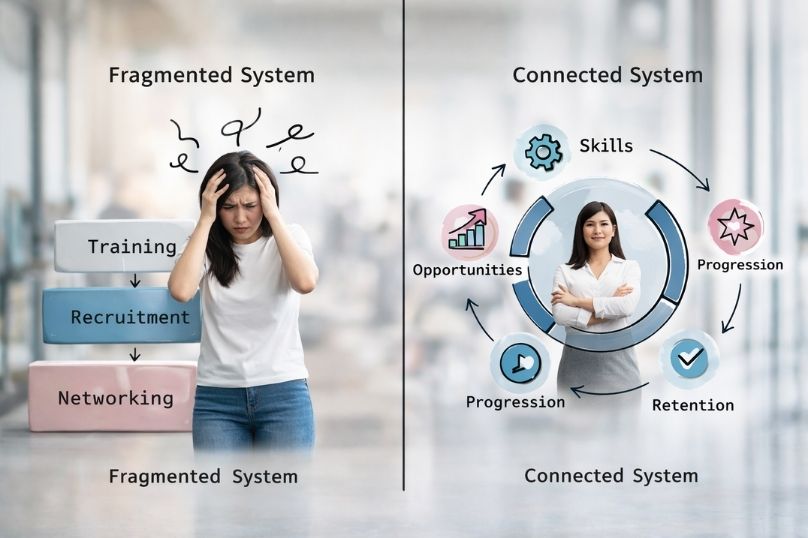
When we talk about culture and diversity, it's easy to get them tangled up, but they are fundamentally different pieces of the same puzzle. Think of it this way: culture is the invisible force that shapes how a team operates—it’s the shared beliefs, the unspoken rules, and the collective habits that define the work environment. On the other hand, diversity is all about who makes up that team, the full, rich spectrum of human differences.
For any STEM organisation looking to make a real impact on a global scale, getting to grips with both concepts isn’t just a ‘nice-to-have’; it’s essential for survival and growth.
Unpacking the Core Concepts of Culture and Diversity
In the workplace, culture and diversity are two separate ideas, yet they are completely intertwined. I often describe culture as the organisation’s personality. It’s the invisible framework that guides everything from how we communicate and collaborate to how we innovate. It’s the "way things are done around here," a mix of shared values, leadership styles, and collective behaviours.
Diversity, then, is the collection of unique individuals who bring that personality to life. It's the full range of human variation, which includes far more than just what we see on the surface. We're talking about:
- Ethnicity, nationality, and race
- Gender identity and sexual orientation
- Age and generational perspectives
- Physical abilities and neurodiversity
- Socioeconomic backgrounds and life experiences
You can assemble a team that looks incredibly diverse on paper, with people from all walks of life and every imaginable discipline. But if the underlying culture isn't inclusive, all that potential is wasted. It’s like having a garage full of high-performance tools but no one feels welcome or empowered to use them. The capacity for incredible results is there, but the system itself prevents anyone from getting the job done.

Distinguishing Between 'How' and 'Who'
At its core, the difference is simple. Culture is about the how—how we interact, how decisions get made, how we celebrate wins, and how we handle setbacks. Diversity is about the who—who is on the team, who gets promoted into leadership, and whose voice is heard when it matters most.
An organisation’s culture is the engine, while diversity is the high-performance fuel. A powerful engine is useless without the right fuel, and premium fuel cannot compensate for a poorly designed engine. Both must work in harmony to achieve peak performance.
This synergy is what truly matters. A strong, inclusive culture creates an environment where a diverse group of people can do their best work because they feel psychologically safe and valued. It’s this combination that unlocks the variety of thought needed for the kind of creative problem-solving that drives the STEM sector forward. For a deeper dive into building this sort of environment, the Open Culture Framework is an excellent resource.
Culture vs. Diversity At a Glance
To make the distinction even clearer, here’s a quick summary table comparing the two concepts. Seeing them side-by-side helps highlight their unique roles and shows why they must be aligned to build a workplace that is both effective and equitable.
| Concept | Represents | Analogy | Key Elements |
|---|---|---|---|
| Culture | The 'How' We Work Together | The organisation's personality | Communication styles, leadership, work-life balance, recognition |
| Diversity | The 'Who' Is on the Team | The collection of unique individuals | Demographics, cognitive styles, experiences, backgrounds |
Understanding these differences is the first step, but putting them into practice is what counts.
The Evolving Landscape of Diversity: A Snapshot from the UK
It’s one thing to discuss culture and diversity in the abstract, but these concepts really come to life when you look at real-world demographic shifts. For any STEM organisation operating in the United Kingdom, for instance, the national landscape isn't static. It's a dynamic, and increasingly multicultural, environment. This evolution presents both a huge opportunity and a clear imperative: the sector must build more inclusive workplaces.
The simple truth is that many countries are becoming more diverse every year. This isn't some far-off trend; it's a present-day reality that directly impacts the available talent pool, customer bases, and the very nature of the problems STEM professionals are paid to solve. Companies that don't recognise and adapt to this will find themselves increasingly disconnected from the societies they aim to serve.
Demographic Shifts and Their Implications
The United Kingdom has undergone a significant demographic transformation, fundamentally reshaping its cultural fabric. For anyone leading a team in STEM, this context is critical.
Recent data paints a very clear picture. The 2021 Census revealed that the proportion of people from ethnic minority backgrounds in England and Wales rose from 14.0% in 2011 to 18.3% in 2021. The Asian ethnic group, in particular, grew from 7.5% of the population to 9.3% over that decade. It's worth exploring the regional insights from this data, as these trends vary quite a bit across the country.
So what does this actually mean for a STEM organisation? A homogenous workforce is no longer an accurate reflection of many modern societies. This has profound implications for a few key areas:
- Talent Acquisition: The pool of skilled professionals is more diverse than ever before. Companies stuck in outdated recruitment habits will inevitably miss out on exceptional talent from a whole host of different backgrounds.
- Market Relevance: It stands to reason that a team reflecting society's diversity is better equipped to understand and design solutions for a wider range of people. This leads to more innovative and successful products.
- Team Dynamics: A multicultural workforce brings a rich variety of perspectives, problem-solving approaches, and ways of thinking. In a field trying to solve complex scientific and technical challenges, that's an incredibly powerful asset.
Why STEM Must Lead the Way
As a primary driver of innovation and progress, the STEM sector has a unique responsibility to be at the forefront of this change. Ignoring growing diversity isn't just a social misstep—it's a strategic error that actively undermines competitive advantage.
A workforce that mirrors a nation's multicultural makeup is simply better positioned to innovate. When people bring different life experiences and viewpoints to the table, they naturally challenge assumptions and prevent the kind of groupthink that can kill creativity. In fields that live or die by breakthroughs and novel solutions, this is absolutely crucial.
Embracing diversity isn't about ticking boxes or fulfilling a quota. It's about enriching the intellectual and creative capacity of an organisation. It is the raw material from which groundbreaking innovation is forged.
Of course, it’s not enough just to hire people from different backgrounds. To retain that diverse talent, organisations have to create a culture where everyone feels they genuinely belong and can do their best work. The challenges are particularly acute for certain groups, and understanding the latest women in STEM statistics offers valuable insight into the specific barriers that still need to be dismantled.
Ultimately, the evolving diversity of many countries isn't a problem to be managed. It’s an opportunity to be seized. For STEM companies, aligning their internal culture with this external reality is fundamental to their future growth, innovation, and societal impact.
Moving Beyond Diversity to Inclusion and Equity
Assembling a team with a wide range of backgrounds is a fantastic start, but it's really just the beginning of the story. To build a truly strong organisation, we have to look past simple representation and start cultivating inclusion and embedding equity into the very fabric of the workplace.
Think of it this way: if diversity is about who is in the room, inclusion is about making sure every single person in that room feels they truly belong. It's the active, ongoing effort to create an environment where everyone's contribution is not just accepted, but genuinely valued and woven into the team's success.
This distinction is absolutely vital for any STEM organisation. A diverse team without an inclusive culture is a huge missed opportunity—it's like having a room full of brilliant minds who can't collaborate effectively because the environment doesn't support psychological safety, mutual respect, or open dialogue.
Understanding Equity Versus Equality
To really unlock a diverse team's potential, we also need to get to grips with the difference between equality and equity. People often use these terms interchangeably, but they mean fundamentally different things.
- Equality means giving everyone the exact same resources or opportunities.
- Equity means recognising that each person has different circumstances and allocating the specific resources and opportunities they need to reach an equal outcome.
A simple analogy brings this to life: equality is giving every runner the same pair of shoes, regardless of their foot size. Equity, on the other hand, is giving each runner the specific shoes that fit them best, removing their unique barriers so they all have a fair chance to compete. In a STEM context, this is about dismantling systemic obstacles that disproportionately affect certain groups, ensuring everyone gets the support they need to thrive.
The Impact of a Non-Inclusive Culture
When a culture lacks inclusion, even with a diverse workforce, the negative effects can be subtle but incredibly damaging. These problems often show up in ways that slowly erode trust, stifle innovation, and ultimately drive talented people away.
Three of the most common and harmful elements in non-inclusive STEM settings are:
- Microaggressions: These are the brief, everyday slights and snubs that, intentionally or not, send hostile or negative messages to people based on their marginalised group. A classic example is repeatedly mistaking a female engineer for an administrative assistant.
- Unconscious Bias: These are the deep-seated stereotypes we hold about certain groups without even realising it. In a lab meeting, this might look like a manager giving more airtime to male colleagues or scrutinising data from a junior female scientist more harshly than others.
- Non-inclusive Language: Using words that exclude or demean certain groups can instantly make team members feel like outsiders. This can range from addressing a mixed-gender team as "guys" to using impenetrable technical jargon that alienates newcomers.

Addressing these seemingly small issues is non-negotiable. An inclusive culture, supported by equitable systems, is the engine that converts the potential of a diverse workforce into tangible innovation and measurable success.
Fixing these behaviours is an ongoing process that demands commitment from every level of an organisation. Mentorship is an especially powerful tool here, as it helps build supportive relationships where individuals can find guidance and advocacy. For anyone looking to make a direct impact, learning how to become a mentor for women in STEM can be a phenomenal step towards building a more equitable industry. At the end of the day, creating an environment free from bias and microaggressions is how we empower every brilliant mind to contribute their very best work.
The Undeniable Business Case for Diversity in STEM
When we move past the theory, a simple truth emerges: fostering a genuinely diverse and inclusive culture is one of the most powerful business strategies available. This isn't just about fulfilling social responsibility; it's a direct route to better financial performance, groundbreaking innovation, and long-term resilience. In the hyper-competitive STEM fields, the evidence is clear—organisations that truly invest in this area consistently pull ahead of those that don’t.
The link between diverse teams and superior results is anything but anecdotal. Study after study has shown that companies with greater ethnic and gender diversity are far more likely to see financial returns above their industry's national average. It makes sense when you think about it. Bringing a variety of backgrounds, life experiences, and perspectives to the table naturally leads to smarter decisions and more creative problem-solving, which ultimately strengthens the bottom line.
The Power of Cognitive Diversity
Beyond the demographics we can see, there’s the crucial idea of cognitive diversity. This is all about blending different thinking styles, unique perspectives, and varied approaches to tackling problems. When you assemble a team of people who think differently, you create a powerful defence against groupthink, that all-too-common pitfall where a close-knit group prioritises harmony over critical thinking.
In STEM, where every breakthrough depends on challenging the status quo, groupthink is a silent killer of progress. A cognitively diverse team is simply better equipped. They are more likely to:
- Scrutinise problems from every angle, spotting risks and opportunities that a more uniform group would completely miss.
- Generate a much wider spectrum of creative ideas, providing the essential sparks for real research and development breakthroughs.
- Innovate more effectively, as these different viewpoints collide and combine to create something truly original.
This richness of thought is the real engine of scientific and technological advancement. But unlocking it takes more than just hiring people with different CVs. It requires an inclusive culture where every unique perspective is actively invited, heard, and valued.
A homogenous culture risks becoming an echo chamber, where the same ideas are endlessly recycled. Cognitive diversity introduces new frequencies, allowing for the kind of complex harmony that leads to breakthrough innovation.
The High Cost of a Homogenous Culture
On the flip side, organisations that neglect to build a diverse and inclusive environment are taking on significant risks that go well beyond missed opportunities. The price of a homogenous culture is steep, and it can seriously hamstring a company’s future.
These risks pop up in a few critical areas. First, high employee turnover becomes a chronic problem. When talented people from underrepresented groups don’t feel seen, valued, or given a clear path to grow, they will, quite rightly, look for opportunities elsewhere. This churn isn't just disruptive; it's incredibly expensive, leading to endless recruitment cycles and a constant drain of institutional knowledge.
Second, a homogenous culture starves the talent pipeline. By overlooking entire pools of talent, companies are artificially shrinking their access to the best and brightest minds. Using the UK as an example, disparities in employment rates across ethnic groups reveal deep-seated structural barriers. While the 'White Other' ethnic group has an employment rate of 82%, the rate for the combined Pakistani and Bangladeshi ethnic groups is just 58%. These patterns matter for any organisation serious about building a skilled workforce that reflects society.
Finally, a lack of diversity makes it nearly impossible to connect with an increasingly multicultural, global customer base. If your team doesn't reflect your market, how can you truly understand its needs, preferences, or pain points? This disconnect often leads to flawed products, tone-deaf marketing, and a tarnished brand. Exploring the full business benefits of diversity makes it clear that failing here isn't just a cultural misstep—it's a direct threat to market relevance and profitability, contributing to the unseen forces holding back workplace innovation.
Practical Steps for Building an Inclusive STEM Culture
Knowing the definitions of culture and diversity is one thing, but driving real change demands focused, consistent action. Building an inclusive STEM culture isn't something that just happens; it’s a deliberate construction project that needs a clear blueprint and buy-in from every single person in the organisation. This section is a practical playbook for leaders, managers, and HR professionals who are ready to move beyond conversation and start building.
The aim here is to carefully dismantle biased systems and replace them with equitable frameworks where everyone has the opportunity to do their best work. This means taking a hard look at long-standing processes, from how you find new talent to how you support your current team, and having the courage to rebuild them with inclusivity at their very core.
Overhauling Recruitment and Hiring Processes
If you want to build a diverse team, the first place to start is your hiring process. It must be fair and designed to minimise unconscious bias. The truth is, outdated hiring methods often just perpetuate the status quo, favouring candidates who fit a familiar mould.
To build a more equitable system from the ground up, consider these concrete strategies:
- Implement Blind CV Reviews: This simple but powerful practice means stripping identifying information, like names, ages, and even universities, from applications before they reach the review stage. It forces everyone involved to concentrate purely on skills and experience, reducing biases linked to gender, ethnicity, or background.
- Establish Structured Interviews: It's time to move away from informal, "go-with-the-flow" chats. Instead, develop a consistent set of questions for every candidate applying for the same role and score their answers using a pre-defined rubric. This standardisation introduces much-needed objectivity and makes the process far less vulnerable to an individual interviewer's personal bias.
- Diversify Interview Panels: A single perspective is never enough. Make sure your interview panels include people from different backgrounds, departments, and levels of seniority. A diverse group of interviewers is far more likely to assess a candidate from multiple angles and challenge one another's assumptions.
Fostering Psychological Safety and Belonging
Getting diverse talent through the door is only the beginning. The real work is making sure they want to stay, and that comes down to inclusion. This is where psychological safety becomes absolutely critical, creating an environment where people feel safe enough to speak up, share ideas, and be themselves without fearing negative consequences.
A huge part of this involves giving a voice to underrepresented communities.
Building powerful Employee Resource Groups (ERGs) offers a structured platform for employees with shared backgrounds or interests to connect, find support, and provide invaluable feedback to leadership. They are not just social clubs; they are vital strategic partners in driving cultural change.
Beyond ERGs, creating a true sense of belonging requires active and visible leadership. Managers need to be trained to lead inclusively, which means consciously amplifying quieter voices, giving credit where it's due, and having the confidence to step in when they witness microaggressions.
Committing to Measurement and Mentorship
You can’t improve what you don’t measure. To ensure progress is real and not just performative, organisations must set clear, measurable goals and track their progress with meaningful diversity metrics. This has to go deeper than just looking at hiring numbers.
You should be tracking:
- Promotion Rates: Are women and individuals from ethnic minority backgrounds moving up at the same rate as their peers?
- Retention Data: Are there noticeable differences in turnover rates among different demographic groups?
- Pay Equity: Are there any unexplained pay gaps between people doing similar jobs?
This kind of data shines a light on systemic problems that might otherwise go unnoticed. For instance, some UK public sector data shows that while 24.1% of the Home Office workforce came from ethnic minority backgrounds, representation in the Senior Civil Service was only 9.4%. This points to a clear bottleneck in career progression that can only be identified and fixed through careful tracking. You can find more detailed insights in the government's official report on workforce diversity statistics.
Finally, launching impactful mentorship and sponsorship programmes is one of the most powerful levers for change. While mentors offer guidance, sponsors use their professional capital to actively advocate for their protégés' careers. These relationships are essential for helping underrepresented talent navigate the unwritten rules of an organisation and gain access to career-defining opportunities. By combining these programmes with solid data, organisations can create a virtuous cycle of improvement, turning good intentions into a tangible, inclusive reality.
Your Role in Championing a More Inclusive Workplace
It’s easy to think that changing an organisation's culture is a job for leadership alone. But genuine, lasting change doesn't just flow from the top down; it grows from the ground up, built on the actions of every single person.
Whether you're an intern on your first day or a senior director, you have the power to be a catalyst for a more inclusive and psychologically safe environment. The most powerful changes often aren't grand, sweeping gestures, but the small, consistent behaviours we practise every day.
Practical Ways to Become an Effective Ally
Fostering an inclusive culture is a shared responsibility, and it starts with becoming an effective ally. Allyship isn't a title you claim; it's an active, ongoing process of using your position to advocate for others, especially those from underrepresented groups. It’s about moving from silent agreement to visible action.
Small, consistent efforts can fundamentally shift team dynamics for the better:
Amplify Diverse Voices: In meetings, make a conscious effort to create space for quieter colleagues. If you notice someone being spoken over, you can gently redirect the conversation: "I'd like to hear what [colleague's name] was saying."
Challenge Non-Inclusive Behaviours: When you see a microaggression or hear non-inclusive language, address it respectfully. It doesn't have to be a confrontation. A simple question like, "What did you mean by that?" can encourage self-reflection and guide the conversation back to a more positive track.
Share the 'Office Housework': Notice who is always taking notes, organising team events, or handling other non-promotable tasks. These duties often fall disproportionately on women. Step up and volunteer to ensure the load is shared more equitably.
Becoming an ally means moving beyond good intentions to demonstrable actions. It is about taking responsibility for the culture you are a part of and actively working to make it better for everyone, every single day.
Looking beyond your immediate team can also deepen your understanding and impact. Communities like the Women in STEM Network offer a valuable space to connect with peers, share challenges, and learn from others who are driving change. This kind of support is vital, particularly when navigating specific situations. For instance, understanding how pregnant and new mothers in STEM need different support networks can equip you to be a far more effective colleague.
Ultimately, building a truly inclusive culture is a collective effort. Your contribution, no matter how small it may seem, is a vital part of building the momentum we need for a more equitable future in STEM.
Frequently Asked Questions
It’s natural to have questions when digging into the complexities of workplace culture, diversity, and inclusion. Let's tackle some of the most common ones to help clarify these essential concepts.
What Is the Main Difference Between Diversity and Inclusion?
Think of it this way: diversity is about the ‘who’, while inclusion is about the ‘how’. Diversity refers to the demographic makeup of your team, the rich variety of backgrounds, experiences, and identities you have in the room. Inclusion, on the other hand, is the active, ongoing effort you make to ensure every single person feels heard, respected, and empowered to do their best work.
A well-known analogy captures this perfectly: ‘Diversity is being invited to the party; inclusion is being asked to dance.’ In a STEM environment, a diverse team is only the first step. An inclusive culture is what truly unleashes that team's collective genius.
How Can We Measure the Inclusiveness of Our Company Culture?
Measuring inclusion requires looking far beyond simple headcount numbers. You need to gather data that reflects people's actual experiences.
Anonymous employee surveys are a powerful tool, especially when they ask specific questions about belonging, psychological safety, and fairness. You should also closely analyse promotion and retention rates across different employee groups. Are there disparities? That data tells a story.
Ultimately, genuine inclusion shows up in high engagement scores and equitable career progression for everyone. It's not just about who walks through the door, but who stays and thrives. Qualitative feedback from exit interviews can also offer incredibly candid, invaluable insights.
A truly inclusive culture is quantifiable not just by who you hire, but by who you retain and promote. The data on career progression across different demographics often tells the most honest story about a company's cultural health.
How Can Small STEM Companies Prioritise Diversity and Inclusion?
For startups and smaller businesses, building an inclusive culture isn't a luxury, it's a massive competitive advantage. Getting it right from the very beginning sets you up for long-term success.
The key is to be intentional. Start with your hiring process. Write inclusive job descriptions that attract a broad range of candidates, and implement structured interviews to minimise unconscious bias.
Most importantly, embed principles of respect and psychological safety into your company's core values from day one. This foundational work not only helps you attract exceptional talent but also sparks greater innovation and prevents the kind of cultural problems that become much harder to fix as you grow.