
Across the African continent, the gender pay gap is a stubborn economic reality. It's not just about a man and a woman getting different pay cheques for the same job; it's a much broader issue, reflecting deep-seated barriers that hold women back. This disparity is a major roadblock to innovation, economic growth, and social justice.
What Is the Gender Pay Gap in Africa?
Think of a marathon where some runners are forced to start miles behind the line and navigate extra hurdles along the track. That's a pretty good picture of the gender pay gap in Africa. It's not simply about equal pay for equal work—for instance, comparing the salaries of two software developers, one male and one female, at the same company. That's a clear-cut case of pay discrimination, which is often illegal.
Instead, the gender pay gap gives us a bird's-eye view of the entire economy. It calculates the difference between the average hourly earnings of all working men and all working women, no matter their role, seniority, or industry.
This wider metric shines a light on the systemic problems that put women at an economic disadvantage throughout their lives. It takes into account a whole host of complex factors, including:
- Occupational Segregation: The reality that women are often concentrated in sectors and roles that are traditionally paid less.
- Leadership Disparity: The glaring absence of women in senior leadership and high-paying executive positions.
- The Motherhood Penalty: The career breaks and reduced hours women frequently take on to manage caregiving responsibilities.
- The Informal Economy: The large number of women working in the informal sector, where wages are typically lower and job security is minimal.
A Global and Local Perspective
To really get to grips with pay disparity, you have to look at both the local situation and global patterns. Even in highly developed economies, the gap is alive and well. In the UK, for instance, the overall gender pay gap for full-time workers was 7.7% in 2023, meaning women earned significantly less per hour on average. That single figure shows how, even after decades of progress, structural problems continue to chip away at women's earnings, particularly as they get older.
This global context is vital. It proves the challenge is universal, even if its causes and intensity vary from one region to another. For Africa, the gap is often wider and tangled in a more complex web of diverse economic structures and cultural norms.
The gender pay gap is more than a statistic; it is a measure of lost potential. It signifies the untapped talent, stifled innovation, and constrained economic growth that result when half the population cannot participate fully and equally in the economy.
Why This Matters for Women in STEM
For women building careers in science, technology, engineering, and mathematics, the pay gap is an especially sharp reminder of the challenges they face. STEM fields are often held up as meritocracies, but they are far from immune to the biases and barriers that create pay differences.
The following table breaks down the key factors that contribute to the pay gap, with a specific look at how they play out in STEM.
Key Factors Driving the Gender Pay Gap in Africa
| Factor | Description | Impact on STEM Fields |
|---|---|---|
| Occupational Segregation | Women are often channelled into lower-paying sectors or "softer" roles within high-paying industries. | Even within STEM, women may be concentrated in less lucrative specialisms like lab research or teaching, rather than high-paying engineering or software development roles. |
| The "Motherhood Penalty" | Women's careers often slow down after having children due to caregiving duties, leading to missed promotions and lower lifetime earnings. | The intense, 'always-on' culture in many tech and research environments makes it incredibly difficult for mothers to keep pace without strong support systems. |
| Unconscious Bias | Deep-rooted stereotypes about women's capabilities in technical fields affect hiring, promotion, and salary negotiations. | Bias can lead to women's ideas being dismissed, their contributions being undervalued, and their salary expectations being questioned more than their male peers'. |
| Lack of Senior Role Models | With fewer women in leadership positions, aspiring female professionals have limited mentors and visible career paths to follow. | A scarcity of female CTOs, Chief Scientists, or Engineering VPs reinforces the idea that top roles are not for women, which can dampen ambition. |
| Informal Sector Dominance | A significant portion of women work in the informal economy, with no contracts, benefits, or pay protection. | While less common in formal STEM roles, this affects women in related informal tech repair or small-scale manufacturing, limiting their economic security. |
Understanding this broader economic picture is the first step to tackling the specific issues within these demanding and vital fields. You can explore this further in our guide on the latest women in STEM statistics 2025 for a deeper dive. Closing this gap requires a clear-eyed look at the data, the causes, and the solutions that can forge a more equitable future for everyone.
Putting the Continental Pay Gap into Perspective
Numbers on a page can feel abstract. But behind every percentage point of the gender pay gap in Africa is a real story—a story of diminished earnings, hobbled financial independence, and untapped economic potential. To really grasp the scale of the problem, we need to translate the data into a clear narrative, even when reliable, continent-wide statistics are hard to pin down across so many diverse economies.
While a single, definitive figure for Africa remains elusive, reports from global and pan-African bodies all point to the same conclusion: a significant and persistent disparity. In some regions, women earn, on average, a staggering 30% less than men. This isn't just a monthly shortfall. Over a lifetime, it snowballs into a colossal loss of income, directly affecting a woman's ability to save, invest, and provide for her family.
Of course, this gap looks very different from one country to another and between various sectors. A nation’s economic backbone, its laws, and its cultural norms all play a critical role in shaping how wide that gap becomes.

Regional Trends Across the Continent
It’s crucial to remember that Africa is not a monolith, and the gender pay gap is a perfect reflection of this diversity. Economic structures and dominant industries create distinct patterns from one region to the next.
- Southern Africa: In places like South Africa, the story isn't just about women being paid less for the same job. Studies show nearly half the pay gap comes from women being concentrated in lower-paying companies and industries. Men are over-represented in high-wage sectors like mining and manufacturing, while women are far more likely to work in retail and personal care.
- East Africa: Here, the services sector is a major employer, which on the surface creates plenty of opportunities. The problem is that women often end up in administrative or support roles rather than the high-paying leadership positions, cementing a persistent wage disparity.
- West Africa: The sheer size of the informal economy is a massive factor. A huge percentage of women work in roles without formal contracts or pay protection. This systematically pulls their average earnings down compared to men, who have much stronger representation in the formal sector.
The Lifetime Impact of Unequal Pay
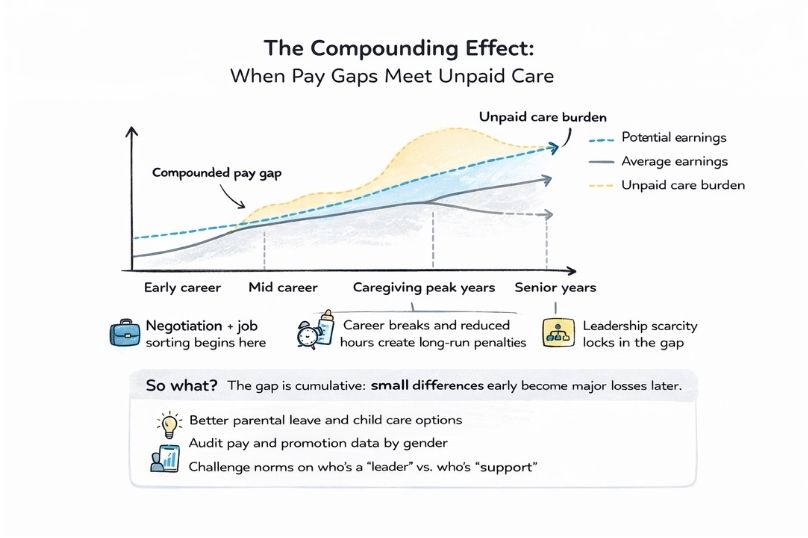
A pay gap of 20% or 30% sounds bad enough, but its true impact only becomes clear when you compound it over a 40-year career. It’s the difference between affording a home, funding a child's education, or building a secure retirement. It's life-changing.
The gender pay gap is a cumulative disadvantage. Think of it as a small leak that, over time, drains a massive amount of economic power from women, their families, and ultimately, their entire communities.
For a young woman just starting her career, the initial gap might seem manageable. But research shows it often widens dramatically during the primary child-rearing years, typically from her mid-20s to mid-40s. This "motherhood penalty" means that women who take career breaks or reduce their hours for caregiving often re-enter the workforce at lower-paying companies than their male peers, a setback from which many never fully recover.
South Africa: A Case Study in Company Sorting
Work coming out of South Africa gives us a crystal-clear example of how these structural factors play out. In the country’s formal sector, women earn an average of 12% less than men. But a groundbreaking study revealed something fascinating: 45% of this gap has nothing to do with unequal pay for equal work within a company. Instead, it's because women tend to work for companies that simply pay all their employees less, regardless of gender.
This isn't necessarily about direct, overt discrimination. It’s a phenomenon called "company sorting," where men and women are subtly channelled into different kinds of workplaces. The firms that women disproportionately join are often in lower-paying industries and are less likely to be covered by the collective bargaining agreements that help boost wages for everyone.
This insight shows that tackling the gender pay gap in Africa requires more than just demanding equal pay for equal work. It means we have to break down the deep-seated barriers that steer women toward lower-paying employers right from the start of their careers.
What's Really Fuelling the Pay Gap?
To get serious about closing the gender pay gap in Africa, we have to dig deeper than the headline numbers. The real question is why it exists in the first place. This isn't about a single cause but a tangled web of issues woven into our social, cultural, and economic fabric.
Think of a woman's career path as a pipeline. From the very beginning, that pipeline has leaks. It starts with disparities in education, where limited access or lower-quality schooling can cut off opportunities before they even begin. Even when girls outperform boys academically, societal norms often nudge them away from more lucrative fields like engineering and technology.
This initial disadvantage is made worse by occupational segregation – the invisible sorting of men and women into different kinds of jobs. Men still dominate high-paying sectors like construction, mining, and manufacturing. Meanwhile, women are channelled into roles in administration, personal care, and education, which are consistently undervalued and underpaid.
The Crushing Weight of Unpaid Care
One of the heaviest anchors holding women's earnings down is the unequal burden of unpaid care. Across the continent, women shoulder the vast majority of childcare, elder care, and household management. This isn't just work; it's a "time tax" that men largely don't have to pay.
This invisible labour has a very visible impact on a woman's ability to earn. It pushes many into part-time work, forces them to accept jobs with more flexibility but lower pay, or leads to long career breaks. These aren't always choices made freely; they're often the only practical option when formal childcare is unavailable or unaffordable.
For women in high-pressure STEM careers, this is a make-or-break issue. The demanding hours of a software developer or the inflexible schedule of a civil engineer can feel impossible to balance with being the primary caregiver. It’s a major reason so many talented professionals end up sidelined, as you can read more about in this piece on why women quit engineering.
The Trap of Informal Work and Weak Laws
The sheer size of the informal economy is another huge piece of the puzzle. A massive share of Africa's female workforce is in jobs with no formal contracts, no benefits, and no legal protection when it comes to pay. This not only keeps their average earnings down but also leaves them completely exposed to exploitation.
Even for women in formal jobs, the laws meant to protect them often lack teeth. Without strong, enforced legislation that demands pay transparency and regular audits, discriminatory pay practices can thrive behind a wall of corporate secrecy.
The gender pay gap is not a simple calculation of prejudice; it is the mathematical result of a system where women's work—both paid and unpaid—is consistently valued less than men's. Closing it requires a systemic re-evaluation of worth.
These challenges aren't unique to Africa. Look at the UK, a highly regulated market. In STEM-related industries, Aspen's 2023 report found a mean hourly gender pay gap of 28.1% and a median of 28.8%. The main driver? Too few women in the senior, high-paying jobs. It’s a clear example of how promotion bottlenecks create and sustain pay gaps over time. You can see the full analysis in their report on UK gender pay gap trends in 2023.
Ingrained Biases and Cultural Headwinds
Finally, you simply can't ignore the powerful role of cultural norms and unconscious bias. Deep-seated ideas about gender roles influence everything, from what a girl is encouraged to dream about to who a manager decides to promote.
In the workplace, these biases show up in countless subtle ways:
- Hiring and Promotion: Managers might subconsciously favour a man for a leadership role, assuming he possesses more "natural" authority or technical prowess.
- Salary Negotiation: Women are often taught to be agreeable, and when they do negotiate assertively for higher pay, they risk being seen as difficult or aggressive.
- Performance Reviews: Vague feedback and subjective criteria can allow bias to flourish, with women's ideas sometimes being overlooked or even credited to their male colleagues.
Tackling the gender pay gap means confronting all of these issues at once. It will take a real, coordinated push from policymakers, employers, and all of us as individuals to break down the barriers and change the mindsets that have held women back for so long.
The Pay Gap Inside Africa's STEM Sector
Science, technology, engineering, and mathematics (STEM) fields are often held up as the gold standard of meritocracy, where your skills and innovative ideas are all that should matter. But even in these forward-thinking sectors, the persistent issue of the gender pay gap in Africa casts a long shadow. It creates unique challenges that are far more complex than a simple side-by-side salary comparison.
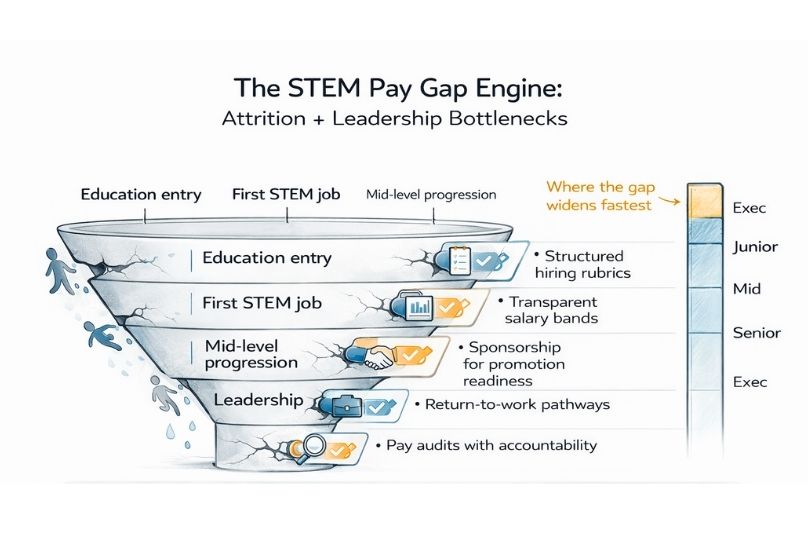
The real problem isn't just that a female data scientist might be offered less than her male counterpart for the exact same job. It's a much deeper, systemic issue that begins early and quietly snowballs throughout a woman's career, effectively pushing incredible talent out of the pipeline long before they can reach senior, high-paying roles.
The Leaky Pipeline Phenomenon in STEM
Think of the journey into a STEM career as a pipeline. For women, this pipeline is riddled with leaks. At every critical stage—from choosing subjects at university to landing a first job, and from climbing into mid-level management to reaching for an executive position—women drop out of the field at a much higher rate than men.
This phenomenon, often called the "leaky pipeline," is one of the most significant drivers of the pay gap within STEM. It starts subtly, with societal norms that can steer girls away from technical subjects. It continues in workplaces where the culture can feel isolating or even hostile. Then comes the clash between the intense demands of many STEM roles and the disproportionate burden of caregiving that women still carry, creating an almost impossible balancing act.
The end result is a slow but steady drain of female talent. This doesn't just cap the earning potential of individual women; it starves the continent's tech and science sectors of the diverse perspectives needed for true innovation.
Unconscious Bias in Hiring and Promotions
Unconscious bias is a powerful, invisible force that quietly shapes careers in STEM. It’s that gut feeling that a male candidate is a more "natural" fit for a technical leadership role, or the tendency to cross-examine a woman's expertise far more intensely during an interview.
These biases show up in a few critical ways:
- Hiring Decisions: A manager might subconsciously favour a male applicant for a software engineering job, simply because they see him as a better cultural fit for a team that's already dominated by men.
- Performance Reviews: A woman's contributions might be downplayed, or her direct communication style could be labelled as "aggressive," while the very same trait in a man is praised as strong "leadership."
- Salary Negotiations: When women negotiate their salary, they often have to walk a fine line, advocating for their value without being perceived as difficult or demanding.
These small, often unintentional moments of bias add up over time, creating significant gaps in pay and seniority. Tackling this requires more than just good intentions; it demands structured, data-driven overhauls of hiring and promotion processes. You can delve deeper into how these salary disparities persist in our article on the pay gap for women in STEM.
The Scarcity of Female Leadership
Take a look at the leadership teams of Africa’s top tech companies and research institutions, and a clear pattern emerges: they are overwhelmingly male. This glaring lack of female leaders creates a self-perpetuating cycle that entrenches the pay gap.
Without visible role models at the top, it becomes incredibly difficult for younger women to see a clear path to leadership for themselves. They miss out on mentors who have navigated similar hurdles and sponsors who can champion them in rooms where key decisions are made.
The absence of women in senior STEM roles is not a reflection of their ambition or ability. It is a symptom of a system where the rungs on the career ladder are spaced further apart for women than for men.
This leadership deficit has a direct financial impact. Senior roles come with higher salaries, bigger bonuses, and equity stakes. When women are systematically underrepresented in these positions, it automatically drags down their average earnings across the board compared to men.
Real-World Challenges for Women in African STEM
To bring this home, let’s consider a couple of familiar scenarios:
The Software Engineer in Lagos: Adanna is a brilliant developer at a buzzy tech start-up. She can't help but notice that her male colleagues, who joined at the same time, are consistently assigned to the higher-profile projects. When promotion season rolls around, they're praised for their "vision," while her meticulous project management is dismissed as simple "support work."
The Data Scientist in Nairobi: Njeri, a data science team lead, has just returned from maternity leave. She soon finds herself passed over for a promotion in favour of a male colleague, with the unspoken assumption that she is now less committed to her career. The rigidity of her company's work policies makes juggling her demanding job and a new baby a constant source of stress.
Stories like these are far too common. They show that the gender pay gap in Africa’s STEM sector is not a simple spreadsheet problem. It’s a complex knot of cultural biases, broken systems, and a severe lack of representation at the top. To fix it, employers must make a conscious, sustained effort to plug the leaks in their talent pipeline and build an industry that is truly inclusive from the ground up.
Actionable Strategies for Achieving Pay Parity
Knowing the numbers and understanding the root causes of the gender pay gap is one thing; doing something about it is another entirely. Real progress is built on decisive action. Closing this economic divide demands a coordinated effort, with individuals, employers, and policymakers each playing a critical role. Think of this as the practical playbook for turning knowledge into meaningful change across Africa's workplaces.
Empowering Individuals to Drive Change
For women building careers in STEM and other demanding fields, taking proactive steps can make a huge difference to your career path and earning potential. While the responsibility for fixing systemic inequality doesn’t fall on individuals alone, your own agency is a powerful tool for navigating an unfair landscape.
A few key strategies can put you in a stronger position:
- Mastering Salary Negotiation: Never walk into a salary conversation unprepared. Do your homework and get a clear picture of the industry benchmarks for your role, experience level, and location. When you make your case, focus on the value you deliver, not what you were paid in your last job.
- Building Strategic Networks: Don't just network; build relationships with intention. Cultivate a circle that includes mentors, sponsors, and peers. A sponsor, in particular, is a senior-level advocate who can champion your work in rooms you're not yet in, opening doors to high-impact projects and promotions.
- Committing to Continuous Skill Development: The technical world is always evolving. Proactively upskilling in high-demand areas doesn't just make you a more valuable team member—it gives you more leverage when it’s time to negotiate for better pay or a more senior role.
Closing the gender pay gap is not a zero-sum game. When women's economic potential is fully realised, it creates a ripple effect of prosperity that lifts entire communities and strengthens national economies.
The Employer’s Playbook for Pay Equity
Ultimately, organisations are the primary battleground where the gender pay gap in Africa can be won or lost. The smartest employers already know that pay equity isn't just a matter of fairness. It's a business imperative for attracting and keeping top talent, especially in competitive fields like technology and engineering.
Here are some high-impact initiatives that actually work:
- Conducting Regular Pay Audits: Move beyond assumptions and dig into the data. Conduct rigorous, confidential pay audits that analyse compensation across roles, departments, and seniority. Once you control for legitimate factors like experience and performance, you can spot and fix the unexplained gender-based disparities.
- Implementing Transparent Compensation Structures: Create clear and consistent salary bands for every role in the company. When you make these structures transparent, you demystify compensation and ensure pay is tied to objective criteria, not someone's negotiation skills or an unconscious bias.
- Fostering Inclusive Promotion Processes: Standardise your criteria for promotions and make sure review panels are diverse. This is a crucial step in mitigating the unconscious bias that often results in women being overlooked for leadership roles—a key driver of the overall pay gap. For more ideas here, explore our insights on retaining women in tech.
- Supporting Work-Life Integration: Offer robust parental leave for all genders and genuinely promote flexible working arrangements. These policies help dismantle the "motherhood penalty" by normalising caregiving for everyone and preventing careers from getting derailed.
The Role of Policymakers in Levelling the Field
While individual and corporate actions are vital, lasting, economy-wide change needs a solid legislative foundation. Governments have the power to create an environment where pay equity isn't just a nice-to-have, but an enforced expectation.
Beyond specific laws, promoting fair hiring practices is essential. For example, a shift towards skills-based hiring helps ensure candidates are evaluated on what they can do, not on proxies from their CV that might trigger bias. This naturally fosters a more equitable workforce and pay structure.
Key policy levers include:
- Mandatory Pay Gap Reporting: Legislation that requires companies over a certain size to publicly report their gender pay gap is a powerful motivator. This transparency creates accountability and allows talented professionals to vote with their feet.
- Investing in Care Infrastructure: Public investment in affordable, high-quality childcare and elder care is one of the single most effective ways to close the gender pay gap. This infrastructure frees women from the disproportionate burden of unpaid care, allowing them to participate fully in the formal economy.
- Strengthening Equal Pay Legislation: It’s time to review and strengthen laws to truly reflect "equal pay for work of equal value." This principle recognises that jobs traditionally dominated by women might look different from male-dominated ones, but they hold equivalent value and deserve to be compensated accordingly.
By adopting these multi-faceted strategies, every stakeholder—from the individual professional to the corporate CEO and the national legislator—can become an active agent of change, helping to build a more equitable and prosperous future for all.
Frequently Asked Questions
Digging into the gender pay gap in Africa often brings up more questions than answers. Here, we tackle some of the most common ones with clear, straightforward explanations to help you grasp the nuances of this critical issue.
Is the Gender Pay Gap the Same Thing as Unequal Pay?
That's a great question, and the answer is no, they're different, though related. Getting the distinction right is key to understanding the full picture.
Think of it this way: unequal pay is the illegal act of paying a woman less than a man for doing the exact same job. It's direct, blatant discrimination.
The gender pay gap, on the other hand, is a much bigger-picture metric. It measures the average earnings difference between all men and all women across an entire workforce, regardless of their specific roles or seniority levels.
This broader gap points to deeper, more systemic problems. In Africa, it's driven by structural issues like the clustering of women in lower-paying sectors, the massive career hit many take due to unpaid caregiving, and a stark lack of women in the highest-paying leadership roles.
Which African Countries Are Actually Making Progress?
Progress across the continent is patchy, to say the least. Some nations are making real strides, while others lag behind. It’s also important to remember that progress isn't a straight line; it can be knocked off course by economic shifts, weak policy enforcement, or stubborn cultural norms.
Countries like Rwanda and Namibia often get a nod for their proactive policies on gender equality. Rwanda, for example, has one of the highest rates of female parliamentary representation in the world, which is a huge factor in driving change from the very top.
But even in these more forward-thinking countries, significant gaps remain, especially in the private sector and in specific fields like tech and engineering. Real progress means looking beyond national averages and tackling the specific disparities within different industries. It takes more than just good policy on paper; it requires consistent enforcement and a genuine commitment from employers to build truly equitable workplaces.
Closing the gender pay gap is not just an economic imperative but a moral one. It reflects a society's commitment to ensuring that every individual, regardless of gender, has an equal opportunity to thrive and contribute their full potential.
What Can I Do to Help Close the Gap in My Own Workplace?
Every single one of us has a role to play, no matter our job title. Lasting change is built from a combination of individual actions and collective effort.
For women, especially those in STEM fields, knowledge is power. You can start making a difference by:
- Doing your homework: Research salary benchmarks thoroughly before any negotiation so you can make your case with data and confidence.
- Building your network: Actively cultivate relationships with mentors and sponsors who can open doors and advocate on your behalf.
- Upskilling constantly: Seek out opportunities to learn new, in-demand skills that boost your professional value.
And this isn't just a "women's issue"—men are crucial allies. That means speaking up for transparent pay policies, mentoring female colleagues, and challenging bias when you see it. If you're in a leadership role, your impact can be even greater. You can champion formal pay equity audits, set objective criteria for promotions, and foster a culture where everyone feels heard and valued.
For more practical strategies, take a look at our guide on salary negotiation for women in STEM. It’s packed with tips to help you build confidence and get paid what you're worth.