
Beyond the Leaky Pipeline
For more than two decades, attrition in STEM has been described through the language of a “leaky pipeline.” The metaphor suggests accidental loss. It implies that women and underrepresented groups simply fall away at various stages due to external pressures or personal decisions.
This framing is insufficient.
Attrition in STEM is not accidental. It is structurally patterned. It reflects predictable friction points embedded within educational systems, institutional incentives, funding architectures, promotion frameworks, and leadership norms. The Women in STEM Network has consistently argued that retention is not a diversity exercise. It is a systems design challenge.
If high-performing, highly trained professionals repeatedly exit at similar transition points, then the problem lies in the architecture, not the individuals.
This article maps the hidden exit points across the STEM lifecycle and proposes a structural redesign framework. The aim is not incremental adjustment. It is systemic recalibration.
Mapping the Hidden Exit Points
Attrition in STEM clusters around transitions. These are not random drop-offs. They are structural inflection points.
Early Academic Identity Formation
The first exit point occurs long before employment. It begins during subject selection in secondary education.
Despite strong performance in mathematics and science, many girls opt out of advanced STEM pathways at GCSE or A-level. Research repeatedly shows that confidence and belonging predict continuation more strongly than ability.
Structural drivers include stereotyped representations of scientists, limited visible female role models, subtle classroom bias, social penalties for visible ambition, and career guidance assumptions about “balanced” subject portfolios.
This is not a capability deficit. It is an identity misalignment. When students decide that STEM is not “for someone like me,” structural signals have already shaped the outcome.
Undergraduate to Postgraduate Transition
Women frequently achieve parity or majority representation at undergraduate level in several scientific disciplines. However, measurable drop-offs occur at the doctoral application stage, particularly in engineering, physics, and computing.
This transition is structurally complex. PhD funding processes are often opaque. Supervisor selection can rely on informal networks. Research culture is not always demystified. Financial risk tolerance varies. The perceived incompatibility between academic precarity and future family life becomes salient.
The doctoral decision is not purely academic. It is a calculation of risk, visibility, and long-term viability. Without clear structural reassurance, attrition becomes rational.
Doctoral to Postdoctoral Phase
The postdoctoral stage represents a precarity cliff. Fixed-term contracts, geographic mobility expectations, grant-dependent employment, and high publication pressure define this period.
This phase frequently overlaps with family formation years. Institutional systems reward uninterrupted productivity. Biological timelines do not align with tenure clocks or grant cycles.
The structural issue is not parenthood. It is the assumption of linear output without pause. Metrics that reward continuity inadvertently penalise caregiving.
Early Career Industry Transition
In industry, attrition spikes around the first leadership promotion. Technical experts are elevated into managerial roles without structured leadership development. Informal sponsorship networks heavily influence advancement.
Structural contributors include sponsorship asymmetry, biased performance evaluation language, lack of stretch assignment allocation, limited revenue-generating project exposure, and cultures of presenteeism.
When promotion pathways appear subjective or opaque, high performers reassess long-term viability. Exit becomes strategic, not emotional.
Mid-Career Plateau
A significant proportion of women remain in STEM yet plateau in middle management roles. Progression slows. Leadership visibility narrows.
Drivers include narrow definitions of executive presence, reliance on informal male-dominated sponsorship pipelines, lack of transparent promotion criteria, disproportionate emotional labour, and allocation of non-promotable tasks such as committee administration or diversity engagement.
Talent does not decline. Structural opportunity bandwidth contracts.
Senior Leadership and Board Access
At senior levels, recruitment becomes increasingly network-driven. Executive search processes may lack transparency. Definitions of gravitas and leadership style remain narrow.
This stage reflects ceiling reinforcement rather than exit. Representation thins not because capability is absent, but because access pathways are informal and exclusive.
Structural Drivers of Attrition
To redesign the pipeline, structural mechanics must be examined directly.
Evaluation Architecture
Performance systems often embed bias in subtle ways. Women receive personality-based feedback. Men receive potential-oriented feedback. Assertiveness is interpreted differently depending on gender. Collaborative leadership styles may be undervalued relative to directive styles.
Without evaluation reform, attrition continues regardless of recruitment efforts.
Productivity Metrics
Academic and corporate environments frequently reward continuous output, revenue generation, and individual visibility. Mentoring, team enablement, knowledge translation, and inclusive leadership contributions receive less formal recognition.
When impact metrics ignore relational and developmental contributions, those who disproportionately perform such work carry invisible burdens.
Sponsorship Asymmetry
Mentorship provides advice. Sponsorship provides advocacy and opportunity access.
Evidence consistently demonstrates that sponsorship distribution is uneven. Without formalised sponsorship mechanisms, advancement depends heavily on informal affinity networks.
Structural Flexibility Deficit
Flexible policies may exist on paper. Cultural legitimacy may not.
If flexible working arrangements are perceived as career-limiting, uptake declines. Retention suffers.
Identity Taxation
Underrepresented professionals frequently shoulder additional expectations. Representation duties, mentoring load, diversity committee participation, and external speaking engagements accumulate.
This invisible labour contributes to burnout and progression delay.
Rethinking the Pipeline Metaphor
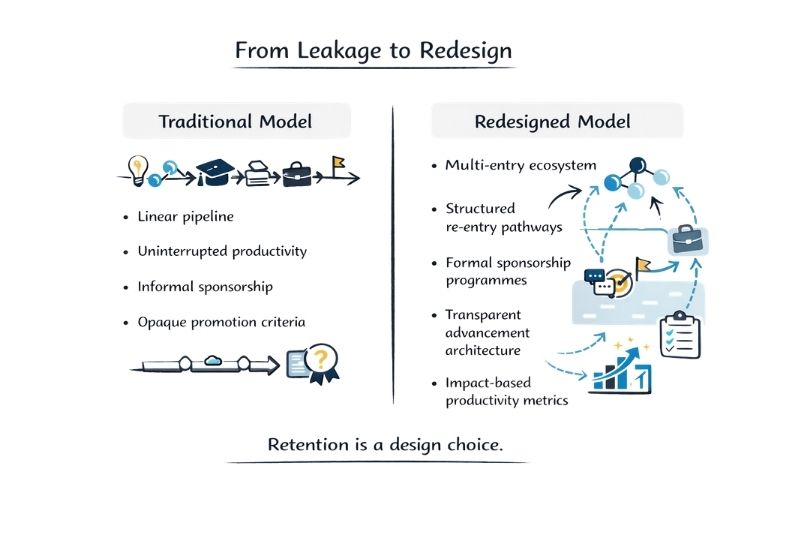
The linear pipeline metaphor fails to reflect modern career realities. STEM careers are increasingly nonlinear. Individuals move between sectors, pause for caregiving, pivot into interdisciplinary roles, or return after industry experience.
A more accurate model resembles a multi-entry ecosystem with structured re-entry pathways.
Attrition occurs when re-entry infrastructure is absent.
Pipeline Redesign Framework
A structural response requires coordinated redesign across multiple domains.
Early Identity Reinforcement
Educational systems must integrate visible female leadership examples, diversify scientific historical narratives, and provide structured confidence-building interventions. Clear articulation of varied STEM career pathways reduces narrow role perception.
Belonging must be engineered, not assumed.
Transparent Advancement Architecture
Institutions should publish promotion criteria, standardise evaluation rubrics, audit language bias, and separate behavioural descriptors from performance metrics.
Transparency reduces interpretative bias.
Structured Sponsorship Programmes
Formal sponsorship initiatives should target high-risk transition points, including doctoral progression, early leadership promotion, and executive succession pipelines.
Sponsorship should be institutionalised rather than incidental.
Productivity Model Recalibration
Performance frameworks should incorporate measurable indicators for mentoring, team enablement, inclusive leadership, and knowledge dissemination.
Impact must be multidimensional.
Re-Entry Infrastructure
Structured returnship programmes, grant extensions following leave, skill refresh accelerators, and executive re-entry fellowships provide continuity after career pauses.
A break should not terminate trajectory.
Organisational Accountability
Redesign requires measurable indicators. Institutions should track transition-specific attrition rates, promotion velocity comparisons, sponsorship mapping, flexible working uptake outcomes, and exit interview pattern analysis.
Data transforms anecdote into accountability.
Cultural Recalibration
Structural reform must align with cultural evolution. Leadership archetypes should expand beyond singular models. Quiet authority should be recognised alongside visible assertiveness. Career pauses should be normalised. Collaborative impact should be rewarded.
The objective is not to reshape individuals to fit outdated systems. It is to update systems to reflect contemporary workforce realities.
The Economic Imperative
Attrition carries direct and indirect costs. Recruitment expenditure increases. Training investments are lost. Institutional knowledge dissipates. Innovation capacity declines. Patent output and research translation slow.
Retention is not a moral preference. It is an economic necessity.
Strategic Implications for the Women in STEM Network
The Women in STEM Network operates or will operate at structural transition points through mentoring infrastructure, leadership visibility initiatives, ambassador-led national chapters, institutional partnerships, and cross-sector collaboration.
By mapping hidden exit points, interventions can be precision-targeted. Early academic confidence programmes address subject selection drop-off. Sponsorship circles support early leadership progression. Mid-career recalibration workshops expand executive bandwidth. Executive visibility intensives support board readiness.
Generalised inclusion messaging is insufficient. Structural precision increases systemic impact.
Conclusion: From Leakage to Design
Attrition in STEM is not inevitable. It is structurally patterned.
Each hidden exit point corresponds to design choices regarding evaluation, flexibility, sponsorship, visibility, and leadership definition. Systems that prioritise linear productivity over sustainable inclusion will continue to experience predictable talent loss.
The future competitiveness of STEM sectors depends on architectural reform rather than surface-level diversity campaigns.
The Women in STEM Network remains committed to evidence-informed structural alignment. The objective is not inspiration alone. It is infrastructure.
Attrition is not a mystery. It is a map.
And maps can be redesigned.