You’re in a project meeting. A senior engineer is walking through a model, a test plan, or a build decision. Something doesn’t add up. You can see a hidden assumption, a missing variable, or a risk nobody has named.
You hesitate.
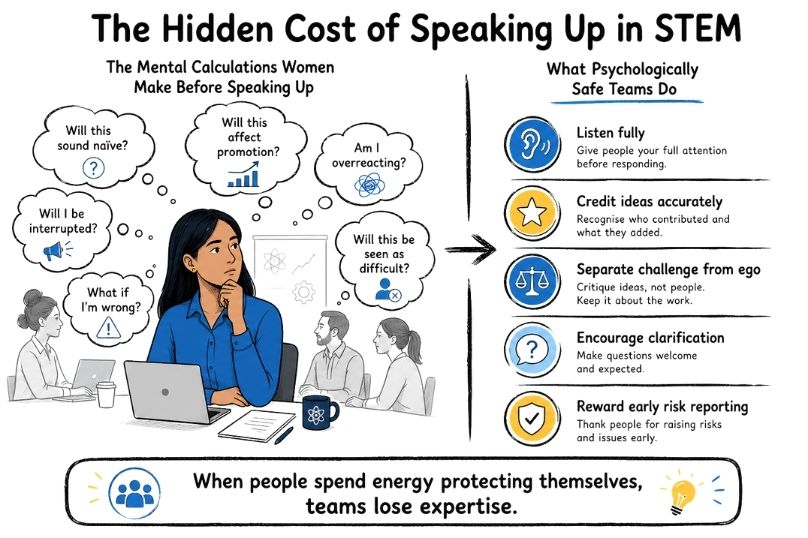
If you speak up, you might be seen as difficult. If you ask a basic question, you might worry that people will question your competence. If you challenge the logic and turn out to be wrong, the moment may stick in people’s minds longer than it should.
That tension sits at the heart of psychological safety in teams.
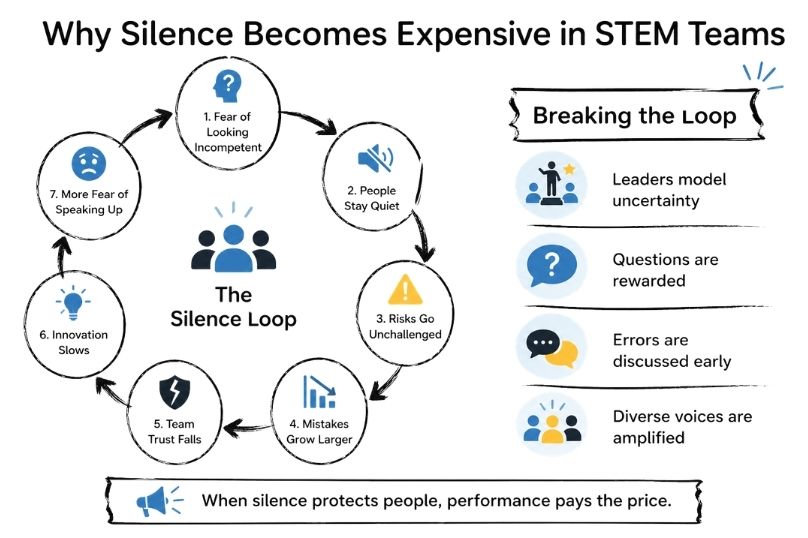
In STEM, silence can look like professionalism. It can sound like agreement. But very often, it’s self-protection. And when talented people protect themselves by staying quiet, teams lose better questions, earlier warnings, sharper ideas, and honest learning.
For many women in STEM, this isn’t a small culture issue. It shapes whether you contribute fully, whether your work gets recognised, and whether you can build a career without constantly calculating the personal cost of speaking.
What Psychological Safety Really Means in STEM
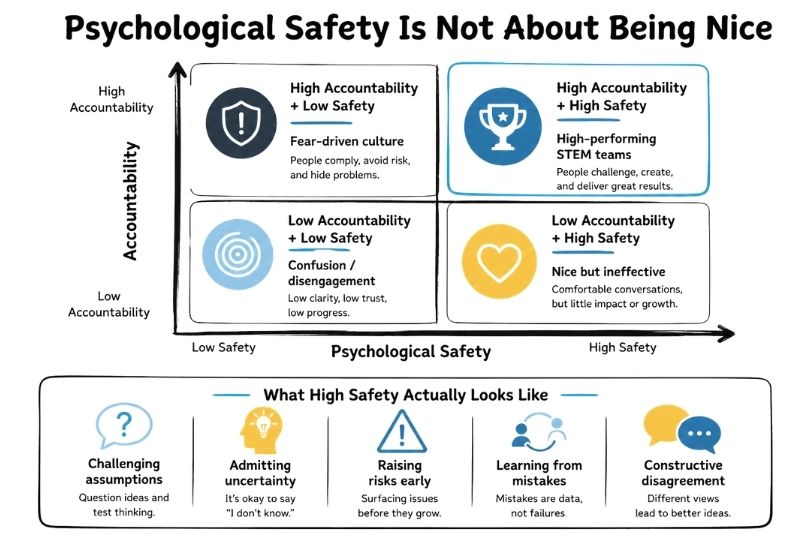
Psychological safety is often misunderstood as “being nice” or avoiding disagreement. It’s neither.
Psychological safety means a team shares the belief that people can take interpersonal risks without being humiliated, ignored, or punished. In practice, that means you can ask a question, admit uncertainty, raise a concern, offer a different view, or say “I think we’ve missed something” without fearing social backlash.
In STEM, that matters because the work itself depends on challenge. Engineers test assumptions. Scientists question methods. Analysts probe data quality. Product teams learn by surfacing flaws early. If people can’t do those things safely, the team becomes less rigorous, not more.
What it looks like in real work
A psychologically safe team doesn’t avoid tough conversations. It handles them well.
On a healthy team, you might hear:
- “I don’t follow that step. Can you walk us through it?”
- “I may be wrong, but I think this dependency changes the result.”
- “I made an error in the earlier version. Here’s the fix.”
- “We’re converging quickly. What are we not questioning?”
On an unsafe team, people edit themselves. They wait until after the meeting. They message a trusted colleague privately instead of raising the issue in the room. Sometimes they stop trying.
Practical rule: If a team treats questions as weakness, it will also treat learning as risk.
What psychological safety is not
It doesn’t mean lower standards.
It doesn’t mean every idea gets approved.
It doesn’t mean conflict disappears.
The best STEM teams combine high safety and high accountability. People are expected to prepare, think clearly, test their claims, and own their mistakes. Psychological safety removes the extra penalty for being human while doing demanding work.
That distinction matters. If your team says it values precision, but punishes people for asking clarifying questions, it isn’t protecting excellence. It’s protecting ego.
The Undeniable Benefits for Performance and Inclusion
Psychological safety often gets framed as a wellbeing topic. It is that. But in technical environments, it’s also a performance system. A useful way to think about it is this. Your team’s methods, tools, and expertise are one layer of capability. Psychological safety is the layer that determines whether people use that capability in the open. Without it, knowledge stays trapped in individual heads.
Why it changes technical performance
Think of a research or engineering team as having an immune system. A strong immune system detects trouble early. A weak one lets problems spread.
Teams with psychological safety spot issues faster because people flag errors while they’re still small. They challenge weak assumptions before they harden into strategy. They ask for help before a deadline becomes a crisis. They share partial ideas early enough for others to improve them.
That’s especially important in STEM because so much high-value work is uncertain. You’re often working with incomplete information, messy data, changing requirements, or unfamiliar tools. In those conditions, silence is expensive.
If you want a simple primer on how behaviour shifts in groups, this overview of Group Dynamics is useful. It isn’t STEM-specific, but it helps explain why teams can drift into conformity even when individuals know better.
What the UK data shows
The strongest verified data provided here is UK-specific, so it’s important to label it clearly.
In the UK, a 2023 Women in STEM Taskforce study found that teams with high psychological safety saw improved retention rates among women in STEM, and UK data adapted from Google’s Project Aristotle showed high-safety STEM teams showed 2.5 times more inventiveness in patents filed by diverse teams (careertrainer.ai).
Those are not soft outcomes. Retention affects continuity, hiring cost, and leadership pipelines. Innovation affects product quality, problem-solving range, and long-term competitiveness.
Why inclusion improves when safety improves
Many inclusion efforts focus on representation first. Representation matters. But representation without safety creates a painful trap.
You can recruit diverse talent into a room where only a few people feel able to challenge the dominant view. On paper, the team looks inclusive. In practice, people still self-censor.
That’s why psychological safety is foundational to inclusion. It changes who gets heard, who asks for clarification, who feels able to disagree, and who can recover after being wrong.
For a broader look at what culture and inclusion mean in practice, this definition of culture and diversity is a helpful reference: https://womeninstemnetwork.com/culture-and-diversity-definition/
It also protects energy, not just ideas
When people constantly monitor how they’ll be judged, they burn energy on impression management. They rehearse sentences. They soften accurate feedback. They avoid visible risk. That hidden labour is exhausting.
A psychologically safe environment reduces that tax. People still work hard. They still face challenge. But they spend less energy protecting themselves and more energy contributing.
A team can’t benefit from your expertise if you have to spend half your attention managing other people’s reactions.
What readers often get wrong
Some people hear this and assume safety is mainly for junior staff, or mainly for people who lack confidence. That’s too narrow.
Senior specialists need it to admit uncertainty in fast-moving domains. Managers need it to hear bad news early. Cross-functional teams need it when terminology, incentives, and assumptions differ. Diverse teams need it because difference only helps when people can use it aloud.
Psychological safety in teams isn’t a bonus feature for harmonious workplaces. It’s part of how serious teams stay accurate, adaptive, and inclusive.
Navigating Unique Barriers in STEM Cultures
Generic workplace advice often misses what makes STEM cultures hard.
Many technical environments are shaped by hierarchy, expert status, tight review processes, and a strong attachment to being right. Those features can support quality. They can also make speaking up feel dangerous, especially if you already carry extra scrutiny.
The pressure to sound certain
In many STEM settings, uncertainty gets confused with weakness.
That creates a problem. Good technical work requires uncertainty to be visible. If nobody can say “I’m not sure this is sound” or “we need another pass at the data”, the team starts rewarding confidence signals over learning signals.
Women often feel this sharply. A man who speaks decisively may be seen as authoritative. A woman who does the same may be judged more harshly. A man who asks a naïve question may be treated as curious. A woman may worry it will be remembered as evidence she doesn’t belong.
Those double standards don’t show up neatly in every framework, but they shape daily behaviour.
Male-dominated environments change the stakes
A critical gap in the available research is that psychological safety literature often doesn’t fully address how gender dynamics affect women’s willingness to speak in male-dominated STEM fields, or whether standard frameworks capture the intersectional barriers women face around speaking up, pay equity, and career advancement (INSEAD Knowledge).
That gap matters because women in STEM often aren’t deciding whether to speak in a neutral environment. They’re reading the room for risk.
They may ask:
- Will I be interrupted?
- Will this be seen as helpful challenge or attitude?
- If I raise a process concern, will people say I’m not collaborative?
- If I ask for support, will it confirm a stereotype?
Why “imposter syndrome” can hide a culture problem
Sometimes organisations label the issue too quickly.
A woman hesitates to contribute in a technical review. Someone says she has imposter syndrome. Perhaps she does feel self-doubt. But that label can become a way to individualise a team-level problem.
If a person repeatedly sees others interrupted, dismissed, or penalised for dissent, caution is not irrational. It’s adaptation.
Many women feel gaslit by mainstream advice. They’re told to be bolder, speak up, and own the room. Meanwhile, the room still rewards some voices more than others.
For a thoughtful look at the structural side of this problem, this article on unseen forces holding back workplace innovation is worth reading: https://womeninstemnetwork.com/the-unseen-forces-holding-back-workplace-innovation/
Where standard safety advice falls short
A lot of advice assumes that if leaders invite input, people will offer it. In STEM, the barrier is often deeper.
You may have a leader who says, “Any questions?” But the team has already learned that:
- errors are remembered,
- challenge is interpreted as disloyalty,
- meetings reward speed over reflection,
- and credibility is unevenly distributed.
So people stay quiet.
When a team says “we welcome challenge” but only rewards challenge from a narrow set of people, it builds compliance, not safety.
Career discussions create another layer of risk
There’s also a blind spot around progression.
Much of the literature focuses on speaking up about mistakes, ideas, and learning. It says far less about the safety needed to ask harder questions such as: What does promotion readiness mean here? Why was that opportunity assigned elsewhere? How do we talk about pay fairly? What happens if I negotiate?
In STEM careers, those conversations can shape years of progression. Yet many women learn to avoid them because the social cost feels higher than the likely reward.
That’s why psychological safety in teams has to be understood as more than meeting etiquette. In STEM cultures, it sits inside power, reputation, expertise, and access. If you don’t account for those realities, the advice stays tidy while the experience stays hard.
Evidence-Based Strategies for STEM Leaders
Leaders set the social rules of a team faster than any policy does.
People watch what happens after someone admits an error, challenges a decision, or asks what seems like a basic question. They notice your face, your tone, whether you interrupt, and what happens to that person later. That’s how they decide whether it’s safe to contribute.
A useful evidence point comes from UK technical teams. A study of 92 teams found a strong positive correlation of r=0.72 between leaders’ transformational leadership training and team psychological safety, and the training was linked to increased learning behaviours plus a 35% reduction in knowledge hiding (Pepperdine Digital Commons).
That matters because knowledge hiding is a quiet team killer. In technical work, it shows up as withheld context, partial handovers, vague documentation, or not mentioning a risk because “someone else probably knows”.
Model visible humility
A leader doesn’t build safety by acting uncertain all the time. A leader builds safety by showing that certainty is not the price of respect.
Try language like:
- “I’m not convinced we’ve tested the edge cases.”
- “I may be missing context. What am I not seeing?”
- “I changed my view after looking at the latest data.”
- “I got that wrong earlier. Thanks for catching it.”
Those statements do two things. They lower the social penalty for honesty, and they make intellectual flexibility normal.
Ask better questions in technical reviews
Many leaders ask, “Any questions?” and think they’ve opened the floor.
That question is too broad and too easy to decline.
Use prompts that reduce ambiguity instead:
Ask for risk, not opinion
“What could fail in production even if this passes test?”Ask for missing context
“What assumption are we relying on that hasn’t been proven?”Invite a second interpretation
“If someone disagreed with this approach, what might they say?”Create a round-robin moment
“Let’s hear one concern or one unknown from each person.”
These are small moves, but they change participation because they make contribution expected, not optional.
Respond well when people bring bad news
A team learns from your first reaction.
If someone flags a late risk and you ask, “Why wasn’t this caught earlier?” in a blaming tone, people hear the underlying message. Next time they’ll wait longer. If you say, “Thank you for raising it. Let’s understand the impact and the decision points,” people learn that surfacing problems is part of the job.
Leader habit: Reward the act of raising the issue, even when the issue itself is serious.
That doesn’t remove accountability. It sequences it properly. First, make the problem discussable. Then solve it. Then learn from it.
Use structure, not charisma
Some managers think they need a special personality to build safety. They don’t. They need repeatable behaviours.
If you’re working on how to build trust in teams, start with routines people can predict:
- Pre-mortems: Before launch, ask what might go wrong.
- Retrospectives: After delivery, discuss what helped, what hindered, and what to change.
- Decision logs: Record why a technical choice was made so challenge becomes part of process, not personal memory.
- Rotating voices: Let different team members present findings, risks, or summaries.
Structured inclusion is often more effective than relying on whoever feels confident enough to jump in.
Emotional intelligence matters in technical leadership
In STEM, some leaders still treat emotional intelligence as separate from serious work. It isn’t.
If you can’t read when a room has gone quiet for the wrong reason, if you miss who gets cut off, or if you respond defensively to challenge, your technical competence won’t protect team quality for long.
This guide on emotional intelligence for STEM leadership and collaboration adds useful depth on that point: https://womeninstemnetwork.com/emotional-intelligence-for-stem-leadership-and-collaboration/
A short video can also help leaders reflect on what these behaviours look like in practice.
A practical leadership reset
If you lead a team, start this week.
At your next meeting:
- Name uncertainty early: say what the team is still learning.
- Invite challenge specifically: ask for one assumption that needs testing.
- Protect the first dissenting voice: don’t let it be brushed aside.
- Close the loop: show what happened because someone spoke up.
People don’t trust a slogan. They trust a pattern.
Building Safety as a Peer and a Returner
You don’t need line management authority to influence team safety.
Peers shape culture every day. So do returners, even when they’re rebuilding confidence after time away. The key is to stop thinking of psychological safety as something only a manager can grant. You can widen or narrow it in small moments.
What peers can do in the room
If a colleague is interrupted, you can bring her point back.
If someone offers a good idea and it lands flat, you can amplify it.
If a meeting moves too fast for reflection, you can slow it down with a clarifying question.
Those actions sound simple, but they change whose contributions survive.
Try phrases like:
- “I want to come back to Priya’s point. I think it affects the risk calculation.”
- “Can we pause there? I’d like to hear the reasoning behind that assumption.”
- “I’m not sure we answered the question yet.”
- “That’s useful. Could you say more about how you reached that conclusion?”
These aren’t dramatic interventions. That’s why they work. They create space without forcing someone else to fight for it alone.
Small acts of peer support can change whether a person speaks once, or keeps speaking over time.
How to support someone privately
Not every moment needs a public correction.
Sometimes the most useful thing you can do is message a colleague after a meeting and say, “Your point was important. I noticed it got skipped. Do you want me to back you up next time?” That kind of follow-up helps people feel less isolated and more willing to try again.
You can also normalise learning language between peers:
- “I had the same question.”
- “I don’t think that was obvious at all.”
- “Want to rehearse how you’ll raise it next time?”
- “I can join that conversation if you’d like another voice in the room.”
If you’re returning after a career break
Returning to STEM can make even experienced professionals feel newly exposed.
Tools have changed. Teams have changed. Jargon has shifted. You may still be highly capable and feel rusty at the same time. Both can be true.
The mistake many returners make is believing they must hide the ramp-up period. That usually increases pressure and makes asking for help feel harder than it needs to be.
A steadier approach is to be clear, professional, and specific.
You might say:
- “I’m reloading context on this stack, so I may ask foundational questions early on.”
- “I’ve done similar work before, though not in this exact system. Can you point me to the current documentation?”
- “I’d like to understand the team’s decision process before I suggest changes.”
That language signals competence and learning at the same time.
For specific support, this resource on rejoining STEM after a break is directly relevant: https://womeninstemnetwork.com/rejoining-stem-after-break/
Boundaries help safety too
Psychological safety isn’t only about speaking up. It’s also about knowing you can set reasonable boundaries without being judged as less committed.
Returners in particular may need to clarify availability, meeting preferences, or how they receive urgent requests. That isn’t a lack of ambition. It’s part of sustainable performance.
Try being concrete:
- “I can review that thoroughly tomorrow morning rather than rush a weak answer tonight.”
- “Please send the technical context before the meeting so I can prepare properly.”
- “If something is urgent, message me directly. I don’t want to miss it in a long thread.”
You can create local safety even in a mixed culture
Some readers work in organisations where the wider culture is inconsistent. Parts of it are supportive. Parts of it aren’t.
In that situation, focus on your sphere of influence:
- the way you respond when someone asks for help,
- the way you credit ideas,
- the way you handle disagreement,
- and the way you make it easier for others to contribute.
You may not be able to redesign the whole culture today. But you can stop passing fear down the chain.
How to Measure and Sustain Psychological Safety
If psychological safety stays abstract, teams rarely improve it for long.
You need a way to notice patterns, discuss them without blame, and check whether your efforts are changing behaviour. Measurement helps with that. Not because every team needs a complex dashboard, but because vague impressions can hide real problems.
A useful model from the verified data is a Psychological Safety Index, or PSI, which combines survey responses, idea-sharing frequency, and retention indicators. In the UK-centric framework provided, the PSI showed reliability with Cronbach’s Alpha of 0.82-0.86, used idea-sharing with a target of more than 3 proposals per person per month, and found that high PSI scores of above 5.0 correlated with a 22% increase in Employee Resource Group participation and an 18% uplift in cross-functional collaboration (WomenTech Network).
What to measure
You don’t need to copy a formal index exactly to use the logic behind it.
A strong measurement approach usually includes three layers:
Perception data
What people say they experience.Behavioural signs
What the team does.Workforce outcomes
What happens over time, especially for underrepresented groups.
Psychological Safety Index key metrics
| Metric Category | Example Indicator or Question | Measurement Method | Target/Benchmark |
|---|---|---|---|
| Survey data | “I feel safe to propose new ideas” | Anonymous pulse survey using a 1 to 7 Likert scale | High PSI benchmark above 5.0 |
| Idea-sharing frequency | Number of proposals raised by each team member | Track in retrospectives, planning, or innovation logs | More than 3 proposals per person per month |
| Retention | Retention of underrepresented group members | HR trend review and exit pattern analysis | Use internal year-on-year comparison |
| ERG engagement | Participation in employee resource groups | Membership or attendance records | High PSI correlates with a 22% increase |
| Cross-functional collaboration | Willingness to work across teams and functions | Project review or collaboration pulse check | High PSI correlates with an 18% uplift |
How to run a simple pulse check
Keep it short. If you ask too much, people stop providing honest answers or stop answering at all.
A practical pulse check can include questions such as:
- I can ask for help on this team.
- I can raise a concern without negative consequences.
- Different views are considered seriously here.
- Mistakes are handled as learning opportunities.
- I feel safe proposing a new idea.
Add one open question:
- What makes it easier or harder to speak openly on this team?
How to interpret the results
Look for gaps, not just averages.
A team can have decent overall scores while still showing warning signs in comments, uneven participation, or poor retention among specific groups. That’s why it helps to compare survey responses with observable behaviour. If people say they feel safe, but only a few people ever challenge assumptions in meetings, something doesn’t line up.
This is also where attrition matters. When the same kinds of people keep leaving, the culture is telling you something. This resource on attrition in STEM and hidden exit points adds helpful context: https://womeninstemnetwork.com/attrition-in-stem-mapping-the-hidden-exit-points/
Measure to learn, not to punish. If people think the data will be used to rank or shame teams, candor disappears.
How to sustain progress
Don’t treat measurement as a one-off culture exercise.
Use it as a loop:
- Ask
- Notice patterns
- Discuss openly
- Choose one or two changes
- Recheck later
Sustaining psychological safety in teams usually comes down to consistency. If people see their feedback shape meeting norms, review processes, or leadership behaviour, they keep engaging. If they fill in surveys and nothing changes, they learn that candour has no value.
Your Next Steps and Network Resources
Psychological safety isn’t about making STEM work easy. It’s about making rigorous work possible without forcing people to trade honesty for belonging.
If you remember three things, keep these.
First, psychological safety in teams is a performance issue. Teams do better work when people can question assumptions, flag risks, and admit what they don’t know.
Second, women in STEM often face extra barriers that generic advice skips over. Hierarchy, biased interpretations of confidence, and the risk attached to pay or progression conversations all shape whether speaking up feels safe.
Third, small repeated behaviours matter more than grand statements. A leader’s response to dissent, a peer’s decision to amplify an overlooked idea, a returner’s choice to ask for context clearly and confidently. Those moments build culture.
If you want support beyond this article, the Women in STEM Network offers places to keep building. The Mentorship Hub can help you find allies, sponsors, and experienced voices. The Skills Hub offers practical development on leadership, communication, and career progression. The Social Hub gives you space to continue the conversation with peers who understand the realities of STEM work.
Psychological safety isn’t a fixed state you achieve once. It’s a practice. Teams build it through habits. Careers benefit from it through confidence, visibility, and better decisions. And for women in STEM, it can make the difference between surviving a team and contributing to it.