
In many professional environments, particularly within science, technology, engineering, and mathematics, there has long been an unspoken assumption that emotions should be kept separate from work. Logic, evidence, and technical competence are often viewed as the primary drivers of decision making and productivity. Yet modern research in neuroscience and behavioural science increasingly demonstrates that emotion is deeply embedded in how people think, interact, and collaborate.
Far from being irrelevant in professional settings, emotional awareness plays a central role in communication, leadership, and teamwork. Understanding how emotions influence behaviour can improve decision making, reduce misunderstandings, and strengthen relationships within teams. In fields that rely heavily on collaboration and complex problem solving, this awareness can be a powerful professional capability.
Emotion and Human Behaviour
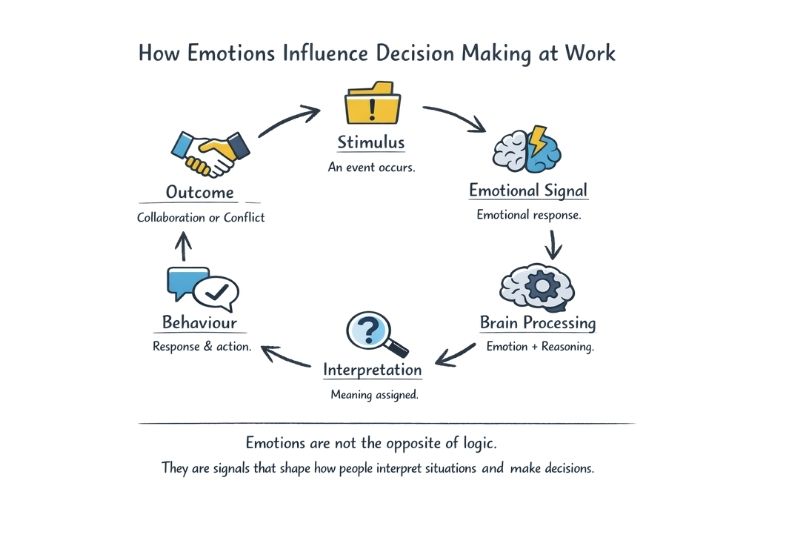
Human behaviour is rarely driven by logic alone. Emotional responses influence how people interpret information, prioritise decisions, and interact with others. While analytical reasoning remains essential, emotional signals often determine how individuals respond to situations and how effectively they engage with colleagues.
Every day, individuals process thousands of thoughts. Many of these are connected to emotional reactions triggered by events, conversations, and internal reflections. Without awareness of these reactions, people may respond automatically to situations rather than thoughtfully considering the context.
Recognising emotional signals provides valuable information. These signals can reveal when an individual feels confident, uncertain, frustrated, motivated, or concerned. When interpreted correctly, they help guide communication and decision making.
For example, tension in a meeting may not simply reflect disagreement about a project plan. It may indicate underlying concerns about risk, workload, or unclear expectations. When emotional signals are recognised and addressed constructively, discussions become more productive and collaborative.
The Importance of Emotional Awareness
Emotional awareness refers to the ability to recognise and understand emotions in oneself and others. This skill allows individuals to identify emotional patterns and respond more thoughtfully in professional situations.
Without emotional awareness, reactions often occur automatically. Stress may lead to defensive communication, frustration may escalate into conflict, and uncertainty may result in withdrawal from discussions.
By contrast, individuals who develop emotional awareness can pause and interpret emotional signals before responding. This pause creates space for more constructive communication and clearer decision making.
Importantly, emotional awareness does not mean suppressing feelings or ignoring emotional responses. Instead, it involves recognising these responses and understanding how they influence behaviour.
In professional environments, this skill supports more effective collaboration and leadership.
Communication and Misinterpretation
One of the most common sources of conflict in workplaces is misinterpretation. When individuals interpret the behaviour or tone of others incorrectly, misunderstandings quickly arise.
For instance, a colleague who appears abrupt in a meeting may simply be focused on solving a technical problem. Another individual might interpret that tone as dismissive or critical.
Without emotional awareness, such misinterpretations can escalate into tension or reduced trust within teams.
Emotional awareness encourages individuals to approach interactions with curiosity rather than assumption. Instead of immediately assigning negative meaning to behaviour, individuals can ask clarifying questions or explore alternative interpretations.
This approach strengthens communication and reduces unnecessary conflict.
Emotional Signals in Team Dynamics
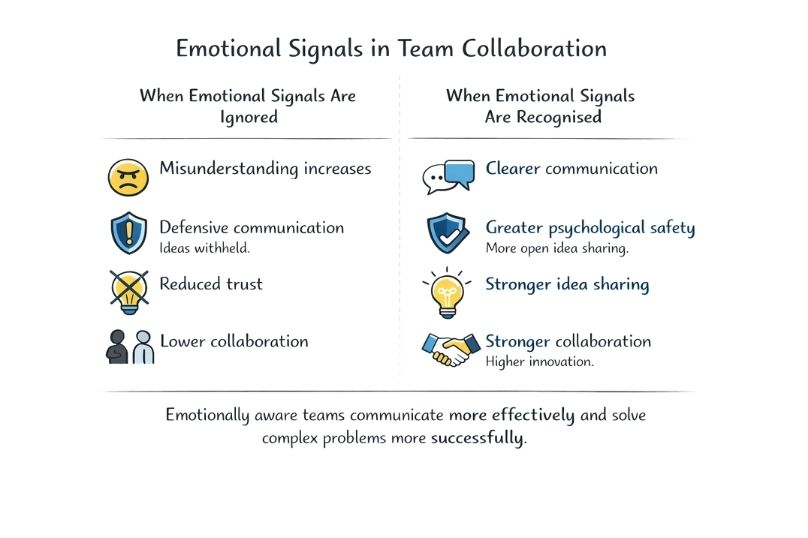
Teams operate not only through formal processes and objectives but also through emotional dynamics. Trust, confidence, motivation, and engagement are all influenced by emotional factors.
When team members feel respected and understood, they are more likely to contribute ideas openly and collaborate effectively. Conversely, environments where emotional signals are ignored often experience disengagement and reduced productivity.
Leaders who recognise emotional dynamics within their teams are better positioned to create supportive environments. This awareness allows leaders to identify when individuals may be experiencing pressure, frustration, or uncertainty.
Addressing these signals early can prevent small issues from developing into larger conflicts.
Emotional Awareness and Leadership
Leadership requires more than technical expertise or strategic thinking. Effective leaders must also understand the human dynamics that influence team performance.
Emotional awareness supports leadership in several ways.
First, it helps leaders interpret the needs and concerns of their teams more accurately. When leaders recognise emotional signals, they can respond with clarity and empathy while maintaining professional boundaries.
Second, emotional awareness strengthens trust. Teams are more likely to engage openly with leaders who demonstrate understanding and respect for their perspectives.
Third, this capability supports better decision making. Leaders who understand emotional dynamics can anticipate how decisions will affect morale, motivation, and collaboration.
These factors are particularly important in STEM environments where complex projects often involve multidisciplinary teams and diverse viewpoints.
Emotional Awareness in STEM Fields
STEM professions are frequently associated with analytical thinking and technical expertise. While these capabilities remain fundamental, the collaborative nature of modern scientific and technological work requires strong interpersonal skills as well.
Research projects, engineering initiatives, and innovation programmes often involve teams spanning multiple disciplines and institutions. These teams must communicate effectively despite differences in expertise, experience, and working styles.
Emotional awareness helps professionals navigate these complexities.
Recognising emotional signals within teams allows individuals to identify misunderstandings early and address them constructively. It also supports respectful discussion when ideas are challenged or revised.
In addition, emotional awareness contributes to resilience. Many STEM roles involve demanding workloads, tight deadlines, and high expectations. Understanding how emotional responses arise during stressful situations can help individuals maintain focus and clarity.
Developing Emotional Awareness
Emotional awareness is not an innate trait limited to certain individuals. It is a skill that can be developed through reflection and practice.
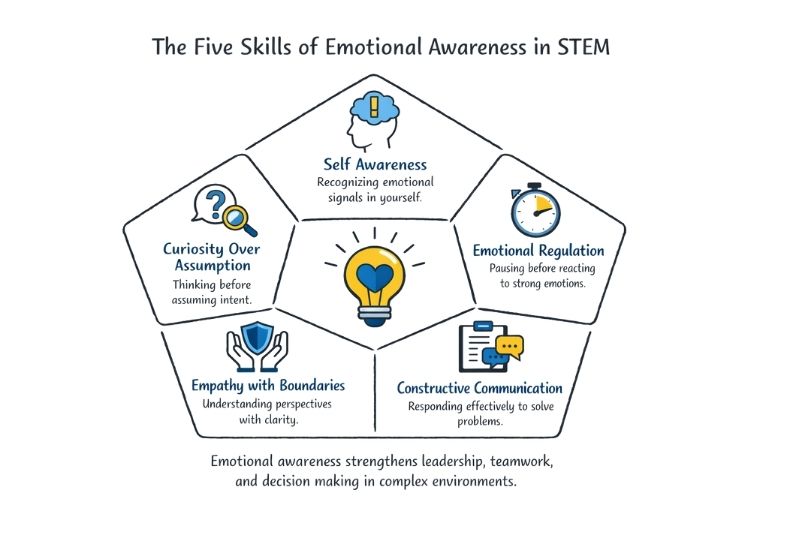
The process often begins with recognising personal emotional responses. This involves paying attention to physical sensations, thoughts, and behavioural patterns that arise in different situations.
For example, individuals may notice that particular conversations trigger anxiety or defensiveness. Others may recognise patterns of impatience during high pressure tasks.
By observing these reactions without judgment, individuals can begin to understand the emotional patterns influencing their behaviour.
The next step involves creating space between emotional stimulus and response. Pausing briefly before reacting allows individuals to interpret situations more accurately.
This pause can prevent impulsive communication and encourage more thoughtful responses.
Another important aspect of emotional awareness is understanding the perspectives of others. When individuals approach interactions with curiosity rather than assumption, communication becomes more open and constructive.
Over time, these habits strengthen emotional regulation and improve collaboration within teams.
Creating Emotionally Healthy Work Cultures
While emotional awareness begins at an individual level, its benefits extend to entire organisations.
Workplaces that recognise emotional dynamics often experience stronger engagement, improved communication, and more effective teamwork.
Leaders play a critical role in establishing these cultures. By modelling respectful communication and encouraging open discussion, leaders create environments where individuals feel safe contributing ideas and raising concerns.
Psychological safety is a key element of this environment. When individuals feel comfortable expressing viewpoints without fear of negative consequences, teams are more likely to explore innovative solutions and address challenges collaboratively.
In contrast, workplaces that discourage emotional expression may unintentionally create environments where concerns remain unspoken and misunderstandings persist.
Addressing emotional awareness within professional cultures therefore contributes not only to wellbeing but also to organisational effectiveness.
Learning More About Emotional Awareness
For professionals interested in exploring these ideas further, the Women in STEM Network offers an on demand webinar for members focused on the role of emotional awareness in leadership and collaboration.
The session explores the biological foundations of emotion, the importance of recognising emotional signals in professional environments, and practical strategies for strengthening emotional awareness in daily work.
The webinar also introduces the concept of Your Interior Design, a framework that helps individuals understand how emotional patterns influence behaviour and communication.
Through this approach, participants gain insights into how emotional awareness can support more effective leadership, teamwork, and decision making.
About the Speaker
The webinar is presented by Sharon A. Kuhn, an Executive Coach and Organizational Health Consultant, author, speaker, Gallup Engagement Champion, member of the Forbes Coaches Council, and contributor to Forbes.
Sharon has more than thirty years of experience working with leaders and organisations to strengthen engagement, communication, and workplace wellbeing. Her work focuses on the neuroscience of empathy, leadership dynamics, and the discovery of individual talents.
Her research led to the development of the framework Your Interior Design, which helps individuals understand the emotional systems that influence behaviour and communication.
Through coaching, consulting, and speaking engagements, Sharon helps leaders and teams apply scientific insights about human behaviour to everyday professional challenges.
More information about Sharon’s work can be found here:
Website
https://www.sharonkuhn.com/
LinkedIn
https://www.linkedin.com/in/sharon-kuhn-3a752b34/
Access the Webinar
Members of the Women in STEM Network can access the on demand webinar here: https://womeninstemnetwork.com/on-demand-workshops-for-women
The Women in STEM Network continues to provide expert led webinars and resources designed to support professional development, leadership growth, and collaboration across the global STEM community.