
Most professionals spend a significant portion of their careers focusing on what they need to improve.
Performance reviews often focus on development areas. Training programmes frequently target skills gaps. Managers commonly discuss weaknesses that need addressing. Even many ambitious professionals spend their time asking themselves what they are not yet good at.
While continuous improvement is important, this approach can sometimes cause people to overlook one of the most powerful drivers of long-term success: their strengths.
Understanding and deliberately using personal strengths can have a profound impact on performance, confidence, career satisfaction, and wellbeing. Yet many people struggle to identify what their genuine strengths are, let alone use them consistently in their daily work.
This is particularly relevant in STEM careers, where technical expertise, problem-solving ability, and professional competence are highly valued. While these qualities are undoubtedly important, technical capability alone does not necessarily lead to engagement, fulfilment, or sustainable high performance.
The professionals who consistently perform at their best often have something else in common. They understand what energises them, and they actively create opportunities to do more of it.
What Is a Strength?
Many people assume a strength is simply something they are good at.
However, strengths researchers and leadership coaches often define strengths more precisely.
A true strength combines two important elements:
- Performance
- Energy
In other words, a strength is not just an activity you perform well. It is an activity you perform well that also leaves you feeling energised, motivated, and engaged.
This distinction matters.
Many professionals have developed expertise in tasks that they do not particularly enjoy. Through experience and practice, they become highly capable, but the work itself can leave them feeling drained.
Conversely, there may be activities that generate enthusiasm and excitement while also producing excellent results. These are often indicators of genuine strengths.
Understanding this difference can be transformative because it shifts attention away from simply asking, "What am I good at?" and towards asking, "What am I good at that gives me energy?"
Why Energy Matters
Modern workplaces often focus heavily on productivity.
The assumption is frequently that greater effort leads to better outcomes.
However, effort alone is not always sustainable.
Anyone can push through difficult tasks for short periods. The challenge comes when that effort must be maintained over months or years.
When people spend most of their time performing activities that deplete their energy, several consequences often emerge:
- Reduced engagement
- Lower motivation
- Increased stress
- Declining job satisfaction
- Higher risk of burnout
In contrast, individuals who regularly use their strengths often report feeling more engaged and fulfilled at work.
This does not mean every task becomes enjoyable. Every role contains responsibilities that may not align perfectly with personal preferences.
However, increasing the proportion of time spent using strengths can significantly improve overall wellbeing and effectiveness.
The Science Behind Strengths
The concept of strengths-based development is rooted in positive psychology, a branch of psychology that focuses on understanding what enables individuals and organisations to thrive.
Traditional approaches to development often begin by identifying weaknesses and attempting to fix them.
Positive psychology takes a broader view.
Rather than focusing exclusively on deficiencies, it asks questions such as:
- What is already working well?
- What enables people to perform at their best?
- How can existing strengths be developed further?
Research has consistently shown that individuals who understand and utilise their strengths experience benefits including:
- Increased confidence
- Higher levels of engagement
- Greater resilience
- Improved workplace relationships
- Better overall wellbeing
- Enhanced performance
These findings have led many organisations to incorporate strengths-based approaches into leadership development, talent management, coaching, and employee engagement initiatives.
Why We Often Miss Our Own Strengths
One of the challenges with strengths is that they can be surprisingly difficult to identify.
Because strengths come naturally, people frequently assume that everyone else finds the same activities equally easy.
As a result, they underestimate their value.
Someone with exceptional communication skills may assume everyone can explain complex concepts clearly.
An individual with strong strategic thinking may not realise that others struggle to see long-term patterns and connections.
A person who naturally builds relationships may not recognise that their ability to create trust is a significant professional asset.
Because strengths feel effortless, they are often invisible to the people who possess them.
This is one reason why feedback from colleagues, managers, mentors, and friends can be so valuable.
Others often notice our strengths before we do.
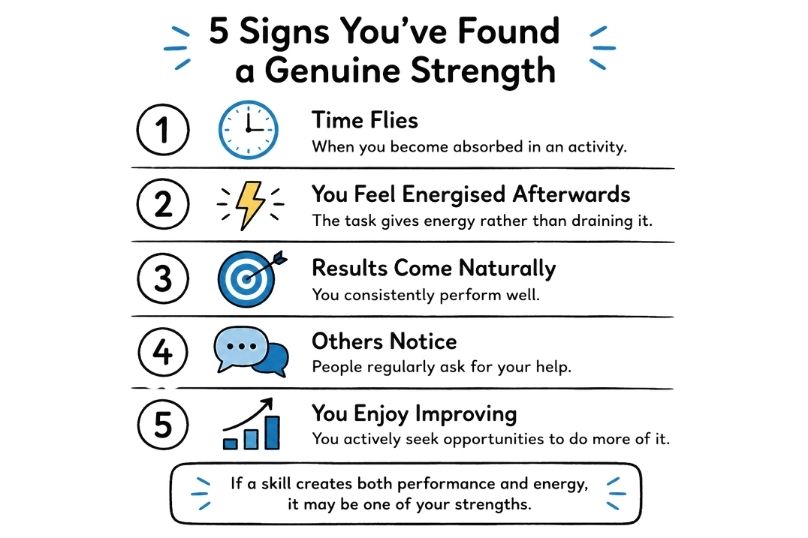
How to Spot Your Strengths
Identifying strengths requires observation and reflection.
Several clues can help reveal where strengths may exist.
Activities That Create Energy
Pay attention to tasks that leave you feeling enthusiastic and motivated rather than exhausted.
Energy is often one of the clearest indicators of a genuine strength.
Activities That Feel Natural
Strengths frequently feel intuitive.
You may not need extensive preparation or conscious effort to perform well in these areas.
Activities That Produce Strong Results
Strengths typically generate consistently positive outcomes.
People often seek your support, advice, or expertise in these areas.
Activities That Create Flow
Psychologist Mihaly Csikszentmihalyi introduced the concept of flow, a state of complete absorption in an activity.
When using strengths, people often experience flow. Time seems to pass quickly, concentration increases, and the work feels intrinsically rewarding.
The Importance of Strengths in STEM
The STEM workforce faces unique challenges.
Rapid technological change, increasing complexity, high workloads, and intense competition create significant pressure for many professionals.
In these environments, strengths can provide a powerful foundation for resilience and sustainable performance.
A software engineer may thrive when solving complex technical problems.
A researcher may gain energy from exploring unanswered questions.
An engineer may excel when designing practical solutions.
A project manager may be energised by coordinating people and resources.
A lecturer may find fulfilment in helping others understand difficult concepts.
Each role requires technical competence, but the activities that create energy can vary dramatically between individuals.
Understanding these differences enables professionals to make more informed career decisions and maximise their contribution.
Strengths Are Not Fixed
Another common misconception is that strengths are permanent and unchangeable.
In reality, strengths can evolve over time.
As people gain experience, develop new skills, and encounter different opportunities, previously hidden strengths may emerge.
Interests also change throughout a career.
Someone who begins their career focused on technical work may later discover strengths in leadership, mentoring, communication, or strategy.
For this reason, strengths exploration should not be viewed as a one-time exercise.
It is an ongoing process of self-discovery and development.
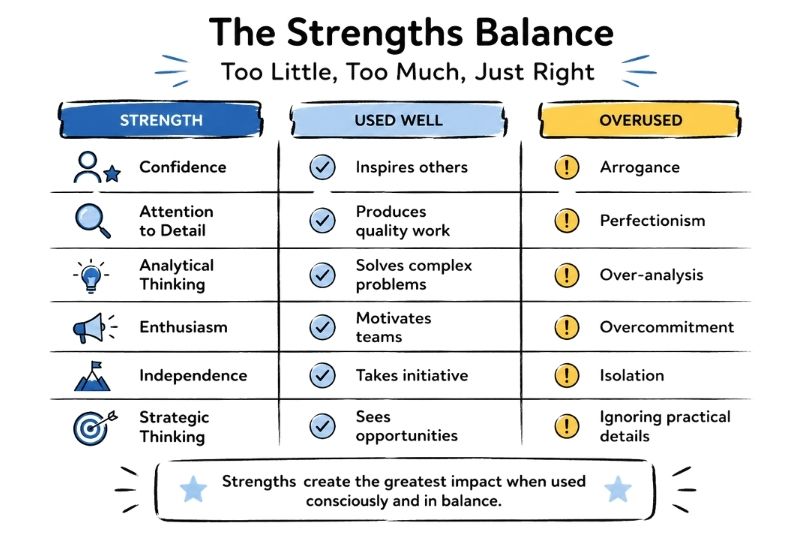
When Strengths Become Weaknesses
Perhaps surprisingly, strengths can sometimes create challenges.
Every strength exists on a continuum.
When used appropriately, strengths support performance. When overused, they can become counterproductive.
For example:
- Confidence can become overconfidence.
- Attention to detail can become perfectionism.
- Strategic thinking can become over-analysis.
- Enthusiasm can become impulsiveness.
- Independence can become isolation.
This concept highlights the importance of self-awareness.
Effective professionals do not simply maximise their strengths at every opportunity. They learn when to apply them, when to moderate them, and how to balance them with other capabilities.
Building Stronger Teams Through Strengths
Strengths are not only valuable for individuals.
They can also transform team performance.
Many managers fall into the trap of expecting every team member to contribute in exactly the same way.
However, high-performing teams typically contain diverse strengths.
Some individuals generate ideas.
Others focus on implementation.
Some excel at relationship building.
Others specialise in analysis and risk management.
Recognising these differences enables teams to allocate responsibilities more effectively and appreciate the unique contribution of each member.
This strengths-based approach can improve collaboration, reduce conflict, and increase collective performance.
Finding Your Zone of Peak Performance
Perhaps the most compelling application of strengths is the concept of a personal zone of peak performance.
This is the point where:
- Strengths are regularly utilised.
- Skills and challenges are well matched.
- Work feels meaningful.
- Energy remains sustainable.
- Performance remains consistently high.
People operating in this zone often describe feeling highly engaged and productive.
Importantly, peak performance does not mean working harder or longer hours.
Instead, it means aligning work more closely with natural strengths and sources of energy.
While no role will ever consist entirely of preferred activities, understanding strengths allows individuals to make intentional choices about how they work, what responsibilities they pursue, and where they can add the greatest value.
Questions Worth Asking Yourself
If you would like to explore your own strengths, consider reflecting on the following questions:
- What activities consistently give me energy?
- What tasks do I look forward to doing?
- When do I feel most engaged at work?
- What do others regularly ask me for help with?
- Which achievements am I most proud of?
- When do I experience a sense of flow?
- What activities would I willingly do even if they were not formally required?
The answers may reveal strengths that have been present all along but have not yet been fully recognised.
Learn More About Strengths and Peak Performance
These themes were explored in greater depth during a recent Women in STEM Network masterclass, Using Your Strengths to Find Your Zone of Peak Performance, delivered by Sarah Leach.
Sarah is a highly experienced executive coach, lecturer in coaching at Henley Business School, and co-editor of Third Wave Cognitive Behavioural Coaching and The Coaches Handbook. Since 2013, she has coached senior leaders across a wide range of sectors and has extensive experience helping individuals and teams achieve greater clarity, confidence, and professional success.
The session explored the science behind strengths, practical techniques for identifying them, and strategies for using them more intentionally to achieve sustainable high performance.
Women in STEM Network members can watch the recording on demand here: womeninstemnetwork.com/on-demand-workshops-for-women/