
When we talk about workplace advice, it's crucial to understand we're often discussing two completely different worlds. On one side, there's the informal advice given to women, which is all about helping them adapt and navigate systems that may not have been built for them. On the other, there's the formal advice given to organisations, which is meant to drive systemic change.
Essentially, women get coached on how to survive, while companies get a blueprint for reform. This creates a massive gap in approach, and more importantly, in accountability.
Decoding the Two Worlds of Workplace Advice
In just about any workplace, two conversations about career progression are happening at the same time, but they rarely intersect.
One happens over coffee, in quiet corners, or through DMs, the classic "whisper network" where women trade tips and strategies for getting by and getting ahead. This is the world of informal, peer-to-peer advice.
The other conversation is unfolding in boardrooms and with HR leaders, guided by pricey consultants and DEI specialists. This is the realm of formal, organisational advice, where policies get drafted and new initiatives are launched. The fundamental problem is that one approach tells individuals to change themselves, while the other tells the system to change. Unsurprisingly, progress often grinds to a halt. This is especially true in technical fields, as highlighted in the latest women in STEM statistics for 2025.
This guide will break down this divide, exploring why these two worlds exist and what their real impact is on careers.
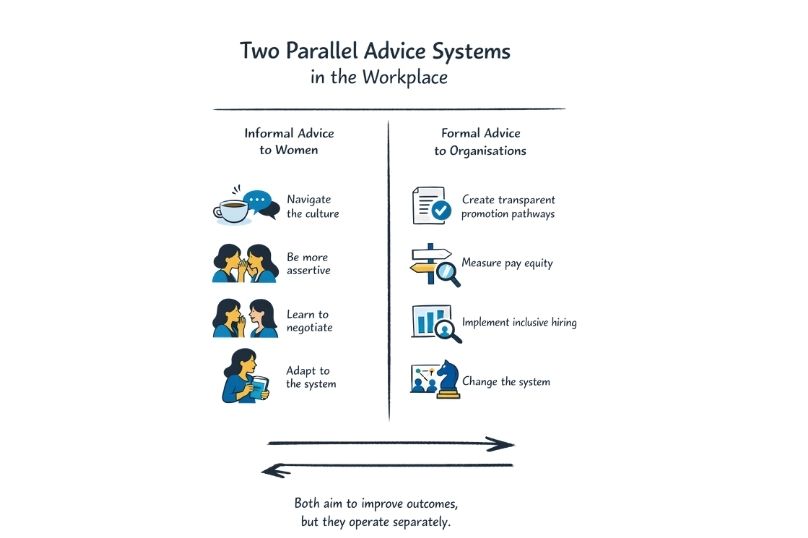
Informal vs. Formal Advice At a Glance
Let's look at the core differences side-by-side.
| Criterion | Informal Advice to Women | Formal Advice to Organisations |
|---|---|---|
| Purpose | Individual survival and navigation. | Systemic reform and compliance. |
| Focus | Adapting to the existing culture. | Changing the underlying culture. |
| Accountability | Placed squarely on the individual woman. | Supposedly on the organisation. |
| Evidence | Anecdotal, drawn from lived experience. | Data-driven, based on research and metrics. |
A Detailed Comparison of Informal vs Formal Frameworks
To get to the heart of why individual and organisational change often feel disconnected, we need to look closely at the two main types of advice being given: informal and formal. These two worlds operate on completely different wavelengths, with separate goals, tones, and ways of measuring success. It's no wonder they rarely meet in the middle.
Think about the informal advice first. It’s all about survival and coping on an individual level. This is the senior colleague pulling a junior woman aside to coach her on dealing with a tough manager or deflecting microaggressions. It’s deeply empathetic, comes from a place of "I've been there," and is meant to help that one person adapt to the company culture as it is.
Now, contrast that with the formal advice directed at the organisation itself. This is about systemic reform, delivered through dense policy documents, consultancy reports, or company-wide DEI programmes. The language is procedural, the arguments are backed by data, and the entire point is to reshape the system to be fairer for everyone.
Purpose and Accountability
Perhaps the biggest difference is where the responsibility for change is placed. With informal advice, the accountability lands squarely on the individual woman. It’s up to her to become more resilient, a sharper negotiator, or better at navigating biased feedback. Her success is seen as a personal victory, and her struggles as a personal failing.
Formal advice, however, puts the accountability on the institution. The organisation is the one responsible for creating fair promotion pathways, closing the pay gap, and building a genuinely inclusive culture. If these things don't happen, it's an organisational failure, not an individual one. For women serious about advancing their careers, working with an executive career coach can be invaluable for learning how to operate within these formal structures.
Informal advice asks the individual to change to fit the system. Formal advice asks the system to change to fit its people. This fundamental opposition is why relying on informal networks alone is insufficient for driving real progress.
Evidence and Tone
The foundation of each type of advice is also worlds apart, which naturally shapes their tone.
- Informal Advice: This is built on anecdotes and shared lived experiences. Its strength lies in relatable stories and emotional connection, offering a powerful sense of validation and community. It’s personal.
- Formal Advice: This is built on aggregated data, academic research, and performance metrics. Think of global frameworks like the UN Women's Empowerment Principles or legislation in specific countries like the NIH Revitalization Act in the USA, which mandates the inclusion of women in clinical research. This ensures policies are based on representative data, not just assumptions. It’s objective.
This core difference explains why the tones are so distinct. Informal guidance feels supportive and empathetic, creating a bond of solidarity. Formal guidance is necessarily objective and procedural, designed to be scaled and applied consistently across an entire organisation.
To make these distinctions clearer, let's break them down side-by-side.
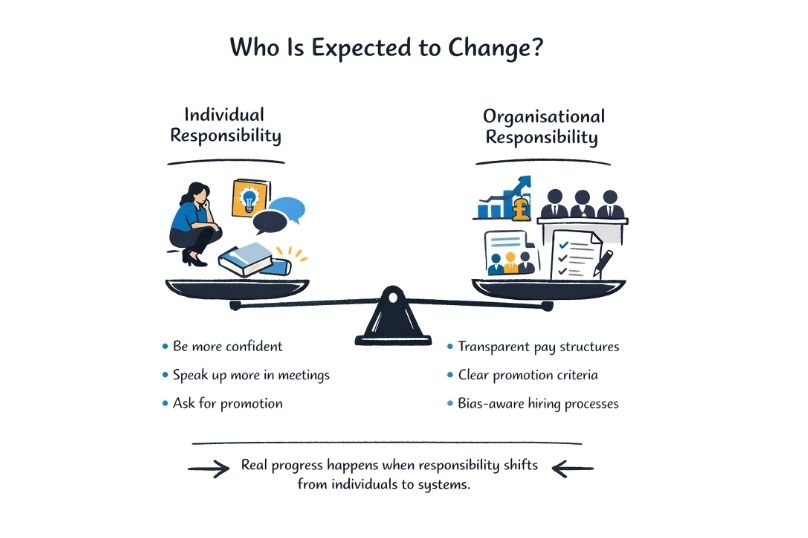
Comparing Informal and Formal Advice Frameworks
This table highlights the fundamental differences between the advice women often receive personally and the guidance given to the organisations they work for.
| Criterion | Informal Advice to Women | Formal Advice to Organisations |
|---|---|---|
| Primary Goal | Individual survival, coping, and adaptation. | Systemic reform and structural change. |
| Target Audience | Individual women, often in one-on-one or small group settings. | Organisational leadership, HR, and D&I departments. |
| Tone | Empathetic, personal, supportive, and subjective. | Procedural, objective, data-driven, and impersonal. |
| Evidence Base | Anecdotes, personal stories, and lived experience. | Aggregated data, research studies, legal precedents, and metrics. |
| Accountability | Placed on the individual to adapt and overcome. | Placed on the organisation to change its policies and culture. |
| Desired Outcome | Increased personal resilience and navigation skills. | A fairer, more equitable, and inclusive system for all. |
As you can see, these two frameworks are designed to solve very different problems. While both have their place, relying solely on informal support leaves the underlying systemic issues completely unaddressed.
Why Informal Advice Fails Without Systemic Support
Relying on informal advice alone asks women to carry the heavy burden of fixing a broken system, one conversation at a time. This approach pushes individuals to develop coping strategies instead of demanding that flawed structures be rebuilt, which often just leads to burnout and maintains the status quo. The gap between informal advice given to women vs formal advice given to organisations becomes painfully obvious when progress grinds to a halt.
Even the most well-intentioned mentoring can only go so far. An informal network might champion a woman for a promotion, but those efforts often count for little when stacked against biased internal systems.
The Risk of Unchecked Bias
One of the biggest problems with informal systems is that they tend to reflect and even amplify existing biases. For example, a 2017 UK government-commissioned review found that companies lacking clear promotion criteria rely heavily on informal social networks, which are typically dominated by men. This is a pattern seen globally.
In these environments, decisions on pay and promotion often fall into a pattern of ‘social cloning’, where leaders promote people who look and think like them. This practice systematically sidelines highly qualified women. The UK review showed that formal interventions, like transparent career ladders and salary bands, dramatically improved outcomes for women, a lesson applicable to companies worldwide.
When the system is flawed, advice on how to navigate it is a temporary fix, not a solution. It treats the symptom—individual struggle, while ignoring the disease, organisational inequity.
This constant battle to work around biased structures is a huge driver of burnout and a key reason so many talented women leave their industries. You can explore how these issues lead to high turnover rates in our article on mapping the hidden exit points for women in STEM.
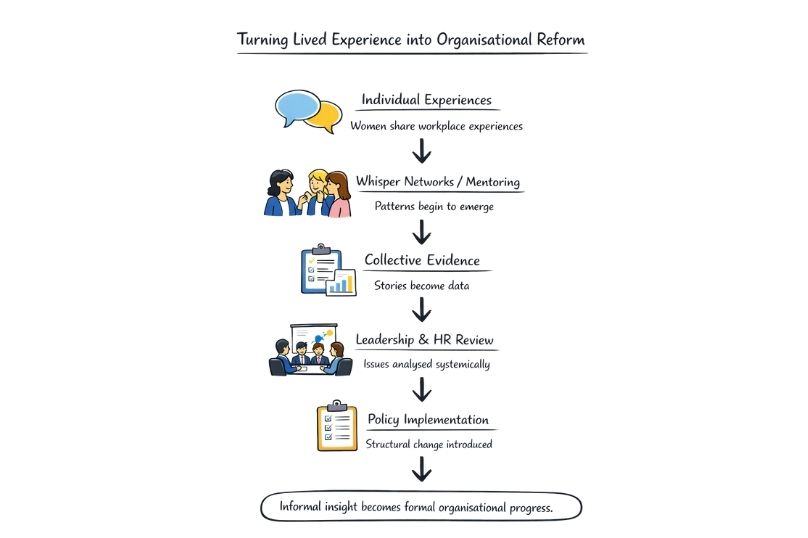
Ultimately, real progress happens when the powerful insights from these informal chats are channelled into driving formal, structural change. Without that vital link, informal advice just becomes a cycle of shared frustration instead of a true force for reform.
The Power of Formal Organisational Change Initiatives
While informal advice helps women find ways to cope with a flawed system, formal organisational initiatives have the power to actually fix it. When a company uses data to drive its policies and build structured programmes, it can create a genuinely equitable environment where everyone has a chance to thrive. This is where the contrast between informal advice given to women vs formal advice given to organisations becomes crystal clear. One is about adapting to the problem; the other is about solving it at its source.
These formal measures take direct aim at the systemic barriers that informal advice can only help individuals get around. It's no surprise that when organisations truly commit to these strategies, they start to see real, measurable improvements in retention, promotion rates, and innovation.
From Policy to Progress
Getting formal change right is about so much more than just writing a new policy document. It’s about putting structured, measurable actions into practice. The most successful initiatives I've seen usually include a few key elements:
- Transparent Salary Bands: This is a game-changer. It takes the guesswork and bias out of pay negotiations, making sure people are paid equally for equal work. Suddenly, the responsibility for fairness shifts from the individual negotiator to the company's structure.
- Structured Sponsorship Programmes: Unlike informal mentoring, a formal sponsorship programme actively identifies and champions high-potential women. It gives them visible projects and a direct line to senior leadership, which can accelerate their careers.
- Inclusive Hiring Practices: This means putting formal processes in place to reduce unconscious bias. Things like blind CV reviews or making sure interview panels are diverse are simple but powerful ways to widen the talent pool and hire based on merit alone.
- Robust Flexible Work Policies: Formalised flexible work options are an incredible tool for promoting equity. A global survey from International Workplace Group (IWG) found that 88% of workers would consider a job offering flexible work as a key benefit, highlighting its worldwide appeal. A 2023 UK survey by LoopMe showed 77% of women were more likely to apply for jobs that clearly advertised flexibility.
When an organisation codifies fairness through policy, it sends a clear message: equity is a core business priority, not an individual’s responsibility.
These initiatives show a real commitment to systemic change, which is absolutely essential for making any lasting progress. These formal structures provide the solid foundation needed for all employees to succeed, a crucial part of retaining women in tech and other STEM fields. At the end of the day, they help create a workplace where your success is defined by your talent and hard work, not by how well you can navigate an unequal system.
Bridging The Divide: From Informal Insight To Formal Action
Spotting the gap between personal advice and company policy is one thing; actually closing it is where the real work begins. We need to move beyond simply comparing informal advice given to women vs formal advice given to organisations and start taking action. This is about turning those lived experiences and whispered words of wisdom into tangible, meaningful change for everyone.
Lasting progress isn't a top-down mandate or a grassroots-only effort. It requires a coordinated dance between employees, their managers, and senior leaders. Each person holds a piece of the puzzle, and when they come together, they can build a bridge from personal insight to real institutional reform. It’s how an organisation stops just giving women survival guides and starts building an environment where they can genuinely thrive.
For Employees: Turning Anecdotes into Evidence
Your individual story has power, but in a corporate setting, collective data is what truly commands attention. You can be the spark that transforms an informal support network into a powerful force for change.
- Document and Depersonalise: Keep a personal log of your experiences, the good, the bad, and the just plain confusing. When you're ready to share, try to frame it systemically. For instance, instead of saying, "I felt left out," you could observe, "Key team decisions are often finalised at after-work social events, which can unintentionally exclude colleagues with caregiving duties."
- Find Strength in Numbers: Employee Resource Groups (ERGs) are your best bet for gathering this kind of feedback. Work with your ERG to collect anonymised stories and data points. A formal proposal coming from a recognised group has far more clout than a single person's complaint.
- Build a Business Case: Armed with this collective insight, you can start building a compelling case for change. Connect your proposals to the things leadership cares about, like boosting employee retention, sparking innovation, or improving team performance metrics.
For Managers: Your Role as an Amplifier
As a manager, you are the critical link between your team’s day-to-day reality and the senior leadership team. Being a true ally means you’re not just a passive observer; you actively listen to the informal chatter and use your position to advocate for change.
Being an ally isn't a passive role. It requires actively listening to understand the challenges your team members face and then using your influence to champion solutions, even small ones, that can lead to bigger systemic shifts.
It all starts with creating a psychologically safe environment where your team members feel they can be honest without fear of reprisal. When you notice patterns or recurring themes, don’t just brush them aside. Why not champion a small pilot programme within your own team? You could test out a new meeting schedule or a more transparent process for assigning projects. Document what happens—the wins and the lessons—and present it to leadership as a case study for a wider rollout. For more on this, check out the resources in our Mentoring Hub.
For HR and D&I Leaders: Building the Formal Channels
Your job is to build the systems that can methodically capture and make sense of all the valuable data currently locked away in those informal networks.
- Create Genuinely Safe Channels: Think anonymous pulse surveys, confidential "listening tours," and dedicated feedback portals. The key is to ensure these channels are not only safe but are seen to be acted upon. Nothing kills trust faster than feedback disappearing into a black hole.
- Analyse for Systemic Fault Lines: Collecting data is just the start—the real value is in the analysis. Hunt for trends across departments, seniority levels, and demographics. Are women in technical roles facing different hurdles than their counterparts in marketing? This kind of analysis helps you pinpoint precisely where your interventions will have the most impact.
- Design Policy with Proof: Use the insights you've gathered to build evidence-based policies. When you propose a new flexible working policy or a sponsorship programme, you can now back it up with both qualitative stories and hard data. This transforms your pitch from "this is the right thing to do" to "this is what our people need to succeed, and here’s the proof."
Got Questions About Workplace Advice? We've Got Answers
It’s easy to get tangled up in the different kinds of advice floating around the workplace. Let’s clear up some of the most common questions people have when comparing the informal, peer-to-peer chats women have versus the formal advice aimed at the organisation itself.
Isn't Informal Advice a Good Thing?
Absolutely. There's immense value in informal advice and mentorship. These conversations build community, offer validation, and provide a kind of support that you just don't get from a corporate handbook. They’re essential.
The problem isn't the advice itself; it's when this is the only support on offer. That puts all the pressure on individuals to navigate a flawed system, rather than fixing the system itself. The real magic happens when you channel the insights from these informal networks to push for real, structural change.
We Have Policies, but I See No Real Change. What’s Going On?
This is a classic 'policy vs. practice' gap. When your company’s beautifully written policies don't translate into real-world results, it’s time to dig into the 'why'.
A policy is only as strong as its implementation. Without genuine accountability and a culture to back it up, even the best guidelines will just gather dust.
The first step is to find out where the disconnect is happening. Confidential culture audits or anonymous employee feedback sessions are great for this. You need to know if your managers are actually trained to apply these policies and, crucially, if they're held accountable for doing so fairly and consistently.
How Can I Bring Up Systemic Issues Without Sounding Like I’m Just Complaining?
The trick is to frame your feedback as a business solution, not just a problem. Arm yourself with data and show how your proposed changes tie into the company's bigger goals.
It's also true that good career advice often comes down to the practical stuff, like helping people to negotiate their pay and understand salary expectations within their industry.
Instead of just pointing out what’s wrong, try framing it like this: "If we created transparent career paths, I believe we could boost our retention rates among women, which would significantly cut down on expensive recruitment costs." Even better, team up with an Employee Resource Group (ERG). When you present ideas as a collective, you're not just an individual with a complaint; you're a group offering a strategic solution.