
When we talk about discrimination in the workplace, we're talking about something more than just a one-off unfair decision. It’s when someone is treated badly not because of their performance or skills, but because of who they are.
This isn't about isolated incidents of poor judgement. It's a systemic problem where personal characteristics like gender, race, age, or disability lead to real, negative consequences in someone's career. At its heart, it creates a toxic and unequal environment where prejudice gets in the way of merit.
So, What Is Workplace Discrimination Really?
Think of it this way: imagine a brilliant orchestra conductor who refuses to audition violinists who are left-handed. By doing this, they've immediately cut themselves off from a huge pool of incredible talent for a reason that has absolutely nothing to do with musical ability. The orchestra might still sound good, but it will never be the best it could possibly be.
Workplace discrimination works just like that. It’s an invisible barrier that holds people back based on who they are, not what they can achieve.
It’s the talented female software developer who gets passed over for promotion time and time again, watching her less experienced male colleagues climb the ladder. Or it could be the highly skilled older project manager who is suddenly pushed aside on major projects, despite a stellar track record.
This isn't just a run of bad luck. It's the very real outcome of bias—whether conscious or not—shaping who gets the opportunities, the promotions, and the job security. It fosters an environment where some people have to work twice as hard just to get to the same starting line.
The Human Cost of Unfair Treatment
The ripple effects of discrimination go far beyond a single missed opportunity or an unfair remark. For the person on the receiving end, it can be devastating, leading to a loss of confidence, chronic stress, and a deep sense of frustration with their chosen career. It silently tells them their hard work doesn't count as much, which slowly chips away at their motivation and well-being.
For the organisation, the damage is just as significant. It cultivates a toxic culture, tanks morale, and inevitably leads to high staff turnover as good people simply leave.
When talented individuals walk away because they see no path forward, the entire organisation loses. Innovation dries up, and the business misses out on the very diversity of thought needed to solve complex problems and grow—especially in demanding fields like STEM.
The truth is, when a workplace lets prejudice dictate careers, it's not just hurting individuals; it's actively sabotaging its own potential. To get a clearer picture of the challenges and progress, it's worth exploring the latest women in STEM statistics for 2025. Understanding the current landscape is the first step toward creating a future where talent is truly the only thing that matters.
Recognising the Many Forms of Discrimination
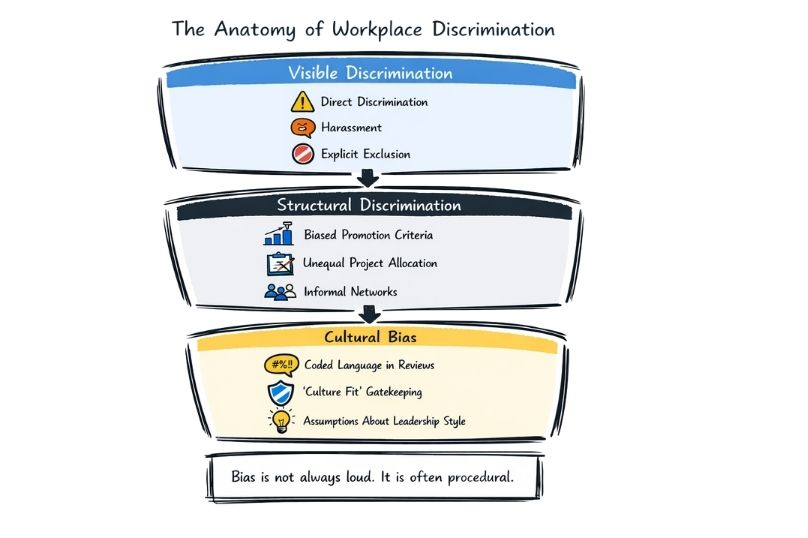
To tackle discrimination at work, you first need to know what you’re looking for. It’s not always a blatant, headline-grabbing act of prejudice. More often than not, it’s subtle—quietly woven into company policies, casual conversations, and decisions that seem perfectly neutral on the surface.
Learning to spot its different shapes and sizes is the first real step toward dismantling it.
Discrimination can be complex, but breaking it down helps clarify what might be happening in your own workplace. Let’s look at the main types you’re likely to encounter.
Types of Workplace Discrimination Explained
| Type of Discrimination | Simple Definition | Example in a STEM Workplace |
|---|---|---|
| Direct Discrimination | Treating someone less favourably because of who they are (e.g., their gender, race, age). | A hiring manager tells a female candidate, "We need someone who can command a room, so we're leaning towards a man for this leadership role." |
| Indirect Discrimination | A seemingly fair rule or policy that disadvantages a particular group of people. | A tech firm requires all key meetings to be held after 6 p.m., which disproportionately penalises working mothers who are more likely to have childcare duties. |
| Harassment | Unwanted behaviour related to a protected characteristic that creates a hostile or offensive environment. | A female engineer is the only woman on her team and has to put up with constant "jokes" about her gender or has her technical opinions repeatedly dismissed. |
| Victimisation | Treating someone badly because they complained about discrimination or supported someone who did. | The engineer who reported the harassment is suddenly overlooked for a promotion she was on track for, with no clear reason given. |
| Intersectional Discrimination | When different aspects of a person's identity overlap (e.g., race and gender) to create a unique and compounded form of bias. | A Black woman in data science faces stereotypes related to both her race and her gender, experiencing barriers that are different to those faced by a white woman or a Black man. |
As you can see, what might seem like a simple "company rule" or a throwaway "joke" can actually be a form of discrimination with serious consequences. Understanding these distinctions is crucial for identifying what's really going on.
When Rules Create Unfair Barriers
Indirect discrimination is particularly tricky because the intention might not be malicious. A policy that seems fair on paper can still create very real barriers.
Take the example of the late-night meetings. While the rule applies to everyone, it places an unfair burden on employees with primary childcare duties—a role still predominantly held by women. This is a classic way that pay inequality can start to creep in, as being excluded from key decisions can directly impact career progression. You can read more on the complex factors contributing to the pay gap for women in STEM.
The Hostile Environment and the Fear of Speaking Out
Then there's harassment. It’s not just one single action; it’s often a pattern of behaviour that chips away at someone’s dignity and confidence. The "jokes," the dismissive comments, the inappropriate remarks—they all add up, creating a toxic atmosphere that makes it nearly impossible for someone to thrive.
What makes this even worse is the risk of victimisation. This is essentially retaliation. It’s what happens when someone is punished for speaking up—they get passed over for a project, receive a sudden poor performance review, or are socially isolated by their team. It’s designed to send a clear message: stay silent.
Understanding the Layers of Bias
Finally, it's vital to recognise that discrimination isn't a one-size-fits-all experience. Intersectional discrimination acknowledges that our identities are layered. A person's experience is shaped by the combination of their race, gender, sexuality, and other characteristics.
A Black woman working in a lab may face a unique blend of racial and gender bias that a white woman or a Black man simply doesn't. Her path is different, and her challenges are compounded. Ignoring this intersectionality means we’re only seeing a fraction of the problem.
These aren't just abstract concepts; they are daily realities for many. Global studies consistently show that ethnic minorities face disproportionate levels of discrimination at work. For instance, a recent survey in the UK found that over two-thirds (69%) of ethnic minorities have faced discrimination at work, a figure that jumps to 76% for people who identify as Black.
Seeing real-world scenarios makes these ideas much clearer. While the legal specifics might vary by location, reviewing discrimination in the workplace examples can help you connect the dots and recognise patterns in your own environment.
Once you learn to identify these different forms of discrimination, from the most obvious to the most deeply hidden, you’re in a much stronger position to challenge the unfair systems that hold talented people back.
Understanding Global Anti-Discrimination Laws
While there isn't one single law that covers every workplace on Earth, there’s a powerful global agreement on a fundamental right: everyone deserves to work without facing discrimination. Most countries have built legal frameworks to protect employees, which has created a sort of worldwide standard for fairness. The point isn’t to turn you into a legal expert, but to show you that your rights are backed by law, wherever you are in your career.
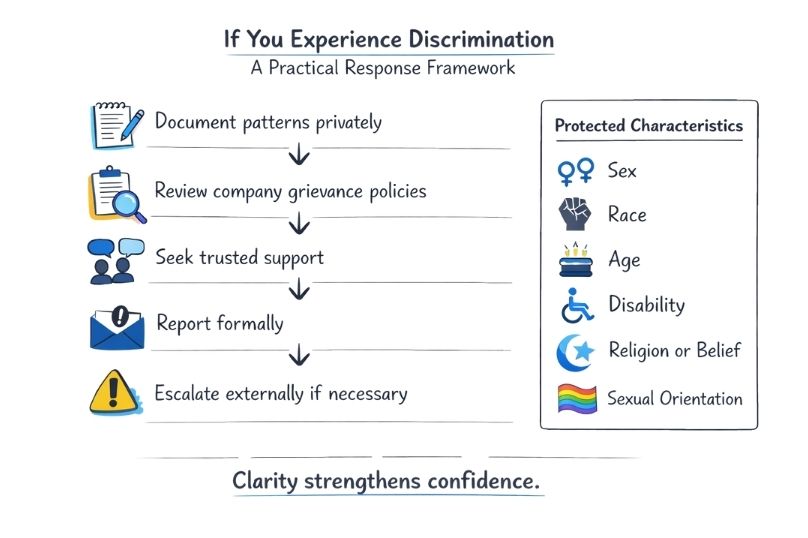
This global safety net is built around the idea of protected characteristics. Think of these as the personal attributes that laws shield from unfair treatment. They are the core parts of who you are that should never be a reason for someone to deny you an opportunity.
Although the exact list of characteristics can differ slightly from one country to another, the core principles are remarkably consistent across the globe.
Core Principles of Anti-Discrimination Law
To see these ideas in action, let's look at a few influential laws. The United Kingdom's Equality Act 2010 is a comprehensive framework that pulled together lots of different laws into one. It protects people from discrimination based on:
- Age
- Disability
- Gender Reassignment
- Marriage and Civil Partnership
- Pregnancy and Maternity
- Race
- Religion or Belief
- Sex
- Sexual Orientation
This framework means that big decisions about hiring, promotions, pay, and redundancy must be based on merit—not on prejudice. For example, you can learn more about how these protections work in practice in our guide on maternity and parental leave rights.
A Quick Look at Global Frameworks
This model is part of a global trend. In the United States, Title VII of the Civil Rights Act of 1964 is a landmark piece of legislation that forbids discrimination based on race, colour, religion, sex, or national origin. Other US laws add protections for age and disability, echoing the same core principles.
It's a similar story in other major economies:
- Canada: The Canadian Human Rights Act offers strong protections at the federal level, and each province has its own human rights code, too.
- Australia: The Fair Work Act 2009, alongside other federal acts, protects against discrimination on grounds like race, sex, age, and disability.
- European Union: The EU has powerful directives that set minimum standards for protection across all member states, covering everything from employment and occupation to vocational training.
Across all these legal systems, a common thread emerges. The law recognises that certain groups have historically faced unfair barriers, and these protections are designed to level the playing field, ensuring everyone gets a fair chance to succeed based on their skills and contributions.
The Common Ground
Even though the names of the laws and the agencies that enforce them change from place to place, their fundamental goals are the same. They all aim to prevent discrimination in a workplace by making unfair treatment illegal in every part of the employment journey.
This covers everything from the wording of a job advert and the questions in an interview to training opportunities, pay reviews, and the reasons for dismissal. They also universally prohibit harassment and victimisation, making sure you can report discrimination without the fear of being punished for it.
The very existence of these laws sends a clear message: workplace discrimination isn't just unethical, it's illegal in most developed and developing nations. This legal backing empowers you to stand up for your rights and holds employers accountable for creating a truly fair and equitable workplace for everyone.
Spotting the Hidden Signs of Discrimination in STEM
In the fast-paced world of STEM, workplace discrimination rarely looks like the blatant, textbook examples we imagine. It’s far more subtle, often hiding in plain sight and disguised as "standard practice," "a cultural fit," or simple "management discretion."
This makes it incredibly difficult to call out. These biases are like a slow leak in a tyre—you might not notice the damage at first, but over time, they steadily deflate careers, drain confidence, and push brilliant people out of the industry altogether.
Learning to recognise these hidden signs is the first, most crucial step toward protecting yourself and your colleagues. These inequities often weave themselves into the day-to-day workflow, looking just like routine decisions.
Unequal Opportunities and The Project Gap
One of the most common red flags is a clear pattern in how work is assigned. Take a look around your team. Who consistently gets the high-profile, career-making projects—the ones involving groundbreaking R&D or client-facing innovation?
And who gets stuck with the essential but less visible "housekeeping" work, like documentation, internal reporting, or team organisation?
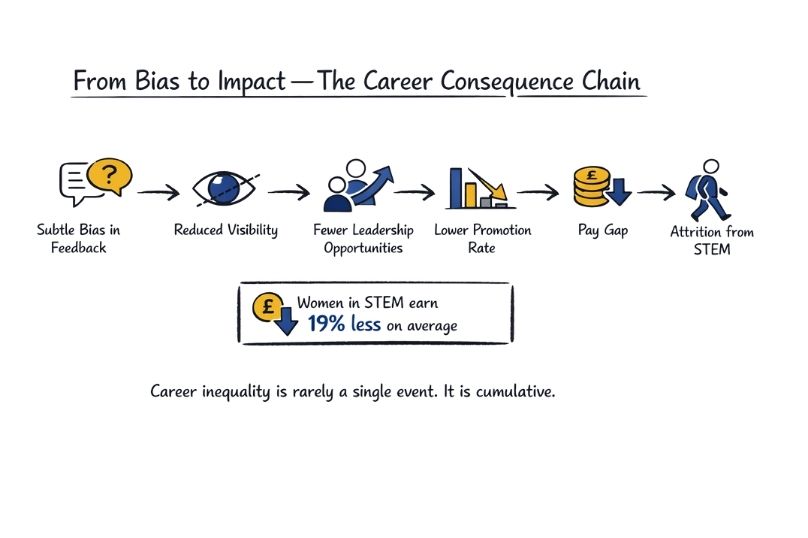
When you notice that women are repeatedly handling these support tasks while their male colleagues lead the charge on new discoveries, you're witnessing a subtle but powerful form of discrimination. It's not about a single project; it’s about a pattern that stifles growth, limits visibility, and closes doors to future leadership roles. This imbalance can have a huge impact on your confidence and mental wellbeing, a topic we explore further in our article on how mindset drives success in STEM.
Coded Language in Performance Reviews
Another place discrimination loves to hide is in the language of performance reviews. It’s amazing how the exact same behaviours can be described in completely different ways, depending on who is being evaluated.
Think about these common examples of coded language:
- Assertiveness in a man is praised as "demonstrating leadership" or being a "go-getter."
- The same assertiveness in a woman is criticised as being "abrasive," "bossy," or "not a team player."
- A quiet male colleague is often seen as "thoughtful" or "strategic."
- A quiet female colleague, on the other hand, is labelled "lacking confidence" or "not showing initiative."
This kind of double standard has a direct impact on promotions and pay rises. It crafts a narrative that holds women back for exhibiting the very traits that help men get ahead, reinforcing stereotypes that have no place in a modern workplace.
Ageism Disguised as Innovation
Ageism is another pervasive problem, especially in tech-heavy fields obsessed with "new" talent. Experienced, older engineers can find themselves sidelined, with their decades of expertise casually dismissed as outdated.
They might be overlooked for training on new software, with managers assuming they "won't be able to keep up." This often culminates in them being managed out of the business, replaced by younger, less-expensive hires. This isn't just a trend in one country; it's a global issue. For example, a recent survey in the UK revealed that a staggering 32% of workers have experienced ageism, making it the most common form of workplace prejudice reported there.
Recognising these patterns is an act of empowerment. When you can connect these subtle, everyday scenarios to the systemic barriers they represent, you move from feeling isolated to understanding the bigger picture. You are no longer just dealing with a difficult manager; you are identifying a form of discrimination.
What to Do if You Think You’re Facing Discrimination
Realising you might be experiencing discrimination at work can leave you feeling isolated and unsure of what to do next. It’s a tough situation, but remember: you have rights and you have options.
Taking a deep breath and following a clear, measured approach is the best way to regain control and decide on your next move. This isn't legal advice, but rather a practical guide to help you navigate the process, starting with the most critical first step.
Step 1: Start a Detailed, Private Log
Before you do anything else, start writing things down. Your memory can fade, but a written record is powerful, objective evidence.
Create a confidential log on a personal device—never a work computer—and document every single incident. This record will become the backbone of any complaint you make.
Make sure each entry includes:
- Date and Time: Pinpoint when it happened.
- What Was Said or Done: Be factual. Use direct quotes if you can remember them.
- Who Was There: Note everyone involved, including any witnesses.
- Location: Was it in a meeting, over Slack, or in the hallway?
- The Impact on You: Briefly mention how it made you feel or affected your work.
A one-off comment can sometimes be brushed aside, but a detailed log showing a pattern of behaviour is much harder to ignore. It builds a clear, undeniable picture of what you’ve been experiencing.
Step 2: Know Your Company's Rules
Next, it's time to do some digging into your company's official policies. Understanding the internal process is key to making sure you follow the correct steps, which strengthens your position.
Look for documents like:
- Anti-Discrimination & Harassment Policy: This will define what your employer considers unacceptable.
- Grievance Procedure: This is your instruction manual. It explains exactly how to raise a formal complaint.
- Employee Handbook or Code of Conduct: This gives you a sense of the company's stated values and expectations.
By following the official channels, you demonstrate that you’ve acted in good faith and given your employer a chance to resolve the issue internally.
Dealing with this can be incredibly draining. It's important to find healthy strategies for dealing with workplace anxiety as you navigate this stressful process.
Step 3: Find Support and Make a Formal Report
You don’t have to do this alone. Reach out to a trusted mentor, a senior colleague, or even a friend outside of work. Talking it through can bring a fresh perspective and give you the emotional boost you need.
When you feel ready, it’s time to make a formal report. Follow the steps outlined in the grievance procedure, which usually means putting your complaint in writing to HR or your line manager.
Stick to the facts. Your goal is to present a clear, professional account of your experiences, using the detailed log you've been keeping as your guide. This isn't just about sharing how you feel; it's about providing a factual report that requires a formal response.
Step 4: Look for Help Outside Your Company
What if the internal process doesn't work? Or worse, what if you face backlash for speaking up (victimisation)? If that happens, it's time to seek external help.
Most countries have government agencies or non-profit organisations set up to handle these situations:
- In the United Kingdom, you can get free, impartial advice from Acas (the Advisory, Conciliation and Arbitration Service).
- In the United States, the Equal Employment Opportunity Commission (EEOC) is the federal body that investigates claims of discrimination.
- Many other nations have similar human rights commissions, workplace tribunals, or ombudsman services that can provide guidance.
These organisations can explain your legal rights and guide you through the next steps, which could include mediation or filing a formal claim.
To help you keep track, here’s a simple checklist of the steps you can take.
Action Plan If You Experience Discrimination
| Step | Key Action | Why It Is Important |
|---|---|---|
| 1. Document | Keep a detailed, private log of every incident on a personal device. | Creates a factual timeline and provides concrete evidence of patterns. |
| 2. Research | Find and read your company's anti-discrimination and grievance policies. | Ensures you follow the correct internal procedures, strengthening your case. |
| 3. Seek Support | Talk to a trusted mentor, colleague, or friend. | Provides emotional support and an objective perspective. |
| 4. Report Internally | Submit a formal, written complaint to HR or the designated manager. | Officially notifies your employer and obligates them to take action. |
| 5. Seek External Advice | Contact your national human rights commission or equivalent body (e.g., Acas in the UK, EEOC in the US). | Gives you access to expert, impartial advice on your legal rights and options. |
| 6. Consider Legal Action | If unresolved, speak with an employment solicitor or lawyer. | A last resort if internal processes fail and you need to pursue a legal claim. |
Standing up to discrimination at work takes real courage, but having a clear plan makes the entire process feel more manageable and puts the power back in your hands.
How Employers Can Build a Truly Inclusive Workplace
Creating a genuinely inclusive workplace takes more than a shiny anti-discrimination policy. Think of that policy as the blueprint for a house, it's essential, but it’s the daily work of building, wiring, and finishing that turns it into a safe and welcoming home. For leaders who are serious about change, it's time to move beyond just having the rules on paper and start embedding them into the company's DNA.
An inclusive culture is one where every single employee feels they can speak up, pitch a wild idea, or flag a concern without looking over their shoulder. That kind of trust doesn't just appear out of thin air. It’s built, decision by decision, by leaders who actively weave fairness into everything they do—from who gets hired and promoted to how projects are assigned and feedback is delivered.
Go Beyond Basic Policies
A policy tucked away in a handbook is practically useless. To effectively tackle discrimination in a workplace, organisations have to bring those words to life through tangible, everyday actions that people can actually see and feel.
It starts with training that sticks. Forget the once-a-year, box-ticking slideshow. Real, impactful training happens regularly and throws people into real-world scenarios. It should equip managers and their teams to spot the subtle biases in a meeting, know how to step in respectfully, and handle those tricky, uncomfortable conversations with confidence.
Building an inclusive culture is an ongoing process, not a one-time project. It requires continuous effort, open dialogue, and a willingness to examine and dismantle the systemic barriers that hold people back.
To cultivate this kind of environment, employers need to focus on a few key areas that go way beyond simple compliance and start a real cultural shift. If you're new to these concepts, you can get grounded in the basics with our guide on the definition of culture and diversity.
Create Robust and Accessible Reporting Systems
Let's be blunt: people won't report problems if they don't trust the system or fear it'll backfire on them. Having just one official, intimidating channel simply won't cut it. Instead, companies need to offer multiple, confidential, and easy-to-access ways for employees to raise a red flag.
Consider setting up a few different options, such as:
- Anonymous reporting hotlines, often managed by an impartial third party.
- Designated and specially trained ombudspersons who can provide neutral, confidential advice.
- Simple, clearly marked reporting tools built right into the company's intranet.
The whole point is to make speaking up as safe and straightforward as possible. And when someone does come forward, the investigation that follows has to be transparent, unbiased, and swift. Keeping the person informed shows their courage was valued and their concerns are being taken seriously.
Foster True Psychological Safety
At the end of the day, your strongest defence against discrimination is a culture of genuine psychological safety. This is an environment where people feel safe enough to take social risks—like admitting they've made a mistake, asking a "stupid" question, or respectfully challenging the consensus.
Leaders are the primary architects of this safety. They can build it by:
- Modelling vulnerability by openly admitting their own errors and uncertainties.
- Actively seeking out opinions from the quieter people in the room, not just the loudest.
- Reacting to tough feedback with curiosity and gratitude, not defensiveness.
When people feel truly safe, they are far more likely to call out a microaggression they witness, question a biased decision in a hiring meeting, or stand up for a colleague. This isn't just about dodging legal bullets; it’s about creating a workplace that attracts the best talent, sparks real innovation, and builds a foundation for long-term success.
Frequently Asked Questions About Workplace Discrimination
It's tough to know what to do when you feel you're being treated unfairly at work. This section tackles some of the most common questions we hear, giving you clear, practical answers to help you navigate these tricky situations.
What’s the Difference Between Direct and Indirect Discrimination?
Think of direct discrimination as being deliberately treated worse because of who you are. It’s when someone makes a decision about you based on a protected characteristic, like your gender, race, or a disability.
A blatant example would be a manager telling you, "We don't give client-facing roles to women returning from maternity leave." It's an obvious, targeted action.
Indirect discrimination, on the other hand, is much sneakier. It’s when a company has a policy or rule that seems fair on the surface but ends up putting people with a certain protected characteristic at a clear disadvantage.
Imagine a company insists that all senior promotions require 10 years of uninterrupted service. While this applies to everyone, it would likely penalise women who have taken career breaks for childcare far more than their male colleagues. The policy itself isn't explicitly discriminatory, but its effect is.
How Do You Prove Discrimination When There Are No Witnesses?
This is a really common problem. Often, these things happen behind closed doors. Without a witness, proving it can feel like your word against theirs, but strong evidence isn't just about having someone else in the room.
The key is to build a clear picture over time. A one-off comment can be brushed aside as a "misunderstanding," but a consistent pattern of behaviour is much harder to ignore.
Your best defence is to become a meticulous record-keeper. Here’s how you can build your case:
- Keep a Private Log: Start a confidential diary of every incident. Note the date, time, location, who was involved, and exactly what was said or done. Crucially, also write down how it made you feel and the impact it had on your work.
- Save Everything: Archive emails, Slack messages, performance reviews, and project feedback. Are you getting glowing praise in your one-to-ones but then a mysteriously negative written review? That inconsistency is evidence.
- Look for Patterns: Pay attention to who gets the exciting projects, the training opportunities, or the promotions. If you notice that you and others from a similar background are consistently passed over, that data tells a powerful story.
What if My Manager Is the One Discriminating Against Me?
This is an incredibly stressful and daunting situation, but you absolutely have options. The goal is to sidestep the person causing the issue and go through a formal, safe channel.
Your first step should be to discreetly check your company's employee handbook or intranet. Look for the grievance or harassment policy. Most companies have a clear process for what to do when your direct line manager is the problem.
Typically, you’ll need to report it to one of these people:
- Human Resources (HR): HR should be your first port of call. They are trained to handle these complaints confidentially and professionally.
- Your Manager's Boss: If you feel comfortable, you can escalate the issue to a more senior, trusted leader in your department.
- An Ethics or Compliance Officer: Larger companies often have a designated person or department for handling sensitive complaints impartially.