
Closing gender gaps in STEM is often framed as a question of access to education, technical skills, and representation. These factors are important, but they do not operate in isolation. Confidence and mental wellbeing are key drivers that determine whether women are able to enter, remain, and progress within STEM fields over time.
Without confidence, opportunities are less likely to be pursued. Without mental wellbeing, progress becomes difficult to sustain. Together, these factors shape how women experience STEM environments, how they respond to challenge, and whether they are able to translate skills into long-term participation and leadership.
Understanding confidence and mental wellbeing as drivers rather than outcomes reframes how gender gaps in STEM should be addressed. It shifts the focus from asking why women leave, to examining the conditions required for women to stay and thrive.
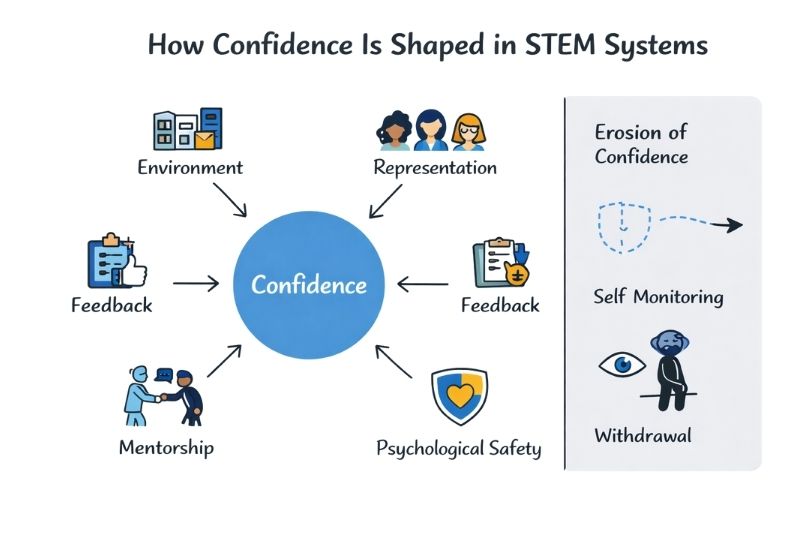
Confidence is shaped by systems, not personalities
Confidence is frequently treated as an individual trait. In reality, it is largely shaped by context. It grows in environments where people are supported, where learning is encouraged, and where not knowing something is treated as part of the process rather than a failure.
For many women in STEM, confidence is repeatedly tested. Being the only woman in a room, having expertise questioned, carrying disproportionate emotional labour, or navigating subtle and overt bias all take a cumulative toll. Over time, this can lead to self-monitoring, hesitation, and withdrawal, not because of lack of ability, but because the environment makes sustained confidence difficult.
These experiences are not incidental. They are structural, and they influence who feels entitled to take up space, apply for opportunities, or step into leadership.
Mental wellbeing directly affects participation and performance
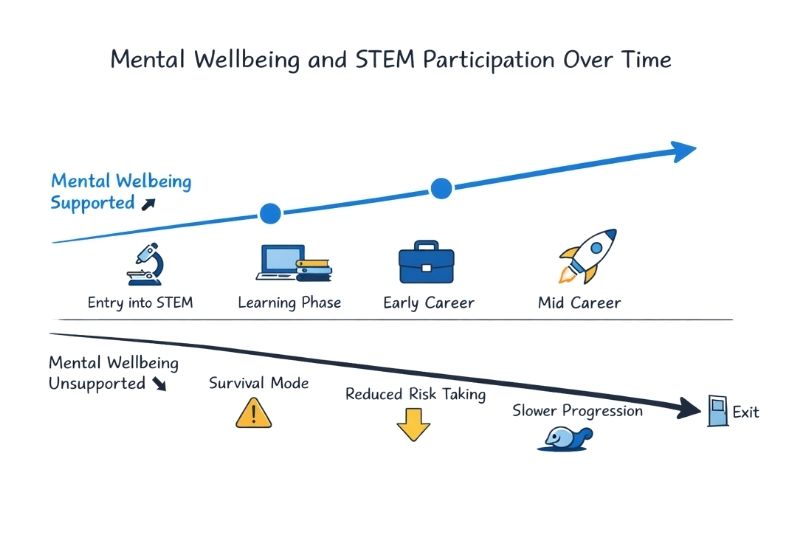
Mental wellbeing is still too often positioned as separate from professional development. In STEM fields that demand concentration, problem solving, and continuous learning, this separation is misleading.
Stress, burnout, unresolved trauma, and chronic instability reduce cognitive capacity and emotional resilience. When individuals are operating in survival mode, long-term career planning becomes secondary to immediate coping. Persistence becomes harder, risk taking decreases, and confidence erodes.
For women managing multiple pressures, including caregiving responsibilities, economic insecurity, or unsafe environments, the impact is amplified. The issue is not motivation. It is capacity.
Why skills focused solutions fall short on their own
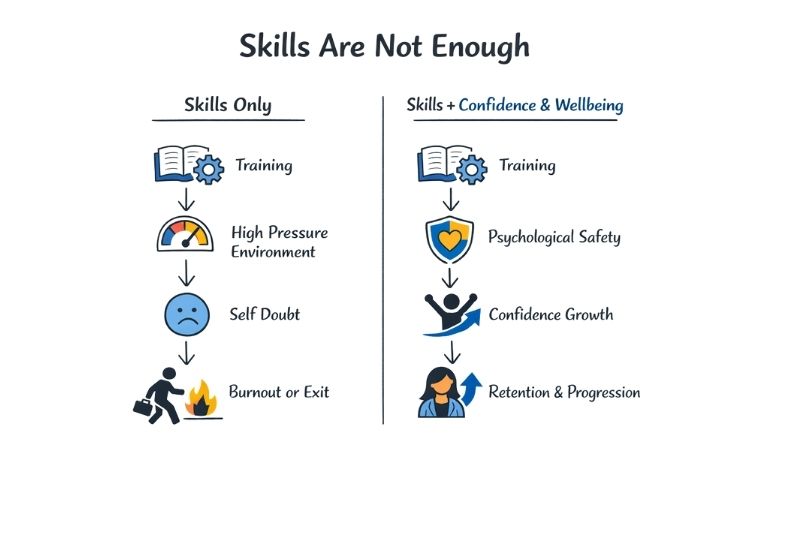
Many efforts to close gender gaps in STEM centre on skills acquisition. Training programmes, bootcamps, and upskilling initiatives play an important role, but skills alone are not sufficient.
When women are expected to acquire complex technical skills while suppressing stress, fear, or self doubt, progress slows and attrition rises. When learning environments lack psychological safety, confidence contracts rather than expands.
Programmes that successfully retain women in STEM consistently recognise this. They embed support structures that acknowledge the realities learners are navigating and treat confidence and wellbeing as foundational conditions for learning.
Creating conditions where confidence can grow
Confidence grows where people are allowed to be learners rather than constant performers. This includes:
- Permission to ask questions without judgement
- Normalising rest and recovery as part of sustainable performance
- Mentorship that affirms potential while offering practical guidance
- Community where women see others like themselves progressing
- Explicit recognition of the external pressures many women carry
These conditions are particularly important for women entering STEM later in life, returning after career breaks, or navigating pathways that were not designed with them in mind.
The global context matters
Gender gaps in STEM exist worldwide, but the pressures shaping confidence and mental wellbeing vary significantly by context. In some communities, women face additional barriers including early responsibility for family care, limited access to education, cultural expectations about gender roles, and economic instability.
In these settings, the psychological load of pursuing a STEM pathway can be as significant as the technical challenge itself. Addressing confidence and mental wellbeing therefore requires approaches that are culturally aware, community grounded, and responsive to lived realities.
Spotlight on confidence, wellbeing, and access in practice
These themes were explored in depth in a recent Women in STEM Network Spotlight featuring Jael Owino, founder and chairperson of Tech Bloom Africa.
In conversation with Carolina Endara, Jael spoke about her journey into technology and the work she leads with girls, teenage mothers, and women in underserved communities in Kenya.
A central insight from her talk was that mental wellbeing cannot be separated from learning. Her programmes intentionally integrate emotional check ins, self awareness conversations, and space to discuss daily challenges alongside technical training. This approach recognises that women cannot fully engage with STEM education while simultaneously managing trauma, instability, or chronic stress without support.
Jael also emphasised access, not only to technology and resources, but to belief. Belief that women belong in technical spaces. Belief that they are capable of shaping technology rather than simply consuming it. Belief that ambition does not need to be constrained by what is considered normal or acceptable within a given community.
Her experience offers a grounded example of how confidence and mental wellbeing can be deliberately built into STEM pathways, particularly where barriers are steep and resources limited.
Women in STEM Spotlights
Jael’s session forms part of the Women in STEM Network’s Spotlight series, which highlights real journeys and practical insights from women across STEM disciplines and regions.
The series is designed to complement strategy and policy discussions with lived experience, showing how confidence, wellbeing, mentorship, and community operate in practice.
Access to the Spotlight series is available to members here:
https://womeninstemnetwork.com/stem-spotlights-women-who-inspire/
Closing reflection
Closing gender gaps in STEM is not solely a matter of skills or representation. It is a question of whether women are supported to develop confidence, maintain mental wellbeing, and sustain momentum over time.
When confidence is actively cultivated and mental wellbeing is treated as integral to performance, participation becomes more durable and leadership more attainable. If we want women to remain and thrive in STEM, the systems surrounding them must recognise the human conditions that make technical excellence possible.