
The phrase women in STEM refers to the presence, work, and unique experiences of women in the fields of Science, Technology, Engineering, and Mathematics. But it’s far more than a simple acronym. It represents a global movement aimed at achieving gender equity, sparking innovation, and ensuring that the sectors shaping our future reflect the diversity of the world they serve.
Defining Women In STEM Beyond The Acronym
At its heart, understanding what ‘women in STEM’ really means requires us to acknowledge a persistent global imbalance. Historically, these critical fields have been dominated by men, which has created cultural and systemic barriers that limit opportunities for women worldwide. As a result, the term has evolved from a statistical observation into a powerful symbol of collective efforts to dismantle these barriers.
This movement isn’t just about hitting quotas or balancing numbers on a spreadsheet. It’s about recognising a fundamental truth that diverse perspectives are essential for genuine progress. When women are equally represented, the solutions, products, and research that emerge are more complete, thoughtful, and effective for all of society. This idea is relevant across all stages, from students exploring potential career paths to established organisations aiming to foster stronger, more creative teams.
The Broader Implications
To really get to grips with this concept, we need to look at its impact from all angles. It spans a range of interconnected issues affecting individuals, industries, and national economies.
Some of the key facets of the women in STEM movement include:
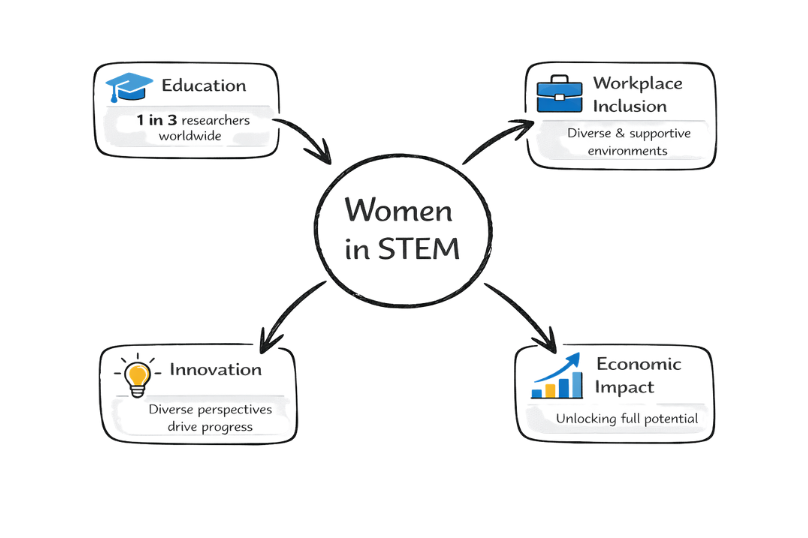
- Educational Equity: Making sure girls and young women have access to and feel encouraged to pursue STEM subjects from their earliest school days.
- Workplace Inclusion: Building professional environments where women can truly thrive, free from bias and with clear opportunities for career advancement.
- Economic Empowerment: Unlocking the huge economic potential of half the population by opening doors to high-growth, well-paid careers.
- Driving Innovation: Bringing in a diversity of thought to solve complex problems and avoid the blind spots that inevitably come from homogenous teams.
Advocating for more women in STEM is ultimately about strengthening science, technology, and engineering, by recognizing that excluding half the population deprives these fields of vital talent and perspectives.
This understanding is the bedrock for exploring the topic in more detail. Before we can analyse historical contributions or current statistics, we have to appreciate that ‘women in STEM’ is a dynamic, multifaceted concept. The journey towards equity isn't just about individual ambition. It demands systemic change, a theme you can explore further in our guide to women in STEM leadership. By setting this scene, we can begin to examine why this movement is so crucial for global progress.
Historical Pioneers Of Women in STEM
To really understand what it means to be a woman in STEM today, we have to look back. This isn't a new story. It's a long, often unrecognised, history of brilliant minds who laid the foundations for the technology and science we rely on now. Women have always been at the forefront of progress, even when their work was ignored or credited to male colleagues.
This journey started long before anyone had even thought of the acronym 'STEM'. Take Ada Lovelace, an English mathematician working back in the 1840s. She did more than just crunch numbers; she saw a future where machines could create music and art, not just solve equations. In doing so, she wrote what many consider the world's first computer program, establishing the core concepts of modern computing.
Redefining The Boundaries Of Science
Throughout history, you’ll find women who completely shattered the scientific thinking of their era. Marie Curie, a physicist and chemist of Polish and French origin, conducted groundbreaking research on radioactivity in the early 20th century. Her discoveries transformed our understanding of physics and earned her Nobel Prizes in two different fields: Physics and Chemistry. This remarkable achievement remains unmatched.
Centuries filled with contributions like these reveal a powerful legacy of intellect and resilience. For anyone inspired to dig deeper into these stories, it’s always valuable to improve research skills to better navigate historical records and academic archives. A commitment to learning helps uncover the true scale of women's impact on science.
From Hidden Figures To Global Icons
Even in more recent times, the work of women was vital to some of humanity's greatest achievements. Katherine Johnson, an African American mathematician, was one of the key figures who performed the incredibly complex orbital calculations for NASA's first crewed spaceflights in the United States. Her precision and expertise were what kept the astronauts safe and made the Apollo missions a success.
These pioneers weren't just exceptions to the rule; they were proof of a vast, untapped potential. Their stories show that female ingenuity in STEM isn't a modern trend but a persistent force that has shaped our world, often against immense societal odds.
The legacy of these trailblazers provides a powerful foundation for today's generation. It shows that aspiring women in STEM aren't starting from scratch but are carrying on a long and brilliant tradition. By celebrating these historical figures, we honour their work and inspire the innovators of tomorrow. You can learn more about the platforms celebrating today's leaders by exploring current awards for women in STEM. Their stories are a testament to enduring curiosity and intellectual courage.
Global Statistics And Regional Snapshots
To really understand where women stand in STEM today, we have to look at the numbers. While the goal of gender equity is universal, the reality on the ground varies enormously from one region to another. The data reveals a story of both progress and persistent gaps.
On a global scale, women make up roughly one-third of the world's researchers, according to UNESCO. But this single figure doesn't tell the whole story. Dig a little deeper, and you see stark contrasts. In Central Asia, for instance, women are nearly at parity, accounting for 48.1% of researchers. This is a world away from South and West Asia, where the number plummets to just 23.9%. These figures are showing just how much local culture and economic conditions can shape a woman's career path.
The historical contributions of women in these fields have always been significant, even when they weren't widely recognised. Pioneers like Ada Lovelace, Marie Curie, and Katherine Johnson didn't just participate; they fundamentally shaped their disciplines, and their legacy reminds us of the long-standing impact women have had in STEM.
A Comparative Look Across Key Regions
A closer look at specific countries and regions reveals a more nuanced picture of progress and persistent challenges. Pathways toward equal representation differ widely, and successful strategies in one context may inform efforts elsewhere.
Take the UK, for example. In 2023, women constituted 26% of the core STEM workforce. While this is certainly progress, the pace of change is slow, highlighting a persistent gap. More detailed insights can be found in the official WISE Campaign workforce data. In the United States, women make up nearly half of the total workforce but hold less than a third of STEM jobs, with significant underrepresentation in fields such as engineering and computer science.
The global data paints a clear picture: while progress has been made, no country has fully closed the gender gap in STEM. The disparities show that context matters immensely, from educational policies in Europe to cultural norms in the Middle East.
A Global Snapshot Of Women In STEM Workforce
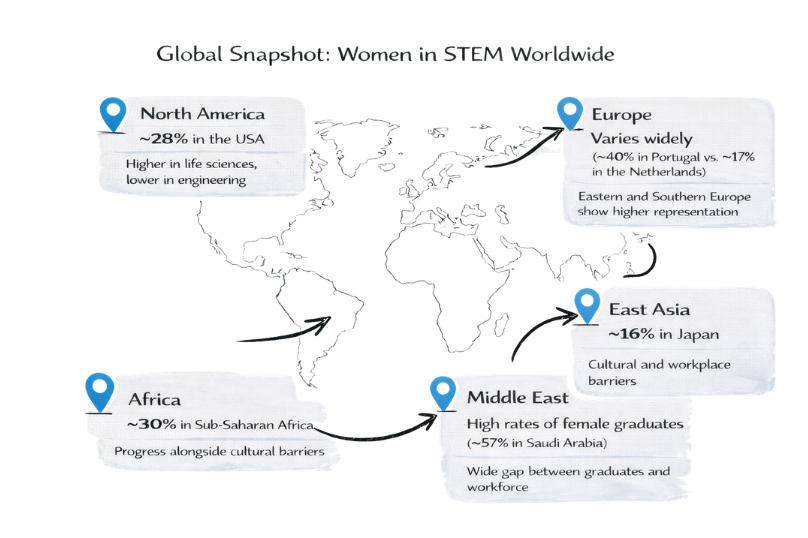
The table below provides the percentage of women in the STEM workforce across different countries and regions, highlighting global disparities and progress.
| Region/Country | Percentage of STEM Workforce Who Are Women | Key Data Point or Trend |
|---|---|---|
| North America | ~28% in the USA | Women are well-represented in health and biological sciences but remain significantly underrepresented in engineering and computer science. |
| Europe | Varies widely (e.g., ~40% in Portugal vs. ~17% in the Netherlands) | Eastern and Southern European countries often show higher representation rates than their Western European counterparts. |
| East Asia | ~16% in Japan | Cultural expectations and demanding work environments present significant barriers to retention and advancement. |
| Middle East | High rates of female graduates (~57% in Saudi Arabia) | A notable gap exists between the high number of female STEM graduates and their actual participation in the workforce. |
| Africa | ~30% in Sub-Saharan Africa | Representation varies, with progress in some nations but ongoing challenges related to access to education and cultural barriers. |
These figures are more than just statistics; they are benchmarks that help us measure the scale of the challenge ahead. They show us where we need to focus our efforts and also allow us to celebrate the regions that are making real strides.
For a deeper dive into these trends, our comprehensive 2025 statistics provide further analysis of what these figures mean for the future.
Understanding The Barriers Women Face in STEM
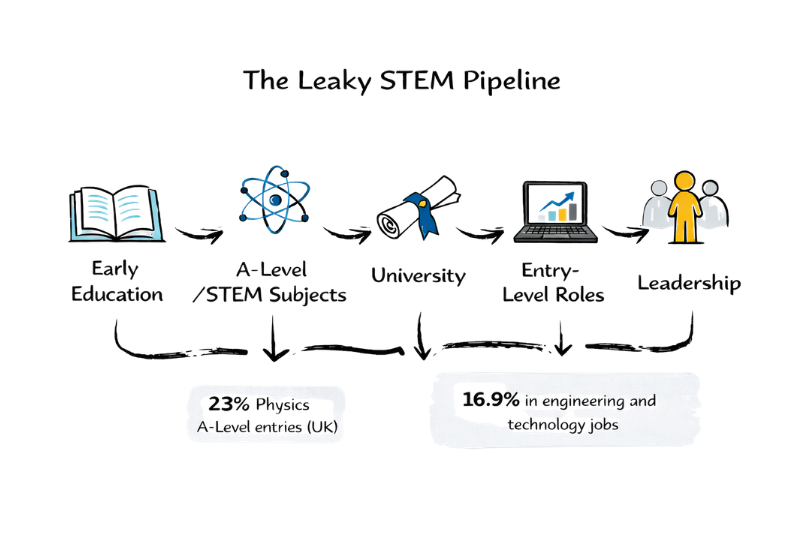
While the statistics paint a clear picture, they don't always capture the lived experiences behind the numbers. To truly grasp the situation, we need to look at what many call the ‘leaky pipeline’. This is a powerful analogy for how women, despite entering STEM education and careers in promising numbers, tend to leave these fields at various stages.
This isn't a story about a lack of ambition or talent; rather, the opposite is true. The departure is often a direct result of systemic hurdles and cultural friction. Obstacles range from persistent pay inequality and rigid working arrangements to workplace cultures that feel isolating, if not outright unwelcoming. For many women, simply staying the course demands an extraordinary level of resilience. You can find a more detailed look into this issue in our article on why women leave STEM careers.
Systemic And Cultural Challenges
The challenges women face are rarely isolated incidents. They are symptoms of a much broader pattern of systemic bias. It can subtly influence everything from hiring and promotions to who gets assigned to high-profile projects. Ingrained stereotypes about gender and technical aptitude can put women at a disadvantage before they even get a foot in the door.
This problem is particularly acute in certain disciplines. In the UK, for instance, women hold just 16.9% of jobs in engineering and technology. The roots of this imbalance run deep, starting much earlier in the educational journey. Girls represent only 23% of physics A-Level entries, showing that the pipeline leaks well before the workforce. For more on these trends, you can discover more insights about women in UK tech on WomenTech Network.
These early disparities don't just disappear; they compound over time, creating a cumulative disadvantage that makes it incredibly difficult to achieve parity in traditionally male-dominated fields.
The Impact Of Workplace Environment
Beyond the big-picture issues, the day-to-day atmosphere of a workplace is a deciding factor for many women. It's often the small, subtle, yet persistent behaviours, known as microaggressions, that can gradually erode a person's confidence and foster a deep sense of not belonging.
These everyday workplace hurdles often include:
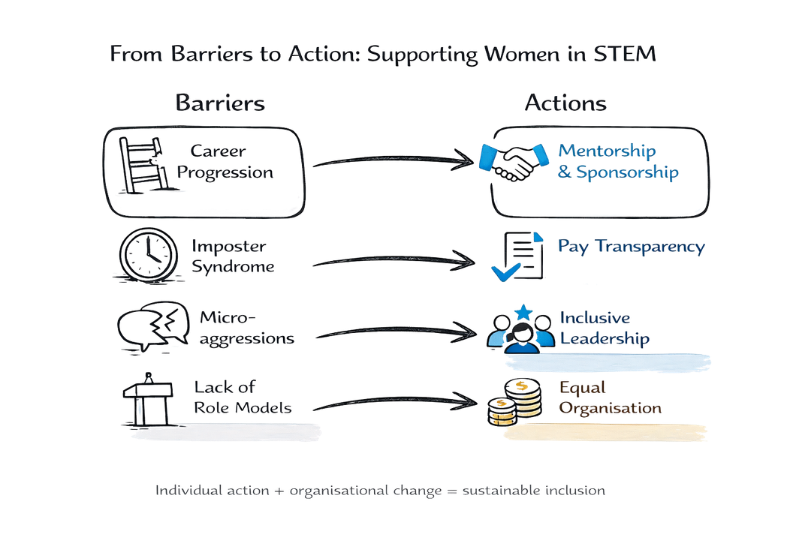
- Imposter Syndrome: A persistent internal feeling of being a fraud, which is frequently made worse by an external environment that constantly questions one's expertise or right to be there.
- Microaggressions: Seemingly small comments or actions that carry a hostile or dismissive message. This could be anything from being consistently talked over in meetings to having your technical contributions automatically credited to a male colleague.
- Lack of Role Models: When you look up the leadership ladder and see no one who looks like you, it becomes incredibly difficult to envision a long-term future for yourself in that organisation.
These elements combine to create a challenging climate where women must expend extra energy simply navigating their environment, let alone excelling in their roles. Addressing these barriers is not just about fairness, retaining valuable talent.
By mapping out these obstacles, we can validate the experiences of those who have faced them and offer a practical guide for allies and leaders who want to drive change. A truly inclusive environment requires active efforts to dismantle persistent barriers.
Why Diverse Teams Drive Better Innovation
Bringing more women into STEM isn't just about fairness or meeting ethical goals. It’s a powerful driver of business progress. The real ‘women in STEM’ meaning is found in the quality of innovation itself, as diverse teams consistently build more creative and robust solutions.
On the other hand, teams where every member has the same idea often suffer from huge blind spots. This can lead to flawed designs and, in some cases, genuinely dangerous outcomes.
Look at the history of car safety systems for a classic, real-world example. For decades, crash test dummies were modelled almost exclusively on the average male body. This glaring oversight meant that seatbelts and airbags weren’t properly optimised for women, leaving them at a higher risk of serious injury in a crash. It’s a costly lesson that teaches a vital principle: when the team building a solution doesn't reflect the people who will use it, the final product will fall short.
Broadening Perspectives To Prevent Flawed Designs
It makes sense that a team made up of people with different backgrounds is better at spotting potential problems. Each person brings a unique lens to a challenge, which helps uncover the hidden assumptions that a more uniform group would miss. This collective creativity is what sparks true innovation.
Think about the early days of voice recognition technology. Many of the first systems were notoriously bad at understanding higher-pitched voices. Why? Because they were primarily trained by male engineers. A team with greater gender diversity would almost certainly have caught this critical flaw much earlier, creating an inclusive product from day one.
Diversity is not just about fairness; it is a strategic advantage. It prevents costly oversights, and ultimately leads to products that serve the entire market, not just a fraction of it.
The Business Case For Inclusion
The advantages of diversity aren't only theoretical, but also show up on the bottom line. Companies that build truly inclusive cultures perform better and gain a significant competitive edge. This happens because diverse teams are simply better at their jobs.
- Understanding Customer Needs: They have a deeper, more intuitive grasp of a varied customer base, which helps them design products for much broader users.
- Enhancing Problem-Solving: Bringing a wider range of viewpoints to the table leads to more thorough analysis and more imaginative solutions to complex problems.
- Attracting Top Talent: People want to work in inclusive environments. These workplaces naturally attract the best candidates, creating a powerful cycle of talent and innovation.
Ultimately, championing women in STEM is an investment in a more inventive and prosperous future. It shifts the conversation from social responsibility to strategic necessity, cementing inclusion as a cornerstone of sustainable growth and meaningful progress.
Practical Steps For Supporting Women in STEM
Understanding the barriers women face is a critical first step, but real change only happens when we move from awareness to action. This means putting concrete strategies in place so that women in STEM don't just survive, but truly thrive. These steps are accessible to individuals, universities, and companies of any size.
The bedrock of any effective support system is often built on mentorship and sponsorship programmes. Mentorship offers guidance and a safe space to navigate career challenges. Sponsorship, on the other hand, is more active; it's about senior leaders advocating for a woman’s advancement and making sure she gets a seat at the table for high-stakes projects.
Fostering An Inclusive Culture
A genuinely inclusive workplace is about more than just having the right policies on paper. It's about nurturing a day-to-day culture of respect and belonging, where people feel psychologically safe enough to contribute their best ideas. It starts with simply listening to the experiences of female colleagues.
Here are a few practical ways to build this kind of culture:
- Establish Clear Mentorship Pathways: Connecting seasoned professionals with those just starting out is a powerful way to share institutional knowledge and build supportive networks. This is a core focus at The Women in STEM Network, where we help combat the isolation many women feel by making these vital connections.
- Promote Sponsorship: Encourage senior leaders to go beyond mentoring. They should actively sponsor high-potential women, using their influence to open doors to opportunities that can define a career.
- Flexible Working Policies: A rigid, one-size-fits-all work structure can be a huge obstacle. Offering genuine flexibility helps professionals manage their careers alongside personal responsibilities. We explore this in more detail in our guide on overcoming work-life balance challenges for women in STEM.
Creating Equitable Systems
An inclusive culture can only flourish if it's supported by fair systems. This means taking a hard look at how you hire, promote, and pay people to root out hidden biases and ensure transparency. The goal is to build an ecosystem where a woman's success is determined by her talent and contributions.
Conducting regular pay equity audits is a non-negotiable step. So is using skills-based assessments during hiring and providing mandatory unconscious bias training for everyone on staff. These systemic changes are crucial. For those interested in how technology is shaping educational pathways, it’s worth exploring learning environments with VR and AI.
Lasting change depends on everyone, from junior employees to CEOs, taking part in creating a more equitable and forward-thinking STEM community.
Frequently Asked Questions
Which STEM Fields Are Growing The Fastest For Women?
Right now, we're seeing huge demand and incredible growth in fields like data science, artificial intelligence, cybersecurity, and biotechnology. These areas are particularly interesting because they thrive on interdisciplinary thinking, which opens up new pathways for women entering the field.
Because these disciplines are relatively new, some of the older, more ingrained gender biases haven't had a chance to take root. As a result, many organisations are actively looking for the diverse perspectives women bring to drive real innovation.
How Can Men Act As Genuine Allies For Women In STEM?
Being a strong ally starts with listening. Men can make a significant impact by paying attention to the experiences of their female colleagues, making sure their voices are heard and credited in meetings, and championing them during promotion reviews.
Other powerful actions include calling out biased language when you hear it, offering mentorship, and, crucially, sponsoring women for high-visibility projects. These steps don't just help individuals; they contribute to a fundamentally more inclusive and successful workplace for all.
I'm Thinking About Changing Careers Into STEM. Where Do I Begin?
A great first step is to figure out which area of STEM genuinely sparks your interest and perhaps even connects with skills you already have. From there, you can look into online courses, coding bootcamps, or university conversion programmes to get the technical grounding you need.
Networking is absolutely key, joining organisations like The Women in STEM Network allows you to connect with professionals who have made similar transitions and can offer invaluable guidance, mentorship, and support on your journey.