
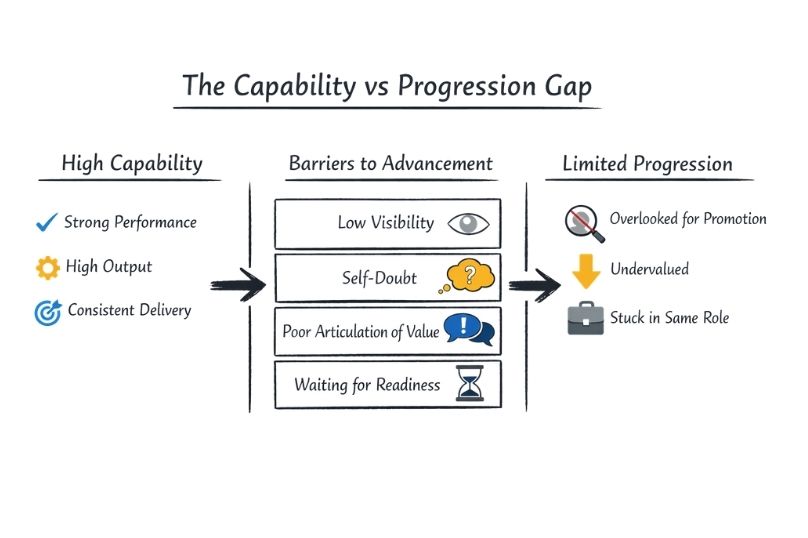
There is a persistent and often misunderstood gap in the workplace. It is not a gap in capability, nor in ambition, nor even in work ethic. It is a gap between what women are capable of doing and how far they actually progress in their careers.
Across science, technology, engineering, and mathematics, there are women delivering exceptional work, consistently performing at a high level, and demonstrating clear potential for leadership. Yet many remain in roles that do not reflect their ability. They are overlooked, under-recognised, or simply not considered for the next step.
This is not because they are not ready.
More often, it is because they are not positioned.
Understanding this distinction is critical. Career progression is not solely determined by competence. It is shaped by visibility, perception, communication, and confidence. When these elements are not aligned, even highly capable individuals can find themselves stagnating.
This article explores the underlying reasons why this happens and, more importantly, what can be done to change it.
The Capability–Visibility Disconnect
One of the most consistent patterns seen across organisations is the assumption that good work will naturally lead to progression. The belief is that if you perform well, opportunities will follow.
In practice, this is rarely the case.
Work that is not visible cannot be evaluated at the level required for progression. Leaders make decisions based on what they see, what they hear, and what they understand about an individual’s impact. If your contribution is not clearly articulated or recognised, it becomes difficult for others to advocate for your advancement.
This creates a disconnect. Women who are highly capable continue to deliver, but without actively shaping how their work is perceived, they remain in the same position.
Progression requires more than delivery. It requires positioning.
The Role of Self-Doubt
Self-doubt is often discussed as a personal challenge, but in professional environments it has structural implications.
When individuals underestimate their own readiness, they are less likely to:
- Apply for roles that stretch them
- Put themselves forward for opportunities
- Speak with authority about their achievements
Over time, this affects how others perceive them. Hesitation can be interpreted as lack of confidence, and lack of confidence can be interpreted as lack of readiness.
Importantly, self-doubt is not an indicator of ability. In many cases, it coexists with high competence. The issue is not the presence of doubt, but the absence of mechanisms to counter it.
The most effective way to address this is through evidence. Clear, specific examples of impact provide a foundation for confidence. Without this, self-assessment becomes subjective and often inaccurate.
Clarity as a Strategic Advantage
A recurring issue in career progression is the inability to clearly articulate value.
Many professionals struggle to answer simple but critical questions:
- What am I particularly good at?
- What do I consistently deliver?
- Where do I create the most impact?
Without clarity, communication becomes vague. This makes it difficult for managers, stakeholders, or interview panels to understand what differentiates you.
Clarity is not just a reflective exercise. It is a strategic tool.
When you can define your strengths precisely, you are better positioned to:
- Align yourself with opportunities
- Communicate your contribution effectively
- Demonstrate relevance for more senior roles
Clarity reduces ambiguity, and in professional environments, reduced ambiguity increases opportunity.
The Misunderstanding Around “Selling Yourself”
The concept of “selling yourself” is often met with resistance. It can feel uncomfortable, particularly in environments where modesty is valued or where self-promotion is perceived negatively.
However, there is a distinction between exaggeration and articulation.
Selling yourself, in a professional context, is about ensuring that your work is understood in terms of outcomes and impact. It is not about inflating achievements. It is about communicating them clearly.
This shift is significant. Moving from describing tasks to describing results changes how your contribution is perceived.
For example:
- “I managed a project” becomes “I delivered a project that reduced processing time by 30%”
- “I supported the team” becomes “I enabled the team to meet a critical deadline under significant constraints”
This level of specificity allows others to see your value without needing to infer it.
Readiness and the Myth of Being “100% Ready”
A common barrier to progression is the belief that one must be fully ready before taking the next step.
In reality, progression often requires stepping into roles that are not entirely comfortable.
Waiting for complete readiness can result in missed opportunities. Many roles are designed to stretch capability, not simply reflect it.
The key is not to eliminate uncertainty, but to manage it. This involves:
- Recognising transferable skills
- Demonstrating the ability to learn quickly
- Showing initiative and adaptability
Readiness is often assessed externally based on potential, not internally based on certainty.
Communication Under Pressure
Even when individuals have the capability and experience, communication can become a barrier, particularly in high-pressure situations such as interviews or presentations.
Common challenges include:
- Over-explaining when nervous
- Losing structure in responses
- Failing to highlight key achievements
These issues are not due to lack of knowledge. They are due to lack of structure.
Structured communication frameworks can significantly improve clarity. Approaches such as Situation, Task, Action, Result or variations of this model allow individuals to present their experience in a concise and impactful way.
This is particularly important in interviews, where time is limited and clarity is essential.
Managing Setbacks Without Losing Momentum
Career progression is not linear. Setbacks are inevitable, whether in the form of rejected applications, missed promotions, or challenging feedback.
The critical factor is interpretation.
When setbacks are viewed as confirmation of limitation, they reduce confidence and slow progression. When they are viewed as part of the development process, they provide information that can be used to improve positioning.
This requires a shift in perspective. Instead of asking “Why did this happen to me?” the more useful question is “What can I adjust to improve the outcome next time?”
Resilience, in this context, is not simply persistence. It is the ability to adapt.
From Capability to Progression
The themes outlined above point to a broader conclusion.
Many women in STEM are not held back by lack of ability. They are held back by a combination of:
- Limited visibility
- Unclear articulation of value
- Hesitation driven by self-doubt
- Misalignment between readiness and action
These are not fixed barriers. They can be addressed through deliberate, structured changes in how individuals position themselves.
This is where targeted support becomes critical.
Learning from Experience: Sheila Starr
These challenges were explored in depth in a recent Women in STEM Network session led by Sheila Starr, an experienced coach and trainer specialising in career progression.
Sheila’s perspective is grounded in her own career journey. She left school at 16 with limited formal qualifications and went on to build a successful 34-year career across multiple industries, progressing into senior leadership roles.
This experience provides a practical understanding of the barriers individuals face, particularly those related to confidence, perception, and progression.
Through her work, Sheila supports women in:
- Building confidence based on evidence
- Identifying and articulating their strengths
- Navigating career progression strategically
- Overcoming limiting beliefs that affect performance
Her approach is direct, pragmatic, and focused on outcomes.
Access the Full Session On Demand
For those who want to explore these strategies in more detail, the full webinar is available to members of the Women in STEM Network.
The session provides a structured framework for:
- Overcoming self-doubt
- Building confidence
- Communicating value effectively
- Demonstrating readiness for progression
- Managing setbacks constructively
If you were unable to attend the live session, you can access the full recording here: womeninstemnetwork.com/on-demand-workshops-for-women/
Moving Forward
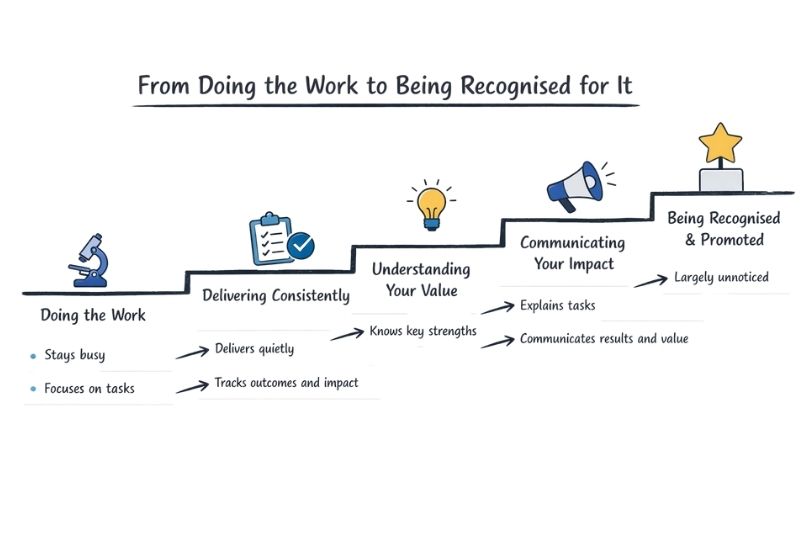
Career progression is not simply a function of time or effort. It is the result of how effectively capability is translated into visibility, communication, and perceived value.
For women in STEM, the challenge is not a lack of potential. It is ensuring that potential is recognised and acted upon.
This requires a shift from passive progression to active positioning.
It involves understanding not only how to do the work, but how to ensure that the right people see, understand, and value that work.
With the right strategies, this is entirely achievable.
The question is not whether the capability exists. In many cases, it already does.
The question is whether it is being communicated in a way that enables progression.