
In STEM careers, progress is often assumed to follow a logical path. Strong academic performance leads to good positions, good positions lead to promotion, and promotion leads to leadership. This model appears rational, particularly in disciplines built on evidence, data, and measurable output. However, real careers rarely develop in such a predictable way. Many highly capable professionals find themselves hesitating at key moments, delaying applications, declining opportunities, or questioning their readiness even when their experience clearly supports advancement.
External barriers are frequently discussed, and they are real. Organisational culture, bias, limited opportunities, workload pressures, and competing responsibilities all influence career trajectories. However, there is another factor that receives less attention. Internal narratives can shape professional behaviour just as strongly as external conditions. These internal patterns are often described as inner saboteurs. They do not appear as dramatic self-doubt. More often they appear as reasonable caution, high standards, or the desire to be fully prepared. Their effect, however, is restriction.
The Nature of Inner Saboteurs
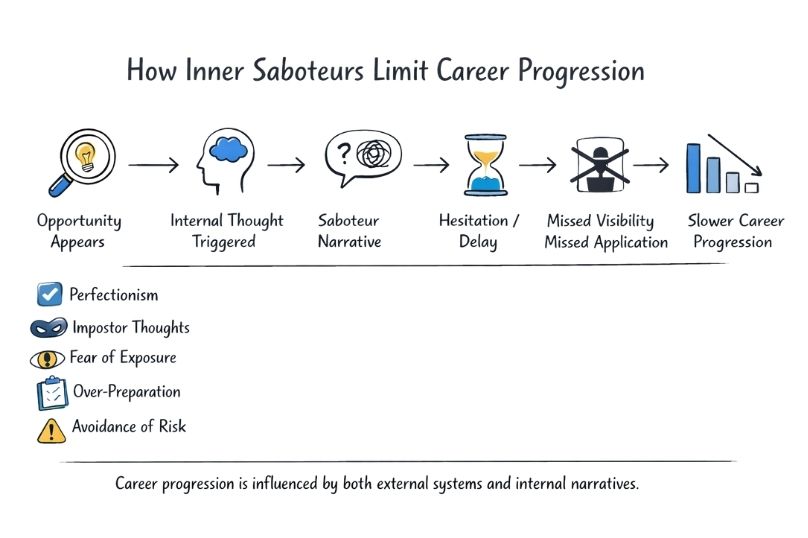
Inner saboteurs are recurring thoughts that limit action at the moment when action would support growth. They may sound like careful planning or responsible decision-making, but they tend to appear at predictable points. Applying for promotion, presenting research, accepting leadership responsibility, negotiating salary, or moving into a more visible role often triggers these internal responses.
Typical examples include believing that one more qualification is required before applying for a role, assuming that others have overestimated ability, deciding to wait until confidence feels complete, or avoiding visibility to reduce the risk of criticism. These thoughts do not usually feel irrational. In fact, they often sound sensible, especially in fields where accuracy and precision matter. The difficulty is that the same pattern repeats even when evidence shows readiness.
In high-performance environments such as science, engineering, medicine, and technology, these patterns can become deeply embedded. Training in these disciplines emphasises careful analysis, attention to detail, and the avoidance of error. These qualities are essential in professional work, but when they are turned inward they can create unrealistic expectations of certainty. When every decision must feel completely safe before action is taken, opportunities pass.
High Standards and Self-Doubt in STEM
Many professionals in STEM hold themselves to extremely high standards. This is often part of what makes them successful. The ability to notice small errors, question assumptions, and seek stronger evidence is central to scientific thinking. However, the same mindset can lead to constant self-evaluation. Instead of recognising competence, the mind focuses on what is missing.
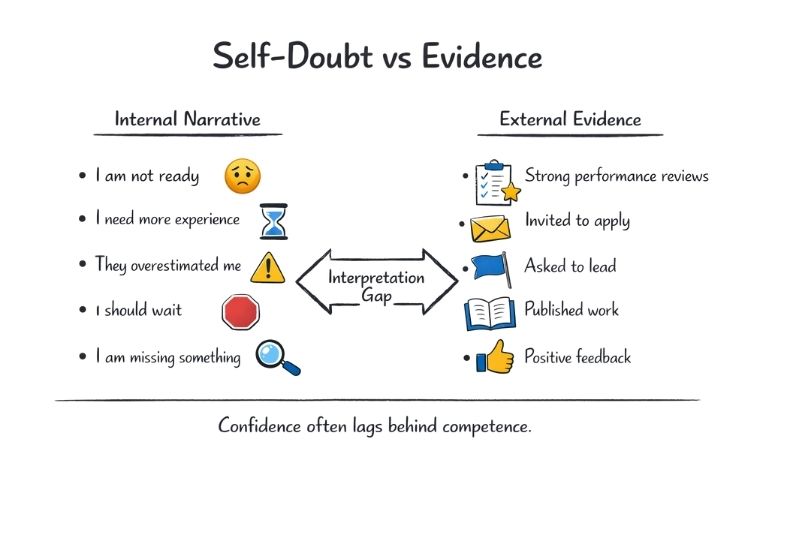
This can create a persistent sense of not being ready. Someone may meet every formal requirement for promotion but still feel that more experience is needed. Another person may receive positive feedback from colleagues and supervisors but assume that others have misunderstood their level of expertise. A third may hesitate to present work publicly because it does not feel perfect, even though the standard is already high.
This pattern is closely related to impostor thoughts, which are common among high-achieving professionals. When individuals know their field well, they are also aware of how much there is to learn. Awareness of complexity can make competence feel smaller than it is. Instead of seeing ability, the mind sees gaps.
The result is a paradox. The more capable a person becomes, the more likely they are to question their readiness. External recognition increases, while internal confidence does not always follow at the same pace.
Perfectionism as a Barrier to Progress
Perfectionism is often described as a positive trait, particularly in technical fields. Accuracy matters, careful work matters, and mistakes can have serious consequences. However, perfectionism becomes a barrier when it prevents participation. Many careers require action before everything feels complete. Promotion, leadership, and visibility often involve learning in real time.
Waiting until every detail feels fully resolved can mean waiting indefinitely. Professionals who hold themselves to extremely high internal standards may decide not to apply for roles unless they meet every listed requirement. They may avoid speaking at conferences unless they feel entirely confident. They may delay submitting work until it feels flawless.
In practice, most people who progress in their careers do so while still developing. Growth rarely happens after certainty. It happens during uncertainty. Recognising this does not mean lowering standards. It means accepting that professional development continues at every level.
The Fear of Exposure
Another common saboteur is the fear of being exposed as less capable than others believe. This can occur even in individuals with strong records of achievement. Being invited to apply for a role, asked to lead a project, or encouraged to speak publicly may trigger the thought that others have overestimated ability.
This reaction is understandable. Moving into a new role always involves unfamiliar territory. No one begins a position knowing everything it requires. However, the saboteur interprets this normal uncertainty as proof of inadequacy. Instead of seeing opportunity, the mind sees risk.
Fear of exposure can lead to avoidance. A professional may decide not to apply for a role because they do not meet every criterion. They may decline an invitation to present because they feel others know more. They may remain in a position where they feel comfortable rather than move into one where learning will be required.
Over time, this pattern limits progression. The individual remains capable, but their career does not reflect their potential.
Where These Beliefs Come From
Internal narratives do not appear without reason. Many develop in response to earlier experiences. A competitive academic environment, a highly critical supervisor, or a workplace where mistakes were punished harshly can create habits of caution. These habits may have been useful at the time. They may have helped someone succeed in a demanding setting. However, patterns that were once protective can become restrictive when circumstances change.
Understanding the origin of a belief can make it easier to adjust. When a thought is treated as an absolute truth, behaviour remains fixed. When the thought is recognised as a response to a particular environment, it becomes possible to question whether it still applies.
For example, someone who learned to rely only on themselves in a difficult workplace may continue to avoid asking for support even when working in a collaborative team. Another person who was criticised early in their career may continue to expect negative judgement even when feedback is positive. Recognising these patterns does not remove caution entirely, but it allows caution to be proportionate rather than automatic.
Emotional Intelligence and Self-Awareness
Emotional intelligence plays a significant role in managing these patterns. Emotional intelligence is sometimes misunderstood as being expressive or naturally confident. In professional settings, it is better understood as awareness of internal reactions and the ability to respond deliberately rather than automatically.
When a saboteur thought appears, emotional intelligence allows a pause between the thought and the action. Instead of immediately believing the thought, the individual can examine it. Is this based on evidence, or is it based on habit? Is the situation genuinely risky, or does it simply feel uncomfortable?
Developing this kind of awareness takes practice. It does not remove doubt, but it prevents doubt from controlling behaviour. A professional may still feel uncertain before giving a presentation, leading a project, or applying for promotion. The difference is that the uncertainty does not stop the action.
Emotional intelligence also influences how people interact with colleagues, teams, and organisations. Leadership requires not only technical skill but also the ability to manage relationships, communicate clearly, and respond constructively to pressure. Professionals who develop these abilities often find that confidence grows through experience rather than appearing in advance.
The Role of Environment and Community
Internal narratives tend to become stronger when professionals feel isolated. When someone believes they are the only person experiencing doubt, the doubt appears more convincing. In reality, many high-achieving individuals experience similar thoughts at similar stages of their careers.
Talking with peers can change perception. Hearing that others have hesitated before applying for promotion, questioned their readiness, or felt uncertain in leadership roles makes these experiences easier to understand. What seemed like a personal weakness becomes recognisable as a common professional pattern.
Professional networks can therefore play an important role in career development. They provide a space where experiences can be discussed openly, without the pressure to appear completely confident. They also allow members to see examples of progression that do not follow a perfect path. This makes it easier to accept that uncertainty and growth often occur together.
At the same time, it is important to recognise that internal barriers do not replace structural barriers. Organisational culture, bias, unequal access to opportunity, and workload expectations all influence careers. Addressing internal narratives does not remove these challenges. However, when opportunities do exist, reducing self-limiting beliefs makes it more likely that they will be taken.
Moving From Self-Doubt to Self-Trust
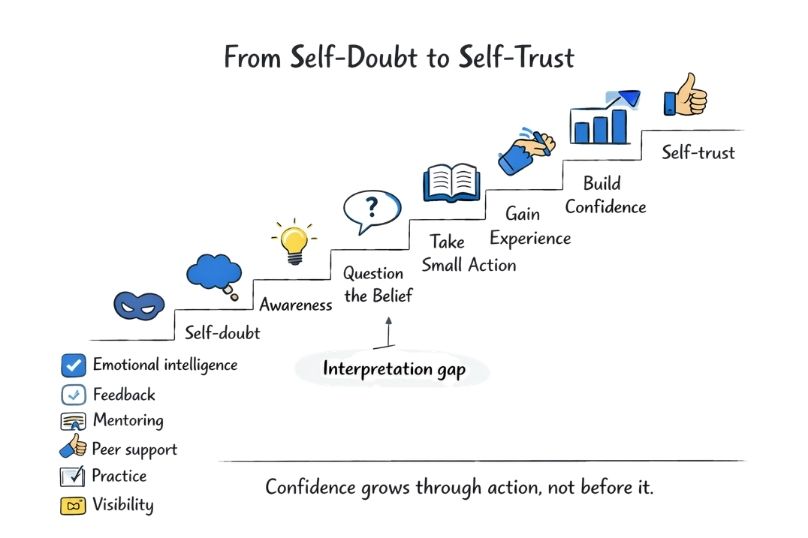
A useful distinction is the difference between self-certainty and self-trust. Self-certainty means feeling completely confident before acting. Self-trust means acting based on evidence, even when confidence is not complete.
In scientific work, decisions are often made without perfect information. Experiments proceed without knowing the outcome. Research proposals are submitted without knowing whether they will be funded. The same principle applies to careers. Waiting for complete certainty before taking a step forward can prevent progress.
Self-trust develops through experience. Each time a professional takes a step that feels uncomfortable but turns out well, confidence increases slightly. Over time, these experiences build a more accurate sense of ability. The goal is not to remove uncertainty, but to prevent uncertainty from stopping growth.
Learning to Challenge Internal Narratives
Changing internal patterns requires deliberate effort. The first step is recognising the narrative. The second is examining the evidence. If the belief is that one is not ready, what facts support that belief, and what facts contradict it? Feedback from supervisors, previous achievements, and objective qualifications often provide a different picture.
The next step is behavioural. Small actions can interrupt long-standing patterns. Applying for a role, volunteering to present, or accepting responsibility for a project can shift perception. Experience provides information that internal thoughts cannot.
Over time, repeated action changes expectation. Situations that once felt risky begin to feel normal. Confidence becomes the result of experience rather than the condition required before experience.
Workshop Recording for Members
These themes were explored in depth in a recent Women in STEM Network workshop focused on recognising and overcoming inner saboteurs. The session examined why high-achieving professionals often hesitate at critical moments, how internal narratives develop, and how they can be replaced with more accurate and constructive ways of thinking. The discussion also covered impostor thoughts, perfectionism, emotional intelligence, and the challenge of stepping into leadership roles without waiting for complete confidence.
The webinar recording is available to Women in STEM Network members.
Members can watch the full session here
https://womeninstemnetwork.com/on-demand-workshops-for-women/
About the Speaker
Dr Mary Jean Vignone, MBA, PhD, is an executive coach, consultant, and educator with leadership experience across large and mid-size organisations in both the for-profit and nonprofit sectors. Her work focuses on leadership development, emotional intelligence, and helping professionals move forward without being limited by internal narratives.
She holds an MBA from California Lutheran University and a Master of Arts and PhD in Organisational Development from Fielding Graduate University, where she serves as adjunct faculty. She also hosts the Fearless Femme: Propel Your Career Virtual Summit.
Connect with Dr Mary Jean Vignone
- LinkedIn: https://www.linkedin.com/in/maryjeanvignone/
- Podcast: https://drmjheartwired.com/podcast
- Website: https://www.drmjheartwired.com/