
You join a new STEM project on Monday. By Wednesday, everyone is still smiling in meetings, but small signs of strain have started to show.
The data scientist uses terms the clinical lead does not recognise. The engineer assumes the product manager will make the final call. A recent graduate stays quiet because she does not want to sound inexperienced. A woman returning after a career break wonders whether asking basic process questions will damage her credibility. The team looks calm from the outside, but nobody is fully sure how work will happen.
That is normal.
Most new team leaders think strong teams appear because smart people have been hired. In practice, smart teams still need time, structure, and honest conversation. That is why tuckman team stages remain so useful. The model gives you a language for what teams go through when they move from awkward beginnings to steady delivery.
For women in STEM, this matters even more. Team dynamics are never only about tasks. They are also about confidence, visibility, belonging, and whether disagreement is treated as leadership or labelled as a problem. Used well, Tuckman’s model can help you lead with more fairness, not just more efficiency.
Navigating the Chaos of a New STEM Project
A new interdisciplinary STEM team often begins with good intentions and low clarity.
You may have a software engineer, a lab scientist, a project sponsor, a data analyst, and an external partner all sitting in the same kickoff call. Everyone is polite. Nobody wants to look difficult. People nod at deadlines they privately doubt. Roles sound clear until work starts.
I see this often with new team leaders. They mistake early harmony for alignment. Then the first setback arrives. A design decision stalls. A senior voice dominates discussion. Someone misses a handover. Suddenly the team feels harder to manage than expected.
That pattern is exactly why Bruce Tuckman’s model still helps. Bruce Tuckman first proposed the model in 1965, and a fifth stage, adjourning, was added in 1977. A 2007 study cited in UK leadership resources found that only 2% of teams progress through all five stages successfully, which shows how difficult sustained team development can be in practice (Institute of Project Management).
Why this model still matters
Tuckman did not create a rigid formula. He offered a map.
When you know the map, you stop asking, “Why is my team suddenly so tense?” and start asking, “Which stage are we in, and what does the team need from me now?”
That shift matters for a new leader. It replaces self-doubt with observation.
A team in tension is not always failing. Often, it is developing.
In STEM settings, teams rarely stay simple. Projects involve specialist language, risk, deadlines, and cross-functional decisions. That means team friction is not unusual. It is part of the work.
What new leaders usually get wrong
Three mistakes appear again and again:
- Mistaking politeness for trust. A quiet kickoff meeting may mean uncertainty, not confidence.
- Treating conflict as a sign of poor fit. Many disagreements are really signs that roles and methods are still unsettled.
- Trying to fix everything alone. Good team leadership is less about having every answer and more about helping the group work clearly.
If you are feeling that pressure now, this may help: how women in STEM can manage uncertainty with confidence.
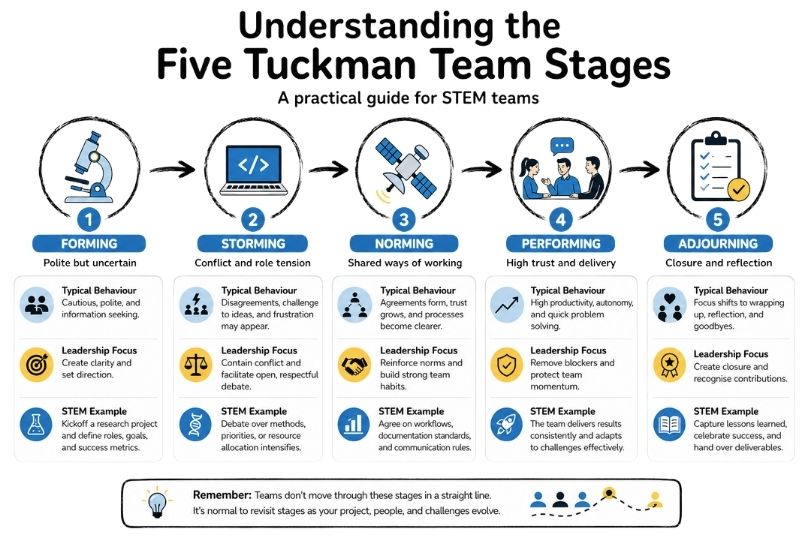
The Five Tuckman Team Stages Explained
A new cross-functional STEM project often begins with good intentions and quiet uncertainty. The software engineer is trying to read the room. The lab lead is protecting quality. The project manager wants momentum. A woman returning from maternity leave or another career break may be doing all of that while also wondering whether she has to prove herself twice.
Tuckman's model helps because it gives that messy experience a sequence. A team rarely becomes effective in one clean jump. It develops in stages, much like a satellite programme that moves from concept, to testing, to launch, to closeout.
Forming
Forming is the setup phase. People are courteous, careful, and alert to status.
On a new satellite project, team members first need to answer simple questions before they can do difficult work well. Who owns the technical decision. Who signs off risk. How should concerns be raised. What counts as a delay versus a necessary quality check.
That is why early productivity is usually lower. UK HR benchmarks from Bitesize Learning describe Forming as a stage where teams often operate well below full output, because members are still establishing roles, expectations, and psychological safety (Bitesize Learning).
For women in STEM, this stage can carry extra weight. In male-dominated teams, people may read confidence through style rather than substance. A leader who speaks cautiously may be judged as uncertain. A specialist returning after time away may know the work perfectly well but still need space to rebuild visibility and trust.
In practice, Forming often sounds like this:
- “Whose timeline are we working to?”
- “Should I challenge this in the meeting or offline?”
- “Are we optimising for speed, compliance, or accuracy?”
A good leader keeps this stage clear and structured. If you want a practical companion to that work, this guide to leadership in STEM is useful.
Storming
Storming begins when the team stops being polite and starts being real.
The satellite team now has live trade-offs to handle. Engineering wants more testing. Finance wants firmer dates. Data wants cleaner inputs. Regulatory wants evidence that the process will stand up to scrutiny. Conflict appears because the work has become concrete.
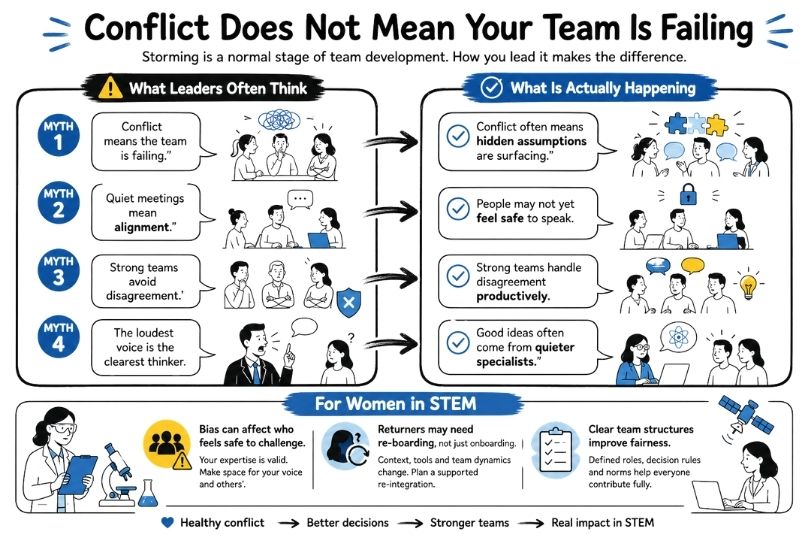
Storming is often misread, especially by first-time leaders. It can feel like failure when it is often a sign that hidden assumptions are finally on the table. In STEM teams, those assumptions usually sit around authority, technical standards, pace, ownership, and whose judgement carries weight.
This stage can be particularly hard for women. If you already feel pressure to avoid being labelled difficult, you may hold back a valid challenge. If you are one of few women in the room, a normal disagreement can feel more exposed. UK women in STEM regularly report bias, exclusion, and pressure to prove competence in ways their male peers do not, which can make healthy conflict harder to practise consistently.
A biotech example shows the pattern clearly. The lab lead wants another replication cycle before reporting results. The commercial lead wants the update now. The analyst is caught in the middle because both requests are reasonable within their own logic. That is not a personality issue. It is a team process issue.
Leaders sometimes rush to smooth this over. A better response is to make the disagreement usable. Name the decision. Name the criteria. Name who decides.
If your team needs help with fixing collaboration and teamwork, focus first on reducing ambiguity before you try to improve harmony.
Later in the lifecycle, this video gives a useful visual summary of the model:
Norming
Norming starts when the team no longer has to renegotiate everything.
The satellite project has agreed how to run meetings, how to escalate risk, how to document decisions, and what good handover looks like. People still disagree, but they do not treat each disagreement as a threat to status or belonging.
You can usually see Norming in small operational signals:
- meetings start producing decisions, not just discussion
- handovers contain enough context to be useful
- quieter specialists speak earlier
- conflict stays on the work, not the person
- team members stop copying the leader into every issue
This stage matters a great deal for women in STEM because predictable ways of working reduce the effect of informal power. Clear decision logs, written responsibilities, and shared review routines make it harder for confidence theatre to outrank evidence. They also help colleagues returning from career breaks re-enter the flow of work without having to decode unwritten rules.
Norming is where a team builds habits it can rely on under pressure. In a research group, that might be a weekly risk review. In engineering, it might be a definition of done that everyone uses. In data science, it might be a documented process for model review and sign-off.
These routines are not glamorous. They are what allow trust to become practical.
Performing
Performing is the stage leaders hope for, but it does not mean the team has become effortless. It means the team spends less energy on coordination and more on delivery.
In a performing satellite team, people know when to decide, when to ask, and when to escalate. The leader still sets direction, but the group does not stall without constant approval. Problems get solved before they spread.
You can recognise Performing by what happens under strain. An engineering issue is surfaced early. A clinical update is translated into a format other functions can use. Someone spots a gap and steps in without waiting for permission. The team protects standards and pace at the same time.
For women leaders, this stage often brings a subtle shift. You are no longer proving you belong in every interaction. You are shaping conditions where the whole team can do stronger work. That includes making sure strong performance does not depend on one loud voice, one over-functioning manager, or one person doing invisible coordination labour.
High-performing teams still need attention. A new hire, a funding change, a missed deadline, or a return to office policy can unsettle trust quickly.
Adjourning
Adjourning is the closeout stage. The satellite launches, the funding cycle ends, or the project is handed over.
Teams often underrate this part because delivery feels like the finish line. In reality, closeout affects morale, learning, and whether people want to work together again.
Adjourning includes:
- documenting lessons properly
- recognising contributions clearly
- handing over work without gaps
- ending temporary roles with respect
- making space for the emotional side of completion
That last point matters. A team that has worked through tension, uncertainty, and deadline pressure together often feels a real sense of loss when the project ends.
For women in STEM, thoughtful closeout also protects visibility. If contribution records are vague, credit often follows confidence and hierarchy rather than actual effort. Strong leaders prevent that by naming who solved what, who carried risk, and who enabled the team to succeed.
How to Diagnose and Guide Your Team's Stage
It is Monday morning. Your cross-functional STEM team has the right people on paper, but the signals feel off. The senior developer answers every question before anyone else can speak. A returning engineer stays quiet even though she has solved this kind of problem before. Two researchers keep reopening a decision that seemed settled last week.
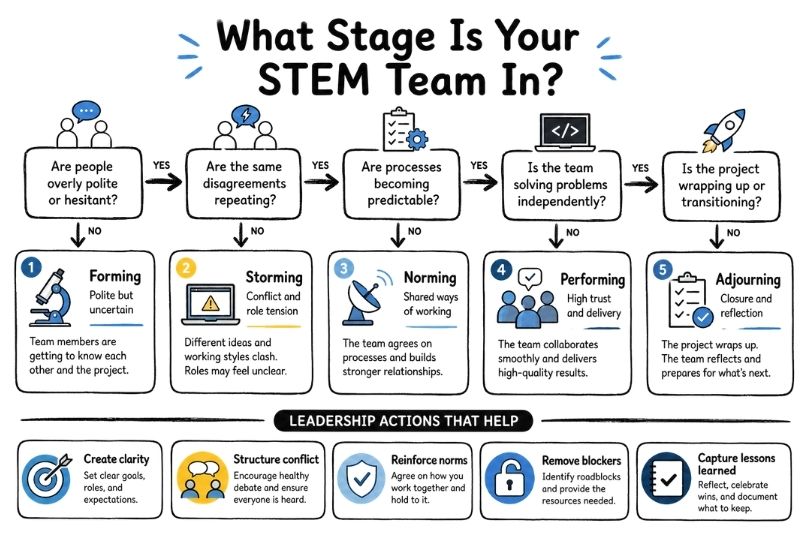
That mix usually does not mean the team is failing. It means the team is in a stage, and your job is to diagnose the stage before you choose the intervention.
A helpful way to read this is to watch the team like a lab instrument panel. Do not focus only on what people say. Check where the pressure is building, where energy is lost, and where the team can regulate itself without your constant input.
Three places reveal a lot quickly. Meetings. Messages. Decisions.
What to look for in real time
Each Tuckman stage leaves a pattern.
Forming often sounds careful and slightly formal. People ask sensible questions, but they wait for permission. Storming sounds repetitive. The same disagreement returns through different topics, often dressed up as a debate about process, quality, or urgency. Norming sounds more economical because the team has shared language. Performing sounds focused, with less theatre and more progress.
For women leading STEM teams, there is another layer to notice. A quiet room is not always a calm room. In male-dominated environments, some women will test whether disagreement is safe before they use their full expertise. That matters if someone is returning from maternity leave, a career break, or a stretch outside hands-on technical work. Hesitation can be read as uncertainty when it is risk assessment.
Fast diagnosis cues
- Meeting tone. Are people polite, defensive, constructive, or sharply task-focused?
- Decision flow. Does every question rise to you, or can the team settle routine issues without escalation?
- Conflict style. Are concerns left unsaid, made personal, or handled in a structured way?
- Communication rhythm. Do updates arrive late, in bursts, or in a steady pattern people trust?
- Ownership. Are people guarding their patch, or are they helping across boundaries?
If your team keeps having the same argument in different forms, you are usually dealing with Storming.
Team Stage Diagnostic and Action Checklist
| Stage | Common Team Behaviours | Leader's Primary Role | Actionable Intervention (STEM Example) |
|---|---|---|---|
| Forming | Polite meetings, unclear responsibilities, dependence on leader | Create clarity | In a software team, write a one-page decision guide covering product, technical, and delivery ownership |
| Storming | Role disputes, repeated debates, frustration, mixed expectations | Contain conflict without suppressing it | In a biotech lab, use a structured discussion to separate scientific caution from timeline pressure |
| Norming | Better handovers, shared language, more trust, fewer repeated conflicts | Reinforce healthy norms | In a clinical research team, agree a shared data handling workflow and review it together |
| Performing | High autonomy, quick problem-solving, cross-functional support | Protect momentum | In an engineering team, remove external blockers and let specialists lead in their domain |
| Adjourning | Mixed emotions, wrap-up tasks, reduced urgency, reflection | Create closure | In a product launch team, run a retrospective and record lessons for the next project |
Stage-specific moves that help
When your team is forming
Give people enough structure to do good work before they know each other well.
A new team usually needs a plain-language purpose, named roles, shared technical definitions, and a few clear working habits in the first week. In a robotics project, software, hardware, and testing often use different assumptions about handoff timing. Write those assumptions down early. You are not being rigid. You are reducing avoidable friction.
This early structure matters even more if someone is re-entering a technical team after a break. Clear expectations lower the pressure to prove competence instantly.
When your team is storming
Storming needs containment, not panic.
A study published on ResearchGate examining Tuckman’s model in a high-stakes academic setting found support for the model’s usefulness in understanding how groups develop under pressure. In practice, that means recurring conflict is not a sign that your team is broken. It is often a sign that hidden assumptions, status differences, and unclear authority are finally becoming visible.
That distinction helps women leaders in particular. In some STEM teams, direct disagreement from a woman is judged more harshly than the same behaviour from a male colleague. If you know that risk is present, you can design the conversation instead of hoping fairness appears on its own.
Use short, disciplined interventions:
- Name the actual disagreement. “We are split on method and risk tolerance, not on effort.”
- Separate evidence from interpretation. Ask what is known, what is assumed, and what each function is worried will happen.
- Balance airtime. Ask quieter specialists to speak before the most senior or most vocal person responds.
- Assign a decision owner. Discussion without ownership keeps conflict alive.
If you need a broader view on fixing collaboration and teamwork, this guide offers useful prompts.
When your team is norming
Norming is where good intentions become repeatable habits.
Your role is to make those habits visible enough that they survive pressure. Record decisions. Confirm team agreements. Invite challenge, but do not reopen settled issues by default. Notice who still sits at the edge of the group, especially if they are newer, more junior, or returning after time away.
In a data science team, that may mean agreeing how model choices are documented so technical debate stays evidence-led. It also means watching whose ideas get credited. In UK STEM workplaces, contribution can still be judged through confidence and familiarity rather than quality. A fair leader corrects that in real time.
When your team is performing
Your team needs protection more than instruction.
Remove blockers. Keep priorities stable where you can. Watch for invisible labour. Women in STEM are often asked, formally or informally, to do the glue work of checking in, smoothing tension, and keeping coordination moving. That work helps the team, but it can also pull time away from visible technical contribution.
Useful questions at this stage include:
- What external friction is slowing us down?
- Where are we relying on goodwill instead of process?
- Who is carrying support work that is helping everyone but recognised by no one?
When your team is adjourning
Closeout affects memory, morale, and reputation.
In STEM teams, adjourning should include knowledge capture, clear recognition, reflection, and transition planning. That is especially important for women whose contributions may otherwise disappear into a vague “team effort” summary. Name what was solved, who carried risk, and who kept the work moving.
A leader with strong emotional intelligence for STEM leadership and collaboration usually handles this stage better because closure is both operational and human.
Challenges for Women Applying Tuckman's Model
You join a new engineering project on Monday. By Wednesday, you are already reading the room as carefully as the project brief. Who interrupts whom? Whose uncertainty is treated as part of learning, and whose uncertainty is read as a lack of technical depth? Tuckman’s model can still help here, but women in STEM often have to apply it while carrying extra social and professional risk.
A generic description of team development assumes people enter with similar levels of credibility and freedom to speak plainly. In many UK STEM workplaces, that assumption falls apart fast. Women may be assessing bias, testing whether challenge is safe, and deciding how visible to be before the team has even agreed how it will work.
Forming can carry extra weight
Forming often looks calm from the outside. For a woman joining a male-dominated technical team, it can feel more like joining a lab where the safety rules have not been posted yet. You are not only learning the task. You are working out whether questions will be welcomed, whether expertise will be assumed, and whether confidence will be judged differently depending on who shows it.
That is one reason silence in early meetings needs careful interpretation. A quiet team member may be reflecting, but she may also be protecting herself until she has more evidence about how the group responds to disagreement or uncertainty.
This matters even more for leaders supporting confidence under pressure. Skills such as reading group tension, naming norms early, and creating safer ways to contribute are part of neuro-emotional leadership as a strategic skill for women in STEM.
Storming does not feel equal for everyone
Storming is usually described as the stage where useful disagreement sharpens the work. In practice, the same behaviour can be rewarded in one person and penalised in another.
A male engineer who pushes back on scope may be seen as decisive. A woman raising the same concern may worry about being labelled difficult, emotional, or not collaborative enough. That changes how conflict appears. Instead of open challenge, you may see hedged language, private follow-up messages, or concerns raised only after the meeting has ended.
For a new team leader, this is the trap. You can mistake constrained participation for alignment. The project then moves ahead with unresolved technical risk because some people are editing themselves more heavily than others.
Career returners can be in a different stage from the rest of the team
Women returning after maternity leave, caring responsibilities, illness, or another career break often enter teams that are already settled. On the org chart, the team may look established. In lived experience, the returner may be starting at Forming while everyone else is operating in Norming or Performing.
That gap creates friction that Tuckman’s model does not always spell out clearly. The returner is learning current tools, decision habits, shorthand, and informal alliances at the same time. Colleagues may assume she only needs a systems refresher, when what she needs is a map of how the team works now.
A re-boarding plan helps more than standard onboarding here. Useful elements include:
- A current map of roles and technical ownership
- A glossary of project terms, acronyms, and tool changes
- A named peer for low-stakes questions
- A short explanation of how decisions are made, challenged, and recorded
- Early opportunities for visible technical contribution
Apply the model with fairness built in
Tuckman’s stages are still useful. The difference is in how you lead through them.
If you are supporting women in STEM teams, make the hidden rules visible early. Set turn-taking norms. Ask for written input before live debate if louder voices tend to dominate. Credit ideas precisely. Separate technical disagreement from tone judgments. If someone is returning after a break, treat reintegration as a team design task, not a personal confidence problem.
The model explains how teams develop. Good leadership decides whether that development is fair, and whether talented people are allowed to contribute before they have spent months proving they belong.
Leading Team Stages in Remote and Hybrid Workplaces
A new hybrid STEM project often looks calm on the surface. Cameras are on, updates are posted, deadlines are logged, and yet the team still feels harder to read than an office-based group. For a woman leading in that environment, the challenge can be sharper. Silence may be mistaken for agreement, confidence may be judged differently depending on who speaks, and a colleague returning from a career break may disappear behind a screen just when she most needs context.
Tuckman’s stages still apply online. The difference is that the clues are more digital, more delayed, and easier to misread.
In an office, you can spot uncertainty in posture, side conversations, or who stays behind after a meeting. In remote and hybrid teams, the same dynamics show up in Slack threads, delayed responses, private messages, patchy documentation, and video calls where nobody wants to be the first to speak. A team can look organised while still sitting in early-stage confusion.
What each stage looks like online
In Forming, remote teams often sound polished before they feel safe. People stay muted, contribute cautiously, and wait for explicit permission to ask basic questions. That matters in STEM settings, where women already dealing with imposter syndrome may hold back to avoid sounding underprepared.
In Storming, disagreement often shifts into channels the whole team cannot see. Technical objections arrive in side chats. Written feedback feels harsher than intended because tone is missing. In male-dominated teams, that pattern can leave women doing extra relational work to keep discussion constructive while also defending their technical judgment.
In Norming, the team begins to settle into shared habits. People know where decisions belong, how quickly to respond, and when a problem needs a live call rather than another comment thread. This stage works like a good lab protocol. Clear enough to repeat, flexible enough to handle exceptions.
In Performing, trust becomes visible through the system itself. Work is documented, blockers are surfaced early, and people can move a task forward without chasing three colleagues for hidden context. Hybrid teams do well here when information is easy to find and ownership is obvious.
Simple rituals that help
You do not need more software. You need clearer team habits.
Try these:
- Forming. Create a shared project brief, a visible ownership map, and short introductions that cover technical strengths, communication preferences, and availability.
- Storming. Bring difficult debate into a live conversation, then record the decision, rationale, and next step in writing.
- Norming. Set async rules that explain when to message, when to comment in a document, and when to escalate to a call.
- Performing. Keep work visible through tools such as Jira, Trello, Notion, or GitHub Projects so progress does not depend on who happens to be online.
- Adjourning. Run a virtual retrospective, recognise contributions clearly, and close the project properly.
One more habit helps across every stage. Rotate who speaks first in meetings. It reduces the pattern where the most senior or loudest voice sets the direction before others have had time to think.
Protecting psychological safety at distance
Distance can make uncertainty grow. A team member who is confused may stay silent for days. A returner may hesitate to ask what feels like an obvious question. A woman leading a technical discussion may be interrupted less visibly in person, but overruled more subtly in chat, where short replies can carry status as much as substance.
Your job is to make the hidden visible. State expectations plainly. Ask for written input before meetings so people who need processing time are not penalized. Check whether silence means agreement, uncertainty, or concern. If conflict keeps slipping into private channels, bring the decision process back into the open.
Good hybrid leadership also has a coaching element. The same qualities described in the characteristics of a good coach help here. Clear listening, useful questions, and feedback that builds confidence without lowering standards.
The strongest hybrid leaders pay attention to emotional signals as carefully as delivery milestones. That is why understanding why neuro-emotional leadership is a strategic skill for women in STEM is highly practical.
Common Tuckman Model Questions for STEM Leaders
A new project lead joins your research team halfway through a grant. Meetings that felt settled now feel careful again. People start checking who has authority to decide, who needs more context, and whose ideas carry weight. If you are a woman leading in STEM, that shift can feel personal, especially in teams where you are already managing assumptions about credibility, seniority, or technical authority.
That is why Tuckman’s model works best as a map. It helps you recognise patterns without treating normal team change as failure.
What happens when team membership changes halfway through a project
Teams usually need a reset.
A new member changes more than headcount. They change trust, routines, and the quiet rules people follow without naming them. In a lab, that might mean fresh questions about data ownership or handover standards. In engineering, it might mean revisiting who signs off technical risk. In a university department, it may surface old tensions about workload or authorship.
For women returning from maternity leave, caring leave, or another career break, this stage can be sharper. The team may assume they can "slot back in" quickly, even though tools, priorities, and informal alliances may have shifted. That gap between visible role and invisible context often feeds imposter syndrome.
A practical response helps:
- Clarify responsibilities again
- Restate team norms in plain language
- Assign a trusted colleague for context sharing
- Address unresolved friction before it hardens into resentment
Is it always bad to return to Storming
No. Returning to Storming is often a normal response to change.
Tuckman’s original framework, outlined on the West Chester University overview of group development stages, describes team development as a progression leaders can observe and guide. In practice, STEM teams often revisit earlier patterns when leadership changes, deadlines tighten, or the project scope shifts.
That matters in real workplaces. A new principal investigator, engineering manager, or programme lead changes the social chemistry of the group. People test expectations again. They check what disagreement is safe, what quality looks like, and whether decisions will be centralised or shared.
For women in STEM, this phase can be tiring because ordinary team tension is sometimes filtered through bias. Direct communication may be judged more harshly. Confidence may be read as overstepping. A leader who understands the stage can respond with structure instead of self-doubt.
Does the model work differently in diverse teams
The model still applies, but the leadership work becomes more deliberate.
Diverse teams bring a wider range of technical insight, lived experience, and problem-solving habits. That is a strength. It also means leaders need clearer ways to handle disagreement, airtime, and decision-making. Without that structure, the team may confuse difference with dysfunction.
This shows up clearly in male-dominated environments. A woman software lead may notice that her suggestions gain traction only after a male colleague repeats them. A returner in a clinical research team may hesitate to challenge assumptions because she is still rebuilding confidence. A junior woman of colour may stay quiet in Storming because the social risk of being seen as difficult feels too high.
The issue is not diversity. The issue is whether the leader creates conditions where different voices can shape the work. That is why coaching skills matter. If you are refining your approach, these characteristics of a good coach are useful because strong STEM leaders ask, listen, and guide before they push for compliance.
How should a STEM leader use the model without becoming rigid
Use it to diagnose what the team needs next.
A team in Forming needs clarity. A team in Storming needs fair process. A team in Norming needs reinforcement. A team in Performing needs space and trust. A team in Adjourning needs a proper close, especially after intense delivery periods or grant-funded work.
Ask practical questions:
- Are people uncertain, or are they holding back?
- Is conflict about technical method, role boundaries, or status?
- Have we agreed norms, or are we relying on habit?
- Can the team solve problems without waiting for me?
- Have returners and new joiners been given enough context to contribute fully?
Your own behaviour matters just as much as the team’s pattern. Some leaders over-explain because they fear being judged. Some avoid conflict because they do not want to confirm stereotypes about being difficult. Some keep control too long because handing over feels risky. This is why understanding yourself is the foundation of modern leadership matters so much in practice.
What should you remember above all
Strong teams are not the teams with no friction. They are the teams that know how to work through friction without losing trust, standards, or momentum.
That is the value of Tuckman team stages. The model gives STEM leaders a practical way to read what is happening and choose a response that fits the moment. For women in STEM, it also helps name pressures that generic leadership advice often misses, including imposter syndrome, career return transitions, and the extra scrutiny that can come with leading in male-dominated teams.
Lead the stage your team is in. That is where progress starts.