

Mentoring as a Response to Attrition
Across universities, research institutes, and technology companies, mentoring has become one of the most widely promoted responses to attrition in science, technology, engineering, and mathematics. Mentoring programmes appear in strategic plans, diversity initiatives, and leadership frameworks. They are often presented as a constructive and positive intervention that helps early career professionals navigate complex environments while benefiting from the wisdom of those who have travelled the path before them.
Mentoring has genuine value. Guidance from experienced colleagues can accelerate learning, provide reassurance during difficult stages of a career, and open doors that might otherwise remain closed. Many professionals can point to at least one individual whose advice or encouragement made a meaningful difference.
However, mentoring is frequently positioned as a central solution to a structural problem. High attrition rates in STEM are often framed as evidence that individuals require more support, more guidance, or more role models. In response, organisations invest in mentoring programmes with the expectation that these initiatives will improve retention.
The difficulty is that mentoring addresses individual experience rather than institutional architecture. When mentoring is treated as the primary mechanism for retaining talent, attention shifts away from the deeper organisational dynamics that shape career trajectories. The result is a well-intentioned intervention that cannot realistically deliver the systemic change that is often expected of it.
Understanding the limits of mentoring does not diminish its value. Rather, it clarifies where mentoring belongs within a broader strategy for institutional improvement.
The Appeal of Mentoring
Mentoring is appealing for several reasons.
First, it is comparatively easy to implement. Establishing a mentoring programme usually involves matching experienced professionals with early career colleagues, offering some guidance on meeting frequency, and providing optional training. Compared with redesigning organisational structures or addressing deeply embedded cultural norms, mentoring appears straightforward.
Second, mentoring is politically comfortable. Few people object to mentoring. It is framed as supportive, collaborative, and constructive. Organisations can demonstrate visible action without confronting more difficult questions about how decisions are made, how recognition is distributed, or how leadership cultures operate.
Third, mentoring aligns with an attractive narrative about career development. The idea that successful individuals guide the next generation carries emotional resonance. Stories of mentorship are common in biographies, academic traditions, and professional folklore.
These characteristics explain why mentoring programmes are frequently expanded when institutions attempt to address disparities or retention challenges. The intervention appears positive, actionable, and widely supported.
However, the same qualities that make mentoring attractive can also obscure its limitations.
What Mentoring Actually Provides
To understand the limits of mentoring, it is useful to clarify what mentoring actually does.
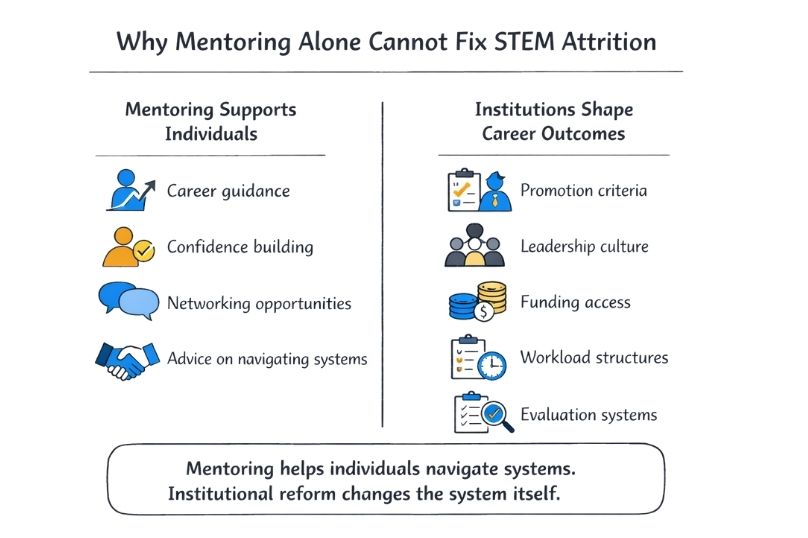
At its core, mentoring provides three forms of support.
Guidance
Mentors can help mentees interpret unfamiliar environments. They may explain unwritten norms, suggest strategies for navigating career decisions, or provide feedback on professional development.
Encouragement
Career progression in STEM often involves long periods of uncertainty. Encouragement from a mentor can reinforce confidence and reduce the sense of isolation that early career professionals sometimes experience.
Access
Mentors may introduce mentees to networks, collaborators, or opportunities that would otherwise be difficult to access.
These functions are meaningful. Many professionals benefit greatly from them. Mentoring can improve confidence, accelerate learning, and create valuable connections.
However, none of these functions alters the institutional conditions that determine how careers progress. Mentoring can help individuals navigate existing systems. It does not change the structure of those systems.
The Structural Nature of STEM Attrition
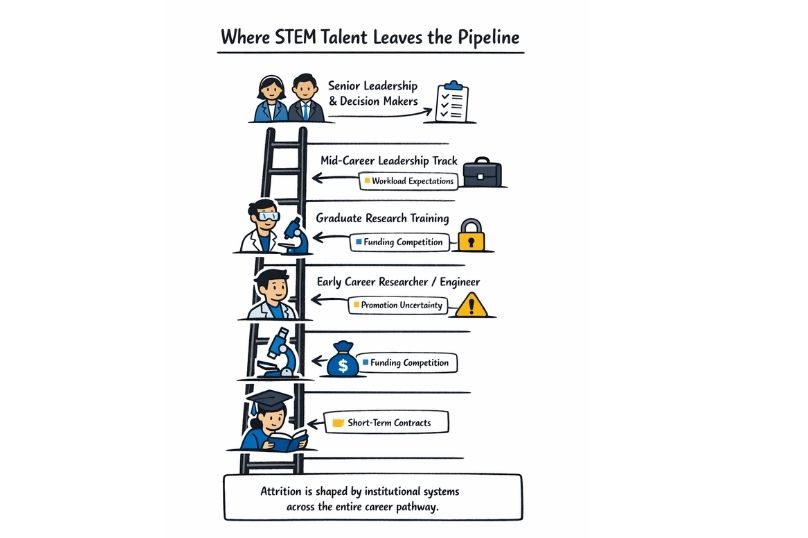
Attrition in STEM is rarely the result of a single factor. Instead, it emerges from a combination of structural dynamics that accumulate over time.
Promotion systems may reward narrow forms of productivity while overlooking collaborative contributions. Funding mechanisms may favour established networks. Leadership cultures may privilege particular communication styles or career patterns. Workload expectations may assume unlimited flexibility or uninterrupted career trajectories.
These dynamics are not always intentional. Many develop gradually through historical precedent, disciplinary traditions, or institutional inertia. However, their impact can be substantial.
When attrition occurs, individuals often interpret their experience through personal narratives. They may conclude that they were not competitive enough, not confident enough, or not well-connected enough. Mentoring programmes reinforce this framing by focusing attention on individual development.
The deeper issue is that institutional systems determine the boundaries within which individual careers unfold. Mentoring can help individuals operate more effectively inside those boundaries. It cannot redefine them.
The Risk of Individualising Systemic Problems
When mentoring becomes the dominant response to attrition, a subtle shift occurs in how problems are framed.
Instead of examining organisational processes, attention moves toward the behaviour and resilience of individuals. The implicit message becomes that people leave because they lack sufficient guidance, confidence, or professional skills.
This framing can unintentionally place responsibility for navigating difficult systems on those who experience the most barriers within them.
A mentee may receive advice on how to negotiate recognition for collaborative work, but the recognition system itself remains unchanged. Another may learn strategies for managing heavy workloads, while the workload expectations remain structurally unrealistic.
In this context, mentoring functions as a coping mechanism rather than a corrective mechanism. It helps individuals adapt to institutional conditions that may continue to drive attrition.
The Capacity Limits of Mentoring
Another challenge is scale.
Effective mentoring requires time, trust, and sustained engagement. Experienced professionals who serve as mentors often carry significant responsibilities already. When mentoring programmes expand rapidly, the quality of mentoring relationships can become uneven.
Some mentors provide thoughtful and consistent guidance. Others may have limited time to engage meaningfully. In large programmes, mentees may be matched with mentors whose expertise or experience does not align closely with their needs.
Even when mentoring relationships are strong, the impact remains inherently individual. A mentor may support one or two mentees effectively, but the reach of that support is limited.
Institutional change, by contrast, operates at scale. Adjustments to promotion criteria, evaluation processes, or workload distribution influence the experiences of entire cohorts simultaneously.
Mentoring cannot substitute for structural reform because its effects are distributed one relationship at a time.
The Mentor Burden
Mentoring programmes also create additional demands on experienced professionals.
Senior scientists, engineers, and academics are frequently asked to mentor multiple individuals. Those who are recognised as strong mentors may find themselves supporting large numbers of mentees while maintaining their own research, teaching, or leadership responsibilities.
In some cases, mentoring expectations fall disproportionately on individuals who are already navigating underrepresentation in their fields. Their visibility and experience make them highly sought after mentors.
This dynamic introduces an additional workload that is rarely reflected in formal recognition systems. Mentoring may be valued rhetorically but remain invisible in promotion metrics or resource allocation.
Over time, this imbalance can create tension between the importance attributed to mentoring and the institutional incentives that shape professional priorities.
When Mentoring Works Well
Despite these limitations, mentoring remains valuable when positioned appropriately.
Mentoring works particularly well when it focuses on professional development rather than structural correction. It can help individuals refine research strategies, expand professional networks, and gain perspective on career pathways.
Mentoring also strengthens professional communities. The relationships that form through mentoring programmes often extend beyond formal meetings. They can create networks of support that contribute to a healthier professional environment.
In addition, mentoring can help leaders understand emerging challenges faced by early-career professionals. Conversations within mentoring relationships sometimes reveal patterns that institutions might otherwise overlook.
When mentoring is integrated within a broader institutional strategy, it becomes a complementary tool rather than a primary intervention.
Redirecting Attention Toward Institutional Depth
Addressing attrition effectively requires attention to institutional depth.
Institutional depth refers to the underlying systems that shape career progression. These include promotion criteria, evaluation processes, leadership cultures, workload structures, and access to resources.
Investment in mentoring programmes often occurs because they are visible and accessible. Redirecting some of that investment toward institutional architecture can produce broader and more durable effects.
Examples of institutional depth include:
Transparent promotion frameworks
Clear criteria reduce ambiguity and limit the influence of informal networks in career progression.
Recognition of diverse contributions
Collaborative work, mentoring, teaching, and community engagement can all be valued within evaluation systems.
Equitable workload distribution
Formal mechanisms can ensure that responsibilities are shared fairly across teams.
Inclusive leadership practices
Leaders who actively examine decision-making processes can reduce unintended biases in opportunities and recognition.
These changes operate at the system level. They influence the environment in which every professional works, rather than supporting individuals in isolation.
Rethinking Investment
Many institutions allocate substantial resources to mentoring initiatives. Redirecting some of that investment toward structural reform could produce a greater impact.
This does not require abandoning mentoring programmes. Instead, it involves recalibrating expectations.
Mentoring should not be tasked with solving systemic challenges. It should function alongside efforts that examine how institutions themselves operate.
When leadership teams analyse attrition patterns, the first questions should focus on organisational processes rather than individual support mechanisms.
- What aspects of the institutional environment influence career decisions?
- How are opportunities distributed?
- Which contributions receive recognition, and which remain invisible?
These questions require deeper analysis than the creation of mentoring schemes. They involve examining policies, incentives, and leadership practices that shape everyday professional experiences.
The Role of Leadership
Leadership commitment is central to addressing institutional depth.
Senior leaders influence the priorities of organisations through resource allocation, performance metrics, and strategic direction. When leadership attention concentrates primarily on mentoring initiatives, structural issues may remain unexamined.
Conversely, leaders who analyse institutional processes can initiate meaningful change. Adjustments to evaluation criteria, decision making transparency, and workload expectations can reshape professional environments more effectively than individual support programmes alone.
Mentoring still plays a role in these environments, but it becomes one component of a larger ecosystem designed to support sustainable careers.
A Balanced Approach
A balanced strategy for addressing STEM attrition includes both relational and structural components.
Mentoring supports individuals. Institutional reform supports the system in which those individuals work.
When both elements operate together, they reinforce each other. Mentors can guide mentees within an environment that is gradually becoming more transparent, equitable, and supportive. Institutions can benefit from the insights that mentoring relationships generate about emerging challenges.
However, when mentoring is positioned as the primary response to attrition, expectations exceed what mentoring can realistically deliver.
Conclusion
Mentoring is one of the most widely endorsed interventions in professional development across STEM fields. It offers guidance, encouragement, and access to networks that can meaningfully support early career professionals.
However, mentoring operates at the level of individual relationships. STEM attrition emerges largely from institutional structures that shape how careers unfold over time.
When mentoring programmes are treated as central solutions to systemic challenges, responsibility shifts subtly toward individuals who must navigate complex environments rather than toward institutions that shape those environments.
Recognising the limits of mentoring creates space for a more effective strategy. Mentoring remains valuable as part of a broader ecosystem of support. At the same time, meaningful progress in retention requires attention to institutional depth.
Redirecting investment toward structural clarity, equitable recognition systems, and inclusive leadership practices can influence the experience of entire communities of professionals.
In that context, mentoring becomes what it was always intended to be: a powerful relationship between colleagues that enriches careers without carrying the burden of solving institutional problems on its own.