
There is a common misconception that confidence is something people are born with.
Many professionals look at successful leaders, keynote speakers, senior executives, or influential scientists and assume they possess some natural quality that others simply do not have. Confidence appears effortless when viewed from the outside. Yet the reality is often very different.
In STEM industries, where women continue to be underrepresented in many leadership positions, this misconception can become particularly damaging. It can lead highly capable professionals to underestimate themselves, remain silent when they have valuable ideas to contribute, or delay pursuing opportunities because they believe they are "not confident enough yet."
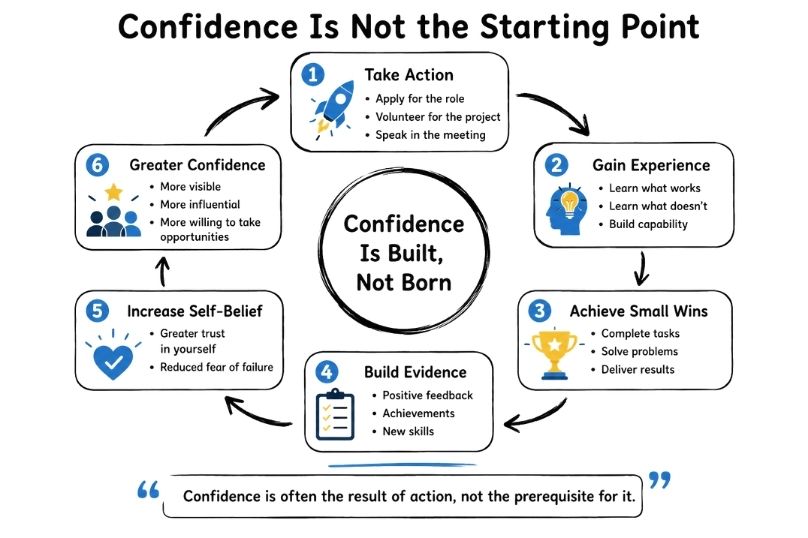
The truth is that confidence is rarely a starting point.
More often, confidence is the result of action.
It is developed through experience, strengthened through practice, and reinforced through evidence that you can handle challenges successfully.
Understanding this distinction can fundamentally change the way people approach their careers.
The Confidence Myth
Many people assume confidence comes first.
They tell themselves:
"When I feel more confident, I will apply for the promotion."
"When I feel more confident, I will speak at the meeting."
"When I feel more confident, I will put myself forward for leadership opportunities."
Unfortunately, confidence rarely works this way.
Most successful people did not feel confident before taking action. They became confident because they took action.
Confidence is often the outcome, not the prerequisite.
If confidence were required before attempting something new, very few people would ever progress beyond their comfort zone.
The first presentation is uncomfortable.
The first leadership role feels intimidating.
The first conference presentation creates anxiety.
The first board meeting can feel overwhelming.
Yet every one of these experiences provides evidence that future challenges can also be managed.
Confidence grows from accumulated evidence.
Why STEM Professionals Often Struggle With Confidence
Confidence challenges are not unique to women, but they can be amplified within STEM environments.
Many STEM professions attract individuals who are analytical, evidence-driven, and highly self-critical. These qualities often contribute to professional excellence, but they can also create hesitation.
Scientists and engineers are trained to identify gaps in knowledge.
Researchers are taught to question assumptions.
Technical professionals are rewarded for precision and accuracy.
These strengths can sometimes translate into excessive self-scrutiny when applied to personal performance.
While less qualified individuals may confidently promote their ideas despite limited evidence, highly capable professionals can become preoccupied with what they still need to learn.
This phenomenon contributes significantly to feelings often described as imposter syndrome.
The more someone knows, the more aware they become of the complexity of a subject.
Paradoxically, expertise can sometimes reduce perceived confidence.
The Cost of Waiting
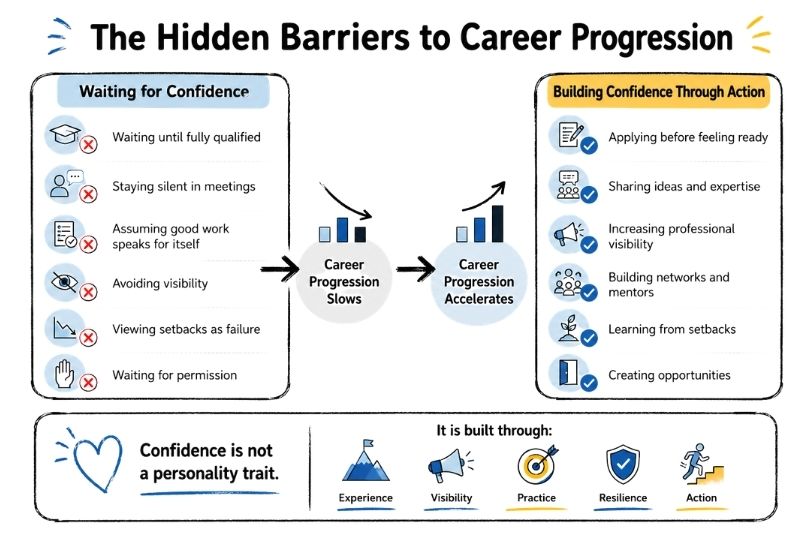
One of the greatest career risks is waiting until you feel ready.
Many talented professionals delay applying for opportunities because they believe they need additional qualifications, more experience, or greater confidence.
Meanwhile, others apply despite meeting fewer of the stated requirements.
Research consistently suggests that women are more likely than men to wait until they meet nearly all criteria before applying for roles.
This can create significant career disadvantages over time.
Every delayed application represents a missed opportunity.
Every unspoken idea represents a contribution that remains unheard.
Every leadership opportunity declined creates a gap between potential and achievement.
The workplace rarely rewards hidden capability.
People cannot recognise expertise they never see.
Building Confidence Through Evidence
One of the most effective ways to strengthen confidence is to focus on evidence rather than emotion.
Feelings fluctuate.
Evidence remains.
Instead of asking:
"Do I feel confident?"
Ask:
"What evidence do I have that I can do this?"
For example:
- Have I solved difficult problems before?
- Have I successfully learned new skills in the past?
- Have I managed challenging situations?
- Have colleagues trusted my judgement?
- Have I achieved difficult goals previously?
The answers to these questions often reveal a much stronger foundation than people realise.
Confidence built on evidence is more sustainable than confidence based purely on motivation.
The Role of Visibility
Confidence and visibility are closely connected.
Many professionals assume excellent work will naturally be recognised.
Unfortunately, this is not always how organisations operate.
Visibility matters.
This does not mean self-promotion for its own sake.
It means ensuring that your contributions are understood by the people making decisions about projects, promotions, and opportunities.
Visibility can include:
- Speaking at meetings.
- Sharing expertise internally.
- Writing articles.
- Presenting at conferences.
- Contributing to professional networks.
- Participating in mentoring programmes.
These activities create opportunities for others to recognise expertise that may otherwise remain hidden.
Authenticity Matters
Many confidence discussions focus heavily on appearing powerful.
However, confidence does not require becoming someone else.
Some professionals mistakenly believe leadership requires adopting a particular personality type.
They assume they must become louder, more aggressive, or more extroverted.
In reality, effective leaders come in many forms.
Some are highly energetic and charismatic.
Others are thoughtful, calm, and measured.
Confidence is not about performing a role.
It is about becoming comfortable expressing your expertise and perspective in your own authentic style.
Authenticity tends to be far more sustainable than imitation.
Handling Setbacks
No discussion about confidence would be complete without acknowledging setbacks.
Confidence is often tested most severely when things do not go according to plan.
A rejected application.
A difficult presentation.
Critical feedback.
A failed project.
These experiences can either strengthen confidence or undermine it.
The difference lies in interpretation.
Highly resilient professionals view setbacks as information rather than judgement.
They ask:
- What can I learn?
- What can I improve?
- What will I do differently next time?
They understand that a single outcome does not define their overall capability.
Confidence becomes more robust when it survives failure.
The Importance of Community
Confidence rarely develops in isolation.
Supportive networks play a significant role in helping professionals recognise their strengths and potential.
Mentors, sponsors, peers, and professional communities provide valuable perspectives that individuals often struggle to see themselves.
This is one reason why networks focused on supporting women in STEM can have such a powerful impact.
They create environments where members can:
- Share experiences.
- Learn from role models.
- Build professional relationships.
- Gain practical career insights.
- Receive encouragement during challenging periods.
Sometimes confidence grows because someone else sees your potential before you do.
Confidence as a Career Skill
Perhaps the most important lesson is that confidence should be viewed as a skill rather than a personality trait.
Skills can be developed.
Skills can be practised.
Skills improve over time.
Nobody expects to master a technical discipline instantly.
Confidence deserves the same perspective.
It is not fixed.
It is not determined by personality.
It is not reserved for a fortunate few.
It is built through experience, visibility, learning, resilience, and action.
The professionals who appear most confident today were often once the people questioning whether they were ready.
The difference is that they moved forward anyway.
About the Speaker
This topic was explored in greater depth during a recent Women in STEM Network webinar delivered by Yvonne Akinmodun, an Executive Career Coach, Speaker, Career Development and Progression Strategist, and former HR Director with more than 25 years of experience across the public, private, and not-for-profit sectors. She is the founder of Career Coaching Matters and specialises in helping professionals and organisations strengthen career development, leadership capability, and progression pathways. (careercoachingmatters.com)
You can learn more about Yvonne through:
Watch the Webinar On Demand
If you missed the live webinar, Women in STEM Network members can watch the full session on demand here:
Women in STEM Network On-Demand Workshop Library
The webinar provides practical guidance on building confidence, developing professional authority, strengthening executive presence, and navigating career progression within male-dominated industries.