
Across decades and across continents, LGBT+ women have contributed to science, engineering, medicine, mathematics and technology while navigating professional environments that were rarely built with them in mind.
The history of STEM is often told through discoveries and patents, laboratories and Nobel Prizes. Less frequently examined is the social architecture surrounding those achievements. Who felt safe to enter the room. Who stayed. Who progressed. Who felt compelled to leave.
For LGBT+ women, excellence has often existed alongside structural pressure. Understanding that duality is essential if STEM institutions are serious about retention, leadership development and innovation.
Historical Context: Silence as Strategy
Throughout much of the twentieth century, same sex relationships were criminalised in many countries and heavily stigmatised in many others. Even in jurisdictions where prosecution was rare, reputational risk was substantial. Academic careers depended on sponsorship, references and professional networks. Industrial research careers depended on security clearance, reputation and managerial endorsement.
In such contexts, disclosure of sexual orientation could carry professional cost. Women in STEM already faced entrenched gender barriers: restricted access to education, limited research funding, exclusion from informal networks and slow progression into senior posts. Adding an LGBT+ identity introduced another layer of vulnerability.
As a result, silence became a strategy. Many compartmentalised their personal lives. Professional credibility was carefully managed. Invitations to social functions required calculation. Language about partners was edited or avoided.
This silence had consequences beyond the individual. It reduced visible role models. It constrained mentoring relationships. It limited collective advocacy. Structural change is slower when those affected cannot safely speak.
Gender Expectations and Sexuality
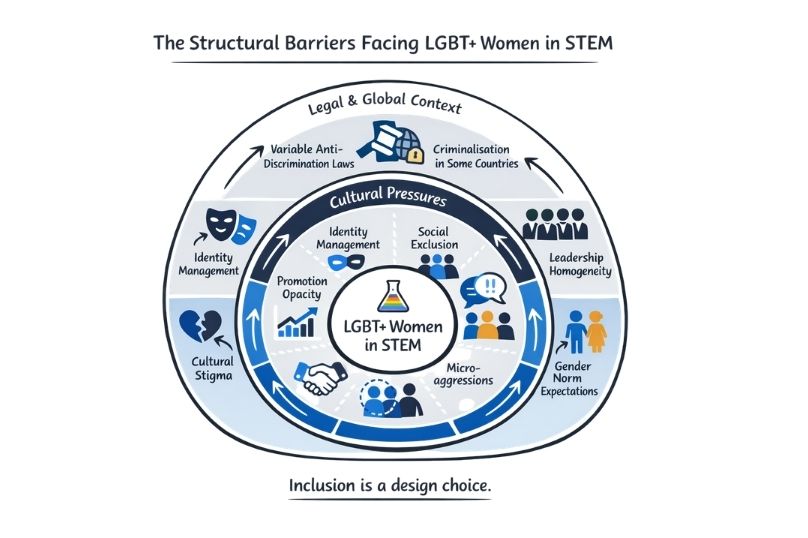
STEM cultures have historically rewarded conformity to established norms. Women who did not align with expected expressions of femininity were sometimes perceived as “difficult”, “abrasive” or “not fitting the culture”. Where sexual orientation intersected with these perceptions, bias could intensify.
Research across engineering and technology sectors has shown that LGBT+ professionals report higher levels of social exclusion and subtle discrimination than their heterosexual peers. Women may experience this through marginalisation in team settings, exclusion from informal networking opportunities or assumptions about personal life that create discomfort in professional spaces.
Such dynamics rarely appear in formal job descriptions. They operate informally, shaping who is sponsored, who is invited into high profile projects and who is perceived as leadership material.
Global Variation in Experience
The experience of LGBT+ women in STEM is not uniform. It varies dramatically across jurisdictions.
In parts of Western Europe, North America and Australasia, legal frameworks protect against discrimination in employment. Universities and corporations frequently operate Pride networks, publish inclusion policies and conduct diversity training. Visibility has increased in many sectors. However, policy presence does not eliminate microaggressions or unconscious bias. Cultural change often lags behind legal reform.
In other regions, legal risk remains significant. In parts of Asia, Africa and the Middle East, same sex relationships may be criminalised or heavily stigmatised. Women working in research collaborations or global corporations may move between countries with very different legal landscapes. International conferences can require careful assessment of safety.
Even within protective legal systems, local cultural contexts matter. A multinational corporation may have progressive policies on paper, while specific regional offices operate with conservative social norms.
For LGBT+ women in STEM, global mobility, often celebrated as a career advantage, can introduce additional complexity.
The Retention Question
Retention is one of the most significant structural issues facing STEM. Innovation requires continuity. Research projects span years. Engineering programmes operate on long timelines. Scientific leadership develops over decades.
When talented professionals exit because they do not feel psychologically safe, institutions incur both reputational and financial cost.
Studies indicate that LGBT+ professionals in STEM are more likely than their heterosexual peers to consider leaving their roles due to workplace climate. Where women already face under representation at senior levels, attrition compounds leadership gaps.
A shortage of openly LGBT+ women in senior posts has downstream effects. Early-career professionals may struggle to see a pathway forward. Leadership pipelines narrow. Sponsorship networks remain homogeneous.
Inclusion, therefore, is not simply about recruitment. It is about progression and sustainability.
The Invisible Labour of Identity Management
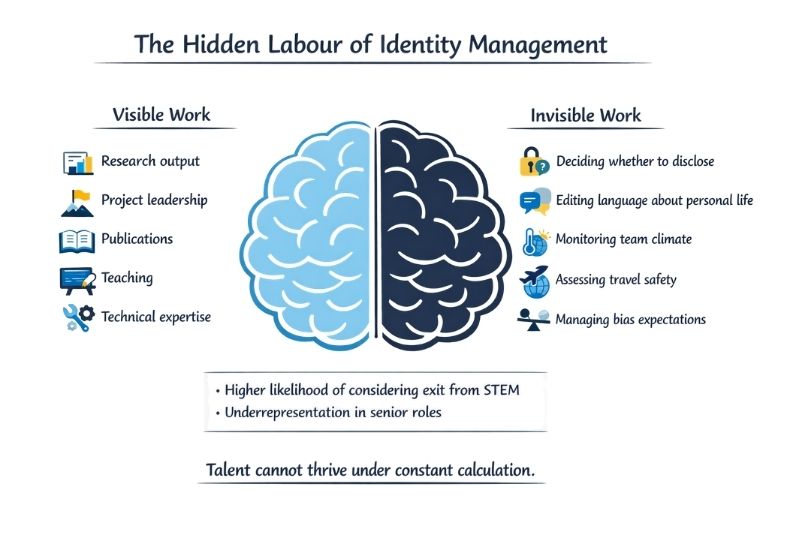
Beyond overt discrimination, many LGBT+ women in STEM describe the ongoing cognitive work of identity management.
This can include:
- Assessing whether it is safe to disclose personal information in a new workplace.
- Editing language about partners or family.
- Monitoring colleagues’ reactions to social issues.
- Anticipating bias during promotion reviews.
- Navigating team travel in regions with restrictive laws.
This invisible labour consumes mental bandwidth. It shapes how individuals participate in informal networks. It may influence willingness to pursue high-visibility roles.
While often unacknowledged, this burden affects performance, wellbeing and long term career decisions.
Intersectionality and Compounded Barriers
For women who also belong to ethnic minority groups, faith communities or lower socioeconomic backgrounds, these dynamics can intensify.
Intersectionality matters because structural systems rarely operate along a single axis. A woman of colour who is also LGBT+ may navigate racial bias, gender bias and sexuality based assumptions simultaneously. A woman from a conservative faith background may experience tension between community expectations and professional visibility.
STEM institutions that address inclusion through a single category lens risk overlooking these layered realities.
Education as the Starting Point
Inclusion challenges do not begin at employment. They begin in education.
School environments shape confidence. University cultures influence early research opportunities. Supervisory relationships determine access to funding and publications.
If LGBT+ students encounter hostility, invisibility or harmful language in classrooms or laboratories, this can influence subject choice and career trajectory. Anticipated discrimination can deter individuals from entering specific sectors such as engineering, computing or physics.
Building inclusive cultures within educational settings is therefore foundational to long term workforce equity.
For a deeper exploration of how LGBT+ inclusion intersects with STEM education, research systems and professional networks in the UK context, see our detailed analysis here:
https://womeninstemnetwork.com/lgbt-inclusion-in-stem-education-research-and-networks-uk/
Organisational Design, Not Symbolism
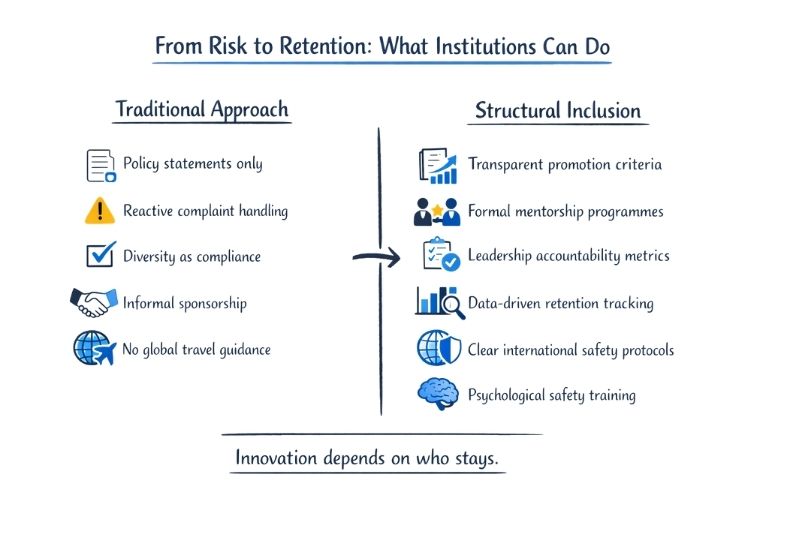
Inclusion is often framed symbolically through awareness days or visible statements of support. While visibility matters, structural design is decisive.
Effective change requires:
- Transparent promotion criteria.
- Clear reporting and accountability mechanisms.
- Leadership training that addresses bias.
- Mentorship access across identity lines.
- Data collection that measures progression and retention.
- Explicit policies covering international travel and safety.
When inclusion is embedded into organisational architecture, rather than appended to it, retention improves.
For STEM institutions seeking to remain competitive globally, this is not optional.
Explore This Topic Further: The Women in STEM Network Webinar
To bring these structural themes into sharper focus, the Women in STEM Network hosted a dedicated Spotlight webinar examining the lived realities, global variations and institutional design questions surrounding LGBT+ inclusion in STEM.
The session moved beyond abstract principles. It explored practical challenges such as navigating identity within faith communities, supporting students before they enter the workforce, and designing psychologically safe workplaces that retain talent.
The webinar featured:
Carolina Endara, Women in STEM Network Ambassador, who facilitated the discussion and contextualised inclusion within global innovation systems. Carolina’s perspective bridges international professional networks and organisational leadership, grounding the conversation in the realities of cross border collaboration and workforce development.
Sarah Bronzite, Head of Education at Keshet UK, who brought expertise in educational frameworks and inclusive practice. Her work focuses on equipping educators and institutions to build environments where LGBT+ students can pursue scientific disciplines without fear or marginalisation. She addressed how early intervention in educational settings influences long term participation in STEM careers.
Esther Rose, Programme and Volunteer Officer at Keshet UK, who offered insight into navigating multiple identities within STEM culture. Her perspective illustrates how structural systems affect individual career decisions, and how community and institutional support can shift outcomes.
Together, the speakers combined policy insight, educational strategy and lived experience. The conversation examined both the macro level design of institutions and the micro level realities of professional life.
For Women in STEM Network members wishing to explore these issues in greater depth, the full webinar recording is available here:
https://womeninstemnetwork.com/stem-spotlights-women-who-inspire/
Understanding the structural realities facing LGBT+ women in STEM is central to the Network’s mission of strengthening retention, leadership and innovation. Conversations such as this are not peripheral to STEM excellence. They are integral to it.