
Across STEM sectors, there is a persistent and measurable gap between technical capability and leadership representation. Organisations continue to invest in recruitment, training, and early career engagement, yet leadership pipelines remain disproportionately narrow. This is often misdiagnosed as a confidence problem among underrepresented groups. In reality, the issue is more structural. Systems frequently assess readiness through signals that are only loosely correlated with actual capability.
Leadership readiness, in this context, must be redefined. It is not simply about who appears confident, visible, or vocal. It is about who can operate effectively under complexity, make sound decisions with incomplete information, and influence outcomes across systems. When these criteria are applied consistently, the gap between capability and confidence becomes highly visible.
The Capability–Confidence Disconnect
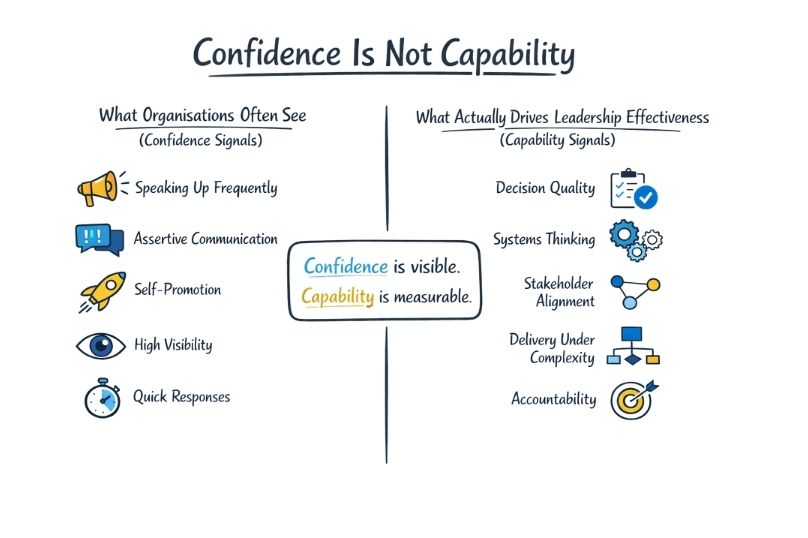
In STEM environments, capability is typically grounded in demonstrable expertise. It is evidenced through academic achievement, technical problem solving, research output, and operational delivery. Confidence, by contrast, is behavioural. It is expressed through communication style, assertiveness, self promotion, and perceived authority.
The problem arises when confidence is used as a proxy for capability.
This substitution introduces bias into leadership selection processes. Individuals who are more comfortable signalling confidence, often due to prior exposure, cultural conditioning, or organisational familiarity, are more likely to be perceived as ready. Meanwhile, individuals with equal or greater capability may be overlooked because they do not display the same behavioural cues.
This is not a marginal issue. It has direct implications for organisational performance. When leadership roles are filled based on confidence signals rather than capability, decision quality, innovation potential, and long term resilience are all affected.
Why Confidence Is Unevenly Distributed
Confidence does not emerge in isolation. It is shaped by environment, reinforcement, and feedback over time. In STEM fields, several structural dynamics influence how confidence develops.
Exposure to Leadership Contexts
Individuals who have had early access to leadership opportunities, formal or informal, are more likely to develop confidence in those settings. This includes leading projects, presenting to senior stakeholders, or participating in strategic discussions.
Feedback Quality
Consistent, constructive feedback plays a critical role in building calibrated confidence. Where feedback is vague, inconsistent, or disproportionately critical, individuals may underestimate their readiness despite strong performance.
Representation and Role Modelling
Seeing people with similar backgrounds in leadership roles affects perceived attainability. Where representation is limited, individuals may internalise leadership as not for them, regardless of capability.
Risk Tolerance and Consequence
Confidence is also linked to perceived risk. In environments where mistakes are penalised heavily, or where individuals feel they are being evaluated more closely, risk taking behaviour declines. This directly impacts willingness to step into leadership roles.
These factors are not evenly distributed. As a result, confidence becomes an unreliable indicator of readiness.
The Cost of Misaligned Signals
When organisations conflate confidence with readiness, several predictable outcomes emerge.
Narrow Leadership Profiles
A limited range of communication styles and behaviours becomes associated with leadership. This reduces diversity of thought and approach at senior levels.
Delayed Progression
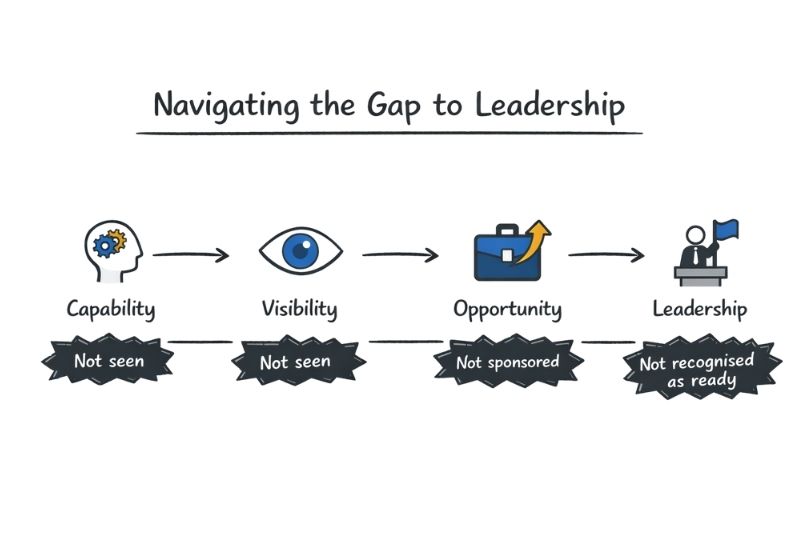
Capable individuals may remain in technical or mid level roles for longer than necessary, waiting until they feel ready by subjective standards that are never clearly defined.
Overextension of Confident Individuals
Those who are perceived as ready may be promoted rapidly, sometimes beyond their current capability. This can lead to performance issues, burnout, or ineffective leadership.
Attrition from the Pipeline
Perhaps most critically, individuals who consistently see capability undervalued may disengage or exit the organisation entirely. This is a direct loss of talent and institutional knowledge.
Redefining Leadership Readiness
To address this, organisations must shift from perception based assessments to evidence based criteria. Leadership readiness should be defined through observable capabilities, not inferred confidence.
Decision Making Under Uncertainty
The ability to evaluate incomplete data, weigh risks, and make timely decisions.
Systems Thinking
Understanding how different components of an organisation interact, and how decisions in one area affect outcomes in another.
Influence Without Authority
The capacity to align stakeholders, manage competing priorities, and drive progress without relying solely on positional power.
Accountability and Ownership
Taking responsibility for outcomes, including when results are not as expected.
Learning Agility
Adapting to new information, environments, and challenges with speed and effectiveness.
These criteria can be assessed through structured observation, project based evaluation, and performance data. They do not require high levels of outward confidence to be demonstrated.
The Role of Organisations in Pipeline Reform
Pipeline reform is not about encouraging individuals to be more confident. It is about redesigning systems so that capability is visible, recognised, and rewarded.
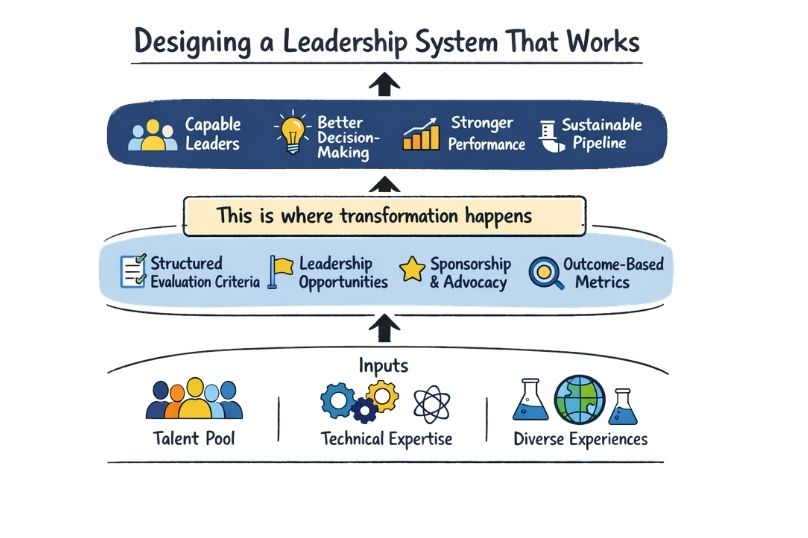
Standardising Evaluation Criteria
Clear, consistent definitions of leadership readiness reduce subjectivity. This includes structured promotion frameworks, competency models, and transparent decision making processes.
Expanding Access to Leadership Experiences
Providing opportunities for individuals to lead projects, manage teams, and contribute to strategic initiatives builds both capability and confidence. Access should be intentional, not incidental.
Separating Communication Style from Competence
Organisations must recognise that effective leadership can be expressed through a range of styles. Quiet, analytical, and reflective approaches are as valuable as more overtly assertive ones.
Embedding Sponsorship, Not Just Mentorship
Mentorship provides guidance. Sponsorship provides advocacy. Individuals who are sponsored are more likely to be considered for leadership roles because their capability is actively endorsed in decision making forums.
Measuring Outcomes, Not Impressions
Performance metrics should focus on outcomes delivered, not on how those outcomes are communicated. This requires a shift in both formal evaluation systems and informal perceptions.
Individual Strategies: Navigating the Gap
While systemic change is essential, individuals operating within current structures still need to navigate the capability–confidence gap.
Translating Capability into Visibility
This does not require self promotion in the traditional sense. It involves ensuring that work, impact, and decision making contributions are clearly documented and communicated.
Seeking High Impact Assignments
Projects that involve cross functional collaboration, ambiguity, or strategic importance provide stronger evidence of leadership capability.
Requesting Specific Feedback
General feedback is often unhelpful. Targeted questions such as what would demonstrate readiness for the next level yield more actionable insights.
Building Strategic Relationships
Visibility in leadership discussions often depends on who is aware of an individual’s work. Building relationships across functions and levels increases this awareness.
Reframing Readiness
Waiting to feel fully confident before pursuing leadership roles can result in missed opportunities. Readiness should be assessed based on capability, not subjective comfort.
Leadership Accountability
Senior leaders and boards have a critical role in addressing this issue. Leadership pipelines are a direct reflection of organisational design choices.
Key responsibilities include ensuring that promotion and succession planning processes are evidence based, challenging assumptions about what leadership presence looks like, monitoring progression data to identify patterns of underrepresentation, and holding management accountable for developing diverse leadership talent.
Without this level of accountability, pipeline reform efforts remain superficial.
Moving Beyond the Confidence Narrative
The narrative that underrepresentation in leadership is primarily a confidence issue is both incomplete and counterproductive. It places responsibility on individuals to adapt to systems that may not be designed to recognise their strengths.
A more accurate framing is this.
There is no shortage of capability in STEM.
There is a shortage of systems that can reliably identify and advance it.
Addressing this requires a shift in focus from individual behaviour to organisational design. It requires recognising that confidence is a variable outcome, not a fixed prerequisite. It also requires committing to leadership models that value substance over signal.
Conclusion: Designing for Capability
Leadership readiness in STEM must be grounded in capability. Confidence may support effective leadership, but it should not determine access to it.
For organisations, this is a strategic issue. The ability to identify and develop capable leaders directly affects innovation, performance, and long term sustainability.
For individuals, it is a matter of positioning. Understanding how capability is assessed, and ensuring that it is visible within existing systems, is essential for progression.
For the broader STEM ecosystem, it is a question of fairness and effectiveness. A leadership pipeline that reflects true capability is not only more equitable, it is more resilient.
The task is not to build confidence in isolation.
The task is to build systems where capability is unmistakable.