
Leadership in STEM isn’t about a fancy title; it’s about impact. It’s about pioneering innovation, building teams where everyone feels they belong, and pushing the boundaries of discovery in demanding, high-stakes fields. At its core, real leadership is a collection of actionable behaviours anyone can learn, not some far-off promotion you have to wait for.
What Does Leadership In STEM Actually Look Like?
When we talk about leadership in science, technology, engineering, and mathematics, it’s all too easy to just picture a lab director in a white coat or a tech CEO on a big stage. While those are certainly leadership roles, that limited view misses the point entirely.
Effective leadership is less about top-down authority and much more about influence, vision, and the ability to rally a team around a shared goal. In the world of STEM, that could mean inspiring a research group to stick with a difficult line of enquiry that others have abandoned. It might look like steering a software development project through a critical breakthrough or ensuring a complex engineering build hits its deadlines without ever compromising on safety or quality. It's a dynamic, hands-on process of solving problems and empowering others to do their best work.
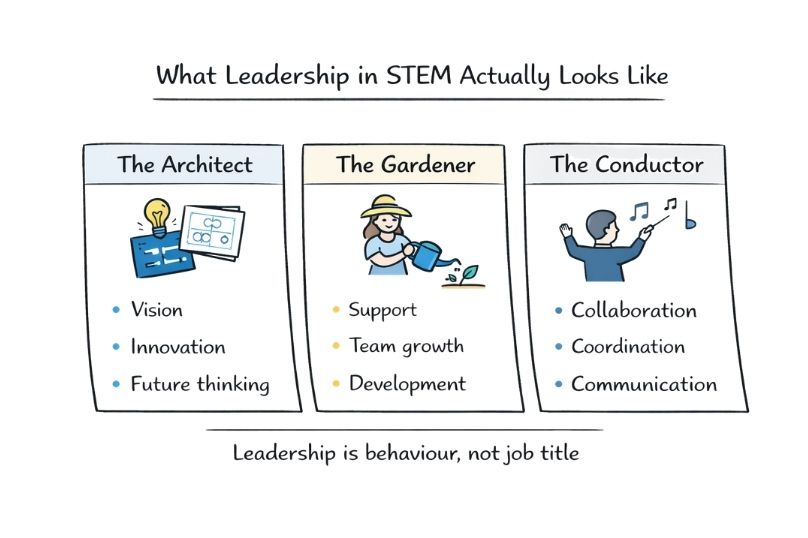
Reframing Leadership Through Practical Analogies
To get a real feel for what this looks like day-to-day, it helps to step away from the abstract definitions and think in terms of practical analogies. Each model highlights a different set of strengths, and the most effective leaders I’ve seen are adept at blending these styles to fit the situation.
Think of these leadership styles as different professional roles, each with a unique purpose:
- The Architect (Transformational): This is the visionary who drafts the blueprint for what's next. They paint a compelling picture of the future that inspires their teams, challenges the status quo, and motivates everyone to build something truly new.
- The Gardener (Servant): This leader is all about cultivating the growth of each person on their team. They work to ensure everyone has the resources, support, and environment they need to flourish, operating on the belief that a healthy, empowered team will always produce the best results.
- The Conductor (Democratic): This leader excels at harmonising the individual talents within a team, much like a conductor leading an orchestra. They facilitate collaboration, make sure every voice is heard, and build consensus so the entire group moves forward in unison.
Leadership is about making others better as a result of your presence and making sure that impact lasts in your absence. This principle is especially potent in STEM, where collaborative success depends on elevating the entire team's capability.
Leadership Is A Skill, Not A Position
Once you start seeing leadership through these different lenses, you realise it’s a set of skills you can start developing right now, from whatever role you're in. You absolutely do not need to wait for a management title to begin acting like a leader. For a concrete example, understanding what a CTO does in a startup shows just how varied a leadership role's responsibilities can be.
By taking ownership of a project, mentoring your peers, or spotting and improving a flawed process, you’re demonstrating leadership qualities every single day. These are the actions that build a solid foundation for future opportunities and let you make a meaningful impact right where you are. As you progress in your career, you’ll find that https://womeninstemnetwork.com/the-new-currency-of-womens-leadership/ is built on these foundational, everyday actions.
Navigating The Obstacles To Women's Leadership
We've talked about what effective leadership looks like in STEM, but it's just as crucial to understand the unique terrain women have to navigate to get there. The path to the top is rarely a straight line, and for women globally, it's often complicated by systemic hurdles that are as subtle as they are significant. These aren’t personal shortcomings; they're well-documented patterns that demand awareness to be overcome.
Facing these obstacles isn’t meant to be discouraging. Quite the opposite. It's about arming yourself with the knowledge to spot them, the language to call them out, and the strategies to get around them. When you understand the landscape, you build the resilience and clarity you need for the journey ahead.
Unpacking Unconscious Bias
One of the sneakiest and most common challenges is unconscious bias. These are the mental shortcuts and automatic stereotypes that quietly influence our judgements, actions, and decisions without us even realising it. In STEM fields, these biases show up in ways that can directly stall a woman’s leadership progression.
For example, countless studies across various countries have shown that men are more likely to be handed the high-stakes, high-visibility projects—the kind that fast-track you for promotion. Women, on the other hand, often find themselves saddled with the "office housework": the administrative tasks and support roles that keep things running smoothly but do little for career advancement. It's rarely a malicious choice; it's the result of deeply ingrained, unexamined assumptions about who is "right" for which role.
This bias also rears its head during performance reviews. A man who is direct and takes charge is praised for being "assertive" and "decisive." A woman exhibiting the very same behaviours? She’s often labelled "abrasive" or "aggressive." This is the classic double-bind dilemma—a no-win scenario where women are penalised for acting in ways that are expected and rewarded in male leaders.
A global study by LeanIn.Org and McKinsey found that for every 100 men promoted from entry-level to manager, only 87 women are promoted. This "broken rung" at the first step up to management is a perfect, everyday example of how unconscious bias can stall careers from the very beginning.
The Tangible Impact of Systemic Barriers
These aren't just abstract theories; they have real, tangible consequences day-to-day. Think about the last critical design review you were in. Did a female engineer’s suggestion get glossed over, only for a male colleague to repeat it five minutes later to a chorus of agreement? Or the lab meeting where a woman’s expertise was repeatedly questioned, while her male peers were simply taken at their word?
These moments aren't just isolated incidents. They form a pattern of microaggressions that can erode confidence and foster a feeling of not belonging. This cumulative effect is a major reason why so many talented women find their careers stalling or, as our analysis shows, leave the STEM fields altogether. The sheer emotional labour of constantly having to prove you deserve to be in the room is exhausting, and it pulls focus from the real work of innovation.
Common Obstacles Women Face in STEM
Spotting these challenges is the first step toward building strategies to counteract them. Here are a few of the most common hurdles you'll encounter in workplaces around the world:
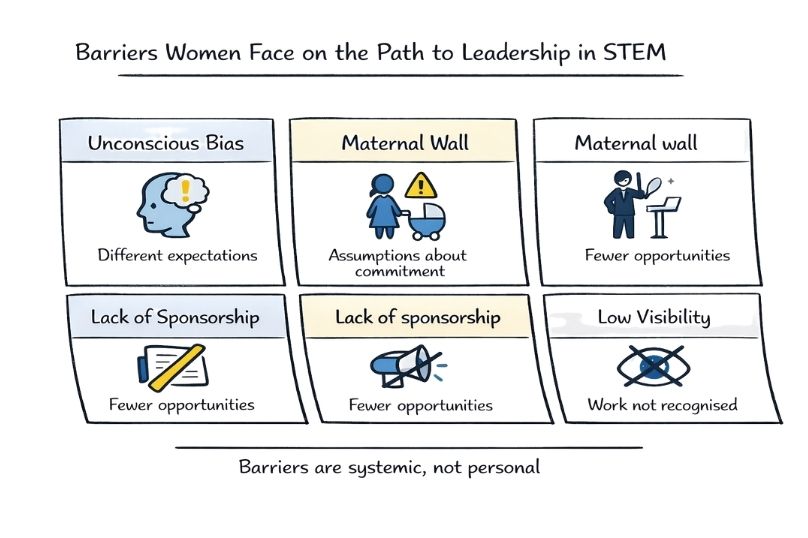
- The Prove-It-Again Bias: Women are often required to provide far more evidence of their competence than male colleagues just to be seen as equally capable. It’s like having to re-submit your credentials for every new task.
- The Maternal Wall: Once a woman has children—or is even perceived as being of an age where she might—assumptions about her commitment suddenly kick in. She may be passed over for opportunities involving travel or long hours, regardless of her actual ambitions or family situation.
- Lack of Sponsorship: Mentors give advice, but sponsors use their influence to create opportunities. They advocate for you behind closed doors. Research shows that men are far more likely to attract this kind of powerful sponsorship, creating a significant opportunity gap.
Understanding these dynamics is empowering. It helps you depersonalise the challenges you face, recognising them as systemic issues, not personal failings. From here, you can start building a targeted plan to dismantle them on your own path to leadership.
Building Your Practical Leadership Toolkit
Knowing the challenges is one thing, but making real progress means rolling up your sleeves and building the skills to dismantle them. This is where we shift from awareness to action. It’s about creating a practical leadership toolkit, focusing on specific, learnable skills that will genuinely shape your career path.
These aren't just abstract theories. They are the tools you'll use day-in and day-out to get noticed, secure resources for your projects, and open doors for yourself. By deliberately honing your skills in strategic visibility, negotiation, and authentic networking, you can start leading with real intention and confidence.
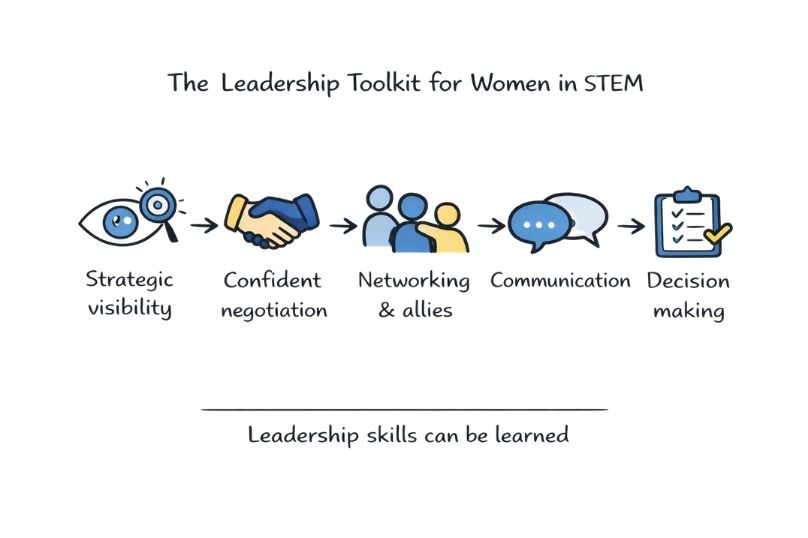
The table below outlines some of the most critical leadership skills for women in STEM and offers practical ways to start developing them right now.
Key Leadership Skills And Development Strategies
| Leadership Skill | Why It's Critical in STEM | Actionable Development Strategy |
|---|---|---|
| Strategic Visibility | Ensures your technical contributions are recognised and valued beyond your immediate team. It translates complex work into tangible business impact. | Start a "brag file" to log achievements. In meetings, connect your updates to project goals or customer solutions. Volunteer to present at an internal tech talk. |
| Confident Negotiation | Essential for securing project budgets, timelines, and resources. It's about advocating for your team's needs and defining achievable goals. | Reframe negotiation as collaborative problem-solving. Prepare thoroughly by defining your goals and non-negotiables, and always back up requests with data. |
| Authentic Networking & Allyship | Builds a support system of sponsors and allies. A strong network provides technical advice, career guidance, and advocacy when you're not in the room. | Focus on quality over quantity. Offer help and share knowledge freely to build genuine, reciprocal relationships. Join an Employee Resource Group (ERG). |
| Effective Communication | Critical for translating complex technical concepts for non-technical stakeholders, aligning teams, and influencing decision-making. | Practise the "so what?" technique: after stating a fact, explain its impact. Ask for feedback on your presentation style from a trusted mentor. |
| Decisive Leadership | In fast-paced STEM environments, the ability to make timely, informed decisions—even with incomplete data—is crucial for driving projects forward. | Start small. Take ownership of decisions within your current role's scope. When faced with a choice, articulate the trade-offs and your reasoning clearly. |
Each of these skills builds on the others, creating a powerful foundation for your leadership journey. Let's dig a little deeper into a few of these.
Mastering Strategic Visibility
Visibility isn’t about being the loudest person in the room. It’s about making sure your contributions are seen and valued by the right people. In STEM fields, where so much incredible work happens behind the scenes, proactively making your accomplishments known is an essential leadership skill.
Think of it as translating your technical success into the language of impact. You aren't just completing tasks; you're solving problems, sparking innovation, and adding real value to the organisation. The trick is to frame your work in a way that shines a light on those outcomes.
A simple but powerful technique is to keep a "brag file" or an accomplishment log. Every time you crack a tough problem, get great feedback, or help a project succeed, write it down. This isn't about ego; it’s about having concrete evidence of your value ready for performance reviews and promotion talks.
Techniques for Increasing Your Visibility
- Own Your Success in Meetings: When you present data or project updates, don’t just state the facts. Explain the "so what"—how your work solved a customer's problem or made a process more efficient.
- Volunteer for Cross-Functional Projects: Stepping outside your immediate team shows your skills to a wider audience and proves you’re invested in the company's bigger goals.
- Present at Internal Tech Talks or Brown Bags: Sharing what you know positions you as an expert and a go-to resource for your colleagues.
Leadership is fundamentally about influence, and influence is impossible without visibility. You cannot influence people who do not know who you are or what you have achieved.
Becoming a Confident Negotiator
Negotiation is a core part of leadership, yet it's a skill many of us tend to avoid. But it's about so much more than salary talks. It’s how you advocate for project resources, define a realistic project scope, and manage expectations with stakeholders. Good negotiation ensures you and your team have what you need to actually succeed.
For women in STEM, this can feel especially tricky because of the "double-bind" dilemma. The key is to reframe it. Think of negotiation not as a conflict, but as a collaborative problem-solving exercise. The goal is to find a solution that works for everyone.
One of the best things you can do is prepare meticulously. Before any negotiation, be crystal clear on your goals, your walk-away points, and your best alternative if you can't reach an agreement (your BATNA). Use data and evidence to back up your requests, tying them directly to business outcomes. In fact, you might find that intentional planning on a single page can change how you lead, because that level of clarity is the bedrock of any successful negotiation.
Building Your Ally Network
Your network is one of your most powerful career assets. I'm not talking about collecting contacts on LinkedIn; I mean building genuine relationships with allies who will support and champion you. In STEM, where collaboration is everything, a strong network can be a lifeline for technical advice, career guidance, and that all-important sponsorship.
Focus on quality, not quantity. Aim to build real connections based on mutual respect and shared interests. This is a two-way street, so be a good ally to others, too—offer help, share your knowledge, and celebrate their wins.
This approach truly pays off. We’re even seeing its impact on a larger scale. For instance, recent progress in the UK shows what happens when organisations get serious about creating leadership opportunities. According to a 2024 report, UK businesses saw the number of women in senior management reach 43%, a significant achievement that puts the country on track to exceed global averages. This growth is directly tied to intentional diversity efforts. You can discover more about how strategic targets deliver results from Grant Thornton. This data is proof that focused strategies, from individual networking to corporate policy, create real, tangible change.
Finding Your Mentors and Sponsors
Technical skills and a solid work ethic will get you far, but they won't get you everywhere. To truly accelerate your career in STEM, you need more than just what’s on your CV; you need a powerful support system. This is where mentorship and sponsorship come in, and while people often lump them together, they play two very different—and equally vital—roles in your leadership journey.
Getting clear on the distinction is the first step. A mentor advises you, but a sponsor advocates for you. Think of a mentor as your trusted guide, the person you turn to for honest feedback, to work through a challenge, or to build a new skill. A sponsor, on the other hand, is your champion. They're the ones using their influence and political capital to get your name on the list for a promotion or a high-stakes project, especially when you're not in the room.
Mentorship is a conversation about your growth; sponsorship is an action that creates your opportunity. You need people who will talk to you about your career and people who will talk about you in rooms where decisions are made.
The Crucial Difference Between Mentors and Sponsors
To build the right network, you have to treat these roles as two distinct parts of your career strategy. One gives you the map and the compass; the other helps unlock the doors you find along the way.
It really breaks down like this:
- Mentors Talk With You: They’re your sounding board. The relationship is often confidential and centred on your personal and professional development, helping you build the skills you need for the future.
- Sponsors Talk About You: They put their reputation on the line for you. This relationship is entirely performance-based; they advocate for you because they believe in your ability to deliver, connecting you to tangible opportunities.
You absolutely need both. A mentor gets you ready for the next big step, but a sponsor is often the one who makes sure you get the chance to take it.
How to Identify Potential Supporters
Finding the right people won't happen by accident. You have to be proactive and intentional, so don't just wait for someone to tap you on the shoulder. Start actively looking for people whose careers, skills, or leadership styles you genuinely admire.
Your own organisation is the best place to start. Who are the senior leaders known for their integrity and for lifting others up? Watch who speaks up for their colleagues in meetings or who consistently delivers successful, high-profile projects. Those are the hallmarks of a potential sponsor. For mentors, you might look to colleagues who are a few steps ahead in their careers and excel in an area you want to improve.
Don’t limit yourself to your own company, either. Professional organisations, industry conferences, and communities like The Women in STEM Network are fantastic places to connect with potential allies from different backgrounds. If you need more specific guidance, you can explore our resources on how to make the most of your mentoring relationships.
Cultivating Relationships Built on Mutual Value
Once you’ve identified a few people, the goal is to build a genuine professional relationship, not just ask for a favour. Your approach should always be grounded in mutual respect and value.
For a potential mentor:
- Be Specific: Ditch the vague "will you be my mentor?" request. Instead, ask for a 20-minute chat about a specific challenge you're facing or their experience in a particular field.
- Do Your Homework: Show them you value their time. Come prepared with thoughtful questions that demonstrate you’ve researched their background.
- Follow Up: A simple thank-you note goes a long way. Better yet, circle back later to share how you applied their advice and what the outcome was.
For a potential sponsor:
Sponsorship isn’t given; it’s earned. A senior leader will only put their name behind you if they have total confidence in your ability to deliver exceptional results.
- Excel in Your Role: The foundation of sponsorship is performance. Become the go-to expert who consistently delivers high-quality work.
- Make Your Ambitions Known: Don't assume people know what you want. Clearly communicate your career goals to your manager and other leaders you trust.
- Seek Visibility: Put your hand up for projects that will showcase your talents to senior leadership.
This kind of intentional networking is creating real change. In the UK, voluntary, business-led initiatives have had a huge impact on female leadership. As of early 2024, women now hold 42.6% of board positions in FTSE 350 companies, a significant milestone that has surpassed the initial 40% target ahead of schedule. This progress proves that creating deliberate pathways to leadership works. You can read more on the FTSE Women Leaders Review findings. By actively building your own network of mentors and sponsors, you become a critical part of this movement.
Creating Inclusive Pathways To Leadership
Helping women in STEM move into leadership isn't something they can do alone, it's a shared responsibility that sits squarely with the organisation. While individual ambition is key, real, lasting change only happens when companies fundamentally redesign how they cultivate talent. This means getting past good intentions and actively building pathways that find, develop, and promote women into leadership roles.
The conversation needs to pivot from trying to ‘fix’ women to fixing the systems that hold them back. Organisations that are serious about progress are the ones building genuinely equitable leadership pipelines, because they understand that diversity isn’t just a box to tick; it’s a powerful engine for business success.
Designing Bias Interruption Mechanisms
Let's be honest: unconscious bias is one of the biggest hurdles women face. It quietly shapes crucial decisions about who gets hired, which projects they’re assigned to, and who gets tapped for promotion. To tackle this head-on, organisations can put bias-interruption mechanisms in place, think of them as structured checks and balances designed to short-circuit automatic, stereotype-based thinking.
What does this look like in practice? It could be as simple as standardising interview questions so every single candidate is measured against the same yardstick. It might also involve anonymising CVs during the initial screening to strip out information like gender or age, letting pure skills and experience shine through. When it comes to promotion panels, it means asking managers to back up their choices with concrete data and evidence, not just a "gut feeling."
Each of these small interventions creates a moment of pause, forcing decision-makers to lean on objective facts rather than falling back on familiar, and often biased, patterns.
The Power Of Formal Sponsorship Programmes
Mentorship is great, but sponsorship is what truly moves the needle in a career. To make sure everyone has a fair shot at these game-changing relationships, forward-thinking companies are creating formal sponsorship programmes. These initiatives strategically pair high-potential women with senior leaders who are explicitly tasked with championing their careers.
Unlike informal networks, which can unintentionally favour the dominant group, these structured programmes forge deliberate and powerful connections. A sponsor’s job is clearly defined:
- Championing: They actively put their sponsee's name forward for high-stakes assignments and leadership opportunities.
- Connecting: They open doors to influential networks that their sponsee might never otherwise access.
- Advocating: They defend their sponsee’s work and make sure their achievements are seen and acknowledged by the right people.
Programmes like these create real, tangible opportunities and directly tackle the sponsorship gap that so often stalls women's careers. To build a more inclusive organisation, you should explore our comprehensive guide on defining culture and diversity within a company.
The Business Case For Inclusive Leadership
The evidence backing inclusive leadership is overwhelming. Companies with more women in their leadership teams consistently innovate more, perform better financially, and are far more adept at solving complex problems.
Research consistently shows that diverse teams are more innovative and make better decisions. By excluding women from leadership, companies are effectively operating with one hand tied behind their back, missing out on a huge pool of talent, perspective, and creativity.
Yet, progress in some sectors is crawling at a snail's pace. For example, in UK financial services, a recent analysis showed that women hold just 18.6% of senior leadership positions, and a mere 9.1% of CEOs are female. This tiny increase from the previous year signals a worrying stagnation, lagging behind the progress seen in the wider FTSE 350. It’s a stark reminder of why deliberate, systemic change is so urgently needed. For a deeper dive, you can review the complete analysis from Fox & Partners.
Ultimately, building inclusive pathways isn’t just about doing the right thing, it’s a strategic investment in an organisation’s own future success.
Defining Your Next Step As A Leader
Think of your leadership journey less like a straight road and more like a continuous cycle of learning, doing, and refining. We’ve covered a lot of ground, from finding your authentic style to building a solid support system. Now, it’s time to pull all those threads together into a clear, actionable plan for what comes next.
Leadership isn't a title you wait for; it's a muscle you build. Whether you're a student sketching out your future, an early-career professional wanting more influence, or a seasoned expert ready for the next challenge, your next move needs to be a conscious one. It’s all about deciding where to put your energy to make the biggest difference.
Creating Your Personal Leadership Framework
To figure out where you're going, you first need to know exactly where you're standing. This means getting brutally honest with yourself and taking a clear-eyed look at the opportunities in front of you. A simple framework can give you the structure needed to turn reflection into real action.
Start by asking yourself three core questions:
- Where am I now? Take a candid look at your current skills, your strengths, and the areas where you know you need to grow. What patterns do you see in the feedback you get? What roadblocks do you keep hitting?
- Where do I want to go? Pinpoint your leadership ambitions, both for the next year and for the long term. This might mean leading a project, mentoring a junior colleague, or stepping into a formal management role. The more specific, the better.
- What is the one step I can take now? Looking at your answers, identify a single, tangible action you can take this month. This focus keeps you from feeling overwhelmed and helps build momentum.
Leadership is ultimately about the legacy you create. It’s the sum of the projects you guided, the people you empowered, and the problems you helped solve. Your next step, no matter how small, is a direct contribution to that legacy.
From Plan To Action
Once your framework is in place, the focus shifts to making it happen. This is where you connect your personal growth to your professional impact. If you're looking to define your next step as a leader and expand your influence, learning how to become a thought leader is a powerful strategy. It's not just about doing your job well; it's about sharing what you know and helping to shape the conversation in your field.
Remember, your action plan is a living document. Revisit it, tweak it, and adapt it as you grow. The goal isn’t to predict the future with perfect accuracy, but to build the resilience and clarity to navigate it with purpose. By focusing on constant improvement and strategic action, you turn ambition into real progress, one step at a time.
Got Questions? Let's Find Some Answers
Stepping up into a leadership role in STEM is a journey, and like any journey, it comes with its fair share of questions. Here are some of the most common ones we hear from women in our network, along with some practical, real-world advice.
How Can I Lead If I’m Not The Boss?
This is a big one. It's easy to think leadership is all about job titles, but it's really about influence. You can demonstrate powerful leadership qualities right where you are, simply by taking initiative and making yourself valuable beyond your job description.
Think about it this way: you could be the person who volunteers to lead that tricky project everyone else is avoiding. Or you could take a junior colleague under your wing, guiding them through the ropes. Even speaking up in meetings with a well-thought-out idea or putting your hand up for a cross-departmental team shows you're a problem-solver. People notice that stuff, and it builds your reputation as a leader long before it's ever on your business card.
What's The One Skill I Absolutely Must Have?
If I had to pick just one, it would be strategic communication. This isn't just about being a good public speaker; it’s the absolute foundation of leading effectively, especially in a technical field.
This is what it looks like in practice:
- Explaining a complex piece of code or a data model to the marketing team in a way they not only understand but get excited about.
- Confidently negotiating for the budget, people, and time your project needs to succeed.
- Giving feedback that helps people improve without making them feel small.
- Making a clear, compelling case for yourself and your team when it's time for performance reviews.
When you nail communication, you build trust, get everyone pulling in the same direction, and make sure your voice is heard when big decisions are being made.
A quick reality check: Imposter syndrome is incredibly common in high-achieving environments like STEM. Acknowledging it is the first step. It’s not a personal failing but a response to being in a challenging field.
How Do I Get Past This Feeling Of Being An Imposter?
That feeling of being a fraud, waiting to be "found out," can really hold you back from pursuing leadership. But you can absolutely manage it. One of the best practical things you can do is start an 'accomplishments log'.
It’s just a simple, private document where you jot down your wins, positive feedback, projects you nailed, and tough problems you solved. Whenever that voice of self-doubt starts creeping in, you open it up and look at the hard evidence of what you're capable of. It’s a powerful way to ground yourself in reality. It also helps to find a mentor who can give you an honest, outside perspective on your strengths. Remember, nobody expects you to have all the answers. Good leadership is about learning as you go.