
The landscape of opportunity for women in Science, Technology, Engineering, and Mathematics (STEM) is expanding globally, but navigating it can be complex. While progress has been made, significant disparities persist across different regions and sectors. This guide is designed to demystify the field by spotlighting 12 high-growth jobs for women, offering a transparent and practical look at exciting roles, salary potential, and clear career pathways.
Our focus is on providing actionable insights that are relevant no matter where you are in your professional journey. We will explore data-backed trends from established STEM markets like the UK, USA, Canada, and Australia, while also providing valuable insights relevant to emerging tech hubs in India, Africa, and the Middle East. Understanding these global dynamics is key to planning your next move.
Whether you're a recent graduate mapping out your future, a professional considering a career change, or a woman returning to the workforce after a break, this roundup provides the clarity you need. Beyond the roles themselves, understanding career dynamics is crucial. For unique considerations that many women face, you can find valuable guidance on job searching while pregnant. Let's explore the careers shaping our future and identify the practical steps you can take to become a part of them.
1. Software Engineer / Developer
Software engineers and developers are the creative minds behind the technology we use every day. They design, build, and maintain the applications, websites, and systems that power our digital world. This career path offers a dynamic environment where you'll use coding languages to solve complex problems, collaborate with diverse teams, and bring innovative ideas to life. It's a field with immense potential for growth and impact, making it one of the most exciting jobs for women today.
Many tech giants like Microsoft and Google are actively running global initiatives to support and hire more women engineers, creating inclusive cultures with dedicated internal networks. Similarly, women-led companies such as Canva, founded in Australia, demonstrate how a commitment to diversity can fuel innovation and success. These environments provide crucial support, though it's also common for women entering the field to face internal hurdles. To help navigate this, you can read more about overcoming imposter syndrome in STEM and build the confidence you need to thrive.
How to Get Started
If you're ready to jump into software engineering, here are a few actionable steps to take:
- Build a Strong Portfolio: Create a GitHub account to showcase your coding projects. This acts as a practical C.V. for recruiters.
- Gain Real-World Experience: Contribute to open-source projects. It’s a fantastic way to learn from experienced developers and gain visibility.
- Accelerate Your Learning: Consider coding bootcamps like General Assembly or online platforms such as Codecademy for structured, intensive training.
- Find Your Niche: Specialise in high-demand areas like Artificial Intelligence (AI), cloud computing, or cybersecurity to give yourself a competitive edge in the global job market.
2. Data Scientist / Data Analyst
Data scientists and data analysts are the strategic thinkers who turn raw information into meaningful insights. They collect, process, and interpret large datasets to help organisations make smarter, evidence-based decisions. This career involves using statistical techniques, programming languages, and specialised software to uncover trends, build predictive models, and present findings in a clear, compelling way. It's a field at the intersection of business, technology, and statistics, offering some of the most influential jobs for women in the modern economy.
Many leading companies recognise the value of diverse perspectives in data. IBM champions women in the field through its global data science academy, while major consulting firms like McKinsey & Company feature prominent women in their analytics divisions. The rise of data-driven business models at companies like Netflix and Amazon has further solidified the demand for this skillset. For those considering a shift or enhancement in their professional journey, understanding the transformative impact of a data analyst course can be invaluable. As you grow, remember to advocate for your value in salary negotiations to ensure your compensation reflects your expertise.
How to Get Started
If you're eager to start a career in data, here are some actionable steps:
- Master the Fundamentals: Focus on building a strong foundation in SQL for database querying, Python or R for statistical analysis, and core statistical concepts.
- Build a Project Portfolio: Use platforms like Kaggle to participate in competitions and create projects. This demonstrates your practical skills to potential employers.
- Pursue Certifications: Earn industry-recognised credentials like the Google Data Analytics Certificate or Microsoft Certified: Power BI Data Analyst Associate to validate your knowledge.
- Develop Communication Skills: Learn to use data visualisation tools like Tableau or Power BI to tell a story with your findings, making complex insights accessible to non-technical stakeholders.
3. Cybersecurity Specialist / Information Security Analyst
As a cybersecurity specialist or information security analyst, you become the digital guardian for an organisation. Professionals in this role design and implement security measures to protect computer systems, networks, and sensitive data from cyber-attacks and unauthorised access. It's a field defined by constant learning and strategy, where you anticipate threats, conduct risk assessments, and respond to security incidents. This critical role offers a powerful way for women to shape the safety and integrity of our increasingly connected world.
Global initiatives are actively working to bridge the gender gap in this crucial sector. In the UK, GCHQ's "CyberFirst" programme encourages young women to explore cybersecurity, while organisations like Women in Cybersecurity (WiCyS) provide global networks for support and professional growth. Companies such as IBM and Microsoft also run dedicated women in cybersecurity initiatives, fostering inclusive environments. These networks are invaluable, and finding the right guide is key, which is why it's worth exploring how to find a mentor in your field to help you navigate your career path.
How to Get Started
If a career protecting digital assets excites you, here are some actionable steps to take:
- Get Certified: Start with a foundational certification like CompTIA Security+ to build and validate your core knowledge.
- Gain Practical Skills: Participate in capture-the-flag (CTF) competitions and use online labs to gain hands-on experience with real-world scenarios.
- Join a Community: Connect with peers and mentors by joining organisations like Women in Cybersecurity (WiCyS).
- Specialise Your Expertise: Pursue advanced certifications like CISSP (Certified Information Systems Security Professional) or CEH (Certified Ethical Hacker) to focus on a specific career path like management or ethical hacking.
4. Mechanical / Structural Engineer
Mechanical and structural engineers are the architects of the physical world, applying principles of physics and materials science to design and build everything from jet engines and renewable energy systems to iconic bridges and skyscrapers. This career involves analysing problems, creating innovative designs using CAD software, and supervising the manufacturing and construction processes. It's a field that offers tangible results and the chance to build a more sustainable and efficient world, making it a powerful career choice for women.
Leading firms like Rolls-Royce in the UK and Arup, a global firm, are actively promoting gender diversity through dedicated initiatives and inclusive hiring practices. Professional bodies such as The Institution of Mechanical Engineers (IMechE) also run programmes to support and elevate women within the profession. While the industry is making progress, navigating demanding project timelines is a common challenge. You can find strategies for managing work-life balance in STEM to help you build a sustainable and rewarding career.
How to Get Started
If you are ready to shape the world as an engineer, here are some actionable steps:
- Gain Professional Recognition: Work towards obtaining a Professional Engineer (PE) in the US/Canada or Chartered Engineer (CEng) in the UK/Australia qualification to enhance your credibility and career prospects globally.
- Build Your Network: Join and actively participate in professional bodies like the IMechE or the Institution of Structural Engineers (IStructE) to connect with mentors and peers.
- Get Hands-On Experience: Participate in engineering competitions, such as Formula Student or design-build challenges, to apply your theoretical knowledge to practical problems.
- Find a Mentor: Seek mentorship from an established woman engineer in your chosen specialty. Their guidance can be invaluable for navigating career milestones and workplace culture.
5. Data Engineer
Data engineers are the architects of the data universe, building and maintaining the massive reservoirs and pipelines that fuel modern business intelligence. They design the infrastructure that allows data scientists to work their magic, ensuring that vast quantities of data are accessible, clean, and reliable. This role blends software engineering with data management, involving everything from designing databases to developing complex ETL (Extract, Transform, Load) pipelines. It's a foundational tech role, making it one of the most impactful jobs for women who enjoy building robust, scalable systems.
Companies like Netflix and Spotify rely heavily on sophisticated data infrastructure, and their teams include strong women data engineers driving innovation. Tech giants and cloud providers such as Google Cloud and Databricks are also known for championing women in data roles, offering mentorship and career development programmes. These companies recognise that diverse engineering teams build better, more resilient systems. For women entering this specialism, organisations like Women in Data provide a global community and resources to help you connect, learn, and advance in your career.
How to Get Started
If you're interested in building the backbone of data-driven organisations, here are the first steps to take:
- Master the Fundamentals: Become proficient in SQL and at least one programming language like Python or Java, as these are the cornerstones of data engineering.
- Embrace the Cloud: Gain hands-on experience with a major cloud platform such as AWS, Google Cloud, or Azure, as most modern data infrastructure is cloud-based.
- Understand Big Data Technologies: Familiarise yourself with distributed systems and frameworks like Apache Spark and Hadoop, which are essential for processing large-scale data.
- Build a Practical Portfolio: Create projects that showcase your ability to design and implement a data pipeline from end to end. This practical experience is highly valued by employers.
6. Product Manager (Tech/Science-based)
Product managers are the strategic visionaries who guide a product’s journey from a simple idea to a successful market launch. They act as the central hub, connecting engineering, design, and business teams to ensure a product not only functions flawlessly but also delights users and achieves its goals. This career path is perfect for those who love solving complex problems, understanding customer needs, and leading cross-functional teams. It’s a highly influential role that shapes the future of technology, making it one of the most rewarding jobs for women.
Pioneering women like Sheryl Sandberg, who shaped product culture at Facebook, and Marissa Mayer, who defined product management philosophy at Google and Yahoo in the USA, have paved the way. Their influence has helped create product-driven strategies in major tech firms globally. Many organisations now recognise the value of diverse perspectives in product leadership and actively cultivate inclusive environments. To learn from other women navigating this path, you can explore communities like Women In Product, which offers invaluable networking and mentorship opportunities worldwide.
How to Get Started
If you’re ready to transition into product management, here are a few actionable steps:
- Gain Adjacent Experience: Start in related roles like engineering, data analysis, or customer success to build foundational skills and industry knowledge.
- Develop Business Acumen: Consider an MBA or specialised certifications from organisations like Product School to strengthen your strategic thinking.
- Master Key Tools: Become proficient with product roadmapping software (e.g., Jira, Aha!), analytics platforms (e.g., Google Analytics), and prototyping tools (e.g., Figma).
- Seek Mentorship: Connect with experienced product leaders. A good mentor can provide crucial guidance on navigating the career transition and succeeding in the role.
7. UX/UI Designer
User experience (UX) and user interface (UI) designers are the architects of the digital world, creating products that are intuitive, accessible, and enjoyable to use. They conduct user research, prototype solutions, and iterate based on feedback to ensure technology feels human-centred. This career path is perfect for those who blend creativity with analytical thinking, offering a rewarding opportunity to shape how people interact with technology and making it an excellent job for women looking to make a tangible impact.
Global tech leaders like Apple and Google have set high standards for design excellence, championing inclusive principles and diverse design teams. This focus on empathy and accessibility creates a welcoming environment for women, who bring valuable perspectives to user-centred design. Many women-led design agencies and communities, such as Designer Hangout and ADPList, also provide powerful networks for mentorship and collaboration. To dive deeper into the fundamentals, this video offers a great introduction to the field.
How to Get Started
If you're interested in shaping digital experiences, here are some actionable steps to start your journey as a UX/UI designer:
- Build a Process-Driven Portfolio: Create a portfolio that showcases your problem-solving process, not just the final aesthetics. Document your user research, wireframes, and testing outcomes.
- Master Collaborative Tools: Become proficient in industry-standard tools like Figma, which is favoured for its real-time collaboration features.
- Learn Research Methods: Get hands-on with UX research techniques, including user interviews, usability testing, and analysing user analytics to make data-informed decisions.
- Prioritise Inclusive Design: Understand accessibility standards, such as the Web Content Accessibility Guidelines (WCAG), to ensure your designs are usable by everyone.
8. Research Scientist (Physics, Chemistry, Biology, Materials Science)
Research scientists are at the forefront of discovery, conducting original investigations to expand our understanding of the natural world. They design experiments, analyse data, and publish findings that push the boundaries of knowledge in fields like biology, chemistry, and physics. This career path offers a deeply rewarding opportunity to contribute to significant breakthroughs, whether in an academic, governmental, or industrial setting. For women with a passion for inquiry and problem-solving, it’s a role that offers profound intellectual fulfilment and a chance to shape the future.
Pioneering women like Nobel laureates Jennifer Doudna (USA) and Katalin Karikó (Hungary) serve as powerful role models, demonstrating the immense impact women have in scientific research. Organisations such as the Royal Society in the UK are also actively working to support and promote women in science, fostering more inclusive and collaborative environments. While academia is a traditional path, many women find that research roles in industry offer a better work-life balance and more competitive salaries, providing an attractive alternative without sacrificing the chance to innovate.
How to Get Started
If a career in scientific discovery excites you, here are some practical steps to begin your journey:
- Build a Strong Publication Record: Aim to publish your research in reputable journals as early as possible. This is a key metric for success in both academia and industry.
- Seek Out Mentorship: Connect with successful women researchers who can offer guidance, support, and sponsorship. Their insights can be invaluable for navigating your career path.
- Develop Cutting-Edge Skills: Gain expertise in the latest methodologies and technologies relevant to your field, such as CRISPR in biology or machine learning for data analysis.
- Cultivate a Diverse Network: Collaborate with researchers from different disciplines and institutions. A broad network can lead to new opportunities and more innovative research ideas.
9. Machine Learning Engineer / AI Specialist
Machine learning (ML) engineers and AI specialists are at the forefront of technological innovation, building intelligent systems that can learn from data. They design and deploy the algorithms that power everything from recommendation engines to self-driving cars and medical diagnostics. This career combines the principles of software engineering with advanced statistics and data science, offering a chance to solve some of the world's most complex challenges. For women looking for high-impact jobs, this field provides an opportunity to shape the future of technology responsibly.
Pioneers like Fei-Fei Li (USA) are not only advancing AI research but also championing diversity through initiatives at Stanford's Institute for Human-Centered AI. Major global tech labs like Google DeepMind (UK) and OpenAI (USA) are actively working to build more inclusive teams, recognising that diverse perspectives are crucial for developing fair and unbiased AI. These efforts are creating more welcoming environments, which is essential for designing a sustainable and progressive career in STEM. The global demand for ethical AI development makes this one of the most vital jobs for women in tech today.
How to Get Started
If you are interested in a career in AI and machine learning, here are some actionable steps to begin:
- Master the Fundamentals: Build a solid foundation in linear algebra, calculus, and probability, as these are the mathematical cornerstones of machine learning.
- Build Practical Skills: Start with supervised learning concepts before moving to more complex areas like deep learning. Implement algorithms from scratch to truly understand how they work.
- Showcase Your Abilities: Contribute to open-source ML projects on platforms like GitHub or participate in competitions on Kaggle to gain practical experience and visibility.
- Embrace Ethical AI: Engage with the critical conversations around AI ethics. Understanding how to identify and mitigate bias is becoming a core competency for ML engineers.
10. Environmental / Sustainability Engineer
Environmental and sustainability engineers are at the forefront of tackling some of the world’s most pressing challenges. They design and implement innovative solutions to protect our planet, from developing renewable energy systems and advanced water treatment processes to creating circular economies and reducing carbon emissions. This career path offers a powerful way to merge technical skills with a passion for environmental stewardship, making a tangible impact on community health and global climate goals. It's one of the most purpose-driven jobs for women looking to build a sustainable future.
The drive for sustainability has created immense opportunities in this field. Companies like Patagonia, based in the USA, have built their brand around environmental responsibility, relying on engineers to minimise their ecological footprint. Similarly, innovators like Tesla are pushing the boundaries of what's possible in renewable energy and sustainable transport. Global bodies such as the United Nations also employ environmental engineers to help achieve their Sustainable Development Goals, offering a chance to influence policy and drive change on an international scale.
How to Get Started
If you're passionate about engineering a greener world, here are some steps to begin your journey:
- Find Your Specialisation: Concentrate on a high-demand area that interests you, such as renewable energy, water resource management, waste reduction, or air quality control.
- Get Professionally Qualified: Pursue a Chartered Engineer (CEng) or Professional Engineer (PE) status with an environmental speciality to enhance your credibility and career prospects.
- Master the Regulations: Stay current with the latest environmental regulations and climate science, as this knowledge is critical for designing compliant and effective solutions.
- Embrace Sustainable Principles: Deepen your understanding of circular economy concepts and sustainable design to create products and systems that are built to last and minimise waste.
11. Health Data Scientist / Biostatistician
Health data scientists and biostatisticians are at the forefront of medical innovation, using data to solve complex health challenges. They apply sophisticated statistical methods and data analysis techniques to biological and healthcare information, driving advancements in everything from clinical trials to public health policy. This role blends a passion for data with a desire to make a tangible impact, making it a deeply rewarding career and one of the most vital jobs for women in the STEM field today.
This field is filled with inspiring examples of impact. Data scientists at companies like Pfizer (USA) and Moderna (USA) were instrumental in accelerating COVID-19 vaccine development, while in the UK, NHS digital initiatives rely on data experts to transform patient care. These roles are critical in pharmaceutical companies for optimising clinical trials and in public health organisations for tracking disease trends. The demand for these skills ensures a career path with both stability and the opportunity to contribute to global well-being, though it requires a deep understanding of complex regulatory environments.
How to Get Started
If you're interested in using data to improve health outcomes, here are some steps to begin:
- Gain Specialised Knowledge: Pursue a qualification in biostatistics or a related field. Certifications in clinical trial design, such as those covering ICH-GCP guidelines, are highly valued.
- Master the Tools: Become proficient in programming languages like R or Python and learn to work with electronic health records (EHR) and healthcare data systems.
- Understand the Landscape: Familiarise yourself with healthcare regulations and data privacy laws, such as HIPAA in the US or GDPR in Europe, as compliance is non-negotiable.
- Build Practical Experience: Seek out internships or projects that involve real-world healthcare datasets to build a strong portfolio and demonstrate your capabilities to employers.
12. STEM Education Leader / Science Teacher / Program Manager
STEM educators and leaders are the architects of future innovation, shaping the minds of the next generation of scientists, technologists, and engineers. They design engaging curricula, teach complex subjects, and manage educational programmes in schools, universities, and non-profits. This career path is incredibly rewarding, offering the chance to inspire curiosity, close the gender gap in STEM, and directly influence how science and technology are taught and perceived. It’s an ideal choice for women who are passionate about their subject and want to make a lasting impact.
Organisations like the UK's Science Council actively run campaigns to encourage women scientists to enter teaching, recognising the powerful influence they have as role models. Similarly, global initiatives like Code.org, founded in the USA, focus on expanding access to computer science, with specific programmes designed to engage young women and girls. These efforts highlight the growing recognition of how vital female leadership is in STEM education. By fostering inclusive and exciting learning environments, these roles help build a more diverse and capable scientific community, making it one of the most fulfilling jobs for women.
How to Get Started
If you're ready to inspire the next generation of STEM leaders, here are a few steps to begin your journey:
- Develop Innovative Pedagogy: Gain expertise in active learning and student-centred teaching methods to make complex topics accessible and engaging.
- Embrace Educational Technology: Become proficient with digital tools, learning platforms, and virtual labs to create dynamic and modern classroom experiences.
- Build Industry Connections: Forge relationships with companies and professionals in your field to integrate real-world projects and career insights into your curriculum.
- Champion Inclusive Curricula: Advocate for and develop teaching materials that highlight the contributions of diverse scientists and engineers, ensuring all students see themselves represented in STEM.
12 STEM Jobs for Women: Side-by-Side Comparison
| Role | Implementation complexity | Resource requirements | Expected outcomes | Ideal use cases | Key advantages |
|---|---|---|---|---|---|
| Software Engineer / Developer | Medium–High (varies by stack) | Dev tools, cloud, CI/CD, collaborative teams | Production applications, feature delivery, UX improvements | Product development, web/mobile apps, startups | High demand, flexible work, clear career paths |
| Data Scientist / Data Analyst | High (statistics + modelling) | Clean data, compute, Python/R/SQL, visualization tools | Insights, predictive models, data-driven decisions | Business analytics, forecasting, research | Cross‑industry demand, strong earning potential |
| Cybersecurity Specialist / InfoSec Analyst | High (security design & response) | Security tools, monitoring, certifications, on‑call teams | Risk reduction, incident response, compliance | Critical infrastructure, finance, government | Exceptional job security, high salaries, mission‑critical work |
| Mechanical / Structural Engineer | High (theory + practical validation) | CAD, simulation, labs, field testing, materials | Safe, compliant structures/products, prototypes | Construction, aerospace, manufacturing, energy | Tangible impact, international mobility, stable demand |
| Data Engineer | High (distributed systems & pipelines) | Big data tech, cloud platforms, databases, orchestration | Reliable data infrastructure, scalable ETL and pipelines | Data platforms, analytics enablement, real‑time systems | Very high demand, strong compensation, technical depth |
| Product Manager (Tech/Science-based) | Medium–High (cross‑functional leadership) | Cross‑team resources, analytics, user research | Product strategy execution, successful launches, KPIs | SaaS, digital products, research commercialization | High visibility, leadership growth, career mobility |
| UX/UI Designer | Medium (research + design iteration) | Design/prototyping tools, user testing, research participants | Improved usability, engagement, accessibility | Consumer apps, web interfaces, product redesigns | Creative impact, portfolio career, remote/freelance options |
| Research Scientist (Physics/Chem/Bio/Materials) | Very High (original research and validation) | Labs, specialized equipment, funding, collaborations | Publications, discoveries, prototypes, grant outcomes | Academia, industrial R&D, translational research | Intellectual fulfillment, high scientific impact |
| Machine Learning Engineer / AI Specialist | Very High (math + production ML) | Large datasets, GPUs/cloud, ML frameworks, research time | Deployed AI systems, predictive automation, model products | Personalization, forecasting, automation, AI products | Cutting‑edge work, exceptional pay, broad applicability |
| Environmental / Sustainability Engineer | Medium–High (multi‑disciplinary projects) | Field equipment, modelling tools, regulatory expertise | Reduced environmental impact, compliant systems, ESG gains | Renewable energy, waste/water management, corporate ESG | Meaningful societal impact, growing market demand |
| Health Data Scientist / Biostatistician | High (statistical rigor + compliance) | Clinical datasets, regulatory frameworks, stats software | Trial analyses, clinical insights, improved patient outcomes | Pharma, clinical trials, public health analytics | Direct health impact, specialized, stable demand |
| STEM Education Leader / Science Teacher / Program Manager | Medium (curriculum & program design) | Educational resources, institutional support, outreach networks | Trained students, stronger STEM pipeline, community engagement | Schools, NGOs, education programs, diversity initiatives | High social impact, job stability, influence on future talent |
Your Next Step: Building a Fulfilling Career in STEM
We've journeyed through a landscape of incredible opportunities, from coding the future as a Software Engineer to safeguarding our planet as a Sustainability Engineer. The twelve roles explored in this article, spanning data science, engineering, research, and design, represent just a fraction of the dynamic and rewarding jobs for women available within the vast world of STEM. Each path offers a unique blend of intellectual challenge, creative problem-solving, and the chance to make a tangible impact.
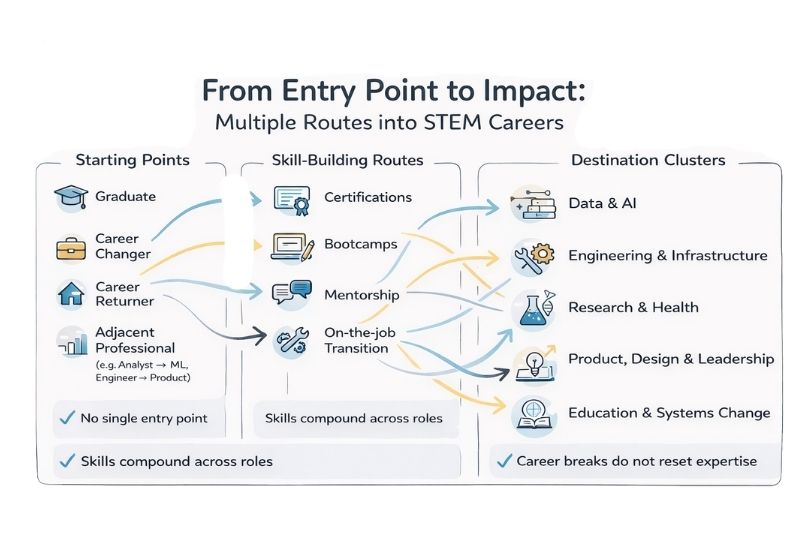
The central message is one of boundless potential. The traditional, rigid career ladder is a thing of the past. Today's professional landscape is more like a climbing frame, offering multiple routes to the top, sideways moves to new specialisms, and the flexibility to pause and pivot. Whether you're a recent graduate mapping out your first move, a professional returning to the workforce, or a seasoned expert aiming for a leadership role, the power to design your career is firmly in your hands.
Key Takeaways for Your Journey Forward
As you process this information and consider your options, let's crystallise the most important takeaways:
- Skills are Transferable: Notice the overlap in skills like problem-solving, data analysis, and communication? A strong foundation in one STEM area, like data analysis, can be a launchpad into another, such as machine learning or health informatics. Don't feel locked into one specialism forever.
- Continuous Learning is Non-Negotiable: The pace of technological and scientific advancement is relentless. The most successful professionals are those who embrace lifelong learning, consistently updating their skills through certifications, online courses, and hands-on projects. This commitment is your greatest asset.
- Your Network is Your Net Worth: We've highlighted the importance of mentorship and community for a reason. Surrounding yourself with supportive peers, experienced mentors, and inspiring role models provides not just guidance but also resilience. These connections, whether local or global, are crucial for navigating challenges and seizing opportunities.
Turning Inspiration into Action
Information is only powerful when acted upon. The gap between knowing about these fantastic jobs for women and actually landing one is bridged by deliberate, strategic action. Here are your immediate next steps:
- Conduct a Personal Audit: Revisit the roles that sparked your interest. Create a simple table comparing your current skills, passions, and long-term goals against the requirements and realities of each job. Where do you align? Where are the gaps? This self-reflection is the foundation of your action plan.
- Focus on One Skill: Instead of feeling overwhelmed by the need to learn everything at once, pick one technical or soft skill to develop over the next three months. This could be learning a specific programming language like Python, completing a UX design course, or taking a public speaking workshop. Small, consistent efforts build powerful momentum.
- Initiate a Conversation: Identify one person on a platform like LinkedIn who is in a role you admire. Craft a polite, concise message asking for a brief, 15-minute virtual coffee chat to learn about their journey. Many professionals are happy to share their insights, and this one conversation could provide invaluable clarity.
The journey into or through a STEM career is a marathon, not a sprint. It demands curiosity, perseverance, and a willingness to step outside your comfort zone. The paths we’ve detailed, from Cybersecurity Specialist to Research Scientist, are not just jobs; they are platforms for innovation, discovery, and personal growth.
By taking these small, deliberate steps, you are not just searching for a job. You are actively building a future where your talents can flourish, your contributions are valued, and your work has meaning. The world needs your perspective, your skills, and your passion.