
You’ve submitted your thesis, or you’re close. People keep asking the same question: what’s next?
For many women in STEM, finding a postdoc feels less like a job search and more like decoding a system that was explained to everyone else in the room. One person tells you to chase prestige. Another says funding matters more than topic. A third says to follow the PI, not the project. You may be carrying imposter syndrome, visa questions, family responsibilities, or the nagging sense that if you choose “wrong” now, you’ll pay for it later.
That pressure is real. So is the confusion.
Generic postdoc advice assumes a frictionless path: no career break, no bias, no need to assess whether a lab is productive only or is safe, equitable, and sustainable. That’s not how many women experience this stage. The unspoken rules matter. Who gets introduced to whom matters. Whether a PI sees you as a future colleague or as labour matters.
A good postdoc can sharpen your research identity, expand your methods, grow your network, and create the evidence base for your next move. A bad one can drain confidence, stall publications, and narrow options. Finding a postdoc isn’t only about getting an offer. It’s about choosing conditions in which you can do strong work and stay well enough to benefit from it.
Your Postdoc Journey Starts Here
The first shift is mental. Stop treating the postdoc search as a single yes-or-no contest. Treat it as a design problem.
You’re not only asking, “Who will take me?” You’re asking better questions. What kind of researcher do you want to become? Which environment will deepen your expertise without flattening your confidence? What trade-offs are acceptable now, and which ones will become expensive later?
This changes everything.
A lot of early-career researchers default to prestige because it’s visible. Prestigious labs can be excellent. They can also be chaotic, under-mentored, or built on assumptions that everyone can work around the clock. A smaller group with strong supervision, clean authorship practices, and genuine career support can be the better launchpad.
Practical rule: Choose for growth conditions, not just brand recognition.
Women in STEM face an extra layer of self-editing during this stage. They discount their fit if they don’t match every line of a job description. They describe achievements modestly. They interpret silence as proof they aren’t ready. None of that helps. Postdoc hiring is imperfect, relationship-driven, and shaped by timing, budget cycles, and institutional process. Rejection doesn’t always mean weak candidacy. Sometimes it means the slot vanished, the funding changed, or the PI already had someone in mind.
Finding a postdoc works better when you replace vague hope with deliberate criteria. You need a shortlist, a timeline, application materials that sound like you at your best, and a way to assess people as carefully as they assess you.
This is especially important if you are managing a return after maternity leave, caring duties, relocation, or a field pivot. You don’t need a perfect path. You need a strategic one.
Charting Your Course The Strategic Postdoc Search
Most mistakes happen before the first application is sent. People search too late, chase whatever appears most prestigious, and build no system for comparing options.
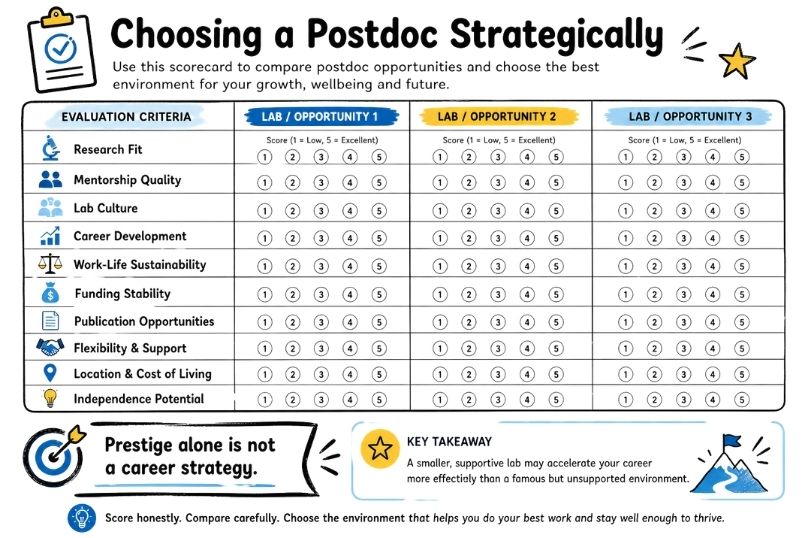
A better approach starts with a scorecard.
Build a postdoc scorecard
Create a document or spreadsheet and score each opportunity against the same criteria. Keep it practical. If you can’t compare options clearly, you’ll drift towards whichever lab feels most flattering.
Use factors like these:
Research fit
Does the project strengthen your core area, or give you a method you need next?Mentorship quality
Does the PI have a reputation for regular feedback, clear expectations, and fair credit?Lab culture
Are people collaborative, or does the group run on scarcity and competition?Career development
Will you be supported to apply for fellowships, attend conferences, supervise students, or learn new techniques?Working model
Are the hours realistic? Is there flexibility if your life includes caring responsibilities or a dual-career partnership?Location and mobility
Can you live there, afford it, and build support around yourself there?
This scorecard protects you from making a decision based only on project title or institutional name.
Work backwards from your next move
The best postdoc isn’t always the most exciting one on paper. It’s the one that makes your next move easier.
If you want an academic pathway, prioritise places where you can publish strong work, build independence, and develop grant-writing exposure. If you’re considering industry, translational research, policy, or research infrastructure roles, you may need different assets: cross-functional collaboration, applied methods, exposure to non-academic stakeholders, or data-intensive project management.
Ask yourself:
- What do I want to be known for in three years?
- What skill is currently missing from my profile?
- What environment will let me produce visible work without burning out?
- Which trade-off would I regret most: less prestige, less support, less autonomy, or less stability?
Write the answers down. Vague ambition creates vague targeting.
Use a timeline, not bursts of panic
Finding a postdoc goes better when you start early enough to notice patterns. Funding schemes, PI hiring plans, visa timelines, and conference conversations rarely align.
A workable rhythm looks like this:
| Phase | What to do |
|---|---|
| Early exploration | Map fields, methods, and labs of interest. Read recent papers. Notice who collaborates with whom. |
| Relationship building | Reconnect with supervisors, examiners, collaborators, and alumni. Ask for insight, not favours. |
| Opportunity tracking | Keep one live list of labs, deadlines, funding routes, and contact history. |
| Application window | Tailor outreach, CV, research statement, and fellowship material for each target. |
| Decision stage | Compare offers against your scorecard, not against panic. |
If you need a place to monitor live roles while building your shortlist, browse next job opportunities in STEM and track them alongside direct PI-led opportunities.
Target people, not just institutions
A strong postdoc experience depends more on the supervisor than on the university. Look closely at the PI.
Read their recent papers and acknowledgements. Check whether former postdocs have moved into roles they wanted. Look for signs of intellectual generosity. Do they co-author across career stages? Do they support independent lines of work? Do they seem to train researchers, or only use them?
A famous lab can still be the wrong lab if the supervision is thin and the expectations are opaque.
Also check the layer around the PI. Departmental administrators, institute managers, and senior postdocs shape your day-to-day experience more than a glossy lab website ever will.
Crafting Your Narrative Applications That Open Doors
Applications fail for two opposite reasons. Some are too generic. Others drown in detail and never make the case for why this lab should invest in this person, now.
Your materials need to do three things at once: show evidence of strong research, show where you’re going next, and make it easy for a PI to imagine working with you.
Lead with research identity, not biography
Your CV and cover letter aren’t there to recount everything you’ve done. They’re there to establish a coherent professional argument.
That argument sounds like this: I work on this problem. I use these methods. I’ve produced these outputs. I now want to apply or expand that expertise in your environment because there’s a clear scientific fit.
Women undersell here by describing tasks rather than contribution. Don’t write as though you only assisted your own doctorate. If you designed experiments, built a pipeline, developed a protocol, led analysis, managed collaborations, or trained others, say so plainly.
If you want a useful refresher on understanding the key differences between a resume and a CV, that distinction matters because postdoc hiring expects an academic CV that shows research depth, not a brief general employment summary.
What to include in an academic CV
A postdoc CV should be lean, readable, and evidence-based. It does not need decorative language.
Include:
Research profile
A short opening summary with your field, methods, and current research question.Education and thesis information
Include thesis title, supervisors, and completion status if you’re near submission.Publications and preprints
Separate peer-reviewed work, preprints, and other outputs if needed.Methods and technical strengths
Name the approaches you can use independently.Funding, awards, and invited talks
These help a PI assess external validation and visibility.Teaching, supervision, and leadership
Include mentoring of students, lab coordination, committee work, and outreach where relevant.
For practical formatting help, this guide on how to write a STEM CV is worth reviewing before you send anything.
Write fewer applications, but make them sharper
There’s useful evidence against both extremes: random mass application and prestige-only targeting. Data from one postdoctoral applicant showed that strategically narrowing to 18 targeted applications increased success to 56% from 45%, and the same source reports that 88% of principal investigators prioritise strong research experience while 46% value demonstrated interest in novel scientific fields (application statistics from PhD to postdoc).
That tells you what works. Quality and volume both matter, but only when the applications are selected with intent.
A good application portfolio mixes:
| Application type | Why it belongs in your mix |
|---|---|
| Prestigious fellowship | High visibility and independence if you win it |
| PI-funded postdoc | Faster route to a concrete role |
| Institutional fellowship | Useful where departments have structured support |
| Industry research role | Strong option if you want applied science or broader career flexibility |
The cold or warm email that gets read
Your first message to a PI should be short enough to read on a phone and specific enough to prove you chose them deliberately.
Use this structure:
- One line on who you are and your current stage.
- One sentence showing you know their work.
- Two to three lines on your relevant expertise.
- One line on the fit between your next step and their lab.
- A clear ask.
Here’s a practical template you can adapt:
Subject: Prospective postdoc in [area]
Dear Dr [Name],
I’m completing my PhD in [field] at [institution], where my work focuses on [topic]. I’ve been reading your recent work on [specific theme or paper], particularly your approach to [specific method, question, or model].My doctoral research has involved [brief evidence of fit: method, system, dataset, or result]. I’m especially interested in extending this through [new technique, application, or conceptual question], which is why your group stood out.
I’m exploring postdoctoral opportunities for [timeframe] and wanted to ask whether you anticipate recruiting in this area, or whether there may be scope to discuss fellowship applications aligned with your lab’s research. I’ve attached my CV and would be glad to send a brief research summary if helpful.
Best wishes,
[Name]
What doesn’t work:
- Long autobiographies
- Empty praise
- “I am interested in any opportunity in your esteemed lab”
- Attachments with no explanation
- Sending the same message to ten PIs with only the name changed
If your email could be sent to another PI without edits, it isn’t ready.
Frame career breaks as evidence of return, not damage
If you’ve had a break, don’t apologise for it. Explain it briefly where relevant, then redirect attention to readiness, recent activity, and scientific focus.
Good framing sounds like this: after a career break, you refreshed technical knowledge, maintained engagement through reading or networks, and are now returning with a clear research agenda. The tone matters. Calm, factual, and forward-looking beats defensive every time.
Securing Funding and Navigating Global Pathways
Many postdoc searches fail because candidates treat funding as an afterthought. It isn’t. In plenty of cases, the question isn’t whether a PI likes your profile. It’s whether there is money, whether the timing aligns, and whether you can build a viable route across institutions and borders.
Don’t build your whole plan around one fellowship
The clearest warning sign comes from Europe’s best-known scheme. The 2025 Marie Skłodowska-Curie Actions postdoctoral fellowship programme awarded €404.3 million to 1,610 researchers with a 9.6% success rate from 17,066 applications, down from 16.6% in 2024. The same report notes a 65% jump in proposals compared to 2024, and that the UK secured 347 awards, the highest count in Europe (Times Higher Education on the MSCA postdoctoral fellowship results).
The lesson isn’t “don’t apply”. It’s “don’t apply only there”.
For finding a postdoc, funding works best as a portfolio. Pair elite fellowships with institution-led posts, national schemes, and direct PI conversations. If one route moves slowly, another may convert faster.
Compare funding routes by control and risk
Different funding models create different working conditions.
| Route | Main upside | Main trade-off |
|---|---|---|
| PI-funded role | Clear project, faster hiring | Less independence over topic |
| Independent fellowship | Strong autonomy and profile | Highly competitive, heavy application burden |
| Institutional fellowship | Structured support and training | Often narrower eligibility windows |
| Industry postdoc | Applied research and broader career options | Publication norms may differ |
If you’re searching internationally, keep a separate document for visa status, residency questions, and family logistics. A brilliant offer can still be unworkable if the immigration pathway is fragile or too slow for your timeline. This practical guide to finding jobs abroad is useful for structuring the non-research side of an international move.
Think in regions, not just schemes
In the UK, many candidates focus heavily on UKRI-linked routes and major named fellowships. In the USA, candidates need to understand NIH or NSF norms within their field and the role of PI grant support. In Canada, NSERC-linked environments may matter more in some disciplines. In Australia, ARC-linked ecosystems shape many academic pathways.
The exact names vary by field. The strategic principle doesn’t. Build a map of:
- National funders
- University or institute fellowships
- PI-held grants
- Charities and foundations
- International mobility schemes
- Industry research programmes
If you need a starting point for awards, fellowships, and visibility-building opportunities, review women in STEM awards and recognition routes as part of your broader funding map.
A useful primer on how researchers think about postdoc searching and fit sits below.
What a strong fellowship idea usually includes
A weak proposal sounds like a PhD continuation with better branding. Reviewers and hosts want more than that.
A stronger proposal shows:
- A clear research question that matters in the field
- A method or dataset match between you and the host lab
- A training case for why this environment adds something you do not already have
- A realistic workplan
- A future trajectory, not just a short-term project
That final point matters. Funders want to know what this postdoc enables. If your application can’t explain the arc from past work to proposed project to future independence, it will feel incomplete.
The Interview and Negotiation Masterclass
A postdoc interview is not a viva replay. It’s a professional evaluation about future work, future fit, and future conditions.
Too many candidates approach it like a gratitude exercise. They prepare to impress, but not to assess. That’s risky. The interview is one of the few moments when you can test whether the lab’s public story matches private reality.
Prepare for evidence, not performance
Your job talk or research presentation needs one strong spine. Don’t try to prove everything you’ve ever done.
A solid structure is simple:
- The problem
- Why it matters
- What you did
- What you found
- What you’d do next in this new environment
That last part is where many candidates weaken. They present the PhD beautifully, then stop. A PI is hiring for the next project, not awarding a prize for your previous one.
Expect questions in four broad areas:
Scientific judgement
Why did you choose that method? What would you do differently?Research independence
Which ideas were yours? What would you lead next?Collaboration style
How do you handle disagreement, feedback, or shared projects?Practical readiness
When can you start? What support would you need?
Ask questions that reveal the lab's true nature
Most candidates ask polite but uninformative questions. “What is the lab culture like?” will rarely get an honest answer.
Ask operational questions instead.
Try these:
- How often do you meet one-to-one with postdocs?
- How are authorship decisions usually handled in this group?
- What does a successful first year look like here?
- How much freedom do postdocs have to shape side projects or fellowship applications?
- How do people in the lab usually communicate when timelines slip?
- What support exists for mentoring, teaching, or career development outside the core project?
You’re listening for clarity, not charm. Evasive answers matter. So does overconfidence.
Ask for specifics. Good labs can describe their practices without getting defensive.
If you meet lab members separately, ask them what they wish they had known before joining. That question surfaces the truth faster than anything else.
Negotiate conditions, not just salary
Women are encouraged to be “easy to work with” at exactly the moment they should be getting precise. Postdoc terms shape productivity. If you need equipment access, flexible start dates, relocation help, conference budget, or clarity on hybrid working, ask.
Useful phrasing:
I’m interested in the role. Before finalising, I’d like to clarify the conditions that would help me contribute strongly from the start.
For specific issues, keep the tone practical:
Start date
“I can begin in [month]. If needed, could we discuss a later start to accommodate visa or caring logistics?”Relocation support
“Is there any institutional support for relocation or settling-in costs?”Research resources
“To deliver the project effectively, I’d like to confirm access to [equipment, dataset, software, or training].”Working expectations
“How are core working hours and out-of-hours expectations usually handled in the group?”Professional development
“Would there be support for fellowship applications and conference travel during the appointment?”
If negotiation feels uncomfortable, reframe it. You are not asking for favours. You are reducing friction so the research can succeed.
For more confidence-building language and tactics, this guide on how to negotiate professionally can help you prepare your wording in advance.
Watch what happens after the interview
The process itself is data.
Did they communicate clearly? Did they respect your time? Were expectations transparent? Did anyone ask inappropriate questions about family plans, mobility, or your personal life? Did the lab members seem relaxed or careful?
A postdoc is too consuming to enter on guesswork alone. If the process feels disorganised, opaque, or subtly dismissive, pay attention.
Thriving as a Woman in STEM Beyond the Offer Letter
Getting the offer isn’t the finish line. It’s the point where the true conditions of your next chapter begin.
A lot of postdoc advice still treats hardship as proof that you’re doing serious science. Long hours become a badge. Stress gets normalised. Isolation gets reframed as independence. That story harms people, and it harms science.
Prestige doesn’t protect your wellbeing
For UK postdocs, the warning signs are plain. 52% report poor mental health, and 62% of women in STEM report imposter syndrome. The same body of evidence highlights that 46% of women with STEM degrees leave the sector, while returner-focused fellowships can boost retention by 35%, yet awareness of support such as UKRI’s Returners to Research grants remains low (discussion of the long game in finding a postdoc).
Those figures are UK-specific, but the pattern will feel familiar in many countries. High pressure, short-term contracts, mobility demands, and uneven supervision create risk. Women carry additional invisible labour: pastoral support, diversity work, family coordination, and the emotional cost of proving they belong.
If a role advances your CV but damages your capacity to function, it isn’t a strong career move.
Vet wellbeing before you join
Don’t wait until you’ve relocated to find out how a lab handles pressure.
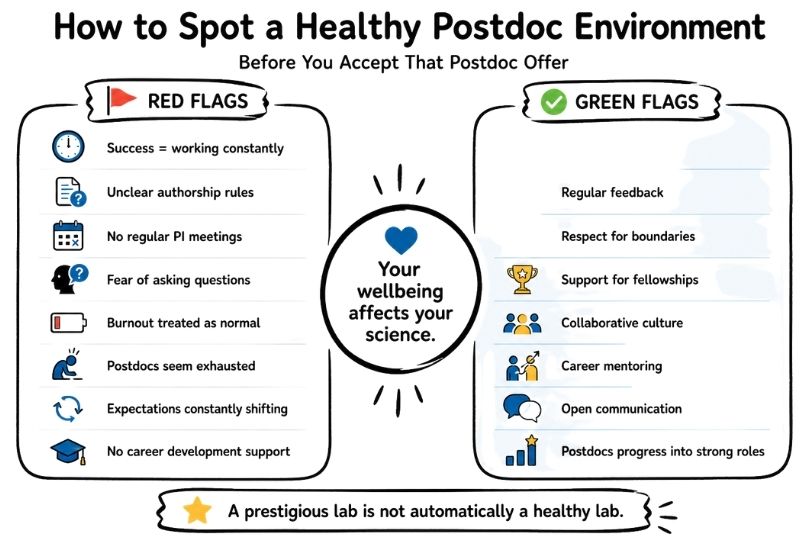
Use a simple red-flag checklist.
| Green flags | Red flags |
|---|---|
| Expectations are stated clearly | Success is described only as “working hard” |
| Postdocs can explain meeting rhythms and feedback | Nobody can tell you how decisions get made |
| Lab members speak openly without looking anxious | People sound careful, vague, or exhausted |
| The PI supports development beyond one paper | Every answer centres on output only |
| There’s evidence of respect for boundaries | Late-night urgency is treated as normal |
Ask directly about support structures. Is there an employee assistance programme? Is there a trusted departmental contact if things go wrong? Are there peer networks, women-in-science groups, or union representatives? You’re not being difficult. You’re checking whether the institution takes researchers seriously as people.
A lab that cannot discuss wellbeing in concrete terms hasn’t built for it.
For returners, your break is part of the story, not the end of it
Women returning after maternity leave, caring responsibilities, illness, relocation, or time in industry assume they must “erase” the gap. That backfires.
A better approach is to make the timeline legible and then shift attention to re-entry momentum. In your CV or cover letter, state the break briefly if relevant to chronology. Then show current readiness through updated reading, recent training, collaborations, conference participation, writing, or renewed technical work.
What helps in practice:
Name the break succinctly
Keep it factual and unembarrassed.Show active re-engagement
Mention recent workshops, methods refreshers, manuscript work, or networking activity.Target returner-aware environments
Some schemes and supervisors understand that excellent researchers don’t all move in uninterrupted lines.Prepare a confident interview answer
Explain what you’re returning to and why now is the right moment.
For UK-based returners, schemes such as the Daphne Jackson Trust can be important to investigate. More broadly, look for hosts who understand phased return, part-time structures where available, and realistic onboarding.
Build a support system on purpose
Relocation strips away the routines that kept you steady. New city, new lab, new admin system, new expectations. If you move internationally, that strain increases.
Don’t leave community to chance. Before you start, identify:
- one scientific mentor inside the lab
- one person outside the lab who can give candid perspective
- one peer group or network in your institution or field
- one non-work routine you’ll protect from the first month
That last point matters more than people think. Exercise, faith community, school pick-up pattern, weekend call with friends, language class, anything grounded and repeatable. Postdocs become consuming when work is the only structure left standing.
Define success more broadly than output alone
Publications matter. So do methods, collaborations, teaching, funding skills, and clarity about what you want next.
A strong postdoc leaves you with more than papers. It leaves you more credible, more connected, and more able to choose. If your current environment is making you smaller, quieter, or constantly depleted, don’t romanticise that as resilience.
The aim isn’t just to survive a postdoc. It’s to finish one with options.
Your Launchpad Your Network
Finding a postdoc asks more of you than polished documents. It asks for judgement. You need to know which opportunities fit, which trade-offs are worth making, and which warning signs to believe the first time you see them.
The strongest candidates aren’t the ones who appear endlessly confident. They’re the ones who approach the process strategically. They target well, present their work clearly, diversify their funding routes, interview with discernment, and protect the conditions that let them do good science.
That approach is easier with community around you..