
Women in STEM are often taught that credibility comes from technical excellence alone. Accuracy matters. Precision matters. Scientific rigor matters. Compliance matters. In many environments, particularly in regulated industries such as pharmaceuticals, biotechnology, healthcare, engineering, and artificial intelligence, technical competence is treated as the gold standard of professional legitimacy.
Yet many women discover that expertise alone does not always translate into influence.
A scientist may produce exceptional work yet struggle to have concerns heard in meetings. A compliance professional may identify operational risks but feel pressure to remain silent in order to avoid conflict. An engineer may notice problematic behaviour within a team but worry that speaking up will damage relationships or career progression. A leader may technically hold authority while still navigating environments where psychological safety is weak and ethical concerns are subtly dismissed.
This tension sits at the heart of a growing conversation about leadership in STEM. Technical competence remains essential, but modern leadership increasingly requires something more: the ability to integrate ethical judgment, emotional intelligence, and organisational awareness into everyday decision-making.
These themes are increasingly being explored by leaders working at the intersection of governance, regulation, and workplace culture. One such voice is Dr. Elizabeth Gilbert, President of Trinity National Consulting and developer of the Trinity Pillars™ Framework for Ethical Leadership in Regulated Industries. With more than 20 years of experience in pharmaceutical quality systems, regulatory governance, and leadership development, Dr. Gilbert specialises in bridging compliance excellence with human-centred leadership.
She also serves as a Senior Advisor and Executive Consultant with PQE Group, supporting quality, compliance, and regulatory strategy initiatives across life sciences organisations. Her expertise spans FDA Quality Management System Regulation, ISO 31000 risk management principles, and emerging AI governance standards. As both a published researcher and leadership expert working within highly regulated sectors, she brings a practical perspective to conversations around integrity, influence, and ethical power in STEM.
That is where the concept of ethical power becomes important.
Ethical power is not about aggression, dominance, or authority for its own sake. It is the ability to influence systems, decisions, and culture while remaining aligned with professional integrity and human values. It is the capacity to hold boundaries, identify risks, and lead responsibly even within complex or high-pressure environments.
For women in STEM, this often involves navigating contradictory expectations. Many are expected to demonstrate confidence without appearing “difficult,” leadership without appearing “controlling,” and compassion without appearing “weak.” In highly regulated sectors, there can also be immense pressure to prioritise productivity, speed, or commercial objectives over long-term ethical thinking.
The result is that many professionals become highly skilled technically while receiving very little training in ethical influence, boundary-setting, or culture navigation.
This gap has significant consequences.
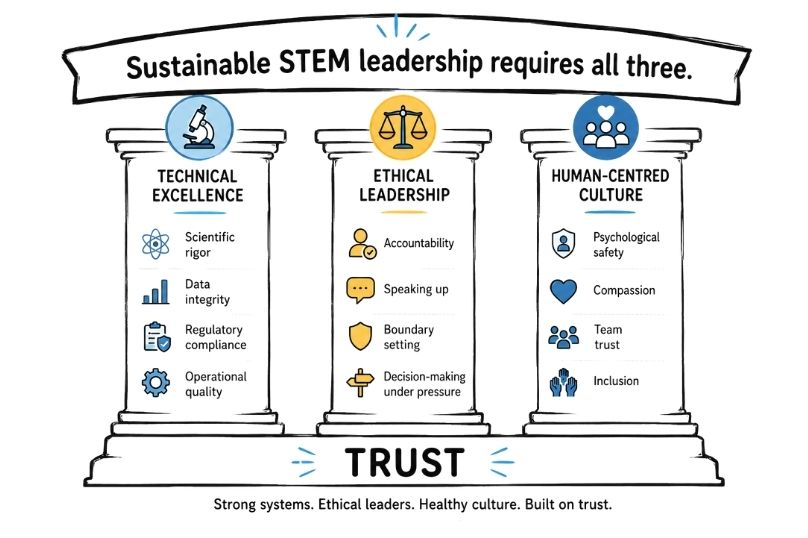
Compliance Alone Does Not Create Ethical Organisations
Many organisations invest heavily in compliance systems. Policies are written. Training modules are completed. Governance frameworks are introduced. Risk registers are maintained. Audits are performed.
These systems are important. Regulation protects industries, consumers, patients, and public trust.
However, history repeatedly demonstrates that compliance structures alone are not enough to prevent ethical failures.
Some of the most serious failures across healthcare, pharmaceuticals, finance, and technology occurred within organisations that technically had compliance systems in place. The issue was often not the absence of rules. The issue was culture.
When employees feel unable to raise concerns, compliance becomes performative rather than protective. When leadership discourages challenge or transparency, ethical risk increases regardless of how sophisticated the governance framework appears on paper.
This is particularly relevant in STEM fields where complexity can create power imbalances. Technical language may obscure concerns. Junior professionals may hesitate to question senior experts. Teams may prioritise output over reflection. High-pressure environments can normalise behaviours that gradually erode ethical standards.
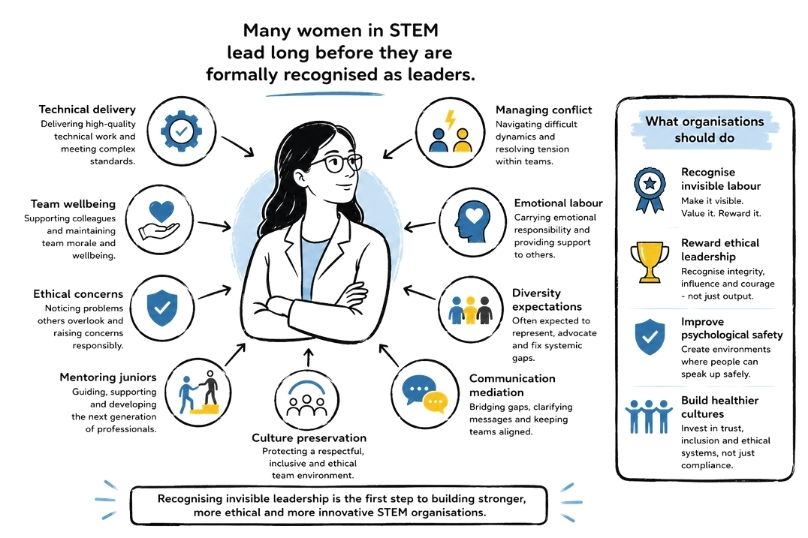
Women in STEM can sometimes find themselves carrying invisible ethical labour within these environments. They may become the individuals who notice interpersonal harm, challenge inappropriate conduct, or attempt to preserve collaborative culture while also maintaining technical responsibilities.
Yet this work is often undervalued because it is less visible than measurable outputs.
The Importance of Defining Personal Non-Negotiables
One of the most important aspects of ethical leadership is identifying personal non-negotiables before difficult situations arise.
In practice, many ethical failures do not begin with dramatic wrongdoing. They begin with small compromises.
A concern is ignored because “this is how things are done.” A questionable decision is accepted because challenging it feels professionally risky. An unhealthy workplace behaviour is tolerated because everyone else appears comfortable with it.
Over time, repeated compromises can create environments where individuals lose confidence in their own judgment.
Defining personal non-negotiables helps professionals recognise when a line is being crossed.
These non-negotiables may involve scientific integrity, treatment of colleagues, transparency, patient safety, diversity, confidentiality, or honesty in reporting. They differ between individuals, but the principle remains consistent: ethical clarity strengthens decision-making under pressure.
This does not mean every workplace disagreement becomes a moral crisis. STEM environments require collaboration, negotiation, and flexibility. However, professionals who have reflected on their values beforehand are often better equipped to respond calmly and decisively when genuine ethical concerns emerge.
Importantly, this process is not only about protecting others. It is also about protecting oneself from gradual moral exhaustion.
Many professionals experience burnout not solely because of workload, but because of prolonged misalignment between personal values and organisational behaviour.
Recognising Red Flags in Workplace Culture
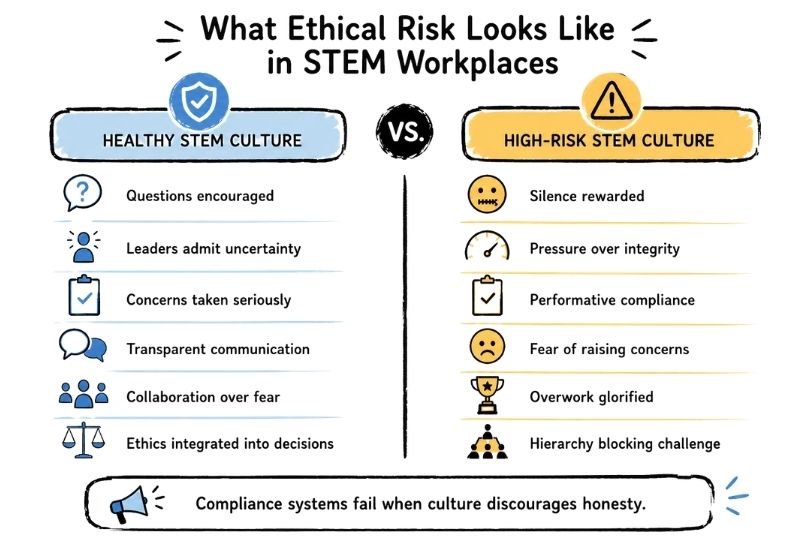
Ethical leadership also requires the ability to recognise unhealthy cultural dynamics early.
Not every difficult workplace is unethical. STEM industries are often high-pressure by nature. Deadlines, regulatory demands, research uncertainty, and commercial constraints can create stress. However, certain patterns consistently indicate elevated ethical risk.
These may include:
• Leadership discouraging questions or dissent
• Punitive reactions to mistakes or concerns
• Lack of transparency around decision-making
• Pressure to compromise scientific rigor for speed or image
• Excessive hierarchy preventing open discussion
• Individuals being marginalised after raising concerns
• “Hero culture” where overwork is glorified
• Performative diversity initiatives without structural support
• Ethical language being used primarily for branding purposes
Women and underrepresented groups may notice these patterns earlier because they are often more exposed to the consequences of poor culture. However, identifying a problem and knowing how to respond are very different challenges.
This is why practical leadership frameworks matter.
Professionals need tools for navigating difficult situations strategically rather than emotionally. They need methods for documenting concerns, setting boundaries, communicating effectively, and protecting professional credibility.
Ethical leadership is not simply about having good intentions. It requires operational skills.
Compassion and Professional Authority Are Not Opposites
One persistent misconception in many technical fields is that compassion somehow weakens authority.
In reality, the opposite is often true.
Leaders who demonstrate emotional intelligence, empathy, and psychological awareness frequently build stronger teams, better communication systems, and healthier organisational cultures. Compassion improves retention, trust, and collaboration. It reduces fear-based communication and increases the likelihood that problems will be identified early.
This is particularly important in regulated industries where silence can have serious consequences.
A psychologically unsafe environment increases operational risk because people become less willing to report concerns, admit uncertainty, or challenge flawed assumptions.
Compassion therefore has practical value. It is not separate from performance. It contributes directly to organisational resilience.
For women in STEM, however, compassion can sometimes become complicated because gender stereotypes may cause empathetic leadership styles to be undervalued or misinterpreted.
Some professionals respond by suppressing relational skills in order to appear more authoritative. Others become trapped in emotional labour roles where they are expected to support team wellbeing without receiving corresponding recognition or advancement.
The goal is not to reject compassion. The goal is to integrate compassion with clear professional boundaries and strategic leadership.
Compassion without boundaries can lead to exhaustion. Authority without compassion can damage culture. Sustainable leadership requires both.
Ethical Leadership in the Age of AI and Emerging Technologies
The conversation around ethical power has become even more important with the rapid expansion of artificial intelligence and emerging technologies.
Many STEM professionals are now working in environments where innovation is moving faster than governance structures can adapt. Questions around bias, privacy, transparency, accountability, automation, and human oversight are becoming central to leadership discussions.
Technical expertise alone cannot solve these issues because the challenges are not purely technical. They are ethical, societal, and organisational.
This creates both pressure and opportunity for women in STEM.
Historically, leadership in emerging technologies has often prioritised disruption and speed over reflection and accountability. However, there is increasing recognition that sustainable innovation requires broader perspectives and stronger ethical frameworks.
Professionals who can bridge technical competence with ethical reasoning will likely become increasingly valuable across industries.
The future of STEM leadership will not simply belong to those who build systems fastest. It will belong to those who can build systems responsibly.
Building Influence Without Losing Integrity
One of the most difficult aspects of leadership is understanding how to build influence without compromising values.
Many professionals assume they must choose between authenticity and advancement. They fear that maintaining integrity will limit opportunities or create professional isolation.
In some environments, this concern is understandable.
However, ethical influence is often built gradually through consistency rather than confrontation. Credibility develops when professionals become known for sound judgment, reliability, fairness, and thoughtful decision-making over time.
This does not require perfection. It requires alignment.
Professionals who communicate clearly, maintain boundaries, and demonstrate principled leadership frequently become trusted voices within organisations even if they are not the loudest people in the room.
Importantly, ethical power does not always look dramatic. Sometimes it is visible in small decisions:
• Asking a difficult question respectfully
• Refusing to manipulate data presentation
• Supporting a junior colleague who raises concerns
• Challenging harmful behaviour calmly rather than aggressively
• Creating psychologically safe discussions within teams
• Maintaining integrity during periods of organisational pressure
These actions shape culture more than many people realise.
Culture is not created solely by executive statements or mission documents. It is reinforced daily through behaviour, incentives, and responses to pressure.
Why These Conversations Matter
The STEM workforce is evolving rapidly. Organisations are increasingly recognising that technical expertise alone does not guarantee effective leadership or healthy culture.
At the same time, many professionals remain underprepared for the ethical and interpersonal complexity of modern STEM environments.
Leadership development often focuses heavily on performance metrics, strategic planning, and operational management while giving insufficient attention to integrity, culture, psychological safety, and ethical influence.
This gap affects organisations at every level.
It affects innovation quality. It affects retention. It affects governance. It affects public trust.
For women in STEM, these conversations also intersect with broader issues around representation, visibility, authority, and inclusion. Ethical leadership is not only about individual success. It is about helping create environments where others can contribute safely and meaningfully as well.
Dr. Elizabeth Gilbert explores many of these themes in her short webinar, “Beyond Compliance: Building Ethical Power as Women in STEM.”
Members interested in watching the webinar can access it here: Women in STEM Network On-Demand Workshops for Women