
Modern leadership has a busyness problem. Look at almost any leadership conference, business book, or productivity article and the message is often the same: work harder, move faster, be more productive, and achieve more. Many professionals spend their careers trying to become more efficient, more responsive, and more capable of managing increasing demands, with success frequently measured by packed calendars, overflowing inboxes, and long working hours. Yet some of the most effective leaders develop a very different skill. They learn when to stop. Not by reducing ambition or avoiding responsibility, but by creating space to pause, reflect, and think. In a world that celebrates constant activity, the ability to step back and gain perspective has become one of the most valuable, and often overlooked, leadership capabilities.
Why Leaders Struggle to Pause
For many professionals, pausing feels uncomfortable because there is always something demanding attention. Another email to answer, another meeting to attend, another deadline to meet, or another problem to solve. Leaders often carry responsibility for teams, projects, organisations, clients, customers, and stakeholders, and the demands can feel relentless. As a result, reflection becomes something people plan to do later, yet later rarely arrives. Instead, many leaders move continuously from one issue to the next, making rapid decisions and responding to challenges as they emerge. While this can create the appearance of productivity, it often comes at a cost. Without opportunities to step back and think strategically, leaders can lose sight of priorities, overlook important risks, miss emerging opportunities, and become trapped in patterns that no longer serve either themselves or their organisations.
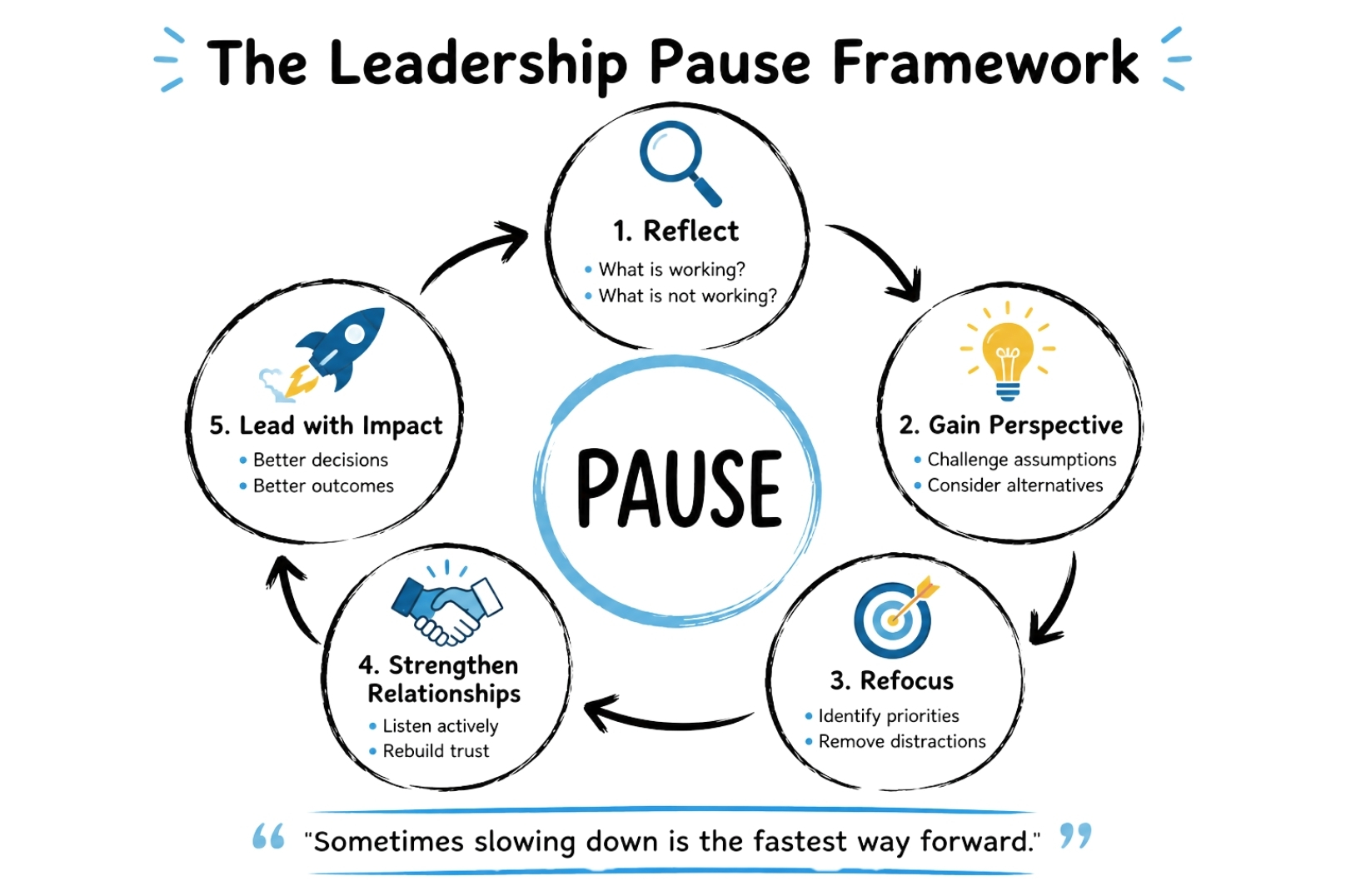
The Difference Between Activity and Impact
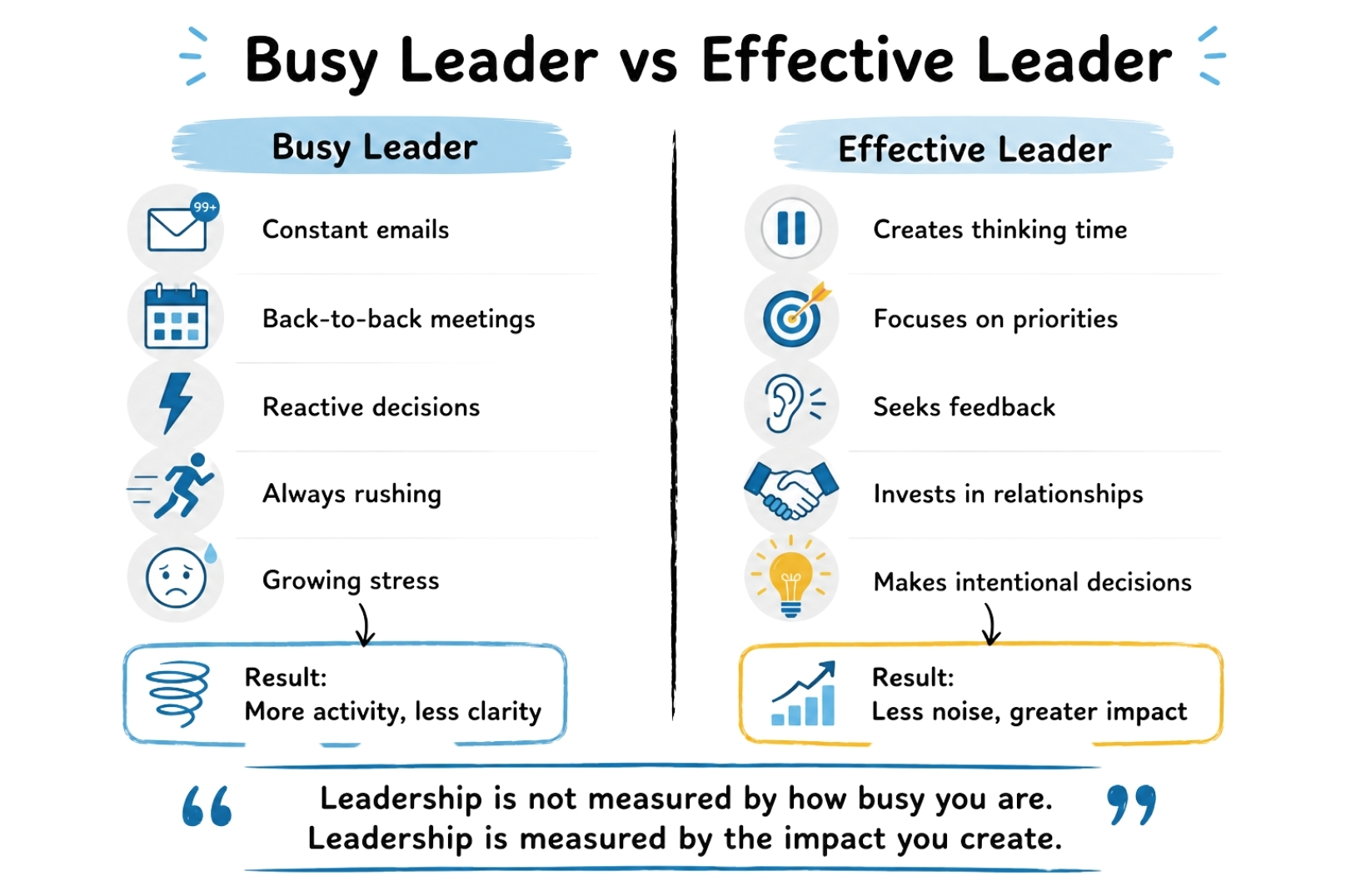
One of the biggest misconceptions in professional life is the belief that activity automatically creates results.
Being busy and being effective are not the same thing.
Many professionals spend enormous amounts of time working on tasks that contribute little to their long-term objectives.
Some become so focused on responding to immediate demands that they never have the opportunity to consider whether those demands deserve their attention in the first place.
Effective leaders understand that every commitment carries an opportunity cost.
Every hour spent on one activity is an hour that cannot be invested elsewhere.
Pausing allows leaders to ask critical questions:
- Is this really a priority?
- What outcome am I trying to achieve?
- Am I focusing on the activities that create the greatest impact?
- What should I stop doing?
- What deserves more attention?
Without reflection, these questions often remain unanswered.
Better Decisions Require Thinking Time
Leadership ultimately involves making decisions, some small and routine, others with significant implications for teams, organisations, careers, and long-term strategy. The quality of those decisions depends heavily on the quality of thinking behind them. When leaders operate under constant pressure, decision-making can become reactive, with people relying on familiar solutions, assumptions, or incomplete information simply because there is no time to think more deeply. Pauses create opportunities for better judgement. Stepping away from a challenge, even briefly, allows information to be processed more effectively, helping new perspectives emerge, risks become more visible, and alternative solutions come into focus. Many leaders can recall moments when their best ideas arrived during a walk, while exercising, during a conversation, or after taking a short break from a problem. This is not a coincidence. The brain often needs space to make connections and identify patterns that are difficult to see when attention is consumed by immediate demands and constant activity.
The Leadership Blind Spot
Another reason pauses matter is that they support self-awareness, one of the most important qualities of effective leadership. Most leaders believe they understand how they are perceived by others, yet leadership research consistently shows that this is not always the case. There is often a significant gap between how leaders see themselves and how colleagues, employees, and stakeholders experience them. A leader may believe they are empowering their team while employees feel unsupported. A manager may think they communicate clearly while colleagues remain confused about expectations. An executive may view themselves as decisive while others perceive them as dismissive. These disconnects can be difficult to recognise without reflection. Developing self-awareness requires leaders to examine their behaviour honestly, seek meaningful feedback, and remain curious about the impact their actions have on others. This process cannot happen effectively when people are moving continuously from one task to the next. It requires time, attention, and a willingness to pause long enough to gain a clearer understanding of both themselves and those around them.
Relationships Need Space
Leadership is fundamentally about people. Regardless of industry, sector, or role, leaders achieve results through relationships. Strong professional relationships support better communication, greater trust, stronger collaboration, increased innovation, and healthier organisational cultures. However, relationships are often among the first things to suffer when workloads become overwhelming. People become focused on completing tasks rather than having meaningful conversations, listening declines, meetings become increasingly transactional, and important discussions are postponed or avoided altogether. Over time, this can lead to misunderstandings, reduced engagement, and an erosion of trust. Leaders who intentionally create space for genuine conversations often find that many challenges become easier to address. Employees feel valued and heard, teams become more engaged, issues surface earlier, and collaboration improves. While relationship-building can sometimes feel less urgent than other demands, the time invested in developing strong connections frequently delivers some of the most significant returns for both leaders and their organisations.
Pausing Is Not Doing Nothing
One reason many professionals resist the concept of pausing is that they associate it with inactivity.
In reality, pausing is not about doing nothing.
It is about creating deliberate space for activities that are essential but often neglected.
These activities may not always appear productive in the traditional sense, yet they are often responsible for some of the most important leadership decisions and breakthroughs.
- Reflection.
- Planning.
- Listening.
- Learning.
- Observing.
- Evaluating.
- Strategic thinking.
The goal is not to work less.
The goal is to work more intentionally.
Small Pauses Can Make a Big Difference
Pausing does not necessarily require a week-long holiday or an extended retreat. In many cases, small, intentional pauses can have a significant impact on leadership effectiveness. A short walk between meetings, ten minutes of uninterrupted thinking time, an honest conversation with a trusted colleague, a review of priorities at the start of the week, or simply taking a moment to consider how others may experience a decision before implementing it can all provide valuable opportunities for reflection. These brief moments help leaders remain aligned with their goals, values, and long-term objectives while reducing the risk of operating in a constant state of reaction. The most effective leaders are rarely those who simply work the longest hours or carry the heaviest workloads. More often, they are the individuals who think most carefully about where their time, attention, and energy will create the greatest impact.
Learn More in Our On-Demand Webinar
This topic was explored in greater depth during a recent Women in STEM Network webinar featuring executive coach and author Phyllis Sarkaria.
The session examined how intentional pauses can strengthen leadership effectiveness, improve decision-making, enhance self-awareness, and help professionals focus on what matters most.
Women in STEM Network members can watch the full webinar recording here: https://womeninstemnetwork.com/on-demand-workshops-for-women/
About the Speaker
Phyllis Sarkaria is a certified executive coach, facilitator, and trusted adviser who works with leaders on one of the most consequential and least examined gaps in leadership: the distance between how leaders see themselves and how they are actually experienced.
She is the Founder of The Sarkaria Group and brings more than 30 years of corporate leadership experience to her work, including executive roles in human resources and government affairs. Throughout her career she has led functions as diverse as strategic planning, merger integration, organisational effectiveness, and team development.
Before founding her consultancy, Phyllis served as Head of Human Resources and internal coach to C-suite executives at Quidel Corporation, now QuidelOrtho, a multinational medical diagnostics company.
She is the author of Courageous Clarity: Navigating the Way Forward on Your Leadership Journey and the forthcoming Harvest: A Leadership Story. Together, these books explore what it takes for leaders to close the gap between intention and impact, improve self-awareness, and create stronger organisational cultures.
Learn more about Phyllis:
Website:
https://sarkariagroup.com/
LinkedIn:
https://www.linkedin.com/in/phyllis-sarkaria/
Harvest: A Leadership Story is available via:
US:
https://www.amazon.com/Harvest-Leadership-Story-Phyllis-Sarkaria-ebook/dp/B0H31M15PD/
UK:
https://www.amazon.co.uk/Harvest-Leadership-Story-Phyllis-Sarkaria-ebook/dp/B0H31M15PD/