
Maternity leave is that protected time off you're entitled to as a new mother, giving you a chance to recover from childbirth and get to know your new baby. It’s a core right that protects your job while you’re away and, in many countries, ensures you receive some level of pay. Just how much time you get and what you’re paid, however, can vary wildly depending on where you live and who you work for.
Understanding Your Maternity Leave Rights: A Global Overview
Trying to figure out maternity leave can feel like you’ve been handed a puzzle with no picture on the box. It’s a mix of legal jargon, company policies, and deeply personal decisions. I like to think of it as a bridge connecting two huge chapters of your career: life before becoming a parent, and life after.
For women in demanding fields like STEM, this support is absolutely vital. It's designed to help you navigate this massive life change without having to sideline your career. This guide will walk you through the essentials from a global perspective, so you can build your confidence and make a solid plan.
Differentiating Types of Leave
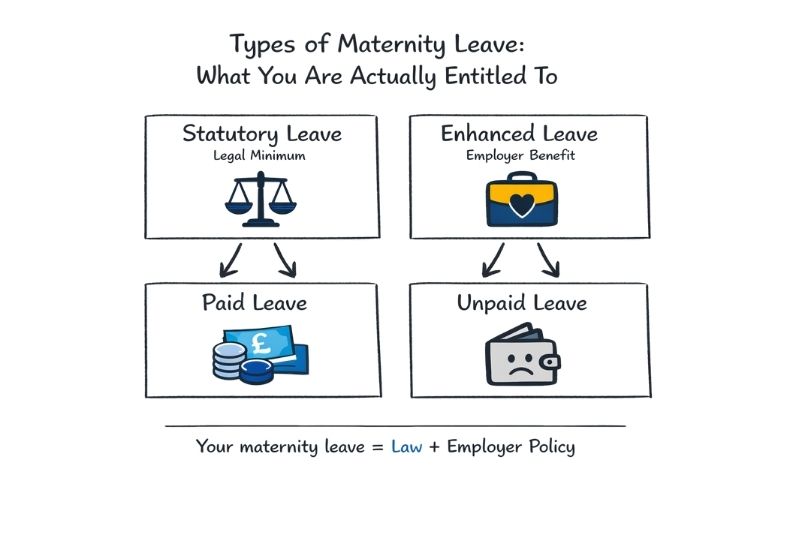
First things first: not all maternity leave is the same. The support you'll actually get is usually a cocktail of what the government legally requires and what your company voluntarily offers. Getting clear on the difference is your first step.
- Statutory Maternity Leave: This is the bare minimum set by law in your country. It outlines the shortest amount of leave you can take and often includes a baseline level of pay. In the UK, for instance, this is called Statutory Maternity Pay (SMP), while in Australia it's known as Parental Leave Pay.
- Enhanced Maternity Leave: This is where a company chooses to offer more than the legal minimum. You’ll often see this in competitive sectors like STEM, where employers provide better benefits, like full pay for several months, to attract and keep talented people.
- Paid vs. Unpaid Leave: Some of your time off will almost certainly be paid, whether by the government, your employer, or both. But if you decide to take a longer break, you might find that part of it is unpaid. It's worth knowing that globally, only 64% of countries offer at least 14 weeks of paid maternity leave.
At its heart, maternity leave is about protecting the health of mothers and their babies while securing their place in the workforce. It’s a recognition that recovering from birth and bonding with a newborn aren't just 'nice-to-haves'—they're essential for families and a stable economy.
The Global Context of Maternity Leave
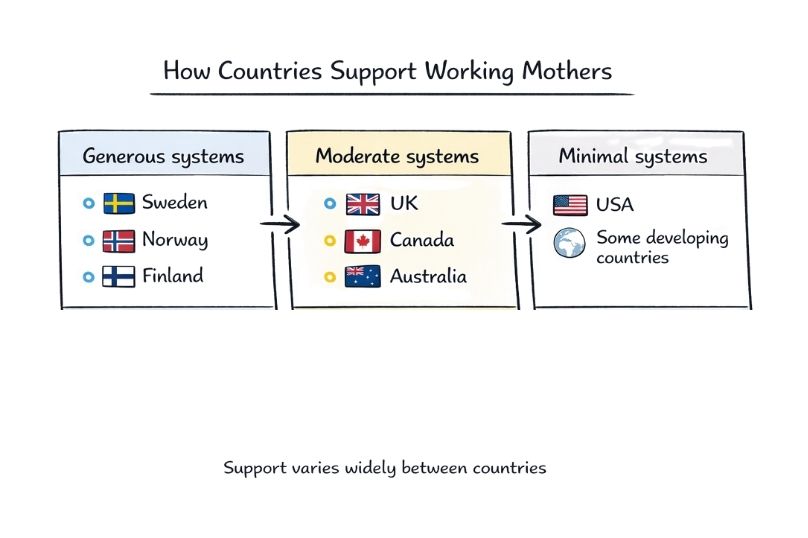
As a professional in a global industry, it’s useful to see just how different these policies can be. In some Scandinavian countries, parents share generous, well-paid leave that's largely funded by the state. Compare that to the United States, which has no federal mandate for paid leave at all. There, eligible employees can take 12 weeks of unpaid, job-protected leave under the Family and Medical Leave Act (FMLA), and that’s it.
This huge variation is exactly why you need to dig into the laws where you live and the specifics of your company's policy. Your rights are a blend of national law and corporate culture. The concepts we're covering here are universal. They give you the language and framework to ask the right questions and figure out your own situation.
Understanding your entitlements is crucial, and not just for planning. It also helps you spot when something isn't right and gives you the confidence to address it. If you're worried about how you're being treated, you can learn more about how to handle discrimination in a workplace.
Ultimately, a clear grasp of your rights empowers you to advocate for yourself, plan your finances, and set yourself up for a smooth transition back to work, so you can focus on your family with real peace of mind.
A Deep Dive Into UK Maternity Leave For STEM Careers
If you're working in a UK-based STEM field, getting to grips with your maternity leave rights is the essential first step towards a smooth transition into parenthood. Think of the UK system as your safety net, a legal framework designed to give you a baseline of support for time off and pay.
While many forward-thinking employers offer more generous packages, this statutory entitlement is the legal minimum you can count on, provided you qualify.
Qualifying for Statutory Maternity Leave and Pay
So, how do you unlock these rights? It’s not automatic. You need to meet a couple of key criteria tied to your employment status and how long you’ve been with your company.
First, you must be legally classified as an 'employee'. This is a crucial distinction. Some contractors or individuals classified as 'workers' won't be eligible for Statutory Maternity Leave (SML), though they may be able to claim Maternity Allowance instead.
Second, there's the continuous service rule. You must have worked for your employer without a break for at least 26 weeks leading up to the end of the 'Qualifying Week'. This specific week is the 15th week before your baby is due. In simple terms, this means you generally need to have been on the payroll before you even became pregnant.
The Structure of Your Pay
Under UK law, eligible new mothers can take up to 52 weeks of maternity leave. But what about the money? It’s important to understand that the pay isn't consistent throughout.
It's a tiered system. For the first six weeks, you get 90% of your average weekly earnings. After that, it drops for the next 33 weeks to a statutory flat rate (or 90% of your earnings, if that's lower). The final 13 weeks are usually unpaid.
For those in well-paid STEM roles, that initial 90% period is a huge help. But the sharp drop to the flat rate can feel like a shock to the system, which is why planning ahead is absolutely non-negotiable.
The most important thing to remember is that your statutory pay is front-loaded. It provides a bigger financial cushion right after birth, but it means you have to budget carefully for the later months, especially if you want to take the full 52 weeks.
Let's break down how this looks for Statutory Maternity Pay (SMP).
UK Statutory Maternity Pay (SMP) Breakdown for 2026
The table below gives you a clear snapshot of how the 39 weeks of paid leave are structured. It’s the minimum your employer has to pay you if you qualify.
| Leave Period | Duration | Payment Rate |
|---|---|---|
| First Period | 6 weeks | 90% of your average weekly earnings (with no upper limit) |
| Second Period | 33 weeks | £184.03 per week or 90% of your average weekly earnings (whichever is lower) |
| Additional Leave | 13 weeks | Unpaid |
Understanding this financial curve is half the battle. It helps you budget, talk through options with your partner, and decide how much time you can realistically afford to take off. Always check your employment contract for an enhanced maternity pay policy—many tech and engineering firms offer this to attract and retain talent.
How to Notify Your Employer
Telling your employer is a formal step, and the timing is important. The process is simple, but you have to follow the rules to lock in your leave.
You must inform your employer about your pregnancy and your plan to take maternity leave by the end of the 15th week before your due date (that 'Qualifying Week' again). You also need to tell them when you want your leave to start.
- Timing is Key: Get your notice in no later than the end of that 15th week.
- Be Specific: Provide the exact date you want your leave to begin. Don't worry, you can change it later with 28 days' notice.
- Put It in Writing: While a verbal chat is fine to start, follow it up with an email or letter. This creates a clear paper trail for everyone.
Once you’ve given notice, your employer has to respond in writing within 28 days. This letter is important—it will confirm your start and end dates, officially acknowledging your 52-week entitlement.
For a deeper dive into managing this process, check out our full guide on UK Maternity Leave in STEM: What You Need to Know.
How Maternity Leave Compares Around the World
As a professional in a global STEM network, context is everything. To really get a handle on maternity leave, you have to zoom out and see how your country’s rules stack up against others. What you’ll find is a massive spectrum of support for working parents.
The differences from one nation to another can be pretty stark. These policies aren't just rules on a page; they reflect deep-seated cultural views on work, family, and gender roles, influencing everything from how long you can take off to who foots the bill.
Generous vs. Minimalist: Two Ends of the Spectrum
On one end, you have the Nordic countries, which are often held up as the gold standard for state-funded parental leave. In a place like Sweden, parents are entitled to a combined 480 days of leave per child. They can share this time, and a huge chunk of it is paid at around 80% of their salary. The whole system is designed to encourage gender equality and get both parents involved from day one.
At the complete opposite end is the United States, which stands alone among developed nations with no federal mandate for paid maternity leave. The main protection is the Family and Medical Leave Act (FMLA), which only gives certain employees up to 12 weeks of unpaid, job-protected leave. This creates a real patchwork system where support depends entirely on state laws or your employer's goodwill.
Finding a Middle Ground: Canada and Australia
Canada and Australia offer a more moderate approach, with national programmes that provide a solid, if varied, level of support.
- Canada: The Canadian system splits leave into two parts: maternity and parental. Birth mothers can take up to 15 weeks of maternity leave. This is followed by a choice between standard parental leave (40 weeks) or an extended option (69 weeks), which can be shared between parents. Payments come from the Employment Insurance (EI) system, usually at 55% of your earnings up to a cap. For a deeper dive, check out our guide on making sense of maternity leave for women in STEM in Canada.
- Australia: Down Under, eligible parents can get up to 18 weeks of government-funded Parental Leave Pay, which is paid out at the national minimum wage. This is often taken on top of whatever paid or unpaid leave an employer offers. It's a foundational safety net that companies are encouraged to build upon.
Provisions Across India, Africa, and the Middle East
The landscape across these diverse regions is just as varied. Some nations are making huge strides in supporting working mothers, while others still offer more limited protections.
India’s Maternity Benefit (Amendment) Act of 2017 is actually one of the most progressive policies in the world. It mandates a generous 26 weeks of fully paid maternity leave for women in the organised sector for their first two children, with the cost covered entirely by the employer.
Across Africa, policies differ hugely. South Africa, for example, provides four consecutive months of maternity leave, with benefits paid from the Unemployment Insurance Fund. In contrast, countries like Nigeria offer around 12 weeks at 50% pay.
The Middle East presents a similar mixed picture. In the UAE, private sector employees get 60 days of maternity leave, 45 days at full pay and the remaining 15 at half pay. Rules can change quite a bit from one country to the next.
Even the UK's structure shows how policy can lock in gender imbalances. Mothers are entitled to up to 52 weeks' leave while fathers get just two weeks of paternity leave. This system often sets a default for who handles childcare and contributes to the gender pay gap, making it one of Europe's less equitable systems. As you can discover more insights about this government review, to even qualify, eligible mothers need 26 weeks of continuous service to get 39 weeks of statutory pay.
Global Maternity Leave Snapshot A Comparison
To give you a clearer picture, here’s a quick-glance table comparing statutory maternity leave in several key countries. This is a high-level overview, so always remember to check the specific rules for your situation.
| Country | Typical Leave Duration | Typical Paid Benefit | Funding Source |
|---|---|---|---|
| Sweden | 480 days (shared parental leave) | ~80% of salary (up to a cap) | Social Security |
| UK | 52 weeks (39 paid) | 90% of pay for 6 weeks, then a flat rate | Employer & Government |
| Canada | 15 weeks (maternity) + 40-69 weeks (parental) | 55% of earnings (up to a cap) | Employment Insurance |
| India | 26 weeks | 100% of salary | Employer |
| Australia | 18 weeks | National minimum wage rate | Government |
| USA | 12 weeks (unpaid, under FMLA) | None at the federal level | N/A |
This comparison really highlights the vast differences in how countries approach supporting new parents. Whether it's a comprehensive social security system or a basic federal mandate, the policy in place has a massive impact on the personal and professional lives of women in STEM.
Your Action Plan for a Seamless Maternity Leave
The thought of stepping away from work for months can feel pretty daunting. But with a bit of forward planning, you can turn a potentially stressful run-up into a smooth, well-organised transition. The trick is to break it down.
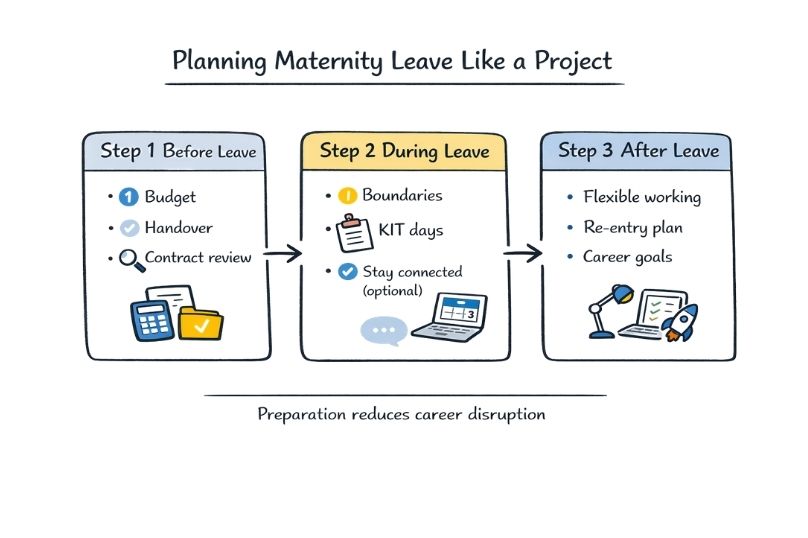
Thinking about it as three distinct phases—before, during, and after your leave, makes everything feel far more manageable. This is your practical playbook for navigating each stage, designed to give you real-world strategies that keep your career on track. Think of it as a project plan for one of the most important new ventures of your life.
Before Your Leave: The Preparation Headquarters
The months leading up to your leave are prime planning time. This is your chance to lay all the groundwork for a seamless handover at work and give yourself some much-needed financial and emotional peace of mind. The goal here is simple: eliminate as many question marks as you can.
First things first, get your finances sorted. Sit down and create a proper maternity leave budget. Factor in the drop in income from statutory pay in your country and add in any enhanced benefits your company might offer. This simple exercise will give you a clear picture of how much leave you can realistically afford to take.
Next up is your handover plan. Nothing creates more stress for you or your team than a messy, last-minute handover. Treat this as a living document that you add to over several weeks.
- Document Everything: Create a central folder with key contacts, project timelines, login details, and step-by-step guides for your main tasks.
- Identify Your Cover: Chat with your manager to figure out who will be picking up your work. Once you know, you can start training them early.
- Set Clear Expectations: Be explicit about which projects will be paused, finished before you go, or handed over completely. Make sure everyone is on the same page.
While you're busy crafting your work plan, don't forget to prepare for your new role at home! It’s worth checking out guides on first-time mum essentials to help you feel ready.
During Your Leave: Setting Boundaries and Staying Connected
Once your baby arrives, the focus shifts entirely. Your priority is your new little one and your own recovery. That said, staying loosely connected to your professional life, entirely on your own terms, can make your eventual return feel a whole lot smoother.
Before you go, establish clear communication boundaries with your manager. Let them know how and when you’d prefer to be contacted, if at all. This stops you from feeling pressured to be "always on" when your attention needs to be elsewhere.
Remember, your maternity leave is a protected period for you to focus on your family. Staying connected is a choice, not an obligation. Use it strategically to serve your own needs, not just your employer's.
Many countries have formal provisions for this. In the UK, 'Keeping in Touch' (KIT) days are a fantastic way to do this. You can work up to 10 days during your leave without it officially ending your maternity period. They’re perfect for dipping into a critical team meeting, doing a training course, or just getting up to speed on major company news. These days are paid, and they're completely optional.
These small touchpoints can make a real difference, as it's easy to feel isolated. It’s important to recognise that pregnant new mothers in STEM need different support networks, and maintaining these professional ties helps build confidence.
After Your Leave: Planning a Successful Return
The final phase of your plan should kick in a few weeks before you’re due back at your desk. This part is all about easing back into your professional role and setting yourself up for a work-life balance that actually works for you and your new family.
Start by reconnecting with your manager. A quick call to discuss your return, get a rundown of any big changes, and talk through your initial priorities can do wonders for reducing any first-day nerves.
This is also the perfect time to start thinking about how you want to work going forward. Your old routine might not fit your new life.
- Assess Your Needs: Would flexible hours, a compressed week, or the ability to work from home more often make a difference?
- Prepare Your Case: If you're going to ask for a change, build a solid business case explaining how it benefits both you and the company.
- Start the Conversation Early: Give your employer plenty of notice to consider your request properly before your official return date.
By thoughtfully planning each stage, you can transform maternity leave from what feels like a career hurdle into a structured, positive, and empowering chapter of your professional journey.
Successfully Returning to Your STEM Career
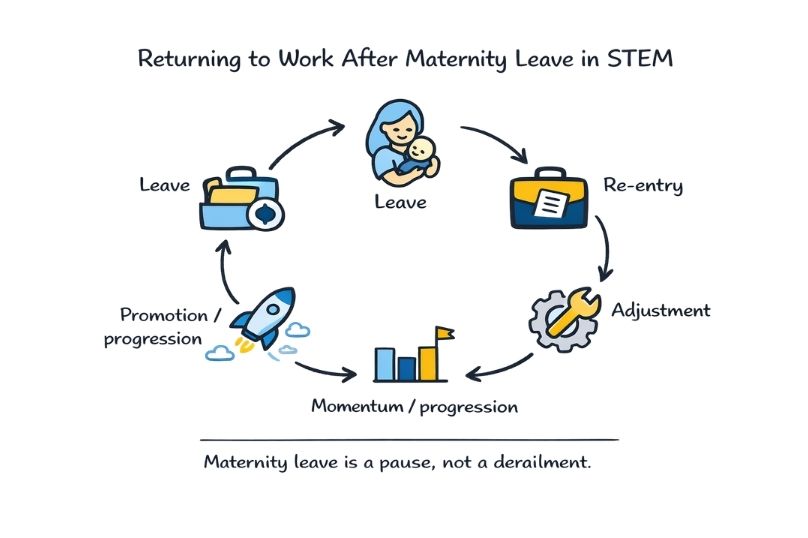
Heading back into a fast-paced STEM field after maternity leave can feel like trying to jump onto a moving train. Technology has likely shifted, project goals may have changed, and your own priorities have definitely evolved. This is a huge step in your career, and with the right approach, you can make it a smooth and confident re-entry.
The key is to frame your return not as a setback, but as the next powerful chapter in your professional story. You’re coming back with a whole new set of skills in time management, problem-solving, and sheer resilience that will make you an even bigger asset to your team.
Preparing for a Confident Re-Entry
A successful return begins weeks, or even months, before your first day back. This prep time is your secret weapon for easing any anxieties and setting yourself up for success from the minute you walk through the door.
A great first step is to reconnect with your professional world, but on your own terms. A couple of weeks before you're due back, why not schedule a relaxed coffee (virtual or in-person) with your manager or a trusted colleague? The goal isn't to dive deep into project specs; it's about getting a feel for the team's current focus and any big shifts that happened while you were away.
This is also the perfect time to get back up to speed with your industry. You don't need to cram, just dedicate a little time each day to:
- Scan Industry News: Skim through a few key trade publications or websites in your field.
- Explore New Tech: If a new piece of software became standard, watch a few intro tutorials to get familiar with it.
- Reconnect Your Network: A few simple "hello" messages to contacts on professional networking sites can do wonders for making you feel plugged back in.
Overcoming Common Hurdles
Most professionals returning to work, especially in demanding fields like STEM, run into similar challenges. Facing them head-on with a clear plan can make all the difference.
One of the biggest emotional hurdles is imposter syndrome. You might feel out of the loop or that your skills have gone a bit rusty. Just remember, this feeling is completely normal, and it will fade as you find your rhythm again. Give yourself some grace and celebrate the small wins as you settle back in.
Another practical challenge is how to talk about your time away. Many people worry about explaining employment gaps on a resume after a long leave, but there are great resources to help you frame it positively. Your maternity leave is a legitimate and valuable part of your life story, not a "gap" you need to hide.
Your return to work is a marathon, not a sprint. Focus on reintegrating at a sustainable pace, prioritising tasks that deliver high impact, and don't be afraid to ask for help when you need it.
These challenges are universal. In the UK, for instance, a recent survey found that 57% of women felt pressured to return early, and 42% felt unsupported by their employer upon their return, which can take a serious toll on mental health. These feelings of pressure and lack of support are common across many countries, highlighting a global issue.
Reigniting Your Career Momentum
Once you're back, it's time to focus on strategies that will help you regain and even accelerate your career momentum. Having early conversations about flexible working is absolutely critical. The old 9-to-5 schedule might not be the most effective way for you to work anymore.
Think about proposing a trial period for a new arrangement, such as:
- A Compressed Week: Working your full hours over four days.
- A Hybrid Model: A mix of in-office and remote work days.
- Flexible Hours: Adjusting your start and end times to fit around family needs.
When you make your request, present it with a clear business case, explaining how the new structure will maintain or even boost your productivity. By taking control of your transition, you're giving yourself the tools and confidence you need to thrive.
Common Questions About Maternity Leave in STEM
It's completely normal for a ton of practical questions to pop up when you start thinking about maternity leave. What happens to my pension? Can I dip my toe back in for a day or two? What if my role changes while I'm away?
Getting clear, straightforward answers is key to feeling confident and in control. Think of this section as a quick-fire FAQ, tackling the nitty-gritty details we often hear from professionals in STEM, with specific examples from the UK for context.
What Happens to My Pension and Holidays During Maternity Leave?
This is a big one, and rightly so—it hits your finances directly. The good news is that while you're on paid maternity leave in countries like the UK, your employer has to keep paying their pension contributions as if you were earning your normal salary. Your contributions, on the other hand, will be based on the actual maternity pay you're receiving.
And what about that well-earned time off? You continue to build up your full holiday entitlement throughout your entire leave, even during the unpaid parts. A popular strategy is to tack this accrued holiday onto the beginning or end of your maternity leave, giving you a little extra time at home. Just be sure to double-check the specifics in your company's policy.
Can I Work at All During My Maternity Leave?
You can, but there are rules. In the UK, you’re allowed to work up to 10 'Keeping in Touch' (KIT) days without it messing with your leave or pay. These are totally optional, and you and your employer have to agree to them.
KIT days are brilliant for things like attending a crucial team meeting, getting trained on a new piece of software, or helping out on a key project. You must get paid for any KIT days you work (at a rate you agree on beforehand). Keep a close eye on the count, though—working more than 10 days will officially end your maternity leave.
Think of Keeping in Touch days as a tool for you, not an obligation. They’re a flexible way to stay connected on your terms, making the eventual return to work feel a little less daunting without cutting into precious bonding time.
What Happens If My Role Is Made Redundant While I’m On Leave?
This is a scary thought, but you have some serious legal protections here. If you're on maternity leave in a country like the UK and your role is at risk of redundancy, your employer is legally obligated to offer you any suitable alternative job they have available.
This effectively puts you at the front of the queue, ahead of other employees who might also be at risk. If you're selected for redundancy because of your pregnancy or maternity leave, the dismissal is automatically considered unfair. This can get complicated fast, so if you find yourself in this position, getting advice from a local advisory service like the UK's Acas is a very smart move.
How Do I Ask for Flexible Working When I Return?
Jumping back into a demanding STEM career after having a baby often means your old 9-to-5 schedule just won't cut it anymore. If you've been with your employer for at least 26 weeks in the UK, you have the legal right to request flexible working.
This could mean changing your hours, the days you work, or even working from home more often. The first step is to put in a formal written request. Your proposal should lay out exactly what you’re asking for and, crucially, explain how you think it can work for the business without causing disruption.
Your employer has to give your request proper consideration and can only turn it down for legitimate business reasons. My advice? Start this conversation well before you're due back. It gives everyone plenty of time to talk it through and find a solution that works for both you and your team.