
When people speak of emotional intelligence in leadership, they refer to the ability to read the emotional landscape of a room. A leader notices their own reactions, understands their source, and regulates them with care. From there, they learn to recognize the feelings of others and respond with intention as they guide their teams. This capacity marks the difference between a manager who assigns work and a leader who earns the trust and commitment of the people they guide.
Think of the difference between a map and a compass. A map shows the terrain, but a compass helps you find your direction while you move through it. Emotional intelligence serves this role. It supports thoughtful decisions, fosters a workplace where people speak without fear, and steadies a leader facing complex challenges.
The Strategic Advantage Of Emotional Intelligence
In fields such as science and technology, people often treat technical expertise and raw intellect as the price of entry. Both matter. Exceptional leadership, though, rests on something else: emotional intelligence, often called EQ.
It’s a mistake to dismiss emotional intelligence as a “soft skill” because it functions as a strategic capability. Picture a dashboard that tracks more than project metrics. It also registers your internal state and the shifting dynamics of the people around you. High EQ provides this awareness.
This emotional acuity forms the foundation of effective leadership. A leader begins to anticipate how a decision will land, speak with clarity, and build the trust that sustains genuine collaboration. In a project meeting, for example, a leader with developed EQ notices the subtle shift in the room. A careful question draws the concern into the open, where the group addresses it early rather than allowing conflict to gather force.
Beyond Traditional Management
The traditional model of management relies on processes, metrics, and top-down authority. These elements matter, but emotionally intelligent leadership adds a people-centered perspective that drives stronger results. For a brief overview, see what is emotional intelligence in leadership.
This approach creates teams that are both adaptable and energized, with a stronger capacity for innovation.
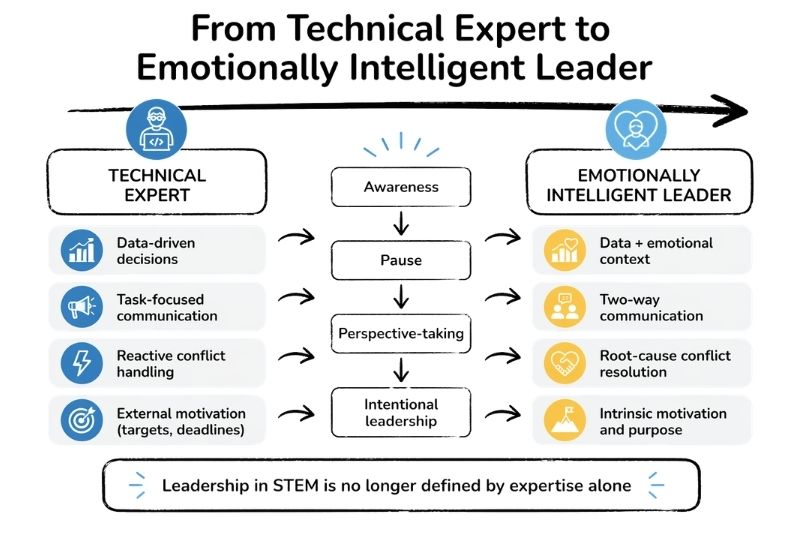
The table below illustrates how emotionally intelligent leadership differs from traditional management in practice.
How The Shift Looks In Practice
| Core Area | Traditional Management | Emotionally Intelligent Leadership |
|---|---|---|
| Decision-Making | Relies on data, logic, and protocols | Integrates data with awareness of team dynamics and emotional impact |
| Communication | Top-down, directive | Two-way dialogue with active listening to ensure understanding |
| Conflict Resolution | Enforces rules or mediates quickly | Addresses root emotional causes to foster real understanding |
| Team Motivation | Depends on external rewards and fear of negative consequences | Cultivates intrinsic motivation by aligning goals with values |
| Feedback | Periodic and focused on errors | Continuous, constructive, and delivered with empathy |
"Emotional intelligence is critical in building and maintaining relationships and influencing others — key skills that help people throughout their career and wherever they sit in an organizational structure," says Margaret Andrews, instructor of Emotional Intelligence in Leadership at Harvard University.
Knowing the definition of emotional intelligence holds little value on its own. The strength of the concept appears through daily practice. Used well, emotional intelligence advances a career by shaping teams that work with focus, share ideas freely, and meet difficult problems with a strong sense of collective purpose.
The Five Pillars Of Emotional Intelligence
Emotional intelligence refers to a defined set of five related skills. Each one shapes how a leader understands their own reactions and responds to the people around them. Together, these skills form a practical structure for leadership.
Viewed this way, the concept becomes easier to grasp. Each component reveals a different aspect of how leaders understand themselves and respond to others. You begin to notice where your strengths lie and where further development would help. What first appears as a broad idea becomes a clear path for growth.
This visual outlines the core progression of emotionally intelligent leadership.
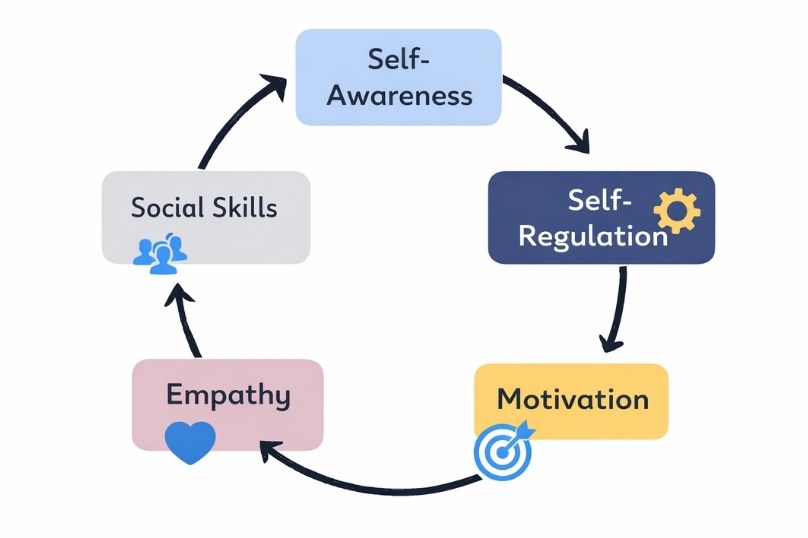
The process begins with self-understanding, then moves toward self-regulation, and from there extends outward to shape how a leader relates to others. The five pillars below explain how this progression unfolds.
Pillar 1: Self-Awareness
Self-awareness forms the foundation. It begins with noticing and accurately identifying your own emotions, understanding your habitual responses, and honestly assessing your strengths and limitations. It’s about recognizing how your feelings shape your decisions and your work.
A leader attuned to herself knows what triggers stress or frustration. For example, a data science manager aware that looming deadlines heighten her anxiety can anticipate it. Rather than letting the feeling dictate her actions, she can regulate her response and communicate with her team effectively.
This kind of internal clarity is uncommon but transformative. Research suggests that 95% of people believe they are self-aware, only a small fraction, about 10-15% of us truly are. That discrepancy highlights a significant opportunity: without this foundation, managing your emotions or understanding others becomes nearly impossible.
Pillar 2: Self-Regulation
Self-regulation grows out of self-awareness. Once you recognize your emotional responses, the next step involves how you govern them. This skill refers to the ability to steady disruptive impulses and choose a measured response rather than reacting in haste. The goal does not involve suppressing emotion but directing it in a constructive way.
Consider a research project that collapses days before a major deadline, placing the entire team under pressure. A leader without self-regulation may react with anger, assign blame, and leave the group anxious and defensive.
A leader with emotional discipline responds differently. They pause, absorb the initial frustration, and steady the room. Attention shifts from failure to the next practical step. The change in tone preserves morale and supports an environment where people remain willing to experiment and propose solutions.
Self-regulation occupies the brief interval between feeling and action. In that small pause lies the ability to choose a response that reflects judgment rather than impulse.
This restraint sustains trust and credibility, especially when circumstances begin to unravel.
Pillar 3: Motivation
In the language of emotional intelligence, motivation refers to a form of inner drive that reaches beyond ambition. It reflects a commitment to the work itself and to the standards a leader sets for their own performance. Leaders shaped by this orientation pursue their goals with steady discipline and a clear sense of purpose.
Their dedication to the organisation’s direction tends to spread through the group. Because their engagement grows from genuine interest in the work, their focus does not depend on titles, bonuses, or other external rewards. The effort itself carries meaning.
This form of motivation steadies a team during demanding periods. After a disappointing quarter or during a research project that advances slowly, such a leader sustains attention on the larger aim. Over time, that persistence turns management into leadership others respect and willingly follow.
Pillar 4: Empathy
Empathy refers to your ability to perceive the emotional atmosphere around you and respond with care. It involves recognizing what others may be experiencing and making a sincere effort to understand their perspective. This skill asks a leader to look beyond surface behaviour and consider the circumstances that shape it.
Consider a junior data analyst who appears overwhelmed and begins to fall behind on a deadline. An attentive manager notices the strain and invites a private conversation. Instead of rushing to judgment, the manager listens closely to learn what lies beneath the difficulty. The analyst may struggle with unfamiliar software or carry pressures from life outside the office.
With that understanding, the manager can respond with judgment and restraint. The solution might involve adjusting a timeline, arranging additional guidance, or offering reassurance during a demanding moment. This form of attention strengthens trust within the team, affirms that each member is regarded as a person whose circumstances and efforts matter, and cultivates deep loyalty.
Pillar 5: Social Skills
The final pillar brings the others into harmony. It is the capacity to navigate relationships with nuance, forge connections, and foster trust that allows a leader to guide others with subtle authority.
Leaders adept in social skills demonstrate strength in:
- Communicating with Precision: They convey difficult messages with clarity and shape a vision that draws others in without force.
- Resolving Tensions: They approach disagreements deliberately, steering discussions toward outcomes that acknowledge differing perspectives while preserving respect.
- Cultivating Networks: They invest in relationships, creating a web of colleagues whose collaboration and support can be relied upon.
These capabilities extend from the daily rhythm of team meetings to complex negotiations. When paired with self-awareness, self-regulation, motivation, and empathy, social skills enable a leader to shape outcomes, foster genuine collaboration, and advance the organization toward its most ambitious objectives.
EQ Is A Superpower For Women In STEM
In disciplines that justly recognize technical expertise, emotional intelligence is often underestimated. For women in STEM, however, it is far more than a “soft skill”; it is a decisive advantage that shapes influence, sparks innovation, and opens pathways to advancement.
When every colleague is highly skilled, what distinguishes a leader? The capacity to form purposeful partnerships, present ideas with clarity and authority, and nurture a culture of authentic collaboration. This is emotional intelligence in action, revealing its power in real-world leadership.
Transforming Challenges Into Opportunities
Women in STEM often encounter distinct challenges, from managing subtle bias to persuading skeptical stakeholders or leading teams where they are in the minority. Emotional intelligence provides the tools to meet these moments with clarity and composure.
This is not about reshaping yourself to meet others’ expectations. Rather, it involves leveraging a deep awareness of human behavior to influence outcomes effectively. High emotional intelligence allows you to sense the dynamics in any interaction, adjust your communication to suit different audiences, and foster an environment where diverse teams feel secure and empowered to perform at their best.
A leader with strong emotional intelligence approaches a new research proposal with foresight, anticipating objections. Instead of presenting only the facts, she crafts the data into a story that aligns with the team’s collective priorities, turning doubt into commitment and fostering engaged collaboration.
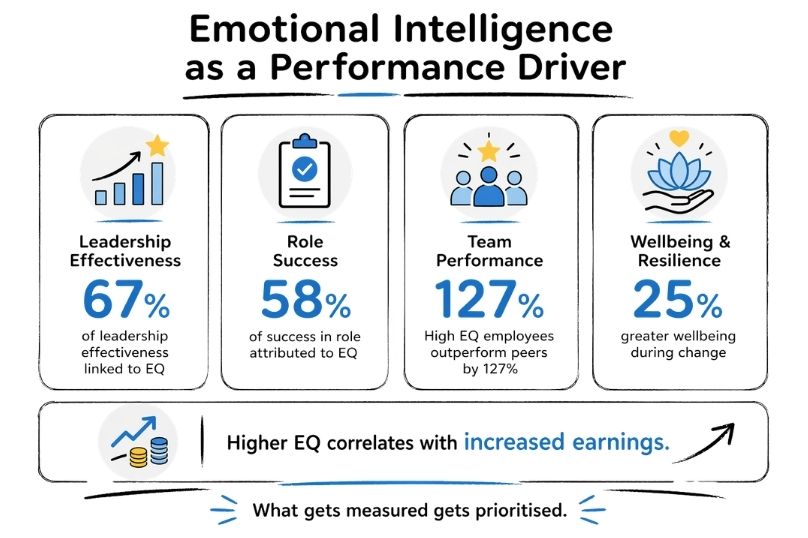
Its value is increasingly recognized in organizational performance. ChangingPoint research shows that leaders with higher emotional intelligence report about 25% greater wellbeing during periods of change. You can explore more of these findings on emotional intelligence in the workplace.
Creating Diverse And Forward-Thinking Workplaces
An emotionally intelligent leader leaves a lasting mark through the culture they shape. By grounding their approach in empathy and open exchange, they create conditions where people feel able to question, test early ideas, and take considered risks without fear of dismissal.
Such an environment supports genuine innovation. When individuals with different perspectives feel heard and respected, they contribute with greater depth and originality, leading to stronger solutions and more thoughtful outcomes. For women in STEM, applying emotional intelligence in this way does more than strengthen leadership practice. It influences the direction of the field itself, fostering a more dynamic and representative professional culture.
The Measurable Business Value of EQ
While cultivating a supportive and forward-thinking team is a valuable outcome, the impact of emotional intelligence in leadership extends well beyond workplace culture. For analytical professionals in STEM, the influence of EQ becomes evident in measurable results. This is not a vague skill; it is a concrete competency with a demonstrable return for both career growth and organizational performance.
The evidence is clear. When emotional intelligence is treated as a key performance metric, it consistently correlates with higher productivity, stronger outcomes, and increased earnings. These data points make a compelling case for prioritizing EQ development, especially for women in STEM seeking senior positions and striving for equitable compensation.
EQ as a Driver of Performance and Financial Impact
The connection between emotional intelligence and professional success is more than anecdotal; it is supported by rigorous research. Across the UK, studies reveal a clear pattern: leaders with higher EQ outperform their peers, and their teams rise to meet the standard. In data-driven fields, this skill produces measurable, tangible results.
Consider leadership effectiveness. How well does a leader inspire their team to achieve goals? Research from Queen Margaret University in Scotland indicates that emotional intelligence accounts for 67% of a leader’s effectiveness and 58% of success in any given role.
Team performance reflects a similar trend. Employees with high EQ outperform their colleagues by an average of 127%, demonstrating the tangible advantage of this skill.
When technical expertise is comparable, emotional intelligence becomes the defining factor that separates competent leaders from exceptional ones. It is arguably the most valuable asset for managing complex team dynamics and sustaining consistent results.
This evidence shifts emotional intelligence from a personal development aspiration into a strategic imperative for organizations.
The Connection Between EQ, Career Advancement, and Earnings
Research published in the Journal of Organizational Behavior turns to a consequential skill: the ability to read emotion in another person’s face or voice. In a study of German employees, this capacity, known as emotion recognition, was examined alongside traits such as social awareness, networking ability, and perceived trustworthiness.
A clear pattern emerges. Those who interpret emotional signals with greater precision tend to earn more, even when factors such as education, experience, and hours worked are taken into account. The advantage appears to lie in how these individuals move through the social web of the workplace. They read situations accurately, respond with judgment, and handle the unspoken dimensions of professional life with greater ease. Over time, this fluency shapes both performance and income.
The implications for leadership are notable. Some evidence suggests that women, on average, demonstrate stronger accuracy in reading emotional cues. In one study, female managers who assessed nonverbal signals with greater precision received higher satisfaction ratings from their teams, a pattern not observed among their male counterparts. This distinction points to the influence of perception, where the ability to read others well can shape authority, trust, and advancement.
How To Develop Your Leadership EQ
Grasping the concept of emotional intelligence is one thing; applying it in your leadership is another. The upside is that EQ isn’t innate—it’s a collection of skills that can be developed, honed, and reinforced through intentional practice.
This isn’t about a complete personality transplant. It’s about embedding small, steady habits into your day-to-day work. By aligning these practices with the five pillars of EQ, you can craft a tangible plan for growth, turning abstract ideas into effective, everyday leadership behavior.
Evidence points to a capacity for change grounded in neuroplasticity, the brain’s ability to reshape itself through repeated experience. Each act of reflection, each moment of attentive listening, each instance of seeking honest feedback leaves a trace, strengthening new patterns of thought and response. With time, what once required conscious effort settles into habit, and deliberate action gives way to instinct.
Start With Self-Awareness
The path to stronger emotional intelligence begins with introspection. Self-awareness forms the foundation; without it, managing your emotions or understanding others is like trying to navigate without a guide. One highly effective method is reflective journaling.
At the close of each day, spend just five minutes noting a few observations. Consider questions such as:
- When today did I feel most energized or frustrated, and why?
- Which moments provoked a strong emotional response?
- How did my mood influence my interactions with the team?
This practice helps you identify emotional triggers and patterns. Over time, it moves you from reacting impulsively to responding with greater clarity and intention.
Strengthen Your Self-Regulation
Once you can recognize your emotions, the next step is learning to manage them. Self-regulation is about creating a gap between feeling an impulse and responding to it. For busy STEM professionals, a simple yet powerful method is the “tactical pause.”
When frustration spikes in a meeting or an experiment goes off track, take a slow, deliberate breath before speaking or acting. This brief pause interrupts the brain’s automatic fight-or-flight reaction, giving reason a chance to guide your response. It’s the difference between sending a sharp email you’ll regret and preserving your team’s trust.
Building emotional intelligence resembles strengthening a muscle. It demands consistent, focused practice. Thinking about improvement isn’t enough—you strengthen it through small, repeated actions.
The tactical pause is a concrete exercise in self-control that, practiced regularly, enhances your ability to remain composed and deliberate under pressure.
Develop Greater Empathy
Empathy goes beyond agreement; it’s about truly grasping how someone else experiences a situation. One effective way to practice this is by intentionally gathering a range of perspectives before making technical or strategic decisions.
Instead of seeking only affirmation, pose questions like, “What might we be overlooking?” or “Where could this approach fail?” This method accomplishes two goals: it signals that every contribution is valued, creating a space where candid feedback is welcome, and it equips you with a more complete understanding, supporting wiser and more resilient choices.
Businesses increasingly link strong emotional intelligence with the creation of inclusive workplaces that retain top talent, especially women in STEM. Although 97% of employers recognize EQ as essential to success, many do not actively develop it. Those that do, however, achieve leadership development outcomes over three times more effectively, highlighting a tangible competitive advantage.
Sharpen Your Social Skills
Social skills bring all the other pillars of EQ into action, transforming internal emotional awareness into meaningful influence. At the heart of this is communication. Developing EQ often involves refining these abilities through practices like effective communication skills training.
One practical exercise: in your next project meeting, focus entirely on listening. Resist the urge to prepare your response while someone else is speaking. Pay close attention to their words and body language. When they finish, summarize what you heard: “If I understand correctly, your main concern is…” This simple practice signals that people are truly heard and respected, laying the groundwork for stronger, more collaborative teams.
Your EQ Growth Plan
To bring it all together, here is a hands-on plan for developing your emotional intelligence. Each pillar is translated into targeted daily and weekly exercises, crafted to meet the demands and pace of STEM work environments.
| EQ Pillar | Daily Practice (5-10 mins) | Weekly Action | Long-Term Goal |
|---|---|---|---|
| Self-Awareness | Journal at day’s end: note one strong emotion and its trigger | Request feedback from a colleague on recent communication | Anticipate and understand your emotional responses in high-pressure situations |
| Self-Regulation | Use a “tactical pause” (one slow, deep breath) before responding to stress | Identify a recurring stressor (e.g., project deadlines) and plan a proactive coping strategy | Stay composed and constructive during project challenges or difficult conversations |
| Motivation | Record one aspect of work that excites you each day | Link a challenging weekly task to a broader team or organizational goal | Sustain a resilient, optimistic mindset that energizes your team |
| Empathy | Focus on understanding others’ emotions, not just their words | Seek a colleague’s differing perspective on a technical issue | Foster a team environment where members feel heard, valued, and psychologically safe |
| Social Skills | Listen with full attention and restate key points to confirm understanding | Share one piece of thoughtful, growth-oriented input with a colleague | Strengthen your ability to guide conversations, build trust, and maintain effective working relationships across the organization |
Beginning with small, consistent steps makes the development of emotional intelligence more manageable. With repetition, these practices accumulate, shifting from deliberate effort into ingrained leadership habits.
Begin Your Path to Emotionally Intelligent Leadership
The development of emotionally intelligent leadership does not follow a fixed endpoint. It unfolds through ongoing practice: reflecting on your responses, considering other perspectives, and choosing actions with care. The core elements of emotional intelligence, its measurable impact, and practical methods for strengthening it now form a framework you can apply.
Emotional intelligence is not an inherent trait reserved for a few. It is a skill that develops through repeated effort. Each deliberate action—pausing before responding under pressure or listening with full attention—refines your capacity to lead. Over time, these habits shape teams that think more creatively, work more cohesively, and remain steady in the face of challenge.
Your Next Steps
The work begins in the small, repeated choices you make each day. As you apply these strategies and develop a clearer understanding of your own emotional patterns, your leadership begins to shift from directing tasks to guiding people. That shift extends outward, shaping not only your team but the wider organization.
It helps to view emotional intelligence as a capacity strengthened through use. With consistent practice, it becomes more instinctive and reliable. The tools are available, and their effect on leadership is substantial.
To sustain progress, seek out spaces where you can exchange ideas with peers and learn from experienced mentors. A well-chosen network offers perspective, guidance, and steady support as you begin to apply these principles in your work.
Put these insights into practice now. Change does not require a complete overhaul. Begin with a single, deliberate step, such as reflecting at the end of the day or inviting candid feedback from a trusted colleague. From these small actions, a more effective form of leadership takes shape.
As you begin to integrate emotional intelligence into your approach, questions will arise. This stage is part of the process. The focus now shifts from understanding the concept to applying it with clarity. The following section addresses common questions with direct, practical guidance to support your next steps.
How Can You Assess Your EQ?
Evaluating your emotional intelligence isn’t a uniform process. You can approach it from several angles—some formal and structured, others rooted in everyday work life. Both offer valuable insights.
Standardized assessments provide a baseline, but for immediate, practical understanding, try these two approaches:
360-Degree Feedback: This method offers a rounded perspective on how you appear at work. Ask a few trusted colleagues, your manager, and direct reports for confidential feedback on areas such as communication style, handling pressure, or approachability during challenges.
Reflective Journaling: Track your emotional responses to specific situations. Did a project delay spark frustration or anxiety? How did you respond? Recording these moments reveals patterns and triggers, forming the foundation of self-awareness.
Real self-awareness goes beyond recognizing your strengths. It requires facing blind spots, and honest feedback from others provides the illumination needed to grow as a leader.
Can Focusing On EQ Have Drawbacks?
The advantages of emotional intelligence are clear, but there are risks if it’s applied without balance. One major danger is falling into emotional labor—feeling responsible for managing everyone else’s feelings all the time. Without clear boundaries, this can quickly lead to burnout.
Another concern is misuse. These skills are powerful. Empathy used to understand a team member is constructive; using that understanding to manipulate or exploit is not.
True emotional intelligence in leadership is about authentic connection and ethical influence. It isn’t performing a role or sidelining your own needs to appease others. The aim is to integrate these skills into your leadership, enabling thoughtful, compassionate decisions that support your team while achieving results.