
Negotiation is so much more than that one awkward conversation about salary. It’s a foundational skill that can genuinely shape your entire career, and this is especially true for women working in STEM. When you break it down, a successful negotiation really comes down to four core elements: preparing a rock-solid, data-driven case; properly benchmarking your market value; clearly articulating what you're worth with confidence; and, crucially, following up professionally.
This guide isn't about generic tips. We're getting into actionable strategies designed specifically for the unique challenges and opportunities you'll face in a global context.
Why Negotiation Is a Non-Negotiable Skill in STEM
In science, tech, engineering, and maths, your technical expertise gets you in the door. No question about it. But it's your ability to negotiate that ultimately determines how that expertise is valued and rewarded. It's the practical tool you use to advocate for fair pay, secure the resources you need for your projects, and steer your own professional journey.
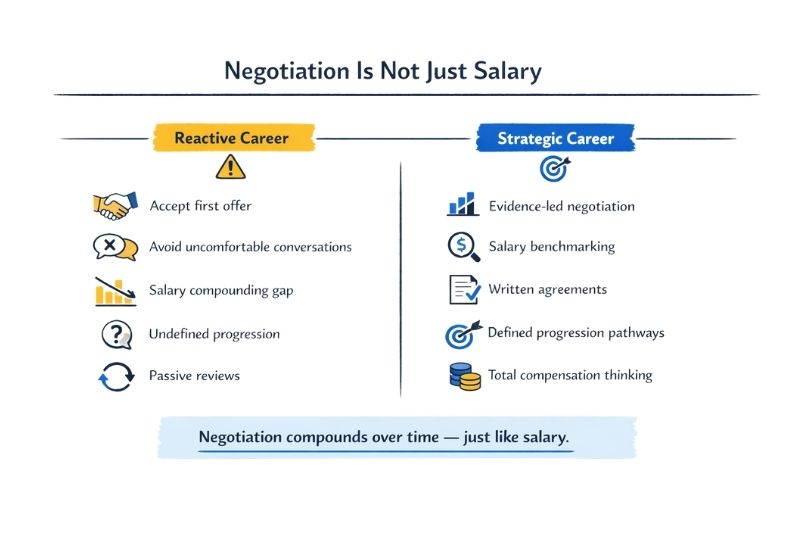
Failing to negotiate, even once, can have a massive knock-on effect. A seemingly small difference in your starting salary can compound over the years, leading to a huge earnings gap down the line. And it’s not just about the money. This is about getting access to the right tools, the best teams, and the kind of high-impact opportunities that allow you to do your best work.
The Landscape for Women in STEM
Let's be honest: the STEM environment comes with its own unique set of hurdles. The demand for talent is incredibly high, which is great, but systemic biases can still colour how things like assertiveness are perceived. Women often have to walk a fine line—being firm and direct without being penalised for it. This guide is built to help you navigate that exact dynamic.
Negotiation empowers you to close the gap between the value you create and the compensation you receive. It transforms your career from a passive experience into one you actively direct.
Getting good at this is about more than memorising a few lines. It's a mindset shift. You start seeing your career growth as a series of strategic conversations. To dig deeper into this idea, you can read our detailed article on what women in STEM need to know about real negotiation power.
Think of this guide as your practical playbook for the most common, and often most nerve-wracking, scenarios you'll encounter:
- Securing a new role: Making your value crystal clear to a new employer.
- Requesting a promotion: Building the case that you're ready for more responsibility.
- Annual salary reviews: Using hard data to justify a meaningful pay rise.
- Returning to work: Re-establishing your professional value and pay after a career break.
By learning to negotiate effectively, you’re not just asking for more. You’re demonstrating your strategic thinking and making a direct investment in your own long-term success.
Building Your Case with Data and Evidence
Successful negotiations aren’t won on charm or gut feelings. They’re won long before you even walk into the room. The real work is in the preparation, where you transform your professional value from something abstract into a compelling, evidence-backed argument that’s impossible to ignore.
This is about making a fundamental shift in your mindset. You’re not just asking for a pay rise or a new title; you’re demonstrating your worth. You're presenting a solid business case for why the company should invest more in you—an investment that will deliver tangible returns. And the foundation for that case is built on cold, hard data.
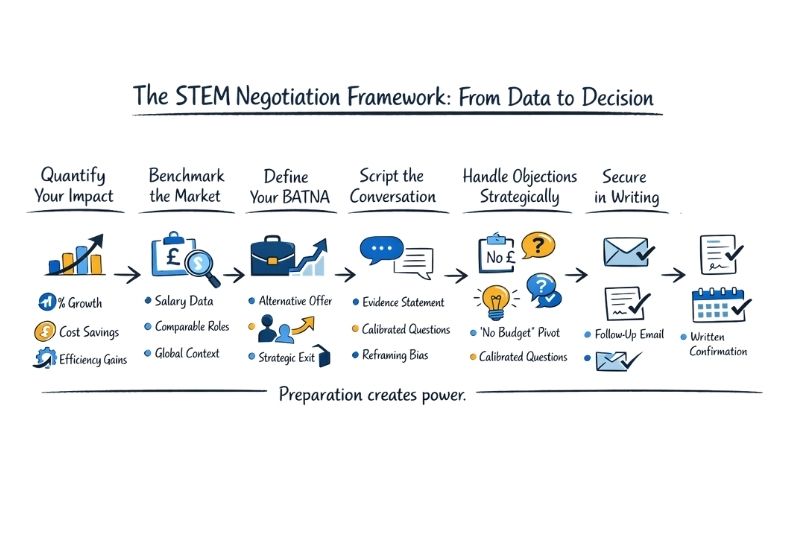
Quantify Your Contributions
First things first: you need to create a detailed log of your accomplishments. But don't just list what you did. The real power lies in quantifying the impact of your work. Your goal is to translate every achievement into a metric that matters to the business.
Did you improve a process? Great. By what percentage? Did you contribute to a successful product launch? Fantastic. How did it affect revenue or user engagement? Numbers cut through subjectivity and make your value concrete.
Let's look at how to frame this:
Instead of: "I helped develop the new software module."Try: "I led the backend development for the new module, which cut server response times by 15% and directly supported a 10% increase in user sign-ups in Q3."
Instead of: "I managed the lab's data analysis."Try: "I optimised the data analysis workflow, which saved the team 20 hours per week and enabled us to complete two additional research sprints this year."
This simple change anchors your value in business outcomes. Suddenly, you're not just a good employee; you're a driver of growth and efficiency. For more on this, our in-depth article on how to ask for a promotion is a great resource for building out your case.
Benchmark Your Market Value
Once you’ve nailed down your internal value, it’s time to see how it stacks up against the external market. This is a critical step. You need to understand what your skills are worth not just within your company, but in major global STEM hubs like Silicon Valley, London, Bangalore, or Sydney.
Get digging. Use salary comparison sites, pull industry reports, and tap into your professional networks. You're looking for roles with similar responsibilities, skill sets, and experience levels at comparable companies (think size, sector, and location). Don't just grab the first number you see; collect a range of data points to build a realistic and, most importantly, defensible salary band.
It's surprising how many people skip this. For instance, some statistics show that in the UK, only 31% of new hires negotiated their last salary offer. Compare that to the US, where 85% of those who did negotiate received a better deal. It shows that simply starting the conversation pays off. For women in STEM with highly sought-after skills, this data reveals a massive opportunity. You can find more of these salary negotiation statistics on procurementtactics.com.
Define Your BATNA
In the world of negotiation, there's a term you need to know: BATNA. It stands for your Best Alternative to a Negotiated Agreement.
Put simply, this is your walk-away point. What will you do if this negotiation doesn’t give you what you need? Knowing your BATNA is your secret weapon.
Your BATNA isn't a threat to be brandished; it’s your source of inner confidence. It's the safety net that allows you to negotiate from a position of strength, not desperation.
So, what could a BATNA look like?
- An acceptable job offer from another company.
- The stability of staying in your current role while you continue your search.
- A concrete plan to start your own consultancy.
Defining this clearly before the conversation isn't about being confrontational. It's about setting your boundaries and empowering yourself to make a clear-headed decision. When you know you have a viable alternative, you can be calmer, more assertive, and completely focused on the value you bring, knowing you’ll be fine no matter the outcome.
Mastering Key Conversations with Proven Scripts
Once you’ve done the groundwork and built your data-driven case, the next step is moving from research to real-time conversation. This is where you bring all that evidence to life, and having a framework—or even just a few key phrases in your back pocket, can make all the difference.
The point isn't to sound like you're reading from a script. It’s about having a solid starting point that keeps you focused on your goals, even when the nerves kick in. These frameworks help you open the conversation confidently, present your case logically, and handle the inevitable objections with poise.
Scripting Your New Job Offer Negotiation
Getting a job offer is a fantastic moment, but it's also your very first chance to set the tone for how your new employer values you. The key is to blend genuine excitement with professional composure. Your first words should always be appreciative.
A strong opening can immediately frame the discussion as a collaboration, not a confrontation. You're not making a demand; you're starting a dialogue.
Opening Statement Example:
"Thank you so much for the offer. I'm very excited about the opportunity to join the team and contribute to [Company Goal]. I'd like to discuss the compensation package to ensure it aligns with the market rate for this role and my experience."
This approach is positive and professional, and it clearly signals your intention to talk details. When you lay out your case, you need to connect your research directly to the specific demands of the role.
Presenting Your Case (Key Phrase):
"Based on my research into similar roles in the local tech sector, which require expertise in [Skill 1] and [Skill 2], the typical salary range is between X and Y. Given my experience in [mention a key achievement], I believe a salary of Z would be a more accurate reflection of the value I bring."
This shows you've done your homework. The number you're proposing isn't just wishful thinking; it's a well-reasoned figure tied directly to your qualifications and the market.
How to Ask for a Promotion and Salary Review
Negotiating within your current company feels different because you're working with an established relationship and a proven track record. The conversation should feel like a natural next step in your career journey, not an ultimatum.
Timing is everything. Make sure you schedule a proper meeting, preferably after you've wrapped up a successful project or during your annual performance review cycle. The last thing you want to do is ambush your manager.
Opening Statement Example:
"Thanks for meeting with me. I've been reflecting on my contributions over the past year, particularly my work on [Project Name] and how I've [mention a quantifiable achievement]. I'd like to discuss my career progression and how we can align my role and compensation with this level of impact."
This frames the discussion around your growth and value, positioning it as a forward-looking conversation about your future at the company.
A well-structured argument transforms a request into a business proposal. You are not just asking for more; you are outlining the return on investment the company receives by advancing you.
Your goal here is to connect your past performance to your future potential. Use the data you’ve gathered on your achievements to build a clear narrative of your increasing responsibility and value.
Presenting Your Case (Key Phrase):
"My analysis of our recent project data shows my work on [Initiative] led to a 15% reduction in operational costs. I’m eager to take on more leadership, and based on industry benchmarks for a [New Title] role with this scope of responsibility, a salary adjustment to X would be appropriate."
This is confident and rooted in hard facts. It’s also a moment where self-doubt can creep in. Remember, it's normal to feel this way, and learning how to turn your imposter syndrome into your secret weapon is a powerful skill to have in these high-stakes conversations.
Handling Common Objections with Grace
No matter how watertight your case is, you'll probably face some pushback. The most common hurdle is often budget-related. The trick is not to see it as a dead end but as just another part of the process.
Instead of taking a "no" at face value, use it as a prompt to dig a little deeper and explore other avenues. This demonstrates resilience and creative problem-solving, incredibly valuable traits for any professional in STEM.
Response to "We don't have the budget right now":
"I understand that budget cycles can be rigid. Could we explore other options to recognise this increased responsibility? For example, I'd be interested in a formal professional development budget or an extra week of annual leave. Alternatively, could we put a formal plan in writing to revisit my salary in six months, tied to specific performance goals?"
This response shows you’re flexible and keeps the door open. You’re pivoting from salary to other forms of valuable compensation, proving you're a partner in finding a workable solution. It shifts the dynamic from a simple yes/no question into a joint problem-solving exercise, which massively increases your chances of a positive outcome.
Real-World Negotiation Scripts
To make this even more practical, here’s a quick breakdown of how these phrases can be adapted across different scenarios you might face.
| Scenario | Opening Statement Example | Presenting Your Case (Key Phrase) | Response to 'No Budget' |
|---|---|---|---|
| New Job Offer | "I'm thrilled with the offer and keen to join. I'd like to discuss the salary component to ensure it fully aligns with the market." | "My research on roles with similar responsibilities indicates a benchmark of X. Given my background in [Specific Area], I'm seeking Y." | "I understand. Could we discuss a signing bonus or a review in three months to bridge that gap?" |
| Promotion Request | "I'd like to talk about my growth here and how I can take on more responsibility, specifically aiming for the [New Title] role." | "I've successfully led [Project A] and increased efficiency by 20%. This aligns with the duties of a [New Title], which typically commands a salary of X." | "I appreciate the transparency. Could we map out the specific goals needed to secure that budget in the next quarter?" |
| Return to Work | "I'm excited to return and reintegrate with the team. I'd like to discuss my role and compensation to reflect my pre-leave performance and current market rates." | "Before my leave, I delivered [Key Result]. As I resume my duties, I want to ensure my compensation reflects that value and the current industry standard." | "If the salary can't be adjusted now, could we explore a flexible working arrangement or additional support for my re-onboarding?" |
These scripts are not meant to be read verbatim. Think of them as springboards to help you articulate your value clearly and confidently, no matter the situation.
Navigating Bias and Difficult Dynamics
For many women in STEM, a negotiation can feel like walking a tightrope. You’ve done your homework, you have the data, and your case is solid, Once you’ve done the groundwork and built your data-driven case, the next step is moving from research to real-time conversation. This is where you bring all that evidence to life, and having a framework, or even just a few key phrases in your back pocket, can make all the difference.
But what if suddenly the conversation veers into subjective territory? This is often the point where unconscious bias quietly slips into the room, creating tricky dynamics that can completely derail a well-prepared argument.
These biases often show up in coded language and frustrating double standards. A man is praised for being “assertive,” yet a woman using the exact same approach is labelled “aggressive.” You might also find your technical expertise questioned in ways your male colleagues never experience. These moments are incredibly challenging, but learning to navigate them is a crucial skill.
The aim here isn't to get into a confrontation. It’s about strategic redirection. With the right tools at your disposal, you can maintain your composure, steer the conversation back to the facts, and keep the focus where it belongs: on your professional value.
Identifying and Labelling the Dynamic
The first step is simply recognising when a bias-driven dynamic is in play. It’s often a subtle shift in focus—away from the substance of your request and onto your personality or communication style. When you feel this happening, one of the most effective things you can do is to calmly and professionally label what you’re observing.
This isn’t about being accusatory. Think of it as holding up a mirror to the conversation.
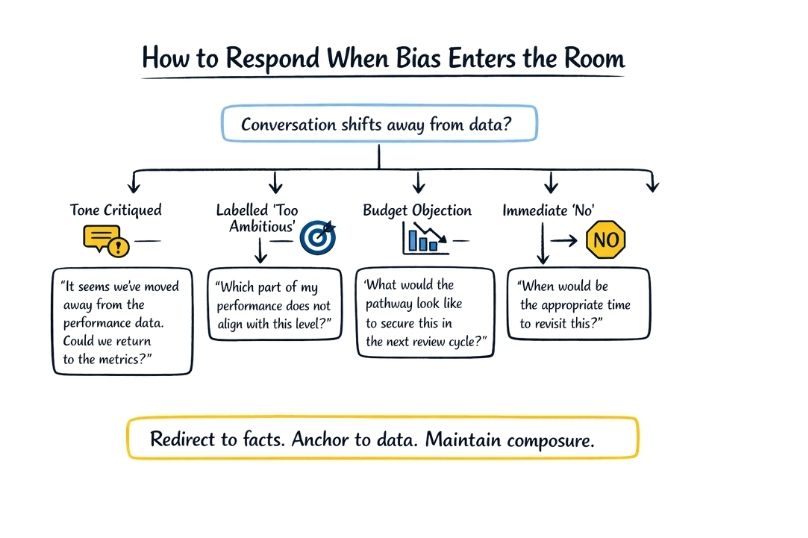
- If your tone is criticised: “It seems the focus has shifted to my communication style rather than the data I’ve presented. Could we return to discussing the project’s 25% efficiency gain?”
- If you’re repeatedly interrupted: “I'd appreciate the opportunity to finish my thought on this point, as it’s central to my proposal.”
- If your confidence is questioned: "My confidence is based on the results I’ve delivered, such as leading the team that secured the recent ISO certification. Let’s look at those metrics again."
Labelling the dynamic re-establishes professional boundaries and gently nudges the other person to re-engage with the facts. It’s a powerful way to reclaim the narrative without escalating the situation. When you find yourself in these moments, understanding how to handle difficult conversations is absolutely key to reaching a good outcome.
Using Calibrated Questions to Refocus
Another brilliant technique is to use calibrated, open-ended questions. These are questions that can't be answered with a simple "yes" or "no," and their purpose is to guide the discussion back into a logical, problem-solving frame of mind.
Instead of reacting with emotion, you respond with genuine curiosity. This approach has a way of disarming defensiveness and encouraging the other person to think more critically about their own statement.
A well-placed question is more powerful than a declarative statement. It invites collaboration and shifts the dynamic from a confrontation to a shared puzzle that needs solving.
Let's look at a couple of examples:
Scenario: Your manager dismisses your salary request by saying, "You seem a bit too ambitious right now."
Response: Rather than defending your ambition, try a calibrated question: "Can you help me understand which part of my performance data doesn't align with the ambitions for this role?"
See how that works? It immediately redirects the focus from a subjective judgement about your personality ("ambitious") back to the objective proof you’ve presented ("performance data"). This forces a fact-based discussion, making it much harder for them to lean on vague, biased assessments.
Likewise, if you’re told your request is "not how we do things here," a great follow-up would be, "What would be a constructive path forward to achieve these goals within the company's framework?" This shows you're a team player while still firmly advocating for your position. Getting good at this can be transformative, and finding a mentor is a great way to practise. You could even explore how to become a mentor for women in STEM to gain more insight into these professional dynamics.
Securing the Deal and Defining What's Next
Hearing a "yes" feels like crossing the finish line, but the race isn't quite over. While you've cleared the biggest hurdle, the final steps are what turn that verbal agreement into a concrete reality. This is where you lock in your win.
This last phase is all about formalising the terms and laying out a clear path forward. It's your defence against the all-too-common problem of misunderstandings, where crucial details get lost or forgotten after the handshake. Nailing this part solidifies everything you've worked for.
Why Getting It in Writing is Non-Negotiable
A verbal agreement is built on memory and goodwill, both of which can unfortunately fade. A written record, on the other hand, is a clear, objective account of what everyone decided. It protects you and the company by creating a single source of truth.
This simple act of documentation prevents "scope creep" from piling onto your new role and ensures the salary, start date, or review period you agreed upon are set in stone. It’s the final, professional seal on a successful negotiation.
It’s surprisingly easy for discussions to fizzle out at this stage. Some studies show that a significant percentage of business negotiations end without a formal agreement, which just goes to show how tough it can be to get things finalised. But here’s the good news: success rates jump dramatically when both sides are working towards common goals.
The Follow-Up Email: A Simple but Powerful Tool
Send a follow-up email within 24 hours of your conversation. This isn't just polite; it's a strategic move that serves two key functions: it shows your appreciation and, more importantly, it summarises the agreement.
Keep your email concise, positive, and clear. You're not trying to reopen the negotiation—you're simply confirming the great outcome you've already achieved together.
Here’s a simple framework you can follow:
- Open with gratitude. Thank them for their time and express your excitement about the decision.
- Recap the key points. Use a bulleted list to outline the main terms: salary, title, specific responsibilities, and any other benefits discussed.
- Clarify the next steps. Briefly mention what you expect to happen next, like receiving a formal offer letter or an updated contract.
- Close on a high note. Reiterate your enthusiasm for the role and your future with the organisation.
A follow-up email isn’t just good manners; it’s a strategic tool. It creates an official paper trail and ensures everyone is on the same page, eliminating any room for future ambiguity.
Handling a "No" or a Disappointing Outcome
Sometimes, even with the best preparation, the answer isn't what you hoped for. If you get a firm "no" or an offer that falls short of your BATNA, how you respond is critical. Handling it with grace preserves your professional reputation and leaves the door open for another conversation down the line.
First, give yourself a moment to process it. Then, thank them for their time and consideration. You can then gently probe to understand their constraints. Try asking something like, "I appreciate your transparency. Could we set a date to revisit this in six months, once the new budget is approved?"
This kind of response shows resilience and a collaborative spirit. It positions you as a problem-solver, not just an employee. It's a skill that extends beyond salary talks; for instance, it's a similar approach you'd use when you ask to be sponsored and secure lasting partnerships.
Of course, if the outcome is truly unworkable, it may be a sign to start exploring your alternatives. You can find more advice on this in our guide: https://womeninstemnetwork.com/salary-negotiation-women-stem/.
Making Negotiation a Core Part of Your Career
Think negotiation is just about that big, scary salary talk every few years? It’s time for a reframe. The real secret to career growth isn't just winning one high-stakes conversation; it's seeing negotiation as a continuous skill you hone every single day.
Look around your workplace. Every interaction is a chance to practise. You're negotiating when you discuss a project deadline, when you ask for more resources for your team, or even when you're just setting a meeting agenda. These are the perfect low-stakes training grounds to build the muscle memory you'll need for the bigger conversations.
From a Daunting Task to an Empowering Tool
When you get into the habit of preparing with hard data and advocating for what you need, something powerful shifts. Negotiation stops being a source of anxiety and becomes your primary tool for shaping your own career. You move from simply reacting to whatever comes your way to actively creating your own opportunities.
This mindset is especially important when you're up against systemic barriers. Don't underestimate the power of persistent, well-reasoned advocacy. A recent UK government report on market access barriers found that out of 394 identified obstacles, a remarkable 165 were fully or partially resolved through sustained effort. While this is about trade, the principle is the same: strategic dialogue can dismantle huge obstacles. That’s a lesson we can all take to heart when advocating for equity in our fields. You can dig into the specifics in these UK government market access findings.
By mastering how to negotiate in the small moments, you build the confidence and skill to succeed in the big ones. Each successful exchange compounds, creating a career defined by proactive growth, not passive acceptance.
Ultimately, weaving these techniques into your professional DNA does far more than just land you a single raise or a better title. It helps you build a career-long competency. This is the skill that will not only fuel your own advancement but also help forge a more equitable path for all women in STEM.
Your Questions, Answered
Even the most well-prepared strategy can hit a few snags. Negotiation is a dynamic process, and tricky questions are bound to pop up. Let's tackle some of the most common ones I hear from women in STEM, so you can walk into these conversations feeling prepared for anything.
When Is the Best Time to Bring Up Pay?
Timing is everything. The most natural entry points are during your performance review, when you're up for a promotion, or when you have a new job offer on the table. In these moments, compensation is already part of the conversation.
Another golden opportunity is right after you've delivered a major project or taken on a hefty new set of responsibilities. You have tangible, recent proof of your value.
On the flip side, try to steer clear of high-stress periods for the company. Broaching the topic right before a massive product launch or during a known budget freeze is unlikely to get you the result you want.
What if They Just Say "No" Straight Away?
First, don't panic. A quick 'no' is rarely the end of the road; it's often just the opening gambit. The key is to stay calm and get curious. Your goal is to pivot from a dead end into a collaborative conversation about your future growth.
Try asking questions to understand their position:
- "Could you walk me through what the path to that salary level looks like here?"
- "I understand if the budget is tight right now. Could we agree to revisit this in six months, perhaps after the Q2 results are in?"
This reframes the situation. You're no longer asking for a simple yes/no but are actively trying to find a solution together.
How Do I Negotiate for Perks Beyond Salary?
This is where great negotiators really shine. If the company is truly immovable on salary, it’s time to get creative and look at the total compensation package. Think about what would genuinely improve your work-life balance or boost your career trajectory.
A successful negotiation isn't just about the final number. It's about the total value of your package, which includes benefits that support your career and well-being.
Consider putting these on the table:
- A dedicated professional development budget for that certification you've been eyeing.
- More flexible hours or a permanent hybrid working arrangement.
- An extra week of paid time off.
- A title change that more accurately reflects your seniority and responsibilities.
The trick is to frame these as mutual wins. For example: "I understand the salary is firm for now. However, having a budget to complete my Chartered Engineer status would be a direct asset for the team's upcoming infrastructure project."
By connecting your request to a clear business need, you make it much harder for them to refuse. It also shows you’re a strategic thinker, adding value far beyond your core technical skills.