
Building real, lasting confidence at work isn’t just about changing your mindset. It’s a mix of internal shifts and external, tangible actions that prove your competence and value, to yourself and to others. It all begins with a clear-eyed look at the systemic hurdles that plant seeds of self-doubt in the first place. From there, you can start proactively honing your skills, sharpening your communication, and building a support network that fuels your resilience and career growth.
Understanding the Confidence Gap in STEM
If you've ever felt uncertain in your role, especially in a demanding technical field, know this: it's not a personal failing. It’s often a symptom of a much larger issue, a disconnect between the support companies think they're providing and what their employees actually feel on the ground. This is particularly glaring when it comes to learning and development.
In the fast-moving world of STEM, keeping up with new tech and methods isn't just a nice-to-have; it's essential for staying relevant. Yet, this is precisely where the perception gap often leaves people feeling stranded and questioning their own abilities, which takes a direct hit on their professional self-assurance.
The Employer-Employee Disconnect
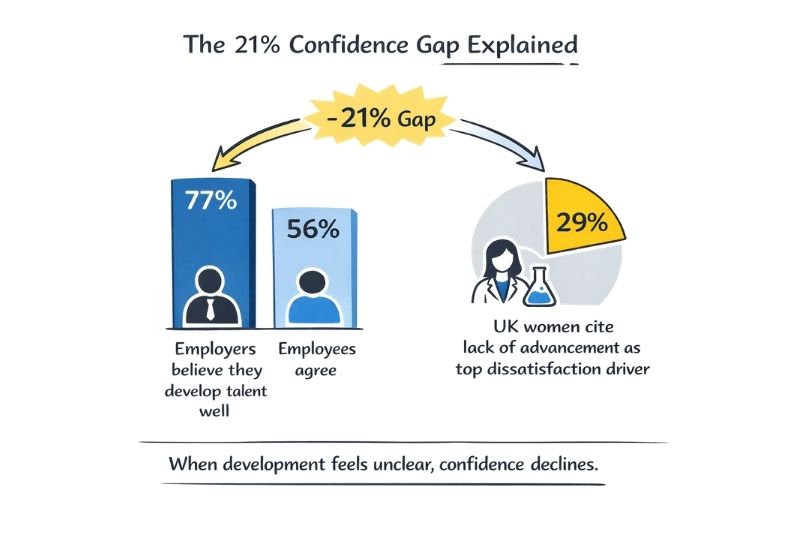
This isn't just a vague feeling; data from around the globe backs it up. In the UK, for instance, there's a startling 21% confidence gap between employers and employees around skills development. While 77% of employers believe their organisation is great at developing its workforce, only 56% of employees feel the same way. This trend is not unique to one country and highlights a common workplace dynamic.
This mismatch breeds an environment where women in STEM, who are often already navigating unique challenges, can start to doubt their own competence. It's a significant barrier to building confidence at work.
When it feels like your organisation isn’t investing in your growth, it’s all too easy to internalise that as a comment on your own value. Realising this gap exists is the first step towards taking back control of your professional story.
The challenge is magnified by the persistent underrepresentation across many technical sectors. For a deeper look, you can find more on the latest statistics on women in STEM fields.
Acknowledging these external pressures is a crucial starting point. It helps shift the narrative from self-blame to a focus on proactive, empowering strategies that are firmly within your control. The next sections will give you the practical tools to do exactly that.
Tame Your Inner Critic and Beat Imposter Syndrome
Let's be honest, confidence is often an inside job. It’s shaped by that internal monologue we have running in the background. For many of us in STEM, this voice takes the form of imposter syndrome—that persistent, nagging feeling that you’re a fraud, about to be found out, even when your accomplishments say otherwise. Simply recognising this pattern is the first real step to taking its power away.
This self-doubt doesn't exist in a vacuum; high-pressure work environments pour fuel on the fire. For example, recent Gallup data reveals that UK full-time employees score 32 on the Negative Experience Index for daily stress and worry. That’s a sharp rise from 23 in 2020, making the UK the second-most distressed in Europe. An environment like that is a perfect breeding ground for imposter syndrome to flourish, and similar trends in workplace stress can be observed globally.
A huge part of this rewiring process comes down to understanding your core beliefs. Are you operating from a scarcity or abundant mindset? This one distinction dramatically affects your confidence. Shifting from a scarcity mindset (where success is a zero-sum game) to an abundant one (where there's plenty of opportunity to go around) can completely change how you see your colleagues and your own potential for growth.
Practical Tools to Reframe Your Thoughts
You can't just 'think' your way out of imposter syndrome; you need to take action. These simple, repeatable exercises are designed to build a more resilient and confident internal narrative based on facts, not feelings.
- Curate a ‘Wins Folder’: I tell every woman I mentor to do this. Create a folder—digital or physical—and fill it with positive feedback, screenshots of praise, successful project reports, and notes on tricky problems you’ve solved. When doubt creeps in before a big meeting, open it up. It’s hard to argue with cold, hard proof of your competence.
- Write Role-Specific Affirmations: Generic phrases like "I am successful" don't cut it. Get specific to your technical role. Try something like, "I am a skilled C++ developer who excels at debugging complex code," or "My analytical perspective is a vital asset to this project."
- Use Strategic Mindfulness: Before a daunting presentation or a technical review, find a quiet space for just five minutes. Focus on deep, slow breathing. This isn't just fluffy advice; it physiologically lowers cortisol levels, calms your nervous system, and helps you walk into that room with clarity instead of anxiety.
Imposter syndrome loves vague feelings of inadequacy. The antidote is specificity. By focusing on documented achievements and practical calming techniques, you systematically replace abstract fear with concrete evidence of your capability.
If you want to dig deeper into this, our guide on overcoming impostor syndrome as a woman in STEM is a great next step. Building these mental habits is what creates a strong foundation for the kind of confidence that lasts.
Own Your Growth: Actively Build and Showcase Your Expertise
Confidence isn't just a state of mind; it's earned. It's the natural result of knowing your stuff, inside and out. The most direct path to that deep, unshakeable self-assurance is by building real, demonstrable competence. This means taking the reins of your own professional development instead of waiting for your manager to suggest the next step.
This is more than just good advice; it's a strategic necessity. A startling 53% of UK workers don’t feel confident that their employers are investing enough in their skills. It's a sentiment that rings true for many women in STEM across the world. Add to that the fact that a significant number of employees globally think AI could take over parts of their job, and the message is clear: taking control of your learning is no longer optional.
Let's move past waiting for an annual review. Your career growth is too important to leave to a once-a-year conversation.
Create Your Personal Development Roadmap
First, get a clear picture of what "expert" looks like in your field right now. What are the must-have technical and leadership skills? Scour job descriptions for the roles you want in a few years. Look at the people you admire in senior positions—what are they good at? What skills keep popping up in industry reports and conference talks?
Once you have a list, it's time to get tactical. Don't just keep these ideas in your head; put them on paper. A structured plan transforms a vague ambition into a concrete project.
This table is a simple but powerful tool to map out exactly how you'll get from where you are to where you want to be.
Your Personal Skills Development Plan
| Skill to Develop (e.g., Python, Project Leadership) | Current Competence Level (1-5) | Target Competence Level (1-5) | Learning Resources (e.g., Online course, Mentorship) | Timeline & Key Milestones |
|---|---|---|---|---|
| Example: Cloud Architecture (AWS) | 2 | 4 | Complete AWS Certified Solutions Architect course | Certification exam by December |
| Example: Public Speaking | 3 | 5 | Join a local Toastmasters group, Volunteer to present at team meetings | Present at a department-wide meeting by June |
Using a plan like this holds you accountable and gives you a clear sense of progress, which is a massive confidence booster in itself.
Volunteer for Challenges That Get You Noticed
With your roadmap in hand, start looking for opportunities to put your learning into practice. Put your hand up for projects that are a slight stretch, especially if they align with the skills you're building. This is how you accelerate your growth and make your contributions visible to everyone.
When you actively seek out challenges, you're sending a clear message to your manager and peers: you are invested, capable, and ready for more. Each successfully completed task becomes another piece of evidence reinforcing your competence.
To really establish your professional authority, you can explore bigger projects, like learning how to write a thought leadership book. It’s also crucial to make sure your growing expertise is reflected in how you present yourself professionally. For guidance, check out our tips on how to write a CV that truly highlights your skills.
Communicate with Authority in Any Situation
Communicating with confidence isn't about being the loudest voice in the room. It’s about making sure your message lands with clarity and conviction, so your expertise is truly heard and respected.
This is especially crucial in high-stakes moments. For women in STEM, where precise articulation and collaboration are everything, mastering this skill is fundamental to building confidence at work. It's about having a game plan for those moments that can shake your self-assurance, whether that's being cut off mid-explanation or presenting a business-critical proposal.
Scripts for Reclaiming Your Space
Being talked over or interrupted is a frustratingly common experience, but you can take back the floor without missing a beat. The trick is to have a few phrases in your back pocket so you’re not caught off guard.
Here are a few you can adapt:
- When interrupted: “I’d just like to finish my point.” It's direct, polite, and effective.
- To redirect a tangent: “That’s an interesting thought, let’s park that for now and circle back once we’ve finished with the main agenda item.”
- To state your idea clearly: “My perspective is…” or “The way I see it is…” followed by your concise point.
The goal here is to be assertive, not aggressive. These simple phrases establish a conversational boundary, signalling that your contribution is valuable and deserves to be heard in full.
Structuring Data-Driven Arguments
In any STEM field, data is your most powerful ally. When you need to persuade stakeholders or make a case for more resources, grounding your argument in solid evidence is non-negotiable.
A simple, clear framework can make all the difference, helping you present your case with unshakeable authority. Think of it as telling a story with data.
- State the Problem: Start by clearly defining the challenge or opportunity. What issue are we trying to solve?
- Present Your Evidence: This is where you bring in the facts. Use key statistics and research findings to build your case. Visuals like charts and graphs are incredibly powerful here.
- Propose Your Solution: Directly connect your proposed action back to the data you just presented. Explain why this is the most logical course of action.
- Outline the Impact: End on a high note. What are the tangible benefits? Think efficiency gains, cost savings, or better project outcomes.
This structured approach does more than just present facts; it shows you’ve done your homework, which is a massive confidence booster in itself. The principles behind this kind of influence are also deeply connected to emotional intelligence in leadership. To dig deeper, read our article on why neuro-emotional leadership is a strategic skill for women in STEM.
Build a Strategic Professional Support System
Trying to build confidence all on your own is like climbing a mountain without a rope. A solid professional support system is that rope, your safety net. It gives you the security to take bigger risks and the resilience to bounce back much faster when things don’t go to plan.
This isn’t about just accumulating a long list of contacts on LinkedIn. It’s about being deliberate, cultivating genuine relationships with people who play distinct, crucial roles in your career. When you understand the difference, you can build a network that truly has your back.
Mentors, Sponsors, and Peers: The Three Pillars of Support
Think of your network as having three essential pillars. Each one provides a unique kind of support, and a well-rounded system needs all of them. If you neglect one area, you’ll find yourself on shaky ground when challenges inevitably pop up.
Mentors Advise You
A mentor is your trusted guide, the person you turn to for wisdom. They’ve walked the path ahead of you and can offer invaluable perspective, help you navigate tricky office politics, and act as a sounding board for your career aspirations.Sponsors Advocate for You
A sponsor is a senior leader who actively uses their clout to open doors for you. They’re the ones championing your work in high-level meetings you’re not invited to, putting your name forward for that stretch project or the next big promotion.Peers Support You
Your peers are your allies in the trenches. These are the trusted colleagues at a similar career stage who offer day-to-day solidarity, practical help on a tough project, or just a safe space to vent and feel understood.
A mentor talks with you, a sponsor talks about you, and a peer talks things through with you. All are essential for building lasting confidence at work.
Finding a sponsor can feel like the most intimidating piece of the puzzle, but it all starts with visibility. Focus on delivering outstanding work, especially on projects that senior leaders are watching. Once you've earned their respect with your performance, you can more naturally ask for their advice, which can often evolve into a sponsorship relationship.
Building a powerful network doesn't happen by accident. It's built one strategic relationship at a time. If you’re looking for more structured guidance on this, you can learn more about finding the right people through your mentoring options.
Your Confidence Questions, Answered
Feeling confident at work isn't a switch you can just flip on. It’s something you build, and it’s completely normal to have questions along the way. I've heard these same concerns from so many women in STEM, so let's tackle them head-on.
How Can I Look Confident in Meetings, Even When I'm Tying Myself in Knots Inside?
The secret here is preparation. It’s your best defence against nerves. Really get to know your subject matter inside and out. Before you even walk into the room, jot down your main talking points and think through the questions you're likely to get. Some people even swear by doing a 'power pose' for a minute beforehand—it sounds a bit silly, but it can genuinely help calm your nerves.
Once you’re in the meeting, focus on your physical presence. Sit up straight, make eye contact with people as you talk, and try to speak at a steady, deliberate pace. If someone cuts you off, don't just let it slide. A simple but firm, ‘I’d just like to finish my point,’ shows you value what you have to say. Remember, you’ve done the prep work, and that earns you the right to be heard.
I Feel Like My Confidence Is at Rock Bottom. Where Do I Even Start?
Start small. Seriously, go for a tiny, manageable win. A vague goal like ‘be more confident’ is impossible to act on. Instead, pick one specific thing you can do. Maybe it’s asking one thoughtful question in your next team meeting, or spending an hour on a tutorial for a new piece of software.
When you do it, write it down. Keep a 'brag file' or a simple journal of your achievements. This isn't about ego; it's about creating tangible proof for yourself that you are capable and effective. It's this cycle of small actions and acknowledgements that lays the foundation for real, lasting confidence.
How Do I Take Critical Feedback Without Letting It Wreck My Confidence?
This one is all about reframing your mindset. Try to see feedback as data, not as a verdict on your worth. When someone gives you criticism, your first instinct might be to get defensive. Fight that urge. Just listen, and thank them for their perspective.
Give yourself some space, then come back to it and look at it objectively. Pull it apart and ask, "What's the actionable piece of information here? How can this genuinely make my work better?" When you start treating feedback as a strategic tool for growth, it loses its emotional sting and you position yourself as someone who is resilient and focused on improving.
Should I Find a Mentor Inside My Company or Look for One Elsewhere?
Honestly, the best-case scenario is to have both. Each type of mentor offers something unique and valuable.
Internal mentors are brilliant for helping you navigate the system you're in right now. They get the company politics, the unwritten rules, and know who the key players are. Their advice is incredibly practical for your day-to-day role.
External mentors give you that crucial outside perspective. They can help you see the bigger picture of your industry and your career path, free from any internal company bias.
This is a huge issue, especially when you consider that career progression is a major point of frustration. A recent study found that 29% of women in the UK named a lack of career advancement as their top reason for job dissatisfaction, that’s nearly double the global average of 17%. It’s hard to feel confident when you feel stuck. Having mentors who can advocate for you and help you see a path forward is absolutely vital. You can dig into the full data on UK workforce satisfaction to get a clearer picture of the challenges.