
In high-performance environments such as STEM, leadership progression is often framed as a natural outcome of experience. Build expertise, deliver results, gain recognition, and the next step should follow. In practice, this linear model rarely holds.
A consistent pattern emerges across sectors. Many professionals reach a point where their technical capability is no longer in question. Their track record is established. Their contributions are visible. And yet, progression stalls.
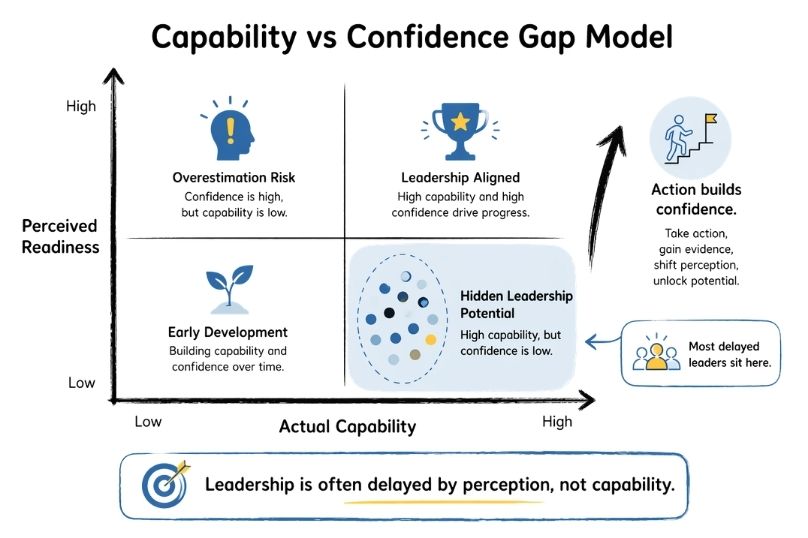
The barrier is not competence. It is the gap between capability and confidence.
This article explores that gap, why it persists, and what can be done to address it. It draws on insights from the recent Women in STEM Network session Courage Over Comfort: Stepping Into the Leadership You Deserve, and outlines practical strategies for moving forward with clarity.
For those who were unable to attend live, the full session is available to members on demand here:
https://womeninstemnetwork.com/on-demand-workshops-for-women/
The Leadership Gap Is Not a Skills Gap
There is a tendency to assume that hesitation reflects a lack of readiness. This assumption is rarely tested. Instead, it becomes internalised.
Professionals delay applying for roles, contributing at a higher level, or positioning themselves for leadership because they believe additional preparation is required. More experience. More qualifications. More certainty.
However, when assessed objectively, many of these individuals are already operating at or near the level required for progression.
This creates a structural inefficiency. Organisations seek leadership capability while capable individuals remain static, waiting for a signal that rarely arrives.
The issue is not a shortage of talent. It is a misalignment between perceived readiness and actual capability.
The Invisible Weight Carried by High Achievers
In STEM environments, where outputs are measurable and standards are high, a particular set of behavioural patterns tends to develop:
- Over-preparation before taking action
- Reluctance to step forward without complete certainty
- A tendency to exceed expectations as a baseline
- Internal questioning despite external validation
These patterns are often reinforced over time. They may initially contribute to success, but they become limiting when applied to leadership progression.
Importantly, these behaviours do not emerge in isolation. They are shaped by context. Environments where feedback is inconsistent, progression pathways are unclear, or recognition is uneven can reinforce the need for individuals to self-regulate through caution.
The result is a form of self-imposed delay, where individuals wait for a level of confidence that is unlikely to precede action.
Why Confidence Is the Wrong Starting Point
One of the central ideas explored in the session is that confidence is not a prerequisite for progression.
Confidence is frequently treated as a condition that must be met before taking action. In reality, it is more accurately described as an outcome of action.
This distinction is operationally significant.
If confidence is required before action, progression is delayed indefinitely. If confidence is generated through action, then movement becomes possible immediately.
This reframing shifts the focus from internal readiness to external behaviour.
Instead of asking, “Do I feel ready?” the question becomes, “What is the next action that aligns with where I want to be?”
Moving from Awareness to Implementation
Recognising the gap between capability and confidence is only the first step. The critical transition is from awareness to implementation.
The session introduced several practical approaches to support this shift.
Reframing Limiting Assumptions
Limiting beliefs tend to operate without scrutiny. Statements such as “I need more experience” or “others are more qualified” are rarely tested against evidence.
A more rigorous approach involves:
- Identifying the specific belief
- Assessing the evidence supporting it
- Considering alternative explanations
- Testing the belief through action
In many cases, these beliefs are based on perception rather than data. Challenging them requires deliberate intervention.
Defining Immediate Actions
Large goals create cognitive resistance. They are abstract, high-stakes, and easy to defer.
Progress is more effectively driven through immediate, contained actions. These are steps that can be completed within a defined timeframe and that contribute directly to a broader objective.
Examples include:
- Submitting an application that has been delayed
- Initiating a conversation about progression
- Volunteering for a visible project or responsibility
During the session, participants highlighted the value of focusing on actions that can be taken immediately, rather than waiting for optimal conditions.
The principle is straightforward. Completion builds momentum. Momentum reduces resistance.
Separating Perceived Risk from Actual Risk
Fear of negative outcomes is a consistent barrier to progression. This is particularly evident when considering significant changes such as applying for new roles or stepping into leadership positions.
However, perceived risk is often disproportionate to actual risk.
A structured approach involves:
- Defining the worst-case scenario
- Assessing its likelihood
- Identifying mitigation strategies
- Comparing this with the potential upside
This process introduces rationality into decision-making and reduces the influence of untested assumptions.
Leadership Presence Is Developed, Not Inherent
Leadership presence is frequently described in abstract terms. It is often associated with confidence, authority, or charisma.
In practice, it is more accurately understood as a set of observable behaviours.
These include:
- Clear and concise communication
- Consistency between stated intentions and actions
- Ownership of decisions and outcomes
- Willingness to engage visibly and contribute at a strategic level
These behaviours are not fixed traits. They are developed through repetition.
Avoiding visibility in order to feel more confident delays the development of presence itself. Exposure, even when uncomfortable, is the mechanism through which presence is built.
The Role of Coaching in Sustained Progress
A notable aspect of the session was its coaching-based approach.
Rather than providing prescriptive answers, the session focused on structured reflection and guided questioning. This aligns with a broader understanding of how behavioural change occurs.
Coaching supports leadership development by:
- Making implicit thought patterns explicit
- Introducing accountability
- Encouraging deliberate action
- Supporting consistency over time
This contrasts with traditional training models, which often focus on knowledge acquisition rather than behavioural implementation.
Speaker Profile: Diane Thompson
The session was led by Diane Thompson, an Executive Coach, leadership consultant, and founder of Courage Over Comfort Coaching.
Diane brings more than twenty years of leadership experience, including serving as a Headteacher across three schools. Her work includes leading institutional transformation, improving performance outcomes, and achieving an “Outstanding” Ofsted rating.
She now works with organisations across sectors to develop leadership capability, with a particular focus on supporting women and underrepresented professionals to progress into senior roles.
Her approach combines practical leadership experience with formal coaching frameworks. She holds an ILM Level 7 qualification in Executive Coaching and Mentoring and is the author of the Mindful Moments Wellbeing Journal. She is also the creator of the Courage Over Comfort 21-Day Challenge Series®, which provides structured tools for building confidence and resilience through consistent action.
Further information and resources:
- Website: https://www.courageovercomfortcoaching.co.uk
- LinkedIn: https://www.linkedin.com/in/dianethompsoncourageovercomfortcoaching
- Clarity Call: https://calendly.com/courageovercomfortcoaching/complimentary-clarity-call
Real Questions from the Community
The discussion was grounded in practical concerns raised by attendees.
Participants asked:
- What is one realistic action that can be taken today to make a difference?
- How do you move forward when you feel stuck in your current role?
- How do you take significant steps when there is a risk of a worse outcome?
These questions reflect a shift from abstract ambition to operational challenge.
The responses consistently returned to the same principle. Progress does not require certainty. It requires a decision to act with the information available.
Systemic Context and Individual Strategy
It is important to recognise that individual behaviour does not exist in isolation.
Structural barriers, biases, and inconsistent progression pathways remain present across many organisations. These factors influence how individuals perceive risk and opportunity.
However, while systemic change is necessary, individuals still require strategies to navigate current conditions effectively.
This dual perspective is critical. It avoids oversimplification while maintaining a focus on actionable steps.
What This Means for Women in STEM
For members of the Women in STEM Network, the implications are clear.
The challenge is not a lack of ambition or ability. It is the alignment between existing capability and visible action.
The network provides a platform for:
- Normalising shared experiences
- Accessing practical tools and frameworks
- Building accountability through community
- Increasing visibility and engagement
Sessions such as Courage Over Comfort are designed to bridge the gap between intention and implementation.
Access the On Demand Session
If you were unable to attend the live session, the full recording is available to members here: https://womeninstemnetwork.com/on-demand-workshops-for-women/
Revisiting the session provides an opportunity to engage with the material at a deeper level and to apply the tools discussed in a structured way.
Final Reflection
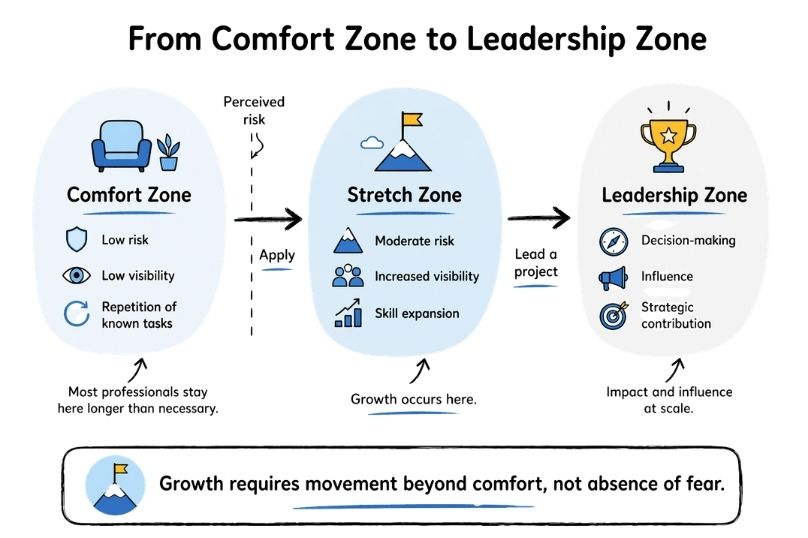
Leadership progression rarely occurs within the boundaries of comfort.
Comfort provides stability, but it can also create stagnation when it prevents movement beyond established roles and behaviours.
Courage, in this context, is not an abstract concept. It is a practical decision. It is the willingness to act without full certainty, to test assumptions, and to move forward despite incomplete information.
For many professionals in STEM, the next step is not about becoming more capable. It is about recognising existing capability and aligning behaviour accordingly.
The question is not whether you are ready.
It is whether you are prepared to act.