The projected revenue for AI in the US healthcare market alone is expected to reach $102.2 billion by 2030 according to this healthcare AI market summary. That figure matters not because every projection comes true exactly, but because it signals something larger. Artificial intelligence and medical practice have moved out of the lab, beyond hype, and into the operating logic of care delivery.
Clinicians now use AI to sort images, structure notes, flag anomalies, and support decisions that once depended only on time, memory, and manual review. Hospitals use it to reduce friction in workflows that have been inefficient for years. Researchers use it to find patterns in data too large for any one team to inspect by hand. The technology isn't replacing medicine. It's changing how medicine is organised, delivered, and governed.
A useful starting point for that broader data and interoperability environment is OMOPHub health data science, which gives context for how healthcare data gets structured for analysis and real-world use. Readers interested in wider leadership examples can also explore women shaping STEM, where the career dimension becomes more visible.
The New Era of Artificial Intelligence in Medicine
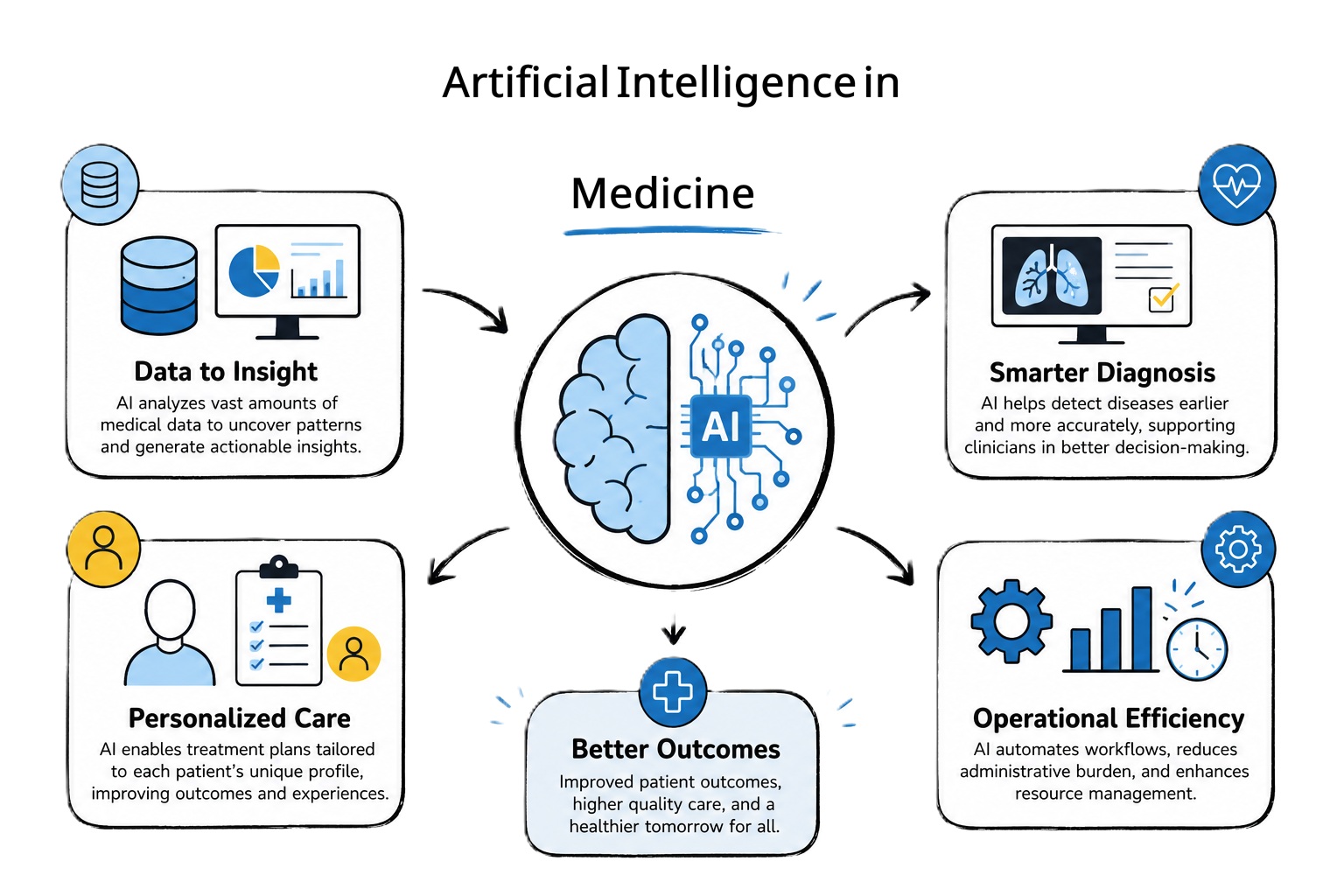
Artificial Intelligence has moved from theoretical promise to practical reality in healthcare, driving innovations that enhance accuracy, efficiency, and patient outcomes. Today, AI supports clinicians in diagnosing diseases, predicting health risks, managing resources, and even training the next generation of medical professionals. As global healthcare systems face rising demand, workforce shortages, and increasing complexity, AI is emerging as a transformative force reshaping medical practice. Artificial Intelligence in healthcare
Understanding Core AI Concepts in a Medical Context
The easiest way to understand AI in healthcare is first to understand the basics of AI and then to integrate in clinical practice as needed.
- Image-focused AI can help detect visual abnormalities that are easy to miss during repetitive screening work.
- Language-focused AI can turn messy clinical conversations into structured documentation.
- Prediction-focused AI can support planning, triage, and resource allocation when used carefully.
Why these categories matter in practice
Confusion often comes from treating all AI systems as if they have the same job. They don't. Different methods fit different parts of care.
A quick way to separate them is this:
| AI approach | Best understood as | Typical medical use |
|---|---|---|
| Machine learning | Learning from prior examples | Risk scoring, classification, prioritisation |
| Deep learning | Detecting complex patterns in rich data | Imaging, signal analysis, visual screening |
| Natural language processing | Understanding and structuring clinical language | Documentation, coding, summarisation |
The important question isn't whether a system is “AI-powered”. It's whether the method matches the clinical problem, the available data, and the level of oversight required.
Real World Applications Transforming Clinical Workflows
AI-powered diagnostic tools are among the most impactful innovations in modern medicine. Machine learning models can analyse medical images, laboratory data, and patient histories with remarkable precision.
Early detection of critical conditions: AI systems in intensive care units can predict the onset of sepsis hours before symptoms appear, enabling earlier intervention and reducing mortality.
Enhanced imaging diagnostics: AI-driven mammography tools can identify early signs of breast cancer with accuracy that often surpasses human radiologists.
COVID‑19 and dermatology applications: AI has been used to diagnose COVID‑19 from chest imaging and assist with dermatology referrals, demonstrating its versatility across specialities.Artificial intelligence (AI) and machine learning
These advancements do not replace clinicians but augment their capabilities, offering faster, more consistent, and data‑rich insights.
AI in Healthcare Operations and Resource Management
Beyond diagnostics, AI is revolutionising how healthcare systems operate.
Predictive modelling: AI can forecast patient admissions and optimise hospital bed usage, staffing, and equipment allocation.
Administrative automation: Tasks such as scheduling, billing, and electronic health record management can be streamlined, reducing costs and freeing clinicians to focus on patient care.
These improvements make healthcare more efficient and economically sustainable, critical as global demand continues to rise.
Where career opportunities sit
Many of the strongest roles for STEM professionals emerge within these specific areas. Healthcare organisations need people who can map data flows, define technical requirements, assess interoperability, and coordinate between vendors, clinicians, informatics teams, and governance leads.
Some of the most valuable contributors won't be writing models from scratch. They will be solving translation problems. They will ask whether the right data exists, whether outputs are interpretable, whether the handoff to human review is sensible, and whether the deployment increases or reduces hidden workload.
Many women leave technical career tracks not because they lack capability, but because organisations undervalue this kind of cross-functional systems work. The pattern described in attrition in STEM and the hidden exit points is highly relevant here. AI in healthcare needs exactly the blend of technical fluency, stakeholder judgement, and implementation discipline that is often overlooked in traditional role definitions.
AI and the Future of Medical Careers for Women in STEM
The labour question gets framed badly. People ask whether AI will replace doctors, nurses, or scientists. In practice, the more important shift is role redesign. Medical work is being redistributed between human judgement, machine assistance, and new layers of technical governance.
That creates opportunity for women in STEM, but only if organisations treat inclusion as design work rather than branding.
A 2024 UKRI report found that women hold only 28% of AI specialist roles in UK healthcare tech firms, and a 2025 BMA survey found 62% of female doctors cited tech intimidation as a barrier. Those figures appear in the verified data supplied for this article. They point to a serious mismatch. Healthcare AI needs broader participation, yet many women are still being edged away from the very roles where system design and oversight happen.
The jobs growing around medical AI
Some roles are highly technical. Others sit at the boundary between medicine, policy, and systems delivery.
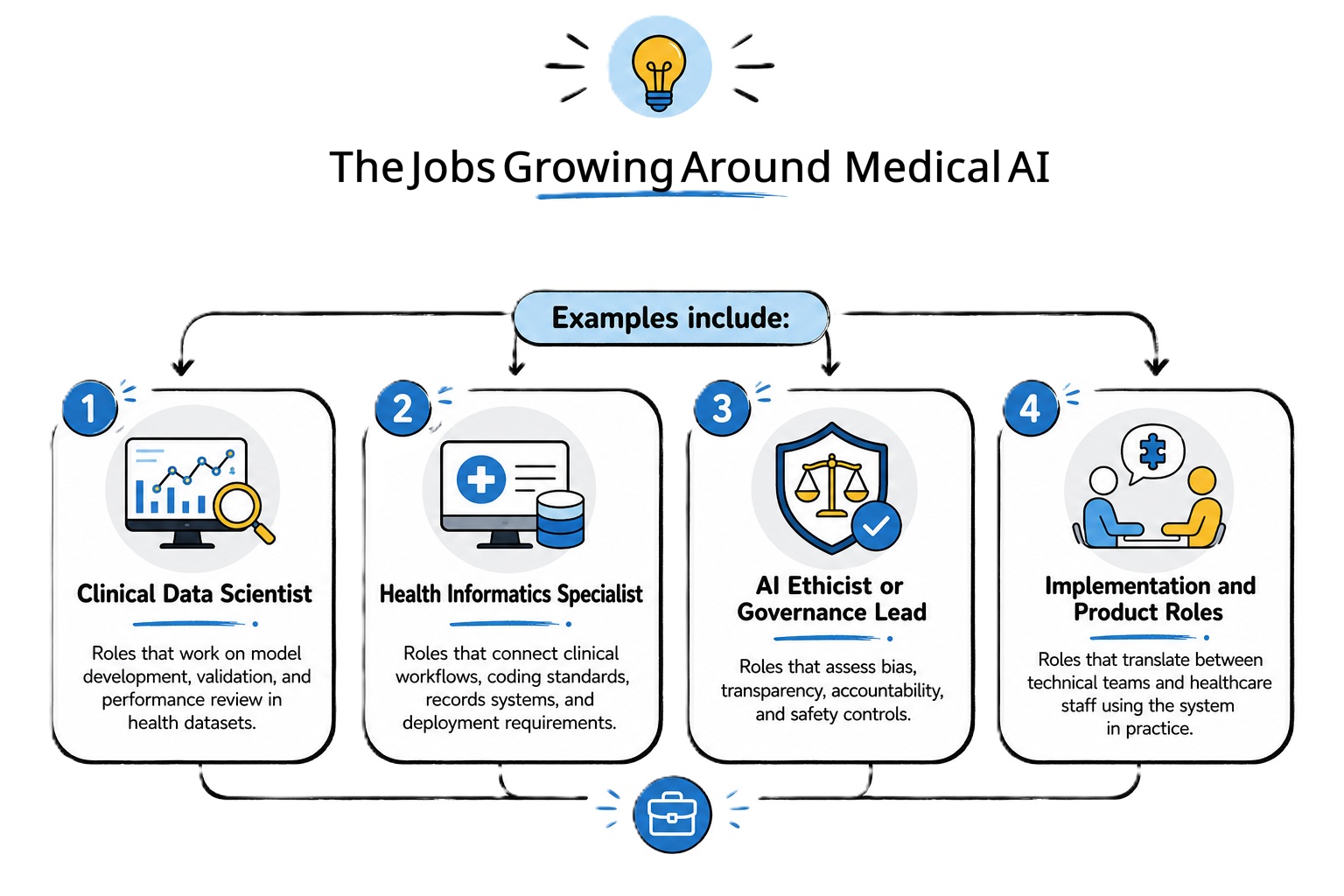
Examples include:
- Clinical data scientist roles that work on model development, validation, and performance review in health datasets.
- Health informatics specialist roles that connect clinical workflows, coding standards, records systems, and deployment requirements.
- AI ethicist or governance lead roles that assess bias, transparency, accountability, and safety controls.
- Implementation and product roles that translate between technical teams and healthcare staff using the system in practice.
These roles matter because most failures in healthcare AI happen at the boundaries. The algorithm may work in theory, but the workflow, governance, or evaluation model breaks down.
How to enter without waiting for permission
Many professionals assume they need a perfect title before they can contribute to AI in medicine. They don't. Entry points often start with adjacent work: data quality improvement, workflow mapping, digital transformation, governance support, or evaluation of new clinical systems.
That's why role visibility matters. A useful place to scan emerging pathways is jobs for women in 2026, especially for readers trying to connect current STEM skills with health-tech opportunities.
The field needs women who can challenge weak assumptions, ask better validation questions, and lead implementation with both technical and human judgement. Those are not secondary contributions. They are the conditions for safe progress.
Your Role in Architecting the Future of Medicine
Artificial intelligence and medical practice are now inseparable in one important sense. Even when a clinician never touches a model directly, AI is starting to shape documentation, screening, operational priorities, and clinical decision support around them.
The key lesson isn't that medicine has become automated. It's that medicine is becoming more dependent on how technical systems are designed, validated, integrated, and governed. That shifts power toward the people who understand both the tools and the context in which they are used.
The strongest opportunities sit inside the hard problems
The biggest gains won't come from generic enthusiasm for innovation. They will come from solving the hard problems that this article has surfaced: data quality, workflow fit, interoperability, bias, privacy, accountability, and inclusive design.
Those problems need clinicians, engineers, analysts, researchers, policy specialists, and implementation leads who can work across boundaries. They also need people who are prepared to challenge bad incentives and shallow deployment logic.
More tips for career advancement can be found on Career Advancement For Women In STEM
A practical next step list
Readers who want to move from interest to action can start with a short sequence:
- Map current skills against healthcare needs. Data analysis, software engineering, biosciences, ethics, design research, and operations all have a place in health AI.
- Learn the workflow, not only the model. A technically strong system still fails if it doesn't fit clinic, ward, or administrative reality.
- Study bias and validation early. Fairness isn't an advanced add-on. It belongs at the start of system design.
- Follow regulation by market. Anyone building globally needs to understand how approval and oversight differ across regions.
- Seek cross-disciplinary projects. The best preparation often comes from work that forces technical and clinical teams to collaborate.
Next move: Treat AI in medicine as a field to shape, not a trend to watch from the side-lines.
The readers best placed to lead this shift may not be the loudest voices in the room. They may be the ones who combine technical discipline, ethical seriousness, and the ability to translate between systems and people. That combination is rare. It is also exactly what healthcare needs.