
Sustainability is often discussed through big promises: net zero, clean energy, responsible growth.
But inside a facility, a lab, a construction project, or a product team, it looks very different.
It is an engineer asking why a system is wasting energy. It is a scientist questioning a material choice. It is an environmental professional reviewing wastewater data, permit limits, chemical use, and waste streams. It is a project manager asking whether a sustainability target can actually be delivered within the budget, timeline, and operational reality of a business.
That is why I do not see sustainability as a side initiative. I see it as a STEM issue.
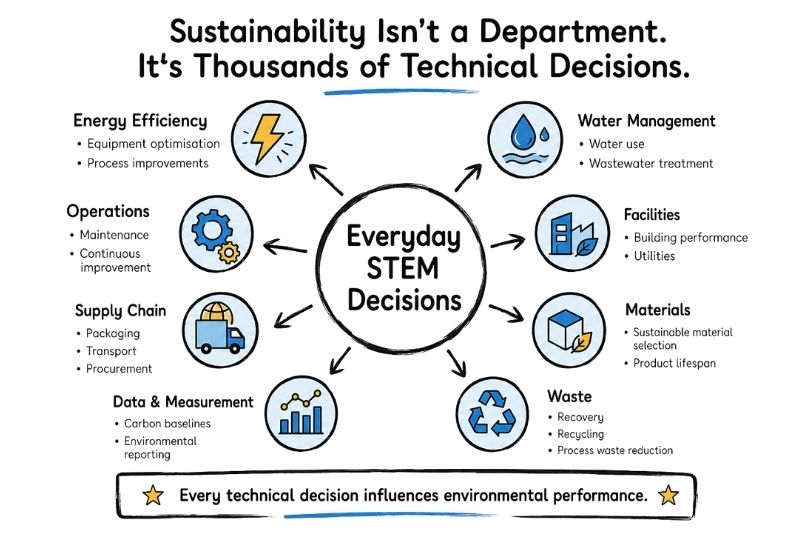
Carbon sits inside everyday technical decisions: how facilities are powered, how products are designed, how water is used, how materials are sourced, and what happens to waste after it leaves a site. A company cannot reduce emissions in a meaningful way without understanding the systems that create them.
This is where women in STEM have an important role to play.
For too long, women have been underrepresented in the rooms where technical, operational, and investment decisions are made. Yet those are the same rooms where climate action becomes real or gets delayed. It is not enough for women to be invited into sustainability conversations after decisions are made. We need women helping shape the decisions from the beginning.
Women engineers, scientists, analysts, designers, and operations leaders bring technical knowledge into spaces where sustainability can otherwise become vague or performative. We can ask the questions that move a company beyond a polished target:
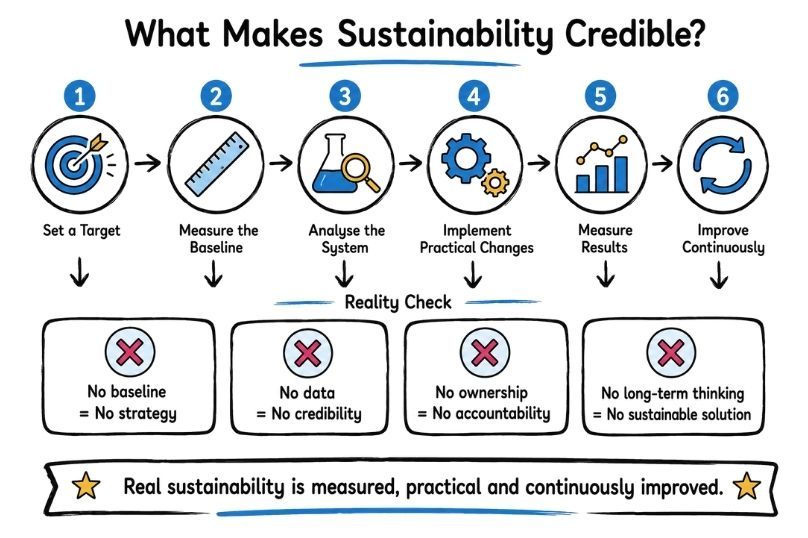
What is the baseline?
Is this reduction measurable?
Who owns the data?
Will this project still deliver results five years from now?
Are we solving the problem, or simply shifting it somewhere else?
Those questions are not always comfortable. But they are necessary.
A carbon target without a clear baseline is not a strategy. A sustainability claim without data is not credibility. A project that ignores cost, maintenance, compliance, and long-term performance is not a solution.
For women entering STEM careers, sustainability is one of the strongest places to build visible and meaningful impact. You do not need a job title that says “sustainability” to contribute.
A mechanical engineer can improve equipment efficiency. A chemical engineer can reduce process emissions. A software engineer can improve environmental data systems. A supply-chain professional can question transport, packaging, and sourcing decisions. A materials scientist can help reduce product impact before manufacturing even begins.
The work is not always glamorous. It happens in utility bills, process reviews, site walks, maintenance logs, environmental permits, supplier meetings, and spreadsheets. But that is where the real work happens.
As a Founding Member of the Women in STEM Network and Local Ambassador for the Ohio Chapter, I believe we need more women who are confident enough to enter these conversations early, ask technical questions, challenge weak assumptions, and make the case for solutions that work in practice.
The climate transition will not be solved by one company announcement or one breakthrough technology.
It will be shaped by thousands of better decisions: a process that uses less energy, a wastewater system that performs better, a material that lasts longer, a waste stream that is recovered, or a carbon number that is measured honestly.
Women in STEM should not be watching this transition from the sidelines.
We should be helping build it.