
A well-structured professional development plan is far more than a corporate formality; it is a strategic blueprint for shaping your career. For women in STEM today, navigating fast-moving technologies alongside structural challenges calls for a informed approach to growth. In an era shaped by advances in artificial intelligence, interdisciplinary research, and flexible working models, a strong plan can provide clarity, build confidence, and create accountability.
This guide moves beyond theory to present eight practical, real-world professional development plan examples. From early-career progression to senior leadership, each example reflects both the opportunities and barriers women continue to encounter across STEM fields. You will find actionable frameworks, strategic insights, and evidence-informed approaches to help you design a plan that develops your skills while aligning with your values and long-term aspirations. As a starting point, a development planning template offers practical ways to translate career ambitions into structured, measurable development plans.
We examine each example in detail, analysing its strategic application and providing tips you can implement. The goal is to equip you with the tools to build a personalised roadmap for success, whether you are pursuing progression, deepening technical expertise, or transitioning into leadership roles. Ultimately, this is about enabling you to take ownership of your trajectory and confidently shape the next phase of your career.
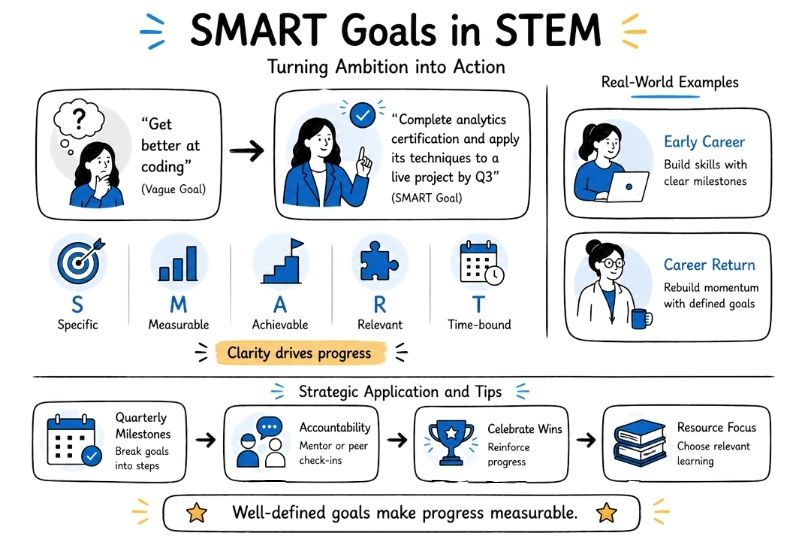
1. SMART Goals Framework for STEM Career Development
The SMART framework is a powerful tool for turning broad career ambitions into a structured, actionable plan. For women in STEM, where progression is difficult to quantify, this approach provides essential clarity. By defining goals that are Specific, Measurable, Achievable, Relevant, and Time-bound, it shifts vague intentions like "get better at coding" to clearly articulated outcomes.
This framework is particularly valuable during critical career transitions. A junior data analyst in India, for example, might set a goal to "complete an advanced analytics certification and apply its techniques to a live project by the end of Q3" rather than simply aiming to "learn new data skills". Similarly, a mid-career researcher in Canada returning from a career break might define success as "co-authoring a peer-reviewed paper and attending three virtual industry events within six months" to rebuild professional momentum. Establishing these parameters makes progress visible, measurable and keeps you focused. To ensure your goals are well-defined and achievable, learn how to set and track effective SMART goals for performance management.
Strategic Application and Tips
Embedding the SMART framework within your professional development plan provides a clear and disciplined roadmap. It reduces ambiguity and enables more effective use of time, energy and resources.
- Quarterly Milestones: Break down long term goals (such as securing a promotion or transitioning roles) into small, quarterly objectives. This builds momentum and allows for timely course correction.
- Mentor Accountability: Share your goals with a mentor or a trusted peer network. Regular check-ins can provide perspective, encouragement and constructive challenge.
- Celebrate Small Wins: Recognise progress at each milestone. Celebrating incremental achievements reinforces motivation and builds confidence over time.
- Resource Alignment: Use clearly defined goals to identify the most relevant courses, certifications, and networking opportunities. Finally, ensure your efforts are focused and efficient.
2. 360-Degree Feedback Development Plans
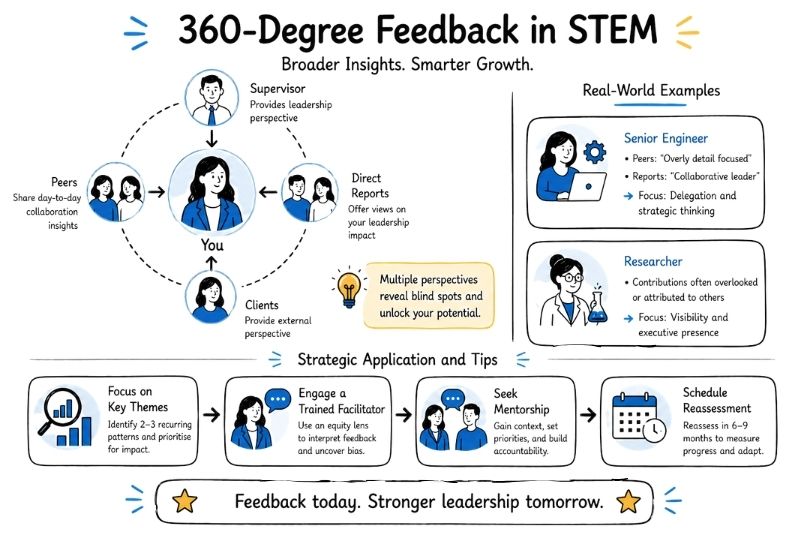
A 360-degree feedback process gathers anonymous performance insights from a full circle of colleagues, including supervisors, peers, direct reports, and sometimes clients. This multi-perspective data forms the foundation of a highly targeted and realistic professional development plan. For women in STEM, this approach is particularly valuable in uncovering blind spots, understanding leadership impact, and recognising how unconscious bias may shape perceptions of their work. The result is a development plan grounded in a broader, more authentic view of professional presence.
This method provides clarity when self-perception and reality differs. For example, a senior engineer in a UK-based firm might receive feedback that peers perceive her as 'overly detail focused', while her direct reports describe her as a 'collaborative leader'. Such insights can inform a development plan centred on strengthening delegation and strategic thinking. Similarly, a researcher in South Africa may find that her contributions in meetings are frequently overlooked or attributed to others, prompting a focus on visibility and executive presence. These examples illustrate how 360-degree feedback transforms subjective experiences into actionable development priorities.
Strategic Application and Tips
Integrating 360-degree feedback within your professional development plan creates a clear, evidence-based pathway for growth. It enables you to direct your efforts towards areas that will have the greatest impact on your progression.
- Focus on Key Themes: Rather than addressing every individual comment, identify two or three recurring patterns. This focused approach makes sustained improvement more achievable.
- Engage a Trained Facilitator: Consider working with a coach, ideally one experienced in gender aware facilitation, to interpret feedback through an equity lens and identify potential bias.
- Seek Mentorship: Discuss key insights with a trusted mentor. They can provide context, help prioritise actions, and support accountability.
- Schedule Reassessment: Plan a follow up review within six to nine months. This creates a clear timeline to measure progress and refine your approach based on new feedback.
3. Mentorship-Based Development Plans (Structured Mentoring)
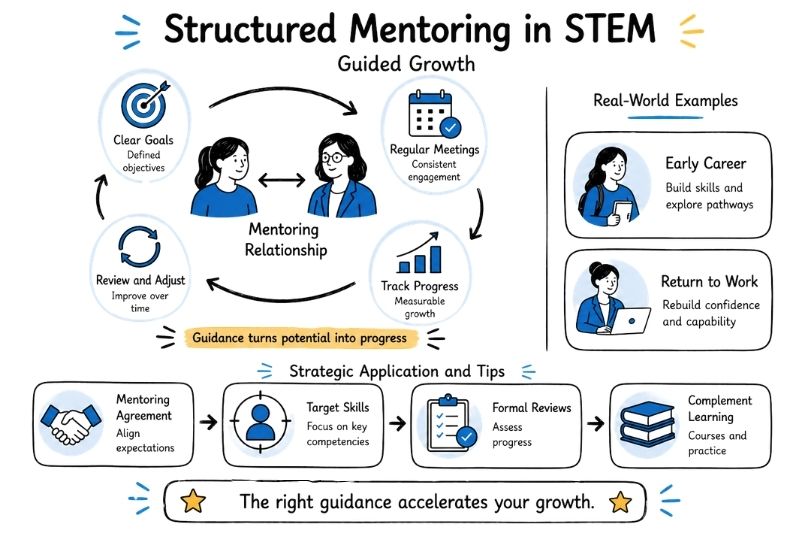
A mentorship-based development plan moves beyond informal advice by establishing a structured, goal-oriented relationship with clearly defined outcomes. Unlike casual chats with a senior colleague, structured mentoring involves agreed objectives, a regular meeting schedule, and measurable progress indicators. For women in STEM fields, this form of guidance is critical. Evidence consistently shows that women with access to mentorship are more likely to progress in their careers, report higher levels of job satisfaction, and build confidence in both technical and leadership capabilities.
This approach provides a focused pathway across different career stages. A recent STEM graduate in Australia, for example, might partner with a mid-career professional to develop networking skills and explore career pathways within her discipline. Similarly, a woman returning to software engineering after a break could be paired with a mentor who has navigated a similar transition, offering practical insight into re-entry and addressing technical skill gaps. These examples demonstrate how structured mentoring creates purposeful, outcome driven development aligned with long term career goals. To find guidance and frameworks for these relationships, you can learn more about the value of structured mentoring in STEM.
Strategic Application and Tips
Incorporating a structured mentorship plan creates accountability and provides access to invaluable experience. It directs your efforts towards specific competencies identified with the help of a experienced professional.
- Create a Mentoring Agreement: Begin with a clear discussion to align expectations. Define two or three key objectives, agree on meeting frequency, and establish how progress will be reviewed.
- Target Specific Competencies: Use your mentor's expertise to focus your development. For instance, an early-career biologist may work with a senior researcher to strengthen presentation skills and build a publication record over a defined period.
- Schedule Formal Reviews: Plan mid-point and end-of-term reviews to assess progress. Recognise achievements and refine your development plan when needed.
- Combine with Other Resources: Use mentoring sessions to identify knowledge gaps, then complement them with relevant courses, workshops, or reading between meetings to maximise impact.
4. Competency-Based Development Plans
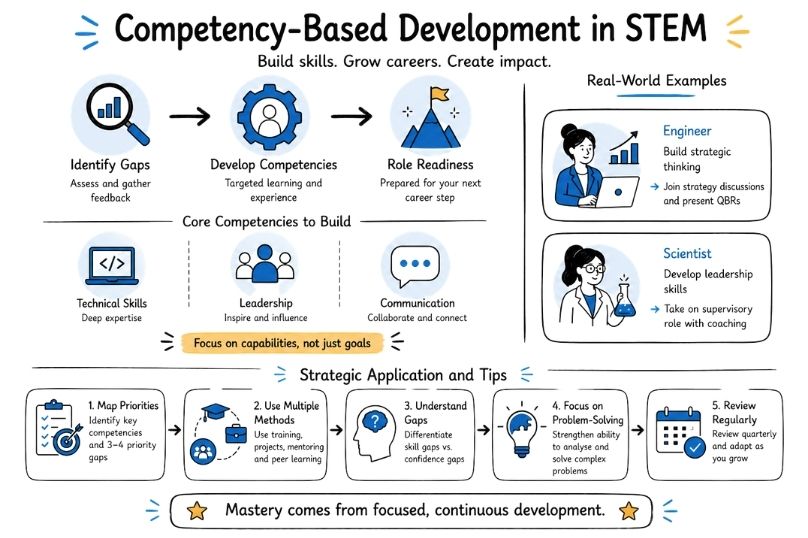
Competency-based development plans focus on building specific, defined skills and behaviours required for current or future roles. This approach shifts the emphasis from time-bound goals to achieving mastery across key competencies, including technical expertise, leadership, and communication. For women in STEM, this method is valuable for cultivating both deep technical capability and the essential behavioural skills, such as stakeholder management and collaboration, which are critical for career progression.
This approach begins with identifying competency gaps through structured assessment and feedback. For instance, a software engineer in a Middle Eastern technology hub might discover a gap in strategic thinking and address it by participating in strategy discussions and presenting quarterly business reviews. Similarly, a laboratory scientist seeking to strengthen her leadership capability could take on a supervisory role, supported by coaching to develop delegation and conflict resolution skills. By focusing on clearly defined competencies, development activities become more targeted and effective, creating a structured pathway towards readiness for the next career step.
Strategic Application and Tips
Adopting a competency-based framework within your professional development plan provides a structured method for building the capabilities that matter most. It moves beyond generic training and focuses on demonstrable, real world skills.
- Map and Prioritise: Identify the core competencies required for both your current role and your target role. Use self assessment and manager feedback to highlight three to four priority areas.
- Use Diverse Activities: For each competency, combine different forms of development such as formal training, stretch assignments, mentoring, and peer learning.
- Distinguish Gaps: Work with mentors and peers to differentiate between a genuine skill gap and a confidence gap, as each requires a different approach to development.
- Focus on Problem-Solving: Many technical and leadership competencies are rooted in the ability to analyse and resolve complex issues. To strengthen this area, you can learn more about how to improve your problem-solving skills.
- Quarterly Reviews: Schedule regular reviews to assess progress against each competency. This enables you to refine your plan as your role and career goals evolve.
5. Individual Development Plans (IDPs) - Personalised Growth Pathways
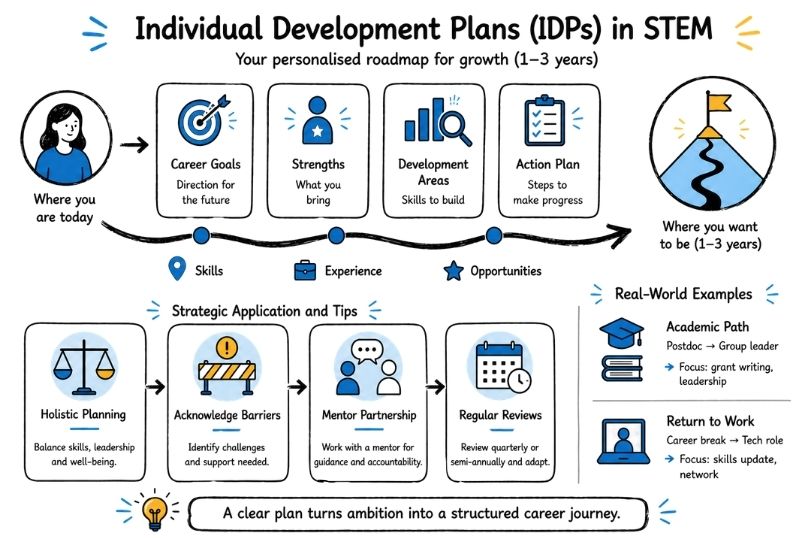
An Individual Development Plan (IDP) is a detailed, personalised document that outlines your career goals, current strengths, development areas, and the actions required to support growth over one to three years. Widely adopted across academia and industry, including organisations such as the US National Institutes of Health, IDPs provide a clear framework for professional progression. For women in STEM, they are particularly valuable in creating a roadmap that reflects individual circumstances, whether that involves transitioning into leadership roles or returning to work after a career break.
This approach is effective because it goes beyond a static list of goals and becomes a living document that evolves with your career. For example, a postdoctoral researcher in a European research institute may use an IDP to plan her transition to a group leader position by identifying gaps in grant writing and team management. Her plan might include a two year strategy involving mentorship, targeted workshops, and co-supervision of a student. Similarly, a woman returning to a technology role in the United States after parental leave may use an IDP to update technical skills, rebuild professional networks, and define flexible working arrangements. These examples demonstrate how an IDP translates ambition into a clear, actionable development pathway. To build a strong foundation for your IDP, explore these essential elements of a career development plan.
Strategic Application and Tips
Adopting an IDP places you at the centre of your career development, ensuring that your efforts are intentional and aligned with your long term goals. It helps you articulate your needs and access the right support.
- Holistic Planning: Develop a plan that includes technical skills, leadership growth, work life integration, and mentoring to ensure balanced development.
- Acknowledge Barriers: Include a section to identify practical and structural challenges, such as time constraints, caring responsibilities, or systemic bias, along with the support required to address them.
- Mentor Partnership: Identify a supervisor or mentor as your IDP partner. Regular discussions provide accountability and informed guidance.
- Regular Reviews: Schedule quarterly or semi-annual reviews, not just annual ones. This allows you to adapt your plan in response to new opportunities or changing priorities.
6. Stretch Assignments and Project-Based Development Plans
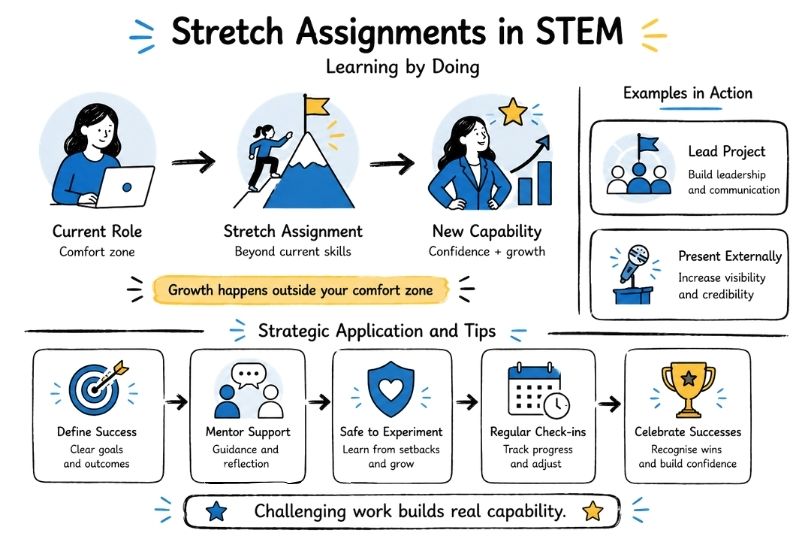
Stretch assignments are designed to place individuals in roles or projects that extend beyond their current capabilities, accelerating learning through direct experience. Rather than relying solely on formal training, this approach builds skills through practical application in real work settings. Evidence on how stretch assignments accelerate career development and leadership growth highlights their significant role in building confidence, expanding capability, and enabling faster career progression. For women in STEM, it is particularly effective in increasing visibility, strengthening technical expertise, and developing leadership capability in practical settings.
This approach works best when combined with structured support, including mentoring and psychological safety, which allows for intelligent risk-taking. For example, a software engineer with strong technical ability may be asked to lead a cross functional product launch, allowing her to develop project management and stakeholder communication skills. Similarly, a scientist may be given the opportunity to represent her organisation at an industry conference, leading a session or workshop to build external credibility and establish thought leadership. These examples demonstrate how well designed challenges can drive tangible and lasting skill development.
Strategic Application and Tips
Incorporating stretch assignments into a development plan provides a practical and high impact pathway to career progression. It builds confidence by demonstrating capability in a supportive yet challenging environment.
- Define Clear Success: Ensure each assignment is a genuine development opportunity rather than additional workload. Clearly outline objectives, success measures, and the specific skills to be developed.
- Pair with a Mentor: Work with a mentor or coach who can offer guidance, support, and space for reflection. This is essential for navigating complexity and maintaining momentum.
- Promote Psychological Safety: Create an environment where individuals feel able to experiment, take informed risks, and learn from setbacks without fear of negative consequences. Frame setbacks as valuable learning moments.
- Schedule Regular Check-ins: Organise bi-weekly or monthly meetings to monitor progress, offer support, and ensure the assignment is meeting its developmental goals without leading to burnout.
- Celebrate Successes: Acknowledge successes to strengthen confidence, enhance professional visibility, and reinforce the value of the experience.
7. Learning Agility and Adaptive Development Plans
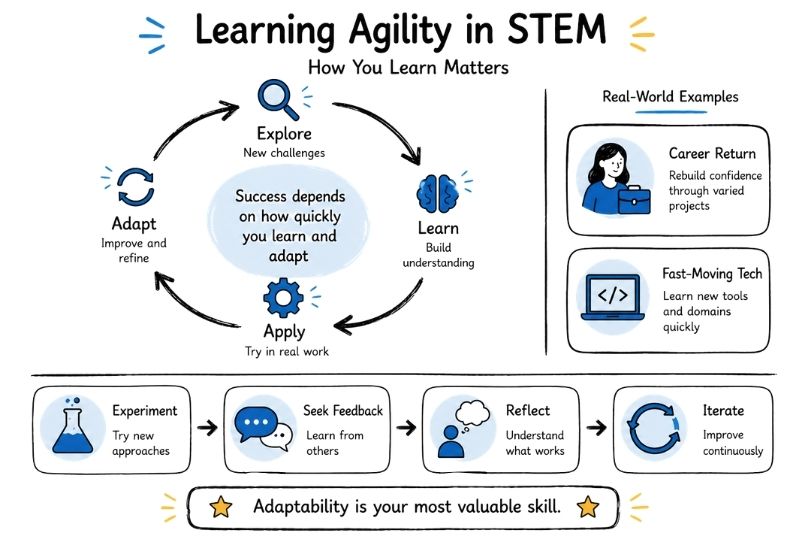
In the rapidly evolving world of STEM, the ability to learn quickly and adapt to new challenges is often more valuable than any single technical skill. A learning agility plan focuses on developing this broader capability, strengthening your capacity to perform effectively in uncertain and changing environments. Rather than concentrating on fixed skill sets, this approach cultivates curiosity, resilience, and continuous improvement, making it one of the most effective strategies for long term career success.
This approach is particularly relevant for women in STEM navigating industry change or career transitions. For example, a scientist returning after a five year break may design a plan that involves working across different projects to rebuild confidence and adaptability. Similarly, an engineer in a fast moving technology environment might intentionally take on work in unfamiliar areas, such as a new programming language or product domain, to strengthen her ability to learn quickly and respond to change. This method shifts the focus from what you know to how effectively you learn.
Strategic Application and Tips
An adaptive development plan builds the core capabilities required to remain relevant and effective as roles and industries evolve. It prioritises reflection, experimentation, and continuous feedback.
- Create a Learning Portfolio: Document a range of learning experiences beyond formal training. Include insights from challenging projects, mentoring discussions, and lessons gained from setbacks.
- Seek Agile Mentors: Engage with mentors who demonstrate strong learning agility. Focus on how they approach uncertainty, respond to challenges, and refine their thinking over time.
- Embrace Small Experiments: Take on tasks or projects outside your comfort zone in a controlled way. This builds confidence in dealing with ambiguity and supports iterative learning.
- Develop a Reflection Practice: Set aside regular time for reflection, such as weekly journalling, peer discussions, or structured reviews. This helps you understand how you learn and adapt more effectively. Learning to navigate uncertainty with confidence is a key outcome of this practice.
8. Inclusive Leadership and Intersectional Development Plans
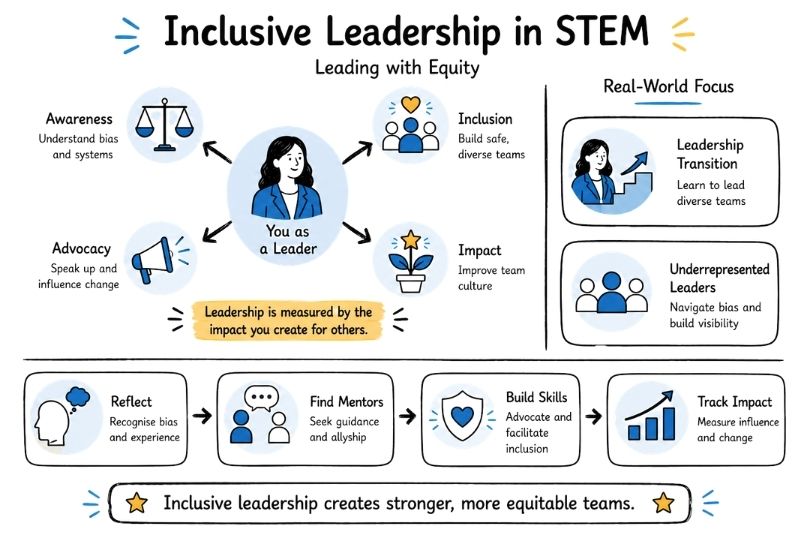
An inclusive leadership development plan integrates technical excellence with a strong commitment to diversity, equity, and inclusion. Rather than treating inclusion as a separate priority, this approach recognises that women in STEM, particularly those from underrepresented backgrounds, benefit from development that builds both leadership capability and the skills required to navigate bias, champion inclusion, and foster psychological safety. It places emphasis on understanding systemic barriers and contributing to meaningful change.
This approach is essential for creating more equitable workplaces. For example, a senior woman of colour may develop a plan that includes coaching for executive presence tailored to her lived experience, rather than relying on a generic leadership framework. Similarly, a woman moving into a management role may prioritise learning how to lead diverse teams and seek mentorship from individuals experienced in navigating organisational bias. These examples illustrate how inclusive development plans ensure leadership capability is built on a foundation of equity and awareness.
Strategic Application and Tips
Adopting an intersectional approach to development extends beyond individual growth and contributes to broader organisational impact. It enables you to lead with both technical strength and inclusive intent.
- Situational Assessment: Reflect on your experiences with bias, both observed and experienced. This awareness provides a foundation for defining meaningful development goals.
- Targeted Mentorship: Seek mentors who share relevant experiences or have a proven track record as allies. You can discover how to become a mentor for women in STEM to connect with peers who can offer culturally informed perspectives.
- Skill-Building for Advocacy: Develop practical capabilities such as addressing microaggressions, facilitating inclusive discussions, and advocating for equitable practices within your team or organisation.
- Document Your Impact: Track not only the skills you develop but also the outcomes of your actions. Note who you have mentored, how your advocacy has influenced decisions, and any visible shifts in team culture resulting from your leadership.
Comparison of Professional Development Plan Examples
| Approach | Implementation complexity | Resource requirements | Expected outcomes | Ideal use cases | Key advantages |
|---|---|---|---|---|---|
| SMART Goals Framework for STEM Career Development | Low to Moderate: simple structure, needs regular review | Low: time for planning, basic tracking tools, mentor check-ins | Clear, measurable milestones and improved accountability | Early-career, mid-career transitions, returners needing structure | Easy to adopt, measurable progress, widely recognised |
| 360-Degree Feedback Development Plans | High: coordination, facilitation, analysis required | High: many raters, anonymity tools, trained facilitator/consultant | Multi-perspective insights, blind-spot identification, targeted behavioral plan | Mid/senior leaders, anyone seeking leadership impact or visibility | Reveals perception gaps, drives accountability, informs coaching |
| Mentorship-Based Development Plans (Structured Mentoring) | Moderate: agreements, scheduled meetings | Moderate: mentor time, program coordination, training | Personalised guidance, network expansion, targeted skill growth | Students, early-career, returners, those needing role models | Direct advice, confidence-building, access to insider knowledge |
| Competency-Based Development Plans | High: develop inclusive competency framework and assessments | Moderate to High: assessment tools, training, calibration time | Role-aligned skill mastery, objective proficiency tracking | Role transitions, succession planning, leadership readiness | Clarifies success criteria, aligns development to role needs |
| Individual Development Plans (IDPs) | Moderate to High: comprehensive planning and reviews | Moderate: supervisor/mentor time, documentation tools | Long-term personalised roadmap, alignment with organisations and life context | Postdocs, researchers, anyone needing tailored 1–3 year plan | Holistic, flexible, supports non-linear careers and accountability |
| Stretch Assignments and Project-Based Plans | Moderate: design meaningful stretches and supports | Low to Moderate: project resources, mentor/coach support | Accelerated on-the-job learning, increased visibility, practical skills | Early–mid career, returners rebuilding credibility, high-potential talent | Fast skill growth, cost-effective, high organisational visibility |
| Learning Agility and Adaptive Plans | Moderate: requires reflective practices and safe-to-fail settings | Low to Moderate: peer groups, reflection tools, diverse exposure | Improved adaptability, resilience, rapid learning across contexts | Rapidly changing fields, career transitions, returners | Builds meta-competencies transferable across roles |
| Inclusive Leadership and Intersectional Plans | High: needs skilled facilitation and organisational commitment | High: training, coaching, DEI resources, leadership buy-in | Stronger inclusive practices, advocacy skills, improved belonging | Senior leaders, allies, women from underrepresented groups | Tackles systemic barriers, builds psychological safety and advocacy |
Putting Your Plan into Action: Your Next Steps
We have explored a wide range of professional development approaches, each offering a distinct pathway for growth in STEM. From the structured clarity of SMART goals and the personalised direction of Individual Development Plans to the adaptability of learning agility frameworks, one theme remains constant that meaningful progress is driven by intentional action. Strong career trajectories are not accidental; they are shaped through deliberate choices, sustained effort, and continuous reflection.
The real strength of these approaches lies in their flexibility. Rather than applying a single framework in isolation, you can combine elements that best suit your context. A competency based approach may provide structure for a new role, while mentorship offers guidance and perspective. For those in leadership, an inclusive development approach is not optional but essential for building effective and equitable teams. These frameworks are best viewed as adaptable tools that evolve with your career. The key is to see these frameworks as building blocks, not as unchangeable blueprints.
From Inspiration to Implementation
Understanding these approaches is an important first step, but real development begins when ideas are translated into action. Moving from intention to execution is where meaningful growth takes place.
To begin, consider these practical next steps:
- Select your starting point
Identify the approach that best aligns with your current stage and priorities. Early career professionals may benefit from a structured plan, while more experienced individuals may focus on feedback or leadership development. - Define your purpose
Clarify what you want to achieve and why it matters. Whether it is progression, greater flexibility, or a transition into a new field, a clear sense of purpose will sustain motivation over time. - Take the first step
Avoid overcomplicating the process. Focus on one immediate action you can take within the next few days, such as reaching out to a mentor, reviewing your current skills, or committing time to learning. - Create accountability
Turn intention into commitment by sharing your plan with a mentor, manager, or peer. Regular check ins, even brief ones, help maintain focus and allow you to adjust your approach as needed.
Ultimately, the frameworks explored in this article are tools for empowerment. They offer structured ways to translate ambition into meaningful action. The process of building and refining your plan strengthens self awareness, clarifies direction, and builds the confidence to pursue your goals with purpose.
Your career is not fixed. It is something you actively shape over time. The next step begins with a single, deliberate action.