
For many women in India, the hope of balancing motherhood with a thriving career in STEM can feel like walking a tightrope. India’s maternity leave law is often celebrated on paper, but behind the statistics, there are real emotions, frustrations, and unspoken struggles. While the law grants up to 26 weeks of paid maternity leave, many women in science, technology, engineering, and mathematics still confront confusion, lack of guidance, and workplace norms that make claiming these rights emotionally daunting and professionally risky. Too often, talented women feel unsupported, overwhelmed, and unsure if they can truly exercise these benefits without jeopardizing their careers.
But there is promise in knowing your rights, not just on paper, but in your lived experience. When women truly understand the protections and leave benefits guaranteed under the Maternity Benefit (Amendment) Act, 2017), they gain more than legal footing, they gain confidence, agency, and a clearer path to balancing family and professional growth without fear or silence.
Legal Framework: Understanding Your Comprehensive Rights
Duration and Eligibility Standards
The Maternity Benefit Act of 1961, substantially amended in 2017, establishes clear entitlements based on birth order. Women receive 26 weeks of fully paid maternity leave for their first and second children, representing a 116% increase from the original 12-week provision. Third and subsequent children qualify for 12 weeks of paid leave.
Considering this India’s maternity leave policy, now provides some of the longest paid maternity leave durations in the world, extending from 12 weeks to 26 weeks for the first two children and additional protections for adoptive and commissioning mothers. It also includes provisions for workplace crèche facilities and options for work-from-home arrangements, reflecting a shift toward more supportive labor frameworks. Yet many women still report that awareness of specific rights is limited, leading to under-utilization of available benefits and workplace stress.
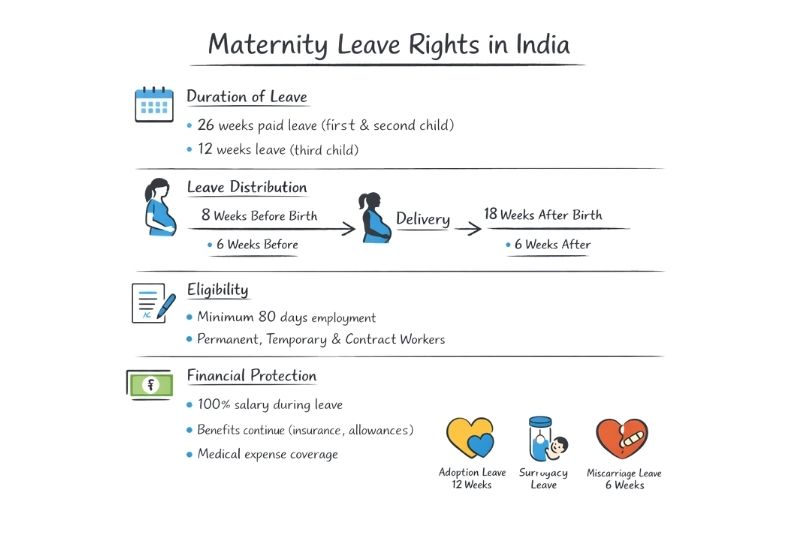
Eligibility requires employment for a minimum of 80 calendar days within the 12 months preceding the expected delivery date. This threshold applies to all employment categories: permanent, temporary, and contractual workers: ensuring comprehensive coverage across India's diverse employment landscape.
Leave distribution follows a structured approach: up to 8 weeks pre-delivery and 18 weeks post-delivery for first and second children, with 6 weeks pre-delivery and 6 weeks post-delivery for subsequent children.
Financial Protections and Benefits
During maternity leave, women receive 100% of their gross salary, calculated as the average daily wage over the preceding period. This full salary protection extends to all standard employee benefits, including housing allowances, medical insurance, and organizational perks.
Additional financial protections include medical expenses coverage for prenatal care and delivery, plus an extra 30 days of paid leave when medical complications require extended recovery time.
Expanded Entitlements Beyond Biological Motherhood
Modern provisions recognize diverse family structures. Adoptive mothers receive 12 weeks of paid leave when adopting children under three months old. Commissioning mothers in surrogacy arrangements qualify for equivalent benefits. Women experiencing miscarriage receive 6 weeks of fully compensated leave.
Recent Legal Developments Strengthening Protections
Supreme Court Landmark Ruling
The 2024 Supreme Court decision in K. Umadevi vs. State of Tamil Nadu fundamentally strengthened maternity leave as a constitutional right under Article 21. The Court ruled that employers cannot impose artificial limitations based on pre-employment children or previous marital status, establishing maternity leave as a fundamental reproductive right rather than discretionary employee benefit.
This judgment mandates "purposive and liberal interpretation" of maternity benefit legislation, requiring employers to adopt the most favorable interpretation when disputes arise. The ruling explicitly prohibits discriminatory policies that penalize women for reproductive choices made before current employment.
Enhanced Workplace Protections
Current legislation provides comprehensive workplace safeguards. From 10 weeks before delivery, women cannot be assigned arduous work, required to stand for extended periods, or perform physically demanding tasks. Post-leave, the Act includes work-from-home provisions and flexible arrangement options, though specific terms depend on role requirements and organizational policies.
STEM-Specific Challenges and Realities
The "Invisible Burden" Phenomenon
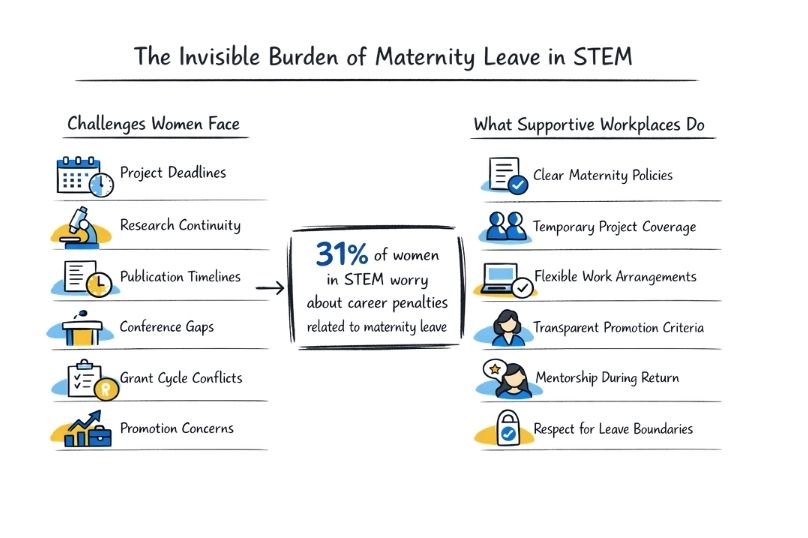
Research identifies significant "invisible burdens" affecting women in STEM during maternity transitions. These include inadequate recognition of leave rights, wage disparities during career transitions, and promotional opportunity gaps both during and after maternity leave periods.
STEM environments often present unique pressures stemming from project timelines, research continuity requirements, and collaborative team structures. Laboratory-based roles, field research commitments, and technology project deadlines create additional complexity in leave planning and career transition management.
Career Progression Concerns
Data indicates that 31% of women in STEM report concerns about career advancement penalties related to maternity leave utilization. These concerns reflect both explicit organizational policies and implicit cultural expectations within technical fields.
Research participation, conference presentations, and publication timelines often align poorly with maternity leave periods, potentially affecting performance evaluations and advancement opportunities. Grant funding cycles and project leadership opportunities may be influenced by leave timing, creating strategic considerations beyond legal entitlements.
Sector-Specific Workplace Dynamics
STEM organizations frequently operate with lean staffing models and specialized skill requirements, making temporary coverage arrangements challenging. This dynamic can create pressure for abbreviated leave periods or continued project involvement during official leave time.
Technology sector work cultures often emphasize continuous connectivity and rapid response times, conflicting with maternity leave boundaries. Academic and research environments may pressure women to maintain research activities or publication schedules during leave periods.
Strategic Navigation: Practical Implementation Approaches
Pre-Leave Preparation and Documentation
Effective maternity leave navigation begins with comprehensive documentation and communication strategies. Document all pregnancy-related communications in writing, creating clear records of notification timing, leave requests, and employer responses.
Request written confirmation of your specific entitlements, including salary calculation methods, benefit continuation terms, and return-to-work arrangements. If organizational policies appear less generous than statutory requirements, the Maternity Benefit Act supersedes internal policies.
Project Transition and Knowledge Management
Proactively develop comprehensive project documentation and transition plans. Create detailed status reports, methodology documentation, and continuation protocols for ongoing work. This preparation demonstrates professional responsibility while establishing clear boundaries around leave period expectations.
Identify and train temporary coverage personnel well in advance. For research-intensive roles, document experimental procedures, data analysis protocols, and collaboration responsibilities to ensure project continuity without requiring your direct involvement.
Boundary Setting and Communication
Establish explicit communication protocols regarding your availability during leave. Clearly define emergency contact criteria and response expectations. Communicate these boundaries to supervisors, collaborators, and team members before leave begins.
Resist pressure to "check in regularly" or maintain project involvement during official leave time. Frame boundary maintenance as legal compliance rather than personal preference, reducing potential conflict or negotiation.
Return-to-Work Strategy Development
Develop a structured return-to-work plan addressing schedule flexibility, workload management, and career development continuity. Request detailed information about any organizational changes, project developments, or team restructuring that occurred during your leave.
Negotiate specific accommodations such as gradual workload increases, flexible scheduling, or modified travel requirements. Document these arrangements in writing to ensure consistency and avoid future misunderstandings.
Legal Recourse and Enforcement Mechanisms
Compliance Monitoring and Reporting
Women experiencing maternity leave violations can file complaints with state labor departments or approach labor courts directly. Valid complaints result in mandatory employer orders to provide full maternity benefits plus potential damages for delayed compliance.
Employers violating Act provisions face financial penalties up to ₹50,000 for general violations and ₹5,000 specifically for benefit non-payment. Repeat violations can result in enhanced penalties and business license implications.
Professional Support and Resources
Consider engaging with women's professional networks for guidance, support, and shared experiences during maternity transitions. These networks often provide practical advice on navigating sector-specific challenges and organizational dynamics.
Legal consultation may be valuable when facing complex situations involving multiple employment relationships, international assignments, or non-standard employment arrangements common in STEM fields.
Building Sustainable Career Strategies
Successful maternity leave navigation in STEM requires both immediate tactical approaches and long-term strategic thinking. Understanding your comprehensive legal rights provides the foundation for confident decision-making and effective communication with employers.
The evolving legal landscape increasingly supports women's reproductive choices while maintaining professional advancement opportunities. Recent Supreme Court rulings and legislative enhancements create stronger protections than ever before, particularly when women understand and actively utilize these rights.
For women in STEM, the key lies in balancing legal entitlements with sector-specific dynamics, creating sustainable approaches that honor both professional ambitions and family priorities. Comprehensive preparation, clear communication, and strategic boundary-setting enable successful transitions that support both immediate well-being and long-term career development.
Through informed navigation of maternity leave rights and proactive management of STEM-specific challenges, women can maintain career momentum while fully utilizing the substantial protections Indian legislation provides.
That’s why it’s essential to go beyond basic awareness, to internalize your rights, learn how they apply in your workplace, and advocate for yourself with clarity and confidence. For women in STEM especially, blending legal literacy with emotional support and career planning can transform fear into empowerment. By knowing what you’re entitled to, why it matters, and how to ask for it, you protect not only your health and family but also your professional aspirations.