
The STEM talent loss crisis continues to dominate headlines, with organisations across the globe striving to fill critical roles in science, technology, engineering, and mathematics. Yet while billions of dollars flow toward recruitment initiatives and diversity programs, a fundamental barrier remains conspicuously absent from most strategic discussions: child care accessibility.
Research demonstrates that the majority of parents in STEM fields report child care as a primary obstacle to career advancement. At the same time, many professionals who exit these industries do so specifically because work schedules conflict with child care availability. These statistics represent more than individual challenges: they reveal a systemic failure to address one of the most significant drivers of talent attrition in STEM sectors worldwide.
The Global Magnitude of Career Disruption
Child care barriers affect STEM professionals across continents, though manifestations vary by region. In the United States, 92% of currently employed STEM workers indicate that educational advancement opportunities directly influence their employment decisions, yet access to child care remains the primary constraint preventing such advancement. European data shows similar patterns, with parents citing schedule inflexibility as the leading reason for considering career changes.
The problem extends beyond individual inconvenience, contributing to broader workforce instability. Among STEM parents pursuing additional education, an important factor in career progression within rapidly evolving technical fields, many report that child care plays a significant role in their ability to achieve their goals, with a substantial proportion describing it as highly important. This dependency creates a bottleneck in which career advancement can be influenced not only by professional capability but also by the availability of adequate caregiving support.
The departure statistics prove even more concerning. Of STEM professionals with children under six who leave their positions, 23% cite schedule misalignment with child care, while 19% point to incompatible shift requirements. An additional 11% exit entirely to become stay-at-home parents due to insufficient alternative arrangements, representing a complete loss of trained technical talent.
Beyond Individual Impact: Economic and Innovation Consequences
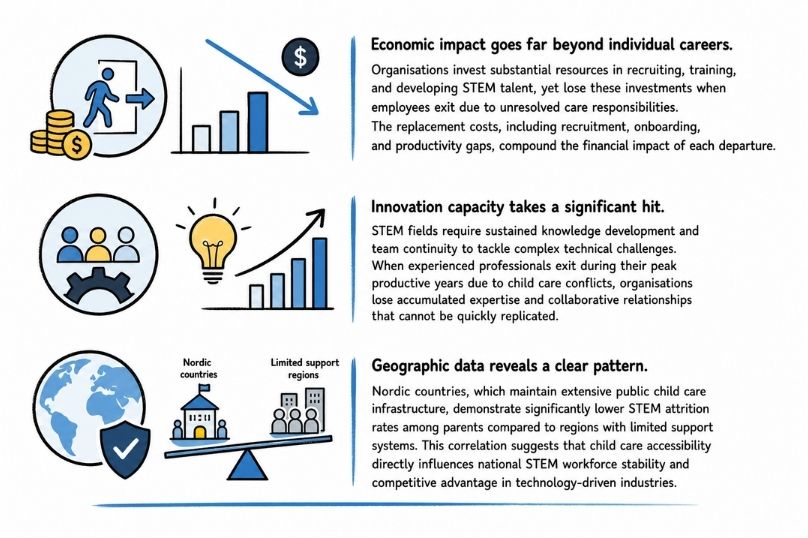
The economic implications of child care-driven attrition extend far beyond personal career progression. Organisations invest substantial resources in recruiting, training, and developing STEM talent, yet lose these investments when employees exit due to unresolved care responsibilities. The replacement costs, including recruitment, onboarding, and productivity gaps, compound the financial impact of each departure.
Innovation capacity suffers equally significant consequences. STEM fields require sustained knowledge development and team continuity to tackle complex technical challenges. When experienced STEM talent professionals exit during their peak productive years due to child care conflicts, organisations lose accumulated expertise and collaborative relationships that cannot be quickly replicated.
Geographic data reveals varying approaches to addressing these challenges. Countries with stronger public child care systems, such as Nordic nations, often report higher workforce participation among parents. This correlation suggests that child care accessibility directly influences national STEM workforce stability and competitive advantage in technology-driven industries.
The Parenthood Penalty Affects All Genders
While cultural assumptions often frame STEM talent loss due to child care as primarily affecting mothers, research reveals broader impacts across gender lines. Approximately 23% of new fathers exit STEM careers following their first child, indicating that caregiving responsibilities create barriers regardless of gender identity.
However, mothers face compound challenges that amplify career disruption. Workplace cultures in many STEM organisations maintain unspoken expectations that serious professionals prioritise work above all other commitments. When mothers demonstrate visible caregiving responsibilities, colleagues and supervisors often interpret this as a reduced level of professional dedication, regardless of actual performance metrics.
Cultural expectations further complicate the situation. Many societies maintain persistent beliefs that mothers should provide primary child care, creating internal conflict for women attempting to maintain demanding STEM careers. Even mothers who continue full-time employment encounter competency stereotypes and salary penalties despite maintaining equivalent professional contributions.
Organisational Blind Spots and Missed Solutions
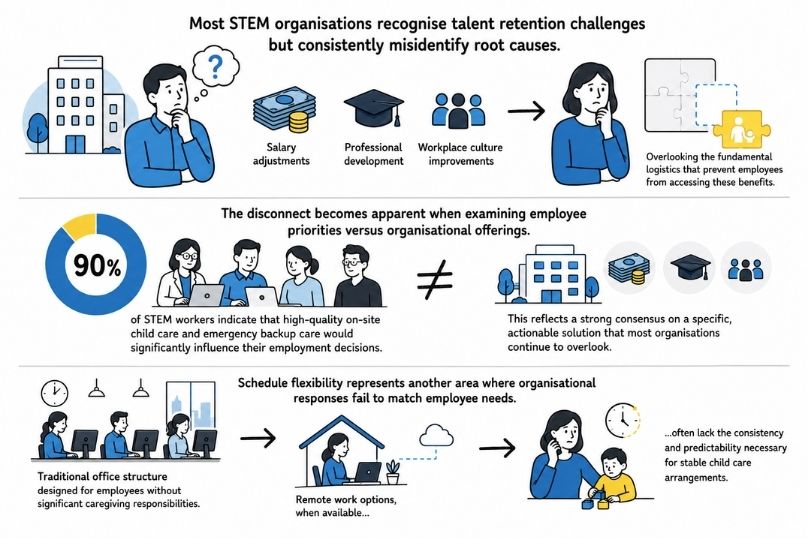
Most STEM organisations recognise talent retention challenges but consistently misidentify root causes. Traditional retention strategies focus on salary adjustments, professional development opportunities, or workplace culture improvements while overlooking the fundamental logistics that prevent employees from accessing these benefits.
The disconnect becomes apparent when examining employee priorities versus organisational offerings. While companies invest in elaborate professional development programs, 90% of STEM workers indicate that high-quality on-site child care and emergency backup care would significantly influence their employment decisions. This reflects a strong consensus on a specific, actionable solution that most organisations continue to overlook.
Schedule flexibility represents another area where organisational responses fail to match employee needs. Many STEM roles maintain traditional office structures designed for employees without significant caregiving responsibilities. Remote work options, when available, often lack the consistency and predictability necessary for stable child care arrangements.
Evidence-Based Solutions That Transform Retention
Organisations that successfully retain STEM parents implement comprehensive support systems rather than piecemeal benefits. On-site child care facilities demonstrate the strongest impact on employee retention, providing reliable, convenient access that eliminates daily logistical complications.
Emergency backup care serves equally critical functions, addressing the unpredictability of child illness, school closures, or regular care provider unavailability. STEM professionals often work on time-sensitive projects, where unexpected absences create significant workflow disruption. Backup care systems enable parents to maintain professional commitments while handling family emergencies.
Flexible schedule structures prove essential for long-term retention. Organisations that establish valued part-time positions and clear re-entry pathways enable parents to maintain career momentum while managing intensive caregiving periods. These arrangements require cultural shifts that recognise professional value independent of traditional full-time schedules.
Progressive organisations also implement "ramp-up" policies that facilitate transitions back to full-time engagement without permanent career penalties. Such systems acknowledge that caregiving intensity varies over time and provide structured pathways for increased professional involvement as children age.
The Path Forward Requires Systematic Change
Addressing child care barriers in STEM talent loss requires coordinated effort across organisational, policy, and cultural dimensions. Individual company initiatives, while valuable, cannot fully resolve challenges rooted in broader infrastructure limitations and cultural assumptions about work-life integration.
Policy interventions that expand public child care access demonstrate measurable impact on STEM workforce participation. Countries with comprehensive early childhood education systems maintain higher rates of parent retention in technical fields, suggesting that systemic solutions produce better outcomes than employer-specific programs alone.
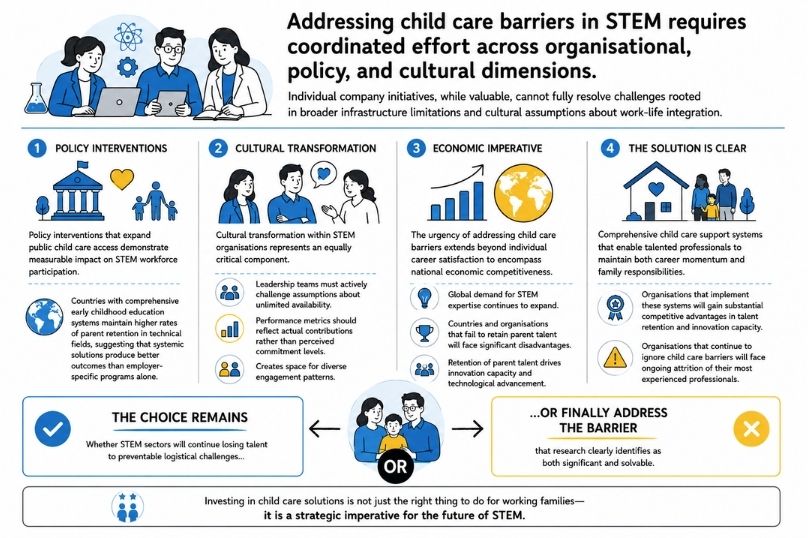
Cultural transformation within STEM organisations represents an equally critical component. Leadership teams must actively challenge assumptions that equate professional dedication with unlimited availability. Performance metrics should reflect actual contributions rather than perceived dedication, creating space for diverse engagement patterns.
The urgency of addressing child care barriers extends beyond individual career satisfaction to encompass national economic competitiveness. As global demand for STEM expertise continues to expand, countries and organisations that fail to retain parent talent will face significant disadvantages in technological advancement.
The solution exists in plain sight: comprehensive child care support systems that enable talented professionals to maintain both career momentum and family responsibilities. Organisations that implement these systems will gain substantial competitive advantages in talent retention and innovation capacity; if they continue to ignore child care barriers, they will face ongoing attrition of their most experienced professionals.
The choice remains whether STEM talent loss will continue to be preventable due to logistical causes or finally address the barrier that research clearly identifies as both significant and solvable.