
Introduction
There is a widely accepted narrative that the challenge in STEM is one of access. The conversation often focuses on the idea that not enough women are entering these fields, and that more needs to be done at the level of education, outreach, and early encouragement. This framing has driven a significant amount of activity, from school level initiatives to university programmes and organisational diversity strategies. It is visible, measurable, and aligns with broader goals around representation.
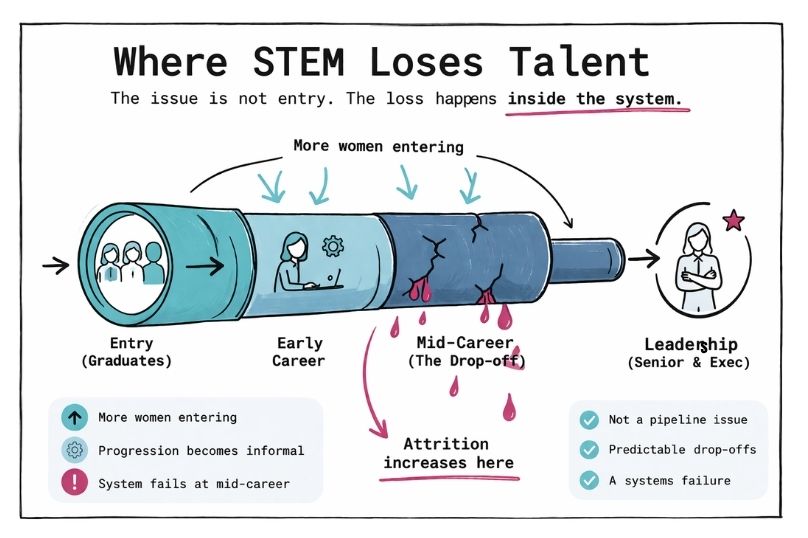
However, this perspective is incomplete. It focuses on entry into the system rather than what happens once individuals are within it. Women are entering STEM fields in increasing numbers, and in many disciplines, early career representation has improved. Yet this progress does not translate into sustained representation at senior levels. Women continue to leave at disproportionately higher rates, particularly at the point where they should be progressing into leadership roles. This pattern cannot be explained by pipeline issues alone. It points to something more structural. This is not simply a diversity issue. It is a workforce systems issue.
The Real Problem Is Retention, Not Attraction
When organisations focus primarily on attracting talent without addressing retention, they create a structural inefficiency. Talent enters the system, develops capability, gains experience, and contributes meaningfully to teams and projects. Over time, these individuals accumulate knowledge that is specific not only to their discipline but also to their organisation. When they leave, that knowledge leaves with them.
This is not a random process. The individuals leaving are not those who lack ability or commitment. In many cases, they are highly capable professionals who have already demonstrated their value. The loss occurs at predictable points, often linked to structural features of how careers progress within organisations. This means that the issue is not a lack of talent. It is a failure of the system to retain it.
In sectors where expertise takes years to build, this has significant implications. Organisations are investing in training and development, only to lose that investment before it translates into leadership capability. This is not only inefficient, it is unsustainable.
Why This Matters Now
The importance of retention is increasing due to broader changes in the workforce and in the nature of work itself. Across STEM industries, there are persistent skills shortages. Organisations are competing for talent in an environment where demand exceeds supply. At the same time, the work itself is becoming more complex. Projects require interdisciplinary thinking, collaboration across teams, and the ability to operate in uncertain and rapidly changing environments.
Technological change, particularly in the form of artificial intelligence, is accelerating this complexity. Roles are evolving, and the expectations placed on individuals are expanding beyond technical expertise. In this context, experienced professionals are more valuable than ever. They bring not only technical knowledge but also the ability to navigate complexity, make decisions, and lead others.
When these individuals leave, the impact is immediate and significant. Teams lose continuity, organisations lose capability, and the overall system becomes less efficient. This is why retention is no longer a secondary concern. It is a business risk.
Where Systems Break Down
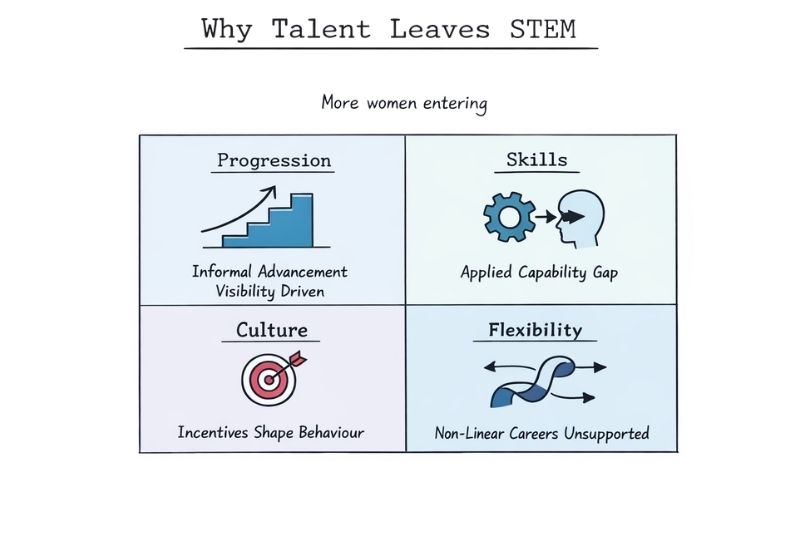
The patterns of attrition observed in STEM are not the result of a single issue. They reflect multiple structural points of failure that interact over time. These failures are often embedded within the design of organisational systems rather than being the result of individual choices.
Progression Becomes Informal
In the early stages of a STEM career, pathways are often clearly defined. Graduate schemes, structured training programmes, and formal evaluation processes provide a sense of direction and transparency. Individuals know what is expected of them and how they can progress.
As careers develop, this clarity often diminishes. Progression becomes less formal and more dependent on factors that are not explicitly defined. Visibility becomes important, meaning that individuals need to be seen by decision makers and recognised beyond their immediate role. Networks become critical, providing access to information and opportunities that are not formally advertised. Sponsorship plays a key role, with senior individuals advocating for those they believe should progress.
This creates a shift from a system based on performance to one that requires navigation of informal structures. For individuals who are not positioned within these networks or who are not visible in the right ways, progression becomes more difficult. This is often the point at which disengagement begins.
The Skills Gap Is Misdiagnosed
Discussions around skills shortages in STEM often focus on technical capability. However, in many cases, the challenge lies elsewhere. Organisations are not lacking individuals with technical expertise. They are lacking individuals who can apply that expertise in complex, real world environments.
Applied capability includes leadership, communication, decision making, and the ability to work across teams and disciplines. These skills are essential for progression into senior roles, yet they are not always systematically developed. Technical training is often prioritised, while broader capability is expected to emerge through experience.
This creates a gap between potential and progression. Individuals may be highly capable, but without structured support in developing applied skills, they may struggle to move into roles where those skills are required. This contributes to attrition at mid career stages.
Culture Reflects System Design
Culture is often described as something intangible, shaped by values and behaviours that are difficult to measure. In reality, culture is closely linked to system design. It is reflected in observable patterns such as who is promoted, who is listened to, and who is given opportunities to lead.
These patterns are not random. They are influenced by incentives, performance metrics, and leadership decisions. If certain behaviours are rewarded, they will be repeated. If certain contributions are recognised, they will be prioritised.
When there are consistent patterns of attrition, particularly among specific groups, this indicates that the system is producing those outcomes. Understanding culture as a system output shifts the focus from individual experiences to organisational structures.
Careers Are Not Linear
Many organisational systems are built on the assumption that careers follow a linear path. Individuals are expected to move steadily through predefined stages, with progression based on continuous and uninterrupted development.
In practice, careers are more complex. They involve pauses, changes in direction, and periods where priorities shift. These variations may be influenced by personal circumstances, health, or evolving interests.
When systems are rigid, they struggle to accommodate this complexity. Individuals who deviate from the expected path may find it difficult to re engage or progress. Flexibility is often framed as a compromise, but in reality, it is a design challenge. It requires organisations to rethink how performance is measured and how progression is supported.
AI and the Increasing Importance of Human Capability
The rise of artificial intelligence is changing the nature of work in STEM. While much of the discussion focuses on automation and efficiency, the impact on workforce capability is equally important.
As AI systems take on routine tasks, the value of human capability increases. The ability to think critically, interpret information, communicate effectively, and lead within complex environments becomes more important. These are not skills that can be easily automated. They require deliberate development.
The key question is whether organisational systems are designed to support this development. If they are not, the gap between technical capability and applied capability will continue to widen.
A Fragmented Approach Limits Impact
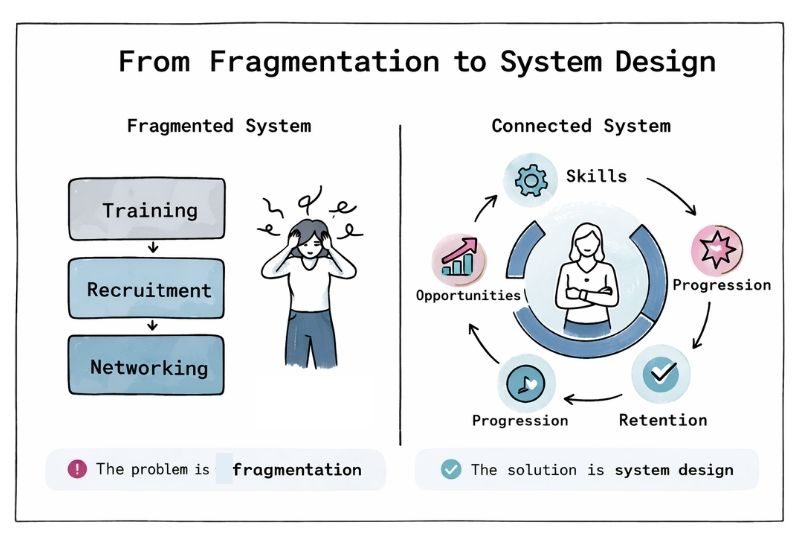
One of the underlying challenges in addressing retention is fragmentation. In many organisations, different aspects of workforce development are managed separately. Training programmes focus on skill development, recruitment teams focus on attracting talent, and networking is often informal.
This creates a system where individuals are expected to connect these elements themselves. They must identify opportunities, build networks, and navigate progression without a coherent structure. This is inefficient and places a significant burden on individuals.
For organisations, this fragmentation reduces the effectiveness of initiatives. Efforts in one area are not reinforced by others, limiting overall impact.
What Leadership Systems Must Change
Addressing these challenges requires a shift in how organisations think about workforce development. Retention must be treated as a system rather than an outcome. This means designing structures that support individuals throughout their careers.
Continuous skills development is essential, particularly in areas related to leadership and communication. Mentorship and sponsorship should be structured and accessible rather than informal. Leadership should be accountable for retention and progression, not just recruitment.
Career pathways need to accommodate non linear progression while maintaining clear standards. This requires a balance between flexibility and structure.
These elements must work together. Isolated interventions are unlikely to produce sustained change.
A Systems Approach to Workforce Development
Over time, it has become clear that many efforts to support women in STEM are fragmented. They address specific challenges but do not connect them into a coherent system.
A more effective approach is to design a connected workforce ecosystem. This involves creating structures that enable individuals to build skills, access opportunities, develop networks, and progress in a clear and supported way.
At the same time, it enables organisations to access talent, improve retention, and build sustainable leadership pipelines.
The Women in STEM Network has been developed with this systems approach in mind. It is designed to connect these elements, providing a framework that supports both individuals and organisations.
Conclusion
The future of STEM will not be determined by how many people are attracted into the sector. It will be determined by how effectively organisations retain and develop the people already within it.
This is not a question of diversity alone. It is a question of capability.
Capability at scale depends on system design.