
When people discuss career progression, leadership development, or professional success, the conversation usually focuses on visible skills. We talk about communication, strategic thinking, networking, technical expertise, project management, and influencing others. These are all important capabilities, but there is one skill that receives far less attention despite having a profound impact on every aspect of our careers.
That skill is self leadership.
It is possible to be highly educated, technically brilliant, respected by colleagues, and successful by most conventional measures, yet still feel overwhelmed, reactive, exhausted, or dissatisfied. Many professionals spend years pursuing goals, only to discover that reaching them does not bring the sense of fulfilment they expected.
This is particularly true in STEM careers. Scientists, engineers, healthcare professionals, researchers, technologists, and academics often operate in environments where expectations are high and the pace rarely slows. There is always another paper to write, another project to deliver, another grant application to submit, another promotion to pursue, or another challenge to overcome.
Success can become a moving target.
The achievement that once felt so important quickly becomes part of the background as attention shifts to the next objective. Before long, many people find themselves trapped in a cycle of constant striving, wondering why success feels far less satisfying than they imagined it would.
Perhaps the issue is not that people lack ambition. Perhaps the issue is that we spend so much time learning how to lead projects, teams, and organisations that we neglect learning how to lead ourselves.
Why Success Doesn't Always Feel Like Success
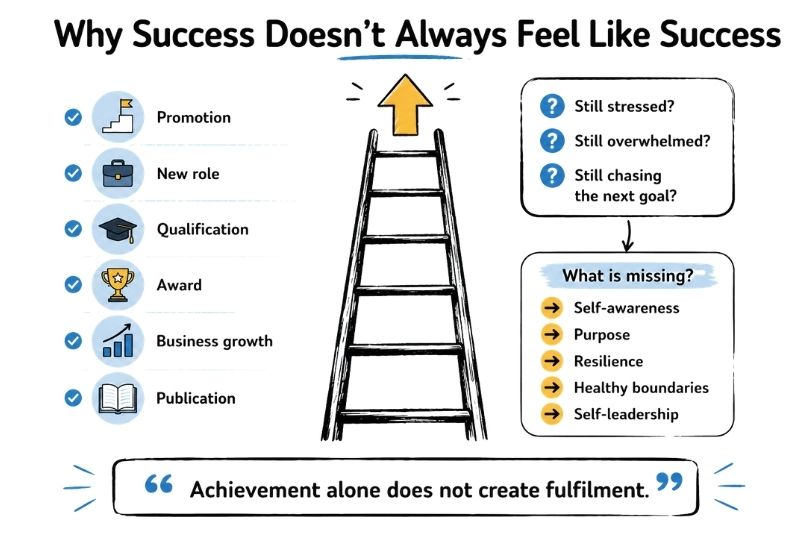
Most professionals have experienced a moment when an anticipated achievement failed to deliver the expected sense of satisfaction.
The promotion arrives, and within a few weeks it feels normal.
The qualification is completed, but attention immediately shifts to the next challenge.
The business reaches a major milestone, but instead of celebrating, the focus turns to maintaining momentum.
This phenomenon is surprisingly common because human beings adapt quickly to new circumstances. What once felt exciting eventually becomes familiar. The sense of achievement fades, and the search for the next goal begins.
There is nothing inherently wrong with ambition. Ambition drives progress. It fuels innovation, discovery, and growth. Many of the scientific advances and technological breakthroughs that improve our lives exist because ambitious people refused to accept the status quo.
However, ambition becomes problematic when achievement becomes the sole source of validation.
Many professionals unconsciously tie their self worth to outcomes. Success becomes evidence that they are capable. Failure becomes evidence that they are not. Praise boosts confidence. Criticism diminishes it.
This creates a fragile foundation because external circumstances are rarely fully within our control.
Projects fail despite careful planning. Funding applications are rejected. Market conditions change. Organisational restructures occur. Opportunities disappear unexpectedly.
If confidence depends entirely on outcomes, it becomes vulnerable to every setback and disappointment.
This is one reason why some highly successful people remain surprisingly insecure. External achievement alone does not create lasting confidence, resilience, or fulfilment.
Those qualities often emerge from something deeper.
The Difference Between Reacting and Leading Yourself
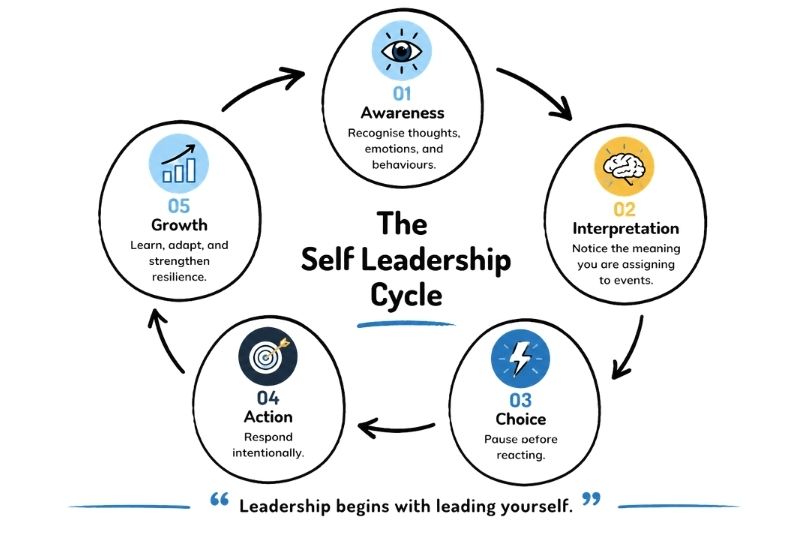
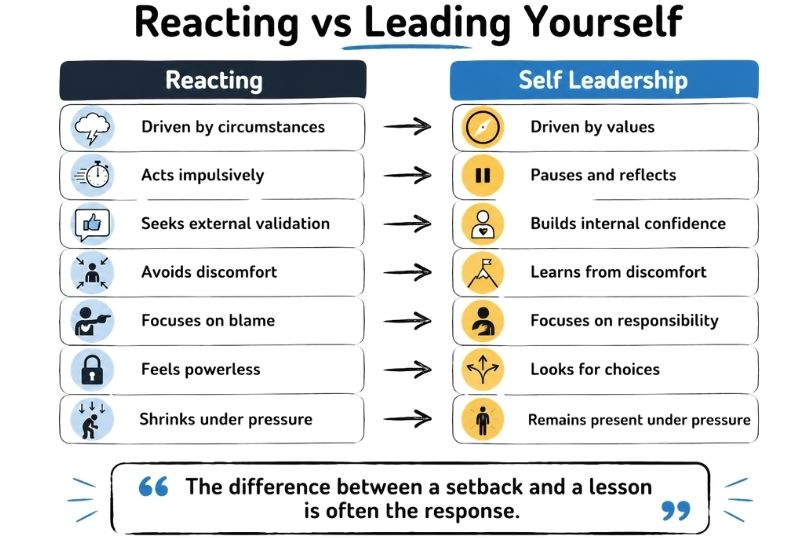
One of the central principles of self leadership is recognising that there is a difference between what happens to us and how we respond to it.
Most people believe their emotions are caused directly by events. A difficult meeting causes frustration. Critical feedback causes disappointment. An unexpected challenge causes stress.
In reality, the process is more complex.
Events occur, but individuals interpret those events through the lens of their beliefs, experiences, assumptions, and expectations.
Consider two professionals receiving exactly the same feedback from a manager.
One interprets the feedback as proof that they are failing. Their confidence drops, and they begin questioning their abilities.
The other sees the feedback as useful information that can help them improve. While they may not enjoy hearing it, they remain constructive and focused on growth.
The feedback itself is identical. The difference lies in the interpretation.
This distinction is important because it highlights where personal influence exists.
Many people spend considerable energy trying to control circumstances, other people, and external outcomes. Yet much of life remains unpredictable.
Self leadership shifts attention towards something far more powerful: the ability to manage our own responses.
This does not mean ignoring problems or pretending challenges do not exist. It means recognising that reactions are not always inevitable.
When individuals become more aware of their thoughts and emotional patterns, they create space for choice.
That space is where self leadership begins.
The Power of Choice in Challenging Situations
Choice is one of the most underappreciated leadership skills.
Many people move through their day on autopilot, reacting automatically to situations as they arise. An email arrives and stress levels increase. A disagreement occurs and defensiveness appears. A project encounters difficulties and frustration takes over.
These reactions often feel immediate and unavoidable.
Yet awareness creates opportunities to pause before responding.
In that pause lies choice.
People can choose whether to react emotionally or respond thoughtfully. They can choose curiosity instead of judgement. They can choose reflection instead of impulsive action.
These choices are not always easy. They require practice and self awareness. However, they can dramatically influence professional effectiveness and personal wellbeing.
Leaders who consistently exercise choice tend to communicate more effectively during difficult conversations. They make better decisions under pressure. They recover more quickly from setbacks and are less likely to become overwhelmed by circumstances.
Importantly, exercising choice does not mean suppressing emotions.
Emotions provide valuable information. Frustration, anxiety, disappointment, and uncertainty are all normal human experiences.
The goal is not to eliminate those feelings. The goal is to avoid becoming controlled by them.
When people develop the ability to acknowledge emotions without immediately acting upon them, they strengthen their capacity for self leadership.
Why Resilience Is Often Misunderstood
Resilience has become one of the most frequently discussed concepts in leadership and professional development.
However, resilience is often misunderstood.
Many people assume resilience means simply enduring difficult situations for as long as possible. They associate resilience with pushing through exhaustion, tolerating unhealthy environments, or continuing despite declining wellbeing.
That interpretation can be dangerous.
There is a significant difference between resilience and endurance.
Resilience involves adapting effectively to challenges. It requires awareness, learning, flexibility, and intentional action.
Endurance simply means tolerating circumstances.
A person can endure a difficult situation for years while appearing resilient from the outside. They continue showing up. They continue performing. They continue coping.
Yet beneath the surface they may be exhausted, disengaged, or struggling.
True resilience involves more than surviving.
It involves making conscious decisions that support both performance and wellbeing.
Sometimes resilience means persisting through difficulties. At other times, resilience means recognising that change is necessary.
It may involve setting boundaries, asking for support, changing direction, or reassessing priorities.
This is particularly relevant in professional environments where high achievement is often celebrated. Ambition can be valuable, but when ambition becomes disconnected from wellbeing, it can lead to burnout.
The challenge is not to become less ambitious.
The challenge is to pursue ambition in a sustainable way.
Learning Not to Shrink
One of the most powerful ideas within self leadership is learning not to shrink when circumstances become difficult.
Most professionals have experienced moments when confidence was challenged. Perhaps a proposal was rejected. Perhaps a project failed. Perhaps they faced criticism or encountered a significant setback.
The natural response is often to retreat.
People speak less in meetings. They become less visible. They stop volunteering for opportunities. They avoid situations that feel uncomfortable.
In effect, they become smaller.
While this reaction is understandable, it rarely serves long term growth.
Some of the most important opportunities emerge during periods of uncertainty. Confidence is not built by avoiding challenges. Confidence develops when individuals continue engaging despite discomfort.
This is particularly relevant for women working in STEM fields.
Many women continue to navigate environments where they may be underrepresented, where their expertise is questioned more frequently, or where visibility requires additional effort.
In these situations, the temptation to shrink can be strong.
Self leadership encourages a different approach.
It encourages individuals to remain present, contribute their ideas, advocate for themselves, and continue moving forward even when confidence feels fragile.
Confidence is not the absence of doubt.
Confidence is the willingness to act despite doubt.
The professionals who create meaningful impact are rarely those who never experience uncertainty. They are often those who refuse to allow uncertainty to determine their actions.
About the Webinar
These themes were explored in greater depth during a recent Women in STEM Network webinar featuring Laura Dewey, leadership coach, speaker, and founder of The Self Leadership Lab.
Drawing on more than 30 years of leadership experience, a Master's degree in Spiritual Psychology, and over a decade of coaching leaders and professionals, Laura shared practical insights into self awareness, resilience, personal choice, and creating success that feels both meaningful and sustainable.
The session generated thoughtful discussion around ambition, confidence, burnout, resilience, and the challenges many professionals face when balancing achievement with wellbeing. Participants explored what it means to lead themselves effectively before attempting to lead others and considered how self leadership influences every aspect of professional and personal success.
Women in STEM Network members can watch the webinar on demand here: https://womeninstemnetwork.com/on-demand-workshops-for-women/
Whether you are leading a team, developing your career, navigating organisational change, or simply looking for a healthier relationship with success, the webinar offers valuable perspectives and practical tools that can be applied immediately.
Success is important. Achievement matters. However, perhaps the most important question is not simply what you achieve throughout your career.
It is who you become in the process of achieving it.