
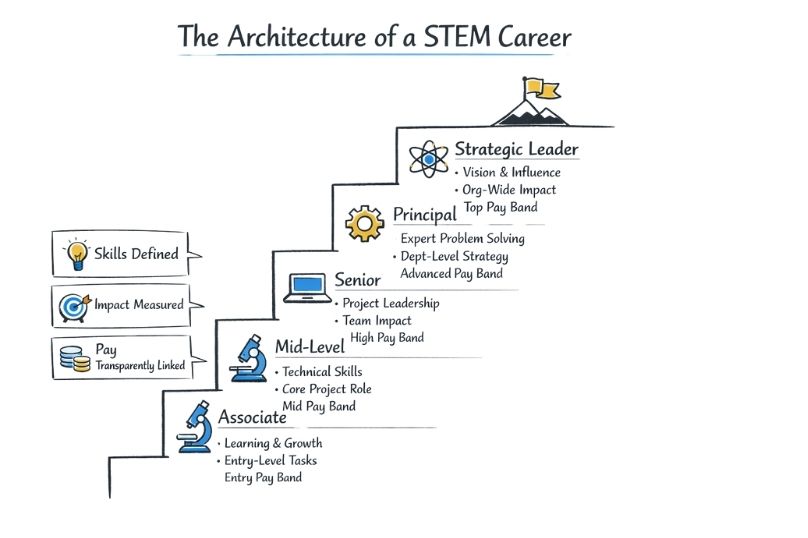
Think of a job ladder as the architectural blueprint for your career within a company. It’s a formal structure that maps out a clear, step-by-step path for moving up within a specific field or department. It clearly defines what skills, responsibilities, and qualifications you need to master at each stage.
What Is a Job Ladder in STEM?
Imagine trying to build a complex skyscraper with just a simple staircase. You know you can go up, but you have no idea how each floor is constructed, what it’s for, or how to get there. A job ladder turns that vague staircase into a detailed set of plans for your career in Science, Technology, Engineering, and Mathematics (STEM).
It cuts through fuzzy promises of “growth opportunities” and instead gives you a transparent, well-defined framework. This blueprint is an essential tool for companies looking to manage promotions fairly, set equitable pay, and keep their best people in fiercely competitive STEM fields globally.
For many, though, just getting onto that first rung is becoming a real challenge. Picture starting your STEM career, eager to climb, only to find the bottom of the ladder is missing. In some markets, such as the UK, recent data has shown a worrying trend: job postings for entry-level, graduate, and junior roles have dropped significantly, reaching a five-year low.
This ‘quiet collapse’ of entry-level jobs in certain regions hits Gen Z and women starting their STEM careers the hardest. Many employers are now asking for 2-3 years of experience for jobs they still label as ‘junior,’ creating a classic catch-22 for newcomers.
The Core Components of a Job Ladder
A robust job ladder isn’t just a list of titles; it’s built on several core components that work together to bring clarity and objectivity to the whole process. If you're planning your career progression in STEM, getting to grips with these building blocks is your first move.
A well-designed job ladder usually includes:
- Job Levels: These are the distinct rungs on the ladder. Think Associate Engineer, Engineer, Senior Engineer, and Principal Engineer. Each level comes with a clearly defined scope of responsibility and influence.
- Competencies: These are the specific skills, knowledge, and behaviours you need to excel at each level. They’re a mix of technical abilities (like mastering a programming language) and behavioural skills (like leadership or communication).
- Pay Bands: Every job level is tied to a specific salary range. This crucial link ensures that pay reflects responsibility and performance, which is a cornerstone of promoting pay equity.
This structure gives everyone, from individual contributors to managers, a shared language and a clear set of expectations. It makes career conversations far more productive because they’re grounded in tangible, measurable goals.
Core Components of a Job Ladder at a Glance
To make this even clearer, here’s a breakdown of the fundamental parts of a typical job ladder and why each one is so important, especially for professionals in STEM.
| Component | Description | Why It Matters for STEM Professionals |
|---|---|---|
| Job Levels | Distinct stages or "rungs" that represent increasing seniority and impact (e.g., Junior, Mid-level, Senior, Principal). | Provides a clear map of what’s next, helping you visualise your long-term career trajectory within the organisation. |
| Competencies | The specific skills, knowledge, and behaviours required to perform successfully at each level. | Demystifies promotion criteria. You know exactly which technical and soft skills to develop to be ready for the next step. |
| Pay Bands | A defined salary range associated with each job level, based on market data and internal equity. | Empowers you with information for salary negotiations and ensures your compensation is fair and transparently linked to your role. |
By breaking down career progression into these manageable parts, job ladders provide a logical and transparent system that benefits both the individual and the organisation.
Ladder or Lattice: Which Career Path is Right for You?
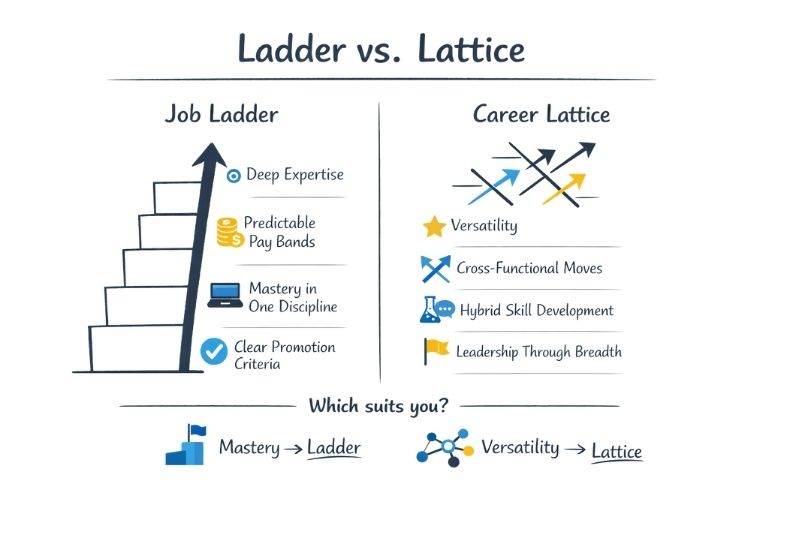
When you picture your career, what do you see? Is it a straight climb to the top, or is it more of a winding journey with interesting detours? This very question gets to the heart of two distinct ways organisations structure career progression: the traditional job ladder and the more modern career lattice.
Knowing the difference isn't just semantics; it's fundamental to matching your personal ambitions with the opportunities your company provides.
A job ladder is all about linear, vertical growth. It’s a well-defined path for someone looking to become a true master of their craft within a single discipline. Imagine a Software Engineer progressing methodically from an associate role to senior, then staff, and ultimately principal engineer. Each step up the ladder signifies a deeper level of technical skill and influence in that one specific field.
The career lattice, however, is built for agility. It embraces the idea that growth can be sideways as well as upwards. This model champions cross-functional moves, recognising that you can gain incredibly valuable skills by stepping into a different department or a related role. It’s a framework that encourages a broader skill set and a richer, more holistic view of the business.
Choosing Your Path: Mastery or Versatility?
So, which structure is better? Neither. The right one for you depends entirely on what you want from your career. One path champions deep expertise, while the other values adaptability and a wide range of experiences.
A job ladder is a fantastic fit if you're passionate about becoming a leading expert in your field. For a Research Scientist, for example, this focused structure allows them to dedicate an entire career to a specific area of discovery, gaining seniority and influence through specialised contributions. It’s a path of depth.
On the other hand, a career lattice is perfect for people who thrive on variety and want to combine different skill sets. A Data Scientist with excellent communication skills might use a lattice to move into a Machine Learning Product Manager role. This lateral step allows them to blend their technical knowledge with a new focus on business strategy, carving out a unique and powerful career niche. A thoughtful career development plan can be a huge help in figuring out which path plays to your strengths and excites you most.
For many women in STEM, a career lattice can unlock opportunities that a rigid job ladder might conceal. It validates moves into adjacent fields like technical writing, project management, or sales engineering, creating multiple pathways to leadership.
Advocating for the Structure You Need
Once you know which model you prefer, you can start having much more strategic conversations with your manager.
Let's say your company is all about the traditional job ladder, but you see a brilliant opportunity in a lateral move. You can build a business case for it. Frame the move not as an escape from your current role, but as a chance to gain new skills that will bring a fresh, valuable perspective back to your team or the wider organisation.
Conversely, what if your company loves the lattice model, but your heart is set on deepening your technical expertise? Use your function’s job ladder as your guide. Clearly state your ambition to achieve mastery in your specialism and work with your manager to define the milestones you need to hit to climb to the next rung. This proactive approach puts you in the driver's seat, ensuring your career journey, whether it’s a ladder or a lattice, is one you consciously choose.
How to Design an Effective STEM Job Ladder
Creating a job ladder isn't just a box-ticking HR exercise. It's a genuine piece of organisational design that sends a powerful message about what your company truly values. When done right, a good framework brings clarity and objectivity to career growth, which is absolutely vital in highly specialised STEM fields. Without it, promotions can feel random, career paths become foggy, and you end up with frustrated people heading for the door.
The whole process starts with getting the foundations right. Before you even think about individual job titles, the first move is to group similar roles into distinct job families. Think of these as broad categories of work that share a common purpose or skillset.
For instance, a tech company would likely have job families like:
- Engineering: All the roles focused on building and maintaining software and hardware.
- Research & Development: The positions dedicated to discovery, experimentation, and innovation.
- Data Science: Roles that revolve around analysing data to find insights and build predictive models.
- Product Management: The people responsible for steering product strategy from idea to launch.
Taking this first step helps you map out your workforce logically before you start getting into the granular details of seniority levels.
Defining Levels and Competencies
With your job families established, the next critical step is to define the different levels within each one. These levels are the rungs of the ladder, marking out a clear path from an entry-level contributor to a senior expert or leader. You’ll often see titles that progress from 'Associate' to 'Senior', and then on to 'Principal' or 'Lead'.
For every single level, you need to pin down a clear set of competencies. These are the specific skills, knowledge, and behaviours someone is expected to show. To actually be useful, these competencies have to be objective and something you can actually measure.
It's so easy to fall into the trap of using vague descriptions like "strong communication skills." A much better way is to define what that actually looks like for that specific role. For example: "Can effectively present complex technical findings to non-technical stakeholders in project review meetings."
When you break competencies down into tangible actions, you strip out the guesswork and give employees a precise roadmap for what they need to work on. It's also worth remembering what motivates people to climb that ladder. In many global STEM sectors, the financial rewards for experience are significant, but what drives people changes as they become more senior. For example, salaries for senior-level technical roles often command a significant premium over mid-level positions, highlighting why your senior-level competencies must be robust enough to justify that kind of premium.
Ensuring Equity and Transparency
Ultimately, a job ladder’s real worth is in its ability to create a fair playing field. To build a system that’s genuinely equitable, the design process itself has to be inclusive. Get a diverse group of employees from different levels, departments, and backgrounds to look over the drafts and give their feedback. This is your best defence against hidden biases that might accidentally favour one group over another.
Tying the ladder to transparent pay bands is an absolute must for equity. Each level on the ladder should map to a specific salary range, backed up by solid market data and your own internal pay analysis. This is one of the most effective tools we have for closing gender and racial pay gaps, because it links what someone earns directly to objective criteria, not their negotiation skills or their manager’s personal opinion.
Finally, remember that a job ladder isn't a "set it and forget it" document. The STEM world moves incredibly fast, so the framework needs to be reviewed and updated every year to stay relevant. Regular check-ins make sure your competencies still line up with business goals and that your pay bands are keeping pace with the market. This ongoing work is key to retaining women in tech and other underrepresented groups who depend on these fair and transparent systems to build their careers.
Taking Control of Your Career With a Job Ladder
A job ladder shouldn't be some dusty document you only see during your annual review. Think of it as your personal career roadmap, a powerful tool you can use to stop passively waiting for a promotion and start strategically planning your next move. It’s what shifts you from the passenger seat to the driver's seat of your career.
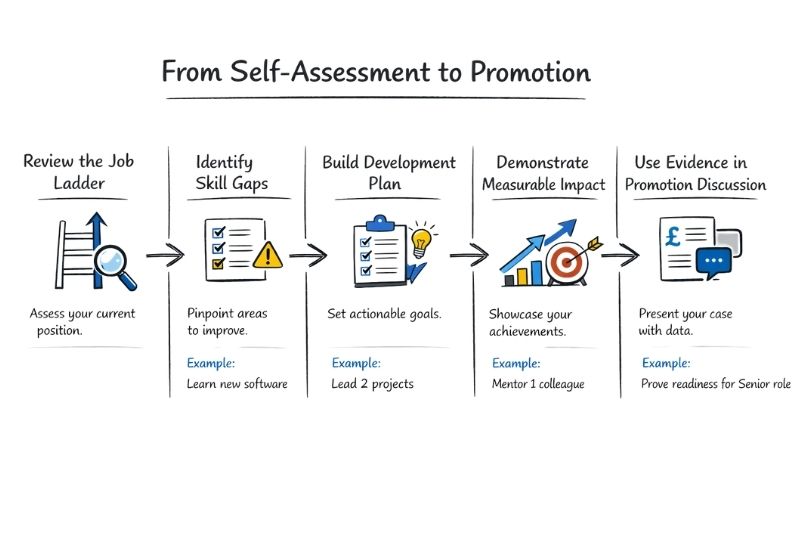
The very first thing to do is a bit of honest self-reflection. Grab the job ladder for your role and hold it up against your current skills and accomplishments. Pay close attention not just to your current level, but to the one directly above it. This simple exercise gives you a clear, objective snapshot of where you shine and, crucially, where the gaps are.
This isn't about being self-critical; it's about collecting intel. Your analysis will show you exactly where to direct your energy, turning a vague goal like "I need to get better at project management" into a tangible, focused plan.
Turning Your Self-Assessment Into a Concrete Plan
Once you’ve pinpointed those development areas, it's time to build a growth plan. This should be a living document that you create and discuss with your manager. The key here is to frame your goals not just as skills you want to learn, but as actions that will bring real value to your team and the wider organisation.
Your development plan might look something like this:
- Targeting a New Skill: "To hit the 'Project Leadership' competency for the Senior Engineer level, I’m going to complete a project management course and put my hand up to lead the next two feature sprints."
- Gaining New Experience: "I need to build my 'Client Communication' skills for the next level, so I’ll ask to shadow senior colleagues on client calls and my goal is to lead a client presentation by the end of Q3."
- Demonstrating Impact: "Mentoring is a key responsibility for the Senior level. I'll start holding weekly one-to-ones with a junior developer to help them with their current project."
An approach like this completely changes the tone of your career conversations. You're no longer asking what you need to do to get promoted; you're showing up with a clear, actionable strategy for how you're going to meet and exceed the defined expectations. Whether you're at the start of your career or gunning for the next big step, this kind of strategic thinking is essential. For a deeper dive into different career trajectories, this comprehensive career path guide is a fantastic resource.
Using the Ladder in Promotion and Pay Discussions
When it comes time to talk about a promotion or a pay rise, the job ladder becomes your strongest ally. It gives you the objective evidence you need to build a compelling case, allowing you to systematically show how your performance maps directly to the requirements of the next level.
Instead of saying, "I feel I'm ready for a promotion," you can confidently state, "I've consistently demonstrated all the core competencies for the Senior level. I led Project X to a successful launch, I’ve been mentoring two junior colleagues, and I've exceeded my performance targets for the last three quarters."
This data-driven argument shifts the conversation away from subjective feelings and towards a factual review of your contributions against clear, pre-agreed standards. This is more important than ever. Globally, many employers now say they prioritise skills over formal qualifications. This skills-first mindset means demonstrating your impact and your abilities is what truly matters.
By getting comfortable with this approach, you can articulate your value with confidence. For more specific tactics, our guide on how to ask for a promotion can help you structure these crucial conversations and ensure you’re fully prepared to advocate for yourself.
Example Job Ladder Templates for Key STEM Roles
Theory is one thing, but seeing how a job ladder works in practice is what really makes it click. To show you what this looks like, I've put together some simplified templates for three common roles in STEM. Think of them as real-world blueprints showing how skills, responsibilities, and influence evolve at each stage.
These aren't meant to be rigid rules, but a solid starting point. If you’re planning your own career, you can use them as a benchmark to figure out where you are and what’s next. For managers and HR leaders, they offer a foundation for building out your own transparent and equitable career paths.
Sample Job Ladder for a Software Engineer Role
The software engineering track is a classic example of a technical job ladder. It's all about deepening your expertise and expanding your influence, from coding a single button to architecting an entire system. As you climb, you gain more autonomy and start shaping the technical direction.
This table gives a bird's-eye view of how a software engineer’s journey might look. Notice how the scope of impact widens at each level, moving from a single task to the entire organisation.
| Level | Title | Core Competencies | Scope of Impact |
|---|---|---|---|
| L1 | Associate Engineer | Writes clean, well-tested code for small features under direct supervision. Actively learns the team's codebase and tools. | Contributes to a single feature or bug fix within one project. |
| L2 | Engineer | Independently owns and delivers moderately complex features. Contributes to code reviews and team technical discussions. | Responsible for the end-to-end delivery of features within a single product. |
| L3 | Senior Engineer | Designs and implements complex systems. Mentors junior engineers and leads technical design for significant projects. | Influences the technical direction of their immediate team and improves code quality across the team's domain. |
| L4 | Principal Engineer | Solves the most complex technical challenges. Sets technical strategy for multiple teams or an entire department. A go-to expert. | Drives technical excellence and innovation across the entire engineering organisation. |
Ultimately, this path illustrates a clear trajectory from executing well-defined tasks to setting the technical vision for a team or even a whole department.
Sample Job Ladder for a Research Scientist Role
For a Research Scientist, a job ladder is less about management and more about growing independence and contributing to the wider scientific community. The focus shifts from carrying out experiments to asking the big questions and driving a whole research agenda.
You can see a clear progression from contributing to existing studies to pioneering entirely new fields of investigation.
- Associate Scientist: You’re in the lab, executing experimental protocols, collecting and analysing data with guidance, and helping write up research papers. Your impact is tied to the successful completion of the experiments you’re assigned.
- Scientist: Now you’re designing and running your own experiments, interpreting the results, and taking the lead on drafting manuscripts for publication. Your influence extends to leading a small research project or a major part of a larger one.
- Senior Scientist: At this level, you’re developing and leading independent research programmes, securing funding, and mentoring junior scientists. Your impact is all about shaping the research direction of your lab or group.
- Principal Scientist: You're a recognised authority in your field. You set the long-term research strategy for an entire department or organisation, and your work has a major impact on the broader scientific community.
A well-structured job ladder in research ensures that advancement is based on scientific contribution and intellectual leadership, not just years of experience. This provides a clear pathway for women to advance to senior roles where they can set research priorities.
Sample Job Ladder for a Product Manager Role
The Product Manager's career path is all about expanding strategic ownership. It's a journey from managing a few features on a single product to defining the vision for an entire product portfolio, all while keeping it aligned with the company’s bigger goals. With one eye always on what’s next, this role is more crucial than ever.
If you're keen to explore high-growth areas, you can learn more about the most promising jobs for women in STEM in 2026.
This path shows a clear shift from tactical, day-to-day execution to strategic leadership. It demands a sophisticated blend of market insight, genuine user empathy, and sharp business acumen.
Got Questions About Job Ladders? Let's Unpack Them.
Even with the best map, you'll still have questions when you're on the trail. Let's tackle some of the most common queries that come up when people start using job ladders in the real world.
What if My Company Doesn’t Have a Job Ladder?
This is a really common situation, but it doesn't mean you're stuck. If your company hasn't built a formal job ladder, you can take the lead and draft one for yourself.
Start by doing some reconnaissance. Look at typical career paths for your role across the wider STEM industry. Scour LinkedIn, dig into industry reports, and chat with people in your professional networks to get a clear picture of what skills and responsibilities define the next level up.
Once you’ve got your research, book a meeting with your manager. Instead of just saying you want to grow, you can walk in with a proposed set of competencies and milestones that would clearly justify a promotion or pay rise. By doing the legwork, you're not just showing initiative; you're creating a concrete framework that makes it easy for them to support your progression. You’re essentially building your own ladder, one rung at a time.
A well-designed job ladder is one of the most powerful tools for fostering genuine pay equity. By tying roles and levels to objective criteria and specific salary bands, it strips away much of the unconscious bias that creeps into compensation decisions.
When pay is linked to defined skills and impact, not just gut feelings or negotiation tactics—it creates a system where people doing similar work are paid fairly, regardless of their gender.
How Do Job Ladders Actually Help With Pay Equity?
This is where a structured framework really shines, especially for women in STEM. A transparent job ladder gives you a solid benchmark. You can see the objective standards for your role and advocate for fair pay based on defined criteria, not just on how well you can negotiate.
It shifts the conversation from a subjective, often uncomfortable discussion to a data-driven one. This transparency gives women the language and the evidence to show exactly how their contributions align with a specific level and its corresponding pay band. It makes it much, much harder for systemic biases to dictate pay cheques.
How Often Should a Job Ladder Be Updated?
A job ladder can't be a "set it and forget it" document. For it to stay useful, it needs to be a living thing. Organisations should plan to review and refresh their ladders at least once a year.
The STEM world moves incredibly fast. New technologies pop up, and in-demand skills can change in the blink of an eye. An annual review makes sure that the competencies and levels are still relevant to the market and actually align with where the company is headed. It’s also the perfect opportunity to recalibrate salary bands against fresh market data and check that the framework is still promoting fair and clear growth for everyone on the team.