
When we talk about gender pay statistics, we’re looking at the average difference in earnings between all men and all women across an entire organisation, an industry, or even a country. It’s a bird’s-eye view that reveals how much less a woman earns, on average, for every dollar, pound, or euro a man makes. This single figure can tell us a powerful story about broad economic and social inequalities on a global scale.
What Gender Pay Statistics Reveal
It’s a common misconception that the gender pay gap is about men and women being paid differently for doing the same job. That specific issue is called unequal pay, and it’s illegal in many countries, such as under the UK's Equality Act 2010.
The gender pay gap is a much bigger picture.
Think of it this way: imagine you took the hourly wage of every single woman working at a company, from the CEO right down to the part-time intern, and calculated the average. Now, do the same for all the men. The difference between those two averages is the gender pay gap. It isn't comparing two people in the same role; it's comparing the entire female workforce with the entire male workforce.
A significant pay gap often signals deeper systemic issues. It points to things like fewer women in leadership, more women in lower-paid roles, and the quiet impact of social norms on who gets promoted. It’s not just a number; it’s an indicator of unequal opportunity.
Getting your head around these figures is vital for anyone navigating their career, especially for women in fields like STEM, where pay scales and progression paths can be particularly complex. These statistics give us the data we need to see the landscape clearly, push for meaningful change, and map out our own strategic career moves. If you want to explore how workplace environments are formed, our guide on culture and diversity definitions and their importance is a great place to start.
Key Concepts in Pay Gap Reporting
To really dig into gender pay statistics, you need to be familiar with a few key terms. The two most common ways the gap is measured are the mean and the median. It's crucial to know the difference.
- Mean (Average) Gap: This is calculated by adding up all the hourly wages for each gender and dividing by the number of employees. The problem? It can be easily skewed by a handful of extremely high earners (who are often male).
- Median (Middle) Gap: This is the difference between the wage of the middle-ranking man and the middle-ranking woman if you were to line them all up in order of pay. This figure is often a more realistic snapshot because it isn't distorted by salaries at the very top or bottom.
To help clarify these foundational ideas, the table below breaks down the essential concepts you'll encounter.
Key Gender Pay Gap Concepts at a Glance
| Concept | What It Means | Why It Matters |
|---|---|---|
| Gender Pay Gap | The overall difference in average hourly earnings between all men and women in a workforce. | It highlights systemic economic inequality and the underrepresentation of women in high-paying roles. |
| Equal Pay | The legal requirement to pay men and women the same for the same or equivalent work. | It focuses on direct discrimination within specific roles, whereas the pay gap is a broader measure. |
| Mean Pay Gap | The difference between the average hourly earnings of men and women. | It gives a general overview but can be skewed by a small number of very high salaries (usually male). |
| Median Pay Gap | The difference between the midpoint hourly earnings of men and women. | It provides a more representative picture of the 'typical' employee's experience and is less affected by outliers. |
With these terms, you’ll be much better equipped to interpret the data and understand the real story behind the numbers we’ll be exploring.
A Global Snapshot of the Gender Pay Gap

The gender pay gap isn't a one-size-fits-all problem. It’s a story that plays out differently everywhere you look, shaped by a country’s unique blend of culture, economic policies, and social norms. For anyone in STEM, especially if you're working for a multinational company or considering a move abroad, getting to grips with these international nuances is essential.
While no country has eliminated the gap, the global picture is a patchwork of slow progress and stubborn inequality. Research from the World Economic Forum is sobering: at the current pace, it will take more than a century to reach worldwide gender parity.
This tells us something important. Economic growth alone won't solve the problem. Some of the world’s most developed nations are still wrestling with significant pay gaps, proving that deep-rooted structural and cultural barriers often hold more sway than GDP.
A Look at Pay Gaps Across Continents
When we zoom in on different regions, clear patterns begin to take shape. Each continent faces its own hurdles and has tried different ways to clear them.
In many Western countries, including the UK and Canada, we’ve seen a big push for transparency through mandatory pay gap reporting. In the UK, for example, the median gap for full-time employees was 7.4% in 2024. But that figure doesn’t tell the whole story; it balloons when you include part-time workers, a group where women are heavily over-represented.
It’s a similar situation elsewhere. Australia's national gender pay gap is 13.0%, which translates to men earning over $250 more than women every single week, on average. In the United States, the gap is even wider. Women there earn roughly 84 cents for every dollar a man makes, a figure that has stubbornly refused to budge for nearly two decades.
To put these international disparities into context, here’s a quick overview of the overall gender pay gap in a few key countries as of 2026.
2026 Global Gender Pay Gap Snapshot (Select Countries)
| Country/Region | Overall Gender Pay Gap (%) | Key Contributing Factor |
|---|---|---|
| Iceland | 9% | Strong government policies on parental leave & childcare. |
| United Kingdom | 14.5% (Overall) | High concentration of women in part-time work. |
| United States | 16% | The "motherhood penalty" and occupational segregation. |
| South Korea | 31.2% | Deep-rooted cultural norms and a rigid corporate culture. |
| Australia | 13.0% | Gender segregation across industries and roles. |
As the table shows, a country's legislative framework and cultural attitudes have a direct and powerful impact on women's earnings.
What's Driving the Differences?
So, why do some countries do so much better than others? It often comes down to policy and social infrastructure. Things like generous parental leave, affordable childcare, and the influence of labour unions all make a real, measurable difference.
- The Nordic Model: Countries like Iceland and Sweden consistently top the gender equality charts for a reason. They have heavily subsidised childcare and progressive, shared parental leave policies that actively encourage fathers to take time off, which helps reduce the "motherhood penalty."
- The Middle East & Africa: In many parts of these vast regions, legal and cultural barriers can limit women’s access to the formal job market, creating wide pay disparities. But change is happening, with some nations and industries making significant strides. You can dive deeper into the trends by reading about the gender pay gap across Africa.
- India: The pay gap here is one of the widest in the world. A key driver is occupational segregation, where women are overwhelmingly found in lower-paying sectors like agriculture and basic services.
Even within the high-paying world of STEM, the gap persists globally. In fact, it’s often widest in high-income countries. In Germany, women in STEM roles earn around 21% less than men. In South Korea, the gap for highly skilled professionals is a shocking 34.6%.
This is often a result of the 'leaky pipeline', with women leaving STEM careers at a much higher rate than men. The reasons are complex, but a lack of flexible work arrangements and male-dominated workplace cultures are major contributors. With women making up only 35% of STEM students in higher education worldwide, the talent pool is already smaller before these workplace pressures even begin.
For any multinational tech or engineering firm, these global statistics are far from abstract. They have a direct impact on recruitment, how you structure compensation, and whether you can attract the best and most diverse talent in each market. To build a truly equitable global team, you have to understand the local reality.
A Closer Look at Gender Pay in the UK
While global averages paint a broad-strokes picture, the real story is in the details. When we zoom in on the UK, the data gets a lot sharper. Here, gender pay reporting isn't just an academic exercise; it’s a legal requirement for large employers, giving us a rich and often frustrating look at what’s really going on with women’s earnings.
The first place we all look is the Office for National Statistics (ONS). Their headline figure for 2024 puts the UK's overall gender pay gap at 7.4% for full-time employees. This means that for every pound a man earns, a woman takes home just 92.6p. It’s a slight improvement from 7.7% in 2023, but let’s be honest, progress is crawling. And even that small step forward masks so many bigger problems hiding just beneath the surface. You can explore more about these trends and the projections for achieving pay equity on iwpr.org.
The STEM Sector: A Worrying Outlier
For women in STEM, the situation is even more concerning. You’d think these high-growth, innovative fields would be leading the way, but they often have some of the most stubborn pay gaps around. Take UK engineering, where the gap widens to a staggering 20%. That’s a woman earning just 80p for every pound her male colleague makes.
This isn’t about a lack of talent or effort. It’s a structural problem. When you dig into why, a couple of key factors stand out:
- A Lack of Women at the Top: Senior leadership, where the highest salaries are, is still overwhelmingly male. This creates a powerful gravitational pull on the average pay for men.
- The Roles Women Hold: Even within innovative STEM companies, women are often concentrated in support functions or administrative roles, which are typically paid less than the core technical and leadership tracks.
It all adds up to a scenario where a brilliant female software engineer can be making a huge impact on a project, but still see a significant gap in her earnings from the very start of her career.
The Hidden Penalties in Bonuses and Age
Bonuses are another part of the story, and they throw even more fuel on the fire. The ONS data shows that bonus payments dramatically widen the gap. Across all sectors, the median bonus for men is around £2,000, while for women, it’s just £500. In sectors like finance and tech, where bonuses make up a huge chunk of total pay, this difference is massive.
Age also plays a crucial role. For people in their 20s and 30s, the pay gap is relatively small. But once women hit their 40s and 50s, it widens dramatically.
This is often called the "motherhood penalty." Caring responsibilities still fall disproportionately on women, leading many to take career breaks or switch to part-time work. This has a direct knock-on effect on everything from pension contributions and promotion prospects to long-term earning power.
Where You Live and Work Matters
The UK's pay gap isn't a single, flat number; it changes depending on where you are. London and the South East, with their high salaries and bonus-heavy industries, tend to have the widest gaps. On the other hand, regions with more public sector jobs, like parts of Scotland and Wales, often show smaller differences.
Systemic issues like these are tough to navigate alone, and knowing your rights is a crucial first step. If you're facing these challenges, our article on how to deal with workplace discrimination can offer guidance.
For any woman working in STEM, these UK-specific stats are more than just numbers on a page. They are a vital tool. They help you understand the professional landscape, benchmark your own salary expectations, and build a powerful, data-driven case when it’s time to negotiate. More than anything, they highlight the urgent need for real action to ensure that talent is what truly defines your career and your paycheque.
Why the Gender Pay Gap Persists in STEM

It’s a question that baffles many. In fields built on logic, data, and objective results - science, technology, engineering, and maths - why is the gender pay gap so incredibly stubborn? The truth is, the reasons are complex and deeply woven into the fabric of our workplaces and wider society.
This isn't just about unequal pay for the same job, which is illegal in many countries and relatively rare. Instead, the gap is the result of subtle, cumulative disadvantages that build up over a woman's entire career, holding back her earning potential at every turn.
One of the most powerful and well-documented factors is the "motherhood penalty". When women have children, their career progression and earnings often take a significant hit. This can be due to time taken out of the workforce, but it’s also driven by the persistent and disproportionate weight of caregiving responsibilities that still falls on women's shoulders.
The Leaky Pipeline and Glass Ceiling
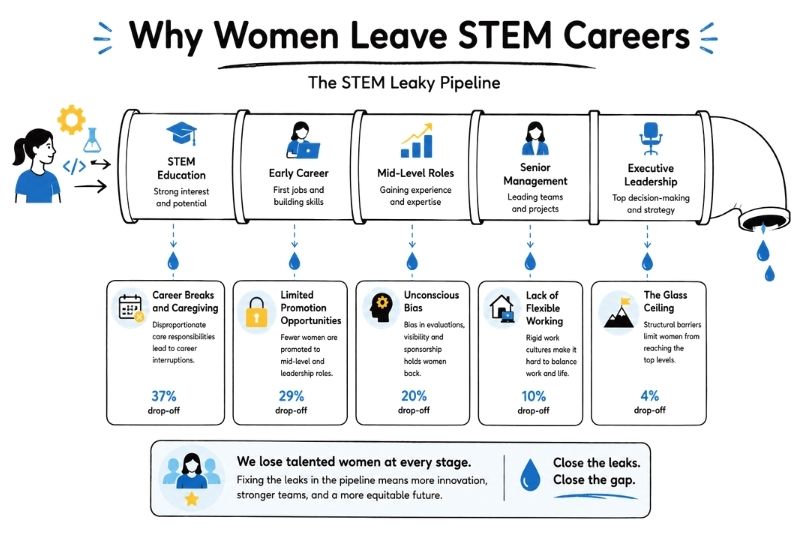
You’ll often hear the terms "leaky pipeline" and "glass ceiling" used to describe women's career paths in STEM. They aren't just corporate jargon; they represent very real obstacles. Think of the pipeline as the entire career journey, from university all the way to the executive board.
- The Leaky Pipeline: This is what happens when women leave STEM professions at a far higher rate than their male colleagues. The attrition is constant at every stage of the career ladder. This means far fewer women who start in a technical role are still there a decade later. You can dig deeper into why this happens in our guide on mapping the hidden exit points in STEM.
- The Glass Ceiling: For those who navigate the leaky pipeline, another barrier awaits. This is the invisible yet very solid barrier that stops so many exceptionally talented women from reaching the highest-paying, senior leadership positions. It’s why you might see a healthy gender mix in junior and mid-level roles, but a glaring absence of women in the C-suite.
These two forces work in tandem. The pipeline leaks talent, meaning fewer women are even in the running for top jobs. The glass ceiling then blocks many of the ones who remain. It creates a self-perpetuating cycle where a lack of female leaders and role models reinforces a culture that feels unwelcoming to the next generation.
The Role of Unconscious Bias
Even when you account for things like career breaks and hours worked, a frustratingly large portion of the pay gap remains. This is where we have to talk about the quiet but powerful impact of unconscious bias. It shapes decisions on everything from who gets hired to who gets that career-making promotion.
Think about it this way: a highly skilled female project manager is up for a promotion. She has a fantastic track record. So does her male colleague. But in the decision-making room, subconscious assumptions can creep in. Her commitment might be questioned because she has a young family. His assertiveness is seen as "leadership potential," while her identical confidence is labelled as "abrasive."
This isn't some far-fetched hypothetical; it’s a daily reality for women in the workplace. Research consistently finds a portion of the pay gap that simply can't be explained by qualifications, experience, or role. A 2025 study from the American Association of University Women found that even one year out of university, women in STEM earned 8% less than men. By mid-career, that gap had ballooned to nearly 20%.
That ‘unexplained’ difference is where discrimination and bias live. It shows us that simply encouraging more girls to study STEM subjects isn’t a complete solution. We need a fundamental cultural shift inside our organisations, one that actively seeks out and dismantles the systemic biases that penalise women from their very first payslip to their last.
How to Use Pay Statistics for Your Career Advantage
Seeing the gender pay gap statistics in black and white can be disheartening. But what if you could turn that data into your secret weapon? Knowing the numbers is one thing; using them to actively push your career forward is where the real power lies.
This isn't about getting angry at the statistics. It's about channelling that energy into a solid, data-driven strategy for your own financial growth. It's time to see the pay gap not just as a huge societal problem, but as a personal challenge you can absolutely tackle with the right information.
When you walk into a salary conversation armed with industry benchmarks and company-specific data, you fundamentally change the dynamic. The discussion shifts from what you feel you deserve to what the market proves your skills are actually worth.
First, Pinpoint Your Real Market Value
Before you even step into an interview or a performance review, you need to do your homework. Building an airtight case for your compensation begins with solid research. This is what gives you the confidence and the evidence to ask for what you’re worth.
- Go deeper than job titles. The title "Project Manager" can mean vastly different things. Focus on the core responsibilities, the skills required, and the company's size to find roles that are genuinely comparable to yours.
- Triangulate your data. Never rely on a single salary calculator. Cross-reference what you find with industry-specific reports, recruitment agency salary guides, and platforms like Glassdoor and LinkedIn Salary. This gives you a much more accurate pay band for your role.
- Dig into company reports. For larger UK companies, their gender pay gap reports are public information. While this data shows averages, a consistently wide gap might signal systemic issues you should be aware of. Similar reporting requirements exist in Australia and are emerging elsewhere.
This preparation is especially crucial if you're a woman returning to STEM after a career break. Your experience is incredibly valuable, and having solid data helps you push back against any outdated assumptions and secure a salary that reflects your current expertise, not a role you held years ago.
Building Your Case for a Raise or Promotion
Once you have the data, you can start to build your story. For anyone in the middle of their career, asking for more money or a bigger role requires a compelling argument that clearly links your personal achievements to the company's success.
The aim here is to present an undeniable case. You need to frame your request around your specific accomplishments, backed up by industry pay data and a clear articulation of your value to the business. This approach transforms the conversation from a subjective plea into an objective business discussion.
Pay transparency is your best friend in this process. A fascinating study in the Harvard Business Review found that in US states with salary history bans, women's pay jumped by an average of 8%. When companies can't anchor their offer to your previous, potentially lower, salary, they have to pay based on current market value.
This is a powerful lesson: don't volunteer your salary history. Instead, steer the conversation towards the salary band for the role you're going for. If you're interested, you can read the comprehensive research on hbr.org.
Ultimately, getting comfortable with these numbers is an act of self-advocacy. For more specific tactics and conversation starters, check out our guide on salary negotiation for women in STEM. Remember, every time you successfully negotiate, you don't just win for yourself; you also help raise the bar for the women who come after you.
What Employers Can Do to Close the Gap

It's one thing for individuals to advocate for themselves, but the real change has to come from the top. The stubborn persistence of the gender pay gap proves that progress isn't happening on its own. Employers need to take a hard look at their own systems and actively break down the barriers holding women back.
This is more than a box-ticking exercise or a compliance headache. It's about building a business that is fundamentally fairer, more competitive, and ultimately, more successful. The only way forward is with deliberate, evidence-backed action.
Adopting Fair and Transparent Pay Practices
Pay gaps thrive in the dark. When salary decisions happen behind closed doors, it creates a perfect breeding ground for unconscious bias to influence who gets paid what. The most effective way to combat this is to switch the lights on.
Here’s what that looks like in practice:
- Conduct regular pay equity audits. Think of this as a regular health check for your company’s pay structure. You need to analyse your compensation data to spot and fix any unexplained pay differences between men and women in similar roles, after accounting for legitimate factors like experience or performance.
- Establish transparent salary bands. Define and, ideally, publish a clear salary range for every single role. This simple step shifts the focus from a candidate's negotiation skills or previous salary to the actual value of the job itself.
- Standardise promotion criteria. Vague pathways to promotion are where bias often does its worst damage. By creating clear, objective, and measurable criteria for career progression, you reduce the subjectivity that can disadvantage women during reviews and promotion cycles.
Getting your house in order now is also smart preparation, as you'll need to prepare for new automated hiring and pay transparency rules that are reshaping how modern, fair workplaces operate.
Fostering an Inclusive and Supportive Culture
Fixing pay practices is a huge step, but it's only half the battle. A truly equitable workplace supports everyone to do their best work, recognising that people face different challenges along the way. This means looking beyond the payslip and addressing the cultural roadblocks that fuel the pay gap.
The business case for doing all this is rock-solid. Investing in diversity and inclusion isn't just the "right thing to do"; it's a massive strategic advantage for attracting and keeping the best people, especially in fiercely competitive fields like STEM.
And we have the data to prove it. Companies actively working to close their gender pay gap are seeing real, tangible benefits. A 2025 report from McKinsey & Company found that executive teams in the top quartile for gender diversity were 25% more likely to have above-average profitability.
The research drew a straight line from practices like pay audits and transparent salary bands to better financial performance and innovation. For employers in the Women in STEM Network, it's a powerful argument for investing in these programmes. You can dig into the data yourself in the full 'Diversity Wins' report from McKinsey.
Common Questions About Gender Pay Statistics
Diving into gender pay statistics often brings up more questions than answers. It's a complex topic, so let's clear up some of the most common points of confusion and unpack what the numbers really mean.
Think of this as your go-to guide for making sense of the data.
Is the Gender Pay Gap the Same as Unequal Pay?
This is the most common question, and the answer is a firm no. Getting this distinction right is key to understanding the entire conversation.
Unequal pay is when a woman is paid less than a man for doing the exact same job. That's illegal in many countries, such as the UK, and has been for decades.
The gender pay gap, on the other hand, is a much wider lens. It looks at the difference between the average earnings of all men and all women across an entire company, industry, or country. It's not about two people in the same role; it's about the overall picture, which often highlights that women are less likely to be in the most senior, highest-paid positions.
Does the Pay Gap Mean Women Choose Lower-Paying Jobs?
That’s a huge oversimplification of a much bigger story. While career choices are part of the equation, those choices don't happen in a vacuum. They are shaped by powerful, often invisible, systemic pressures.
What kind of pressures?
- Deep-rooted societal expectations that caregiving is primarily a woman's role.
- A serious lack of genuinely flexible working arrangements that don't penalise your career.
- Workplace cultures that can subtly (or not so subtly) sideline women, especially in male-dominated fields like STEM.
So, when we talk about "choice," we have to ask how free that choice really is.
It's less a matter of simple preference and more a reflection of structural barriers. The data consistently shows that caregiving duties still fall disproportionately on women, which can stall career progression and push them towards roles that offer more flexibility but come with a smaller pay cheque.
How Can I Find My Company's Gender Pay Gap Data?
If you're in a country with mandatory reporting, like the UK or Australia, and your company meets the size threshold (e.g., 250 or more employees in the UK), you're in luck. These organisations are legally required to report their gender pay gap figures every year.
You can typically find the report on the company's own website, often in an "About Us" or "Careers" section. It's also published on the government's official gender pay gap reporting portal in countries like the UK.
For smaller companies or those in countries where reporting isn't mandatory, the data probably isn't public. In that case, your best bet is to research salary benchmarks for your role and industry. This gives you the knowledge you need to advocate for yourself in any pay discussion.