
Conflict at work is difficult to avoid. Put people with different experiences, priorities, responsibilities and personalities together, and there will inevitably be times when they disagree. That is not necessarily a problem. Some disagreement can be useful. A colleague may notice something that others have missed. Someone may challenge a decision that needs challenging. Two people may approach a problem differently and, by discussing those differences, arrive at a better solution than either would have reached alone.
The difficulty begins when disagreement becomes personal, when people stop listening to each other, or when avoiding conflict feels easier than addressing what is happening. For women working in STEM, there can be another complication. How do you challenge something confidently without being seen as difficult? What happens when the person you disagree with is more senior than you? And how do you know when a difficult conversation is worth having at all?
Not all workplace conflict is unhealthy
We often use the word conflict as though it automatically describes something negative, but there is an important difference between healthy and unhealthy conflict. Healthy conflict allows people to disagree while retaining some interest in understanding each other and finding a way forward. You may have very different opinions, but there is still a shared objective somewhere underneath the disagreement.
Unhealthy conflict is different. It may become about winning, control, blame or proving that somebody else is wrong. At that point, having better communication skills may help, but they cannot guarantee that the conflict will be resolved. Recognising the difference matters because we should not assume that every disagreement needs the same response.
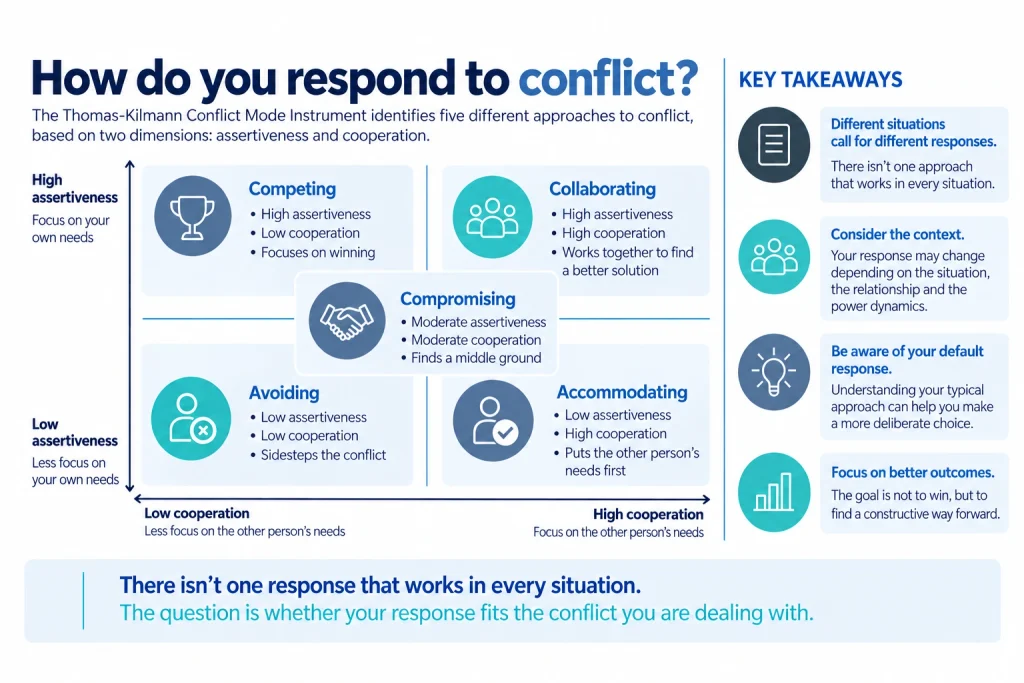
How do you normally respond to conflict?
One useful framework for understanding workplace conflict is the Thomas-Kilmann Conflict Mode Instrument. It considers our responses according to two broad dimensions: how assertive we are about our own position and how cooperative we are with the other person. It identifies five approaches: competing, accommodating, avoiding, compromising and collaborating.
Most of us probably recognise ourselves somewhere in that list, but our response is unlikely to be fixed. We may be perfectly comfortable disagreeing with a colleague but behave very differently when the disagreement is with our manager. We may speak openly in a team where we feel secure but remain silent in an environment where previous challenges have been badly received. Context matters.
This is also why we should be careful about assuming that someone's response to conflict tells us something fixed about their personality. During our recent workshop, a participant asked how neurodivergent people fit within these different approaches. There is no single answer. Neurodivergent people are no more one homogeneous group than anybody else, and an individual's response will depend on the person and the circumstances.
Avoiding conflict does not necessarily make it disappear
Avoidance can be tempting. We delay replying to an email, avoid raising something in a meeting or decide that saying nothing is easier. Sometimes that is a perfectly reasonable choice. Not every disagreement warrants a confrontation, but avoidance can also allow relatively small problems to become larger ones.
If two colleagues know there is tension between them but neither addresses it, each may begin interpreting the other's behaviour through the disagreement. An unanswered email starts to mean something. A short response appears deliberate. An ordinary decision is interpreted as another example of the problem. By the time somebody eventually raises the issue, they may no longer be discussing the original disagreement.
The first question, therefore, may simply be whether this needs a conversation. If it does, having it earlier can sometimes be easier than waiting until both people have accumulated a list of grievances.
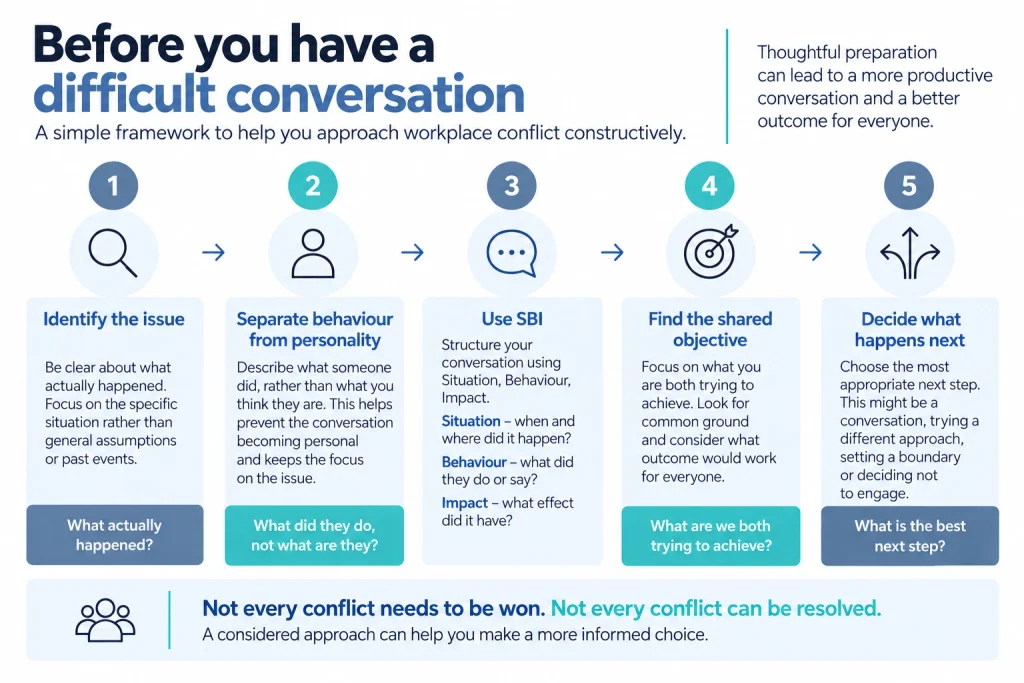
Talk about what happened, not what somebody is
One of the most useful ways to prevent a difficult conversation becoming personal is to distinguish between behaviour and personality. There is a significant difference between saying, “You are dismissive,” and describing a particular occasion when you felt that your contribution was dismissed. The first is a judgement about the person. The second gives you something specific to discuss.
The Situation, Behaviour, Impact (SBI) model provides a simple structure for doing this. Start with the situation: when and where did the problem occur? Then describe the behaviour: what did the person actually do or say? Finally, explain the impact: what effect did that behaviour have on you, the work or the team?
The distinction may seem small, but it changes the nature of the conversation. Instead of arguing about whether somebody is rude, difficult or unreasonable, you can discuss what actually happened and what could happen differently next time.
Listening is not the same as agreeing
Difficult conversations often become two people waiting for an opportunity to explain why they are right. Listening requires something different. It means allowing the other person to explain how they saw the situation before deciding what you think about their interpretation.
You do not have to agree with them. Their version of events may be quite different from yours. They may have misunderstood your intentions, just as you may have misunderstood theirs. But understanding what somebody thinks happened is useful information. There is also a practical reason to listen. If you do not understand what the other person believes the problem is, it becomes much harder to resolve it.
What are you actually trying to achieve?
Conflict can acquire a life of its own. An argument that began with a disagreement about a project can gradually become about previous meetings, old emails, personality differences and who said what six months ago. Returning to the original objective can change the conversation.
What are we trying to achieve? What does the project need? What outcome would work? Is there anything on which we already agree? Finding common ground does not require either person to abandon their position. It gives both sides somewhere from which to begin.
The next step does not necessarily have to be a permanent solution either. Sometimes it is more useful to agree to try something differently and see what happens.
What if the person you disagree with is your manager?
Advice about workplace conflict can become unrealistic when it ignores power. Telling someone to speak openly is easy. Doing it when the other person controls your promotion, opportunities, salary or continued employment can be considerably harder.
This is where psychological safety matters. In a healthy organisation, disagreement should not automatically be interpreted as disloyalty or insubordination. People should be able to question decisions and offer different views, even when the final decision remains with the more senior person. But not every workplace operates like that.
Before entering a difficult conversation, it can therefore be sensible to consider the environment as well as the disagreement itself. How has this person responded to challenge previously? Is there evidence that they will listen? Is there an appropriate process for raising concerns? Is there somebody else you can speak to if the conversation goes badly? Being assertive does not require ignoring the reality of organisational power.
When women are described as “difficult”
There is another question worth examining. What do we actually mean when we describe somebody at work as difficult? It is an imprecise word. Was the person aggressive? Did they repeatedly interrupt colleagues? Did they refuse to cooperate? Or did they disagree, challenge a decision or ask questions that somebody else found uncomfortable?
Those are very different things. For women in STEM, particularly in environments where women remain underrepresented, the distinction deserves attention. If somebody describes a colleague as difficult, asking for specifics can be useful. What did she actually do? What behaviour caused the problem? In what situation did it happen?
That does not mean women cannot behave badly at work. Of course they can. It means behaviour should be assessed as behaviour rather than converted into a broad judgement about someone's character. Perhaps we should all be more cautious about the labels we attach to colleagues when what we actually mean is that we found an interaction with them difficult.
When should you stop trying to resolve a conflict?
There is an assumption behind a lot of advice about conflict: if we communicate well enough, every disagreement can eventually be resolved. That is probably not true. Communication requires participation from both sides.
If one person wants a workable solution but the other person wants to win, dominate or perpetuate the conflict, there may be limits to what another conversation can achieve. This question came up explicitly during our workshop when a participant asked whether the usual approaches need to change when dealing with unhealthy rather than healthy conflict.
Sometimes boundaries are more useful than another attempt at resolution. That does not necessarily mean leaving a job or refusing ever to speak to somebody again. It may mean limiting the subjects on which you engage, documenting conversations, involving somebody else or deciding that you are no longer going to invest the same amount of emotional energy in trying to change a relationship that has repeatedly failed to change.
Knowing how to have a difficult conversation is useful. Knowing when not to have another one may be equally important.
Managing Conflict at Work: The Women in STEM Network Workshop
These questions were explored in our recent The Women in STEM Network workshop, Managing Conflict at Work, led by Amanda Davie, Executive and Leadership Coach.
Amanda has a background spanning digital technology, business leadership, psychology and executive coaching. During the workshop, she explored the difference between healthy and unhealthy conflict, the Thomas-Kilmann approaches to conflict, assertiveness and cooperation, the SBI model, listening, psychological safety and practical ways of approaching difficult workplace conversations.
The discussion also went beyond the formal workshop material. Participants asked about neurodivergence and conflict, whether approaches should change when conflict becomes unhealthy, the effect of workplace hierarchy and whether conversations about conflict would be different if the audience were men rather than women.
The workshop did not suggest that there is one correct way to deal with every disagreement. Perhaps that is the point. Sometimes we need to speak. Sometimes we need to listen. Sometimes we need to challenge. And sometimes we need to recognise that continuing the argument is unlikely to change anything. Understanding the difference may be one of the most useful conflict-management skills we can develop.
Members of The Women in STEM Network can watch the full Managing Conflict at Work workshop in our On-Demand Workshop Library: Watch the workshop