
Let's talk about everyone's favorite part of working in STEM: note taking.
The Problem
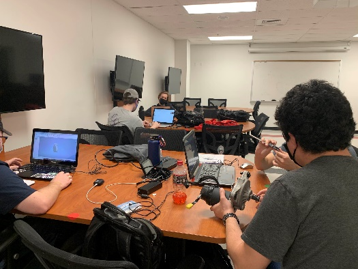
It's not something you notice until you're paying attention, but once you see it, it's hard to ignore. During my third year of undergrad as a Mechanical Engineering student, we were required to take Mechanics of Solids Lab with Dr. Brown (pseudonym). The lab groups were decided by alphabetizing the class by last name, then dividing it into 5 groups. Par for the course, I was the only girl in my group, but there were 4 others in my lab, and exactly one in each group. I chalked it up to coincidence until a senior broke the news: Dr. Brown places the girls to give each group a note-taker.
Investigating for myself, I lined up the last names of my classmates and divided us into 5 equal groups. Lo and behold, one group should have had only boys, and another should have had 2 girls. Like pawns on a chessboard, Dr. Brown had rearranged us.
Last year during my senior friend’s lab, her hands had been full when Dr. Brown asked her to write something down. She requested someone already holding their notebook and a pencil record the note, but he admitted that she had been placed in this group specifically to take notes because of her sex.
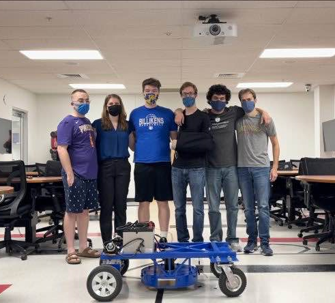
Despite its distance from basement labs and stress intensity factors, the stereotype is not easily escaped in industry. In a male-dominated room, it is too often assumed that the lone woman has the most legible handwriting and should therefore be the scribe — as if this is a biological trait instead of a learned skill.
For decades, the role of secretary and/or executive assistant has been a crucial role in every industry, requiring a sharp set of skills and specific training. (Not to mention, providing women with one of the earliest paths to a stable career and financial independence.) So when I say I am not your secretary, it’s not because I don’t understand the value of secretarial work, but simply because it is the truth. And neither my fellow women in STEM, nor secretaries deserve to have their work devalued that way.
Seen time and again, women on technical teams are expected to book the meeting rooms, handle the logistics, create the attendee list, badge in anyone from offsite, take notes, run the slides and distribute materials. Under the guise of appearing helpful and valuable, we may even do it to ourselves.
The Toolkit
To combat the stereotype and remind everyone (including yourself) of your skills, here's what I do:
Know your work scope
Figure out exactly what is and isn't in your job description, and be aware of people who may (consciously or not) try to assign you tasking based on your gender.
Have your language ready
Be prepared with some polite but firm phrases that redirect work not in line with your job. I use "I am actually not the point of contact you're looking for. Do you have an email or phone number for [executive assistant's name]?" One of my favorites is also "I'm happy to pass this along to our coordination expert. If you end up having questions or additions, here is his/her contact: [contact info]". In a note-taking situation, apply "Since I'll be focusing on my [subject, subject] contributions in this discussion, I won't be able to take notes. Could [colleague’s name] step in?". And if you're speaking to Dr. Brown and he tells you that a boy cannot possibly step in because you are here specifically to take notes on the men's discussions and discoveries, ask "Why, me? My handwriting is chicken scratch." He won't be able to come up with an acceptable answer and you get to leave class early.
Gently make your teammates aware
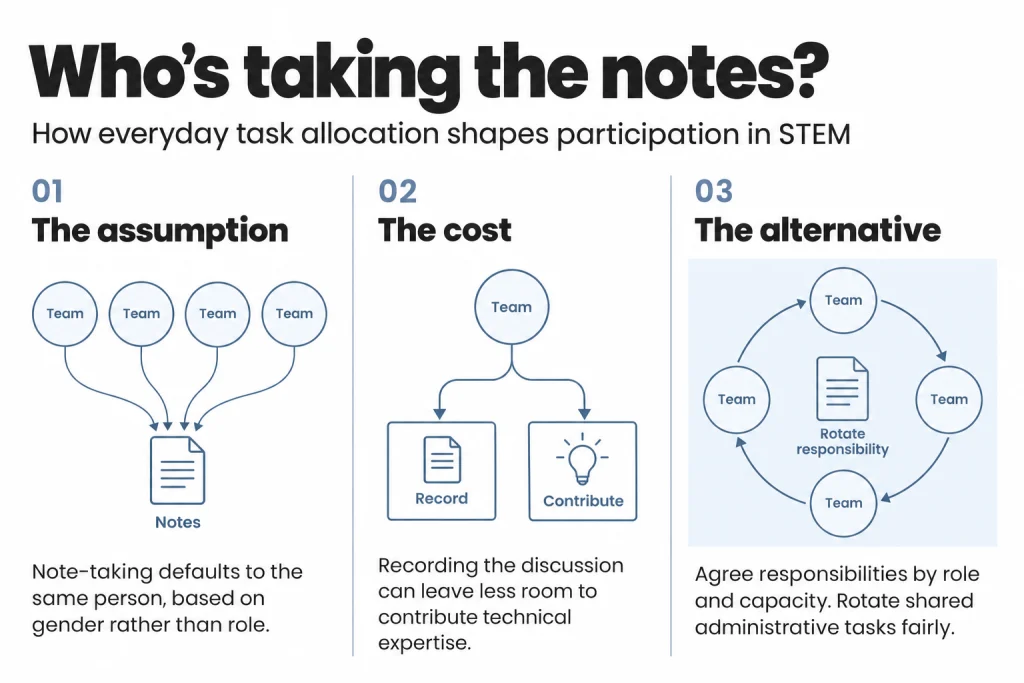
This is an unconscious dynamic that most men will never notice, unless you say something. If possible, in a team meeting suggest rotating who takes notes. If you think you'll be heard, have a conversation about how administrative tasking is split out, and how it prevents you from contributing fully. A tad intimidating, I know, but you took all the same classes they did and deserve the same caliber of experience.
The Conclusion
Administrative obligation is real for so many of us, but your value as a woman in STEM does not come from your handwriting. I will not take on tasks assigned to me purely by my gender, nor will I encroach on someone else's role and pretend I can perform it equally despite my lack of training. These are small but potent victories, which slowly assert us all as skilled individuals in industry and academia. Rising tides lift all boats, and the waves are coming in strong.