
Women make up only 24% of the UK STEM workforce according to the UK government data discussed in this review of women in STEM participation, with especially low representation in engineering and ICT (PMC summary). That number matters because the advancement of women isn’t a slogan. It shows up in who gets hired, who gets heard, who gets promoted, and who stays.
For a woman in STEM, what helps her succeed can look very practical. It can mean having the confidence to apply for a technical role you’re qualified for. It can mean being able to return after parental leave without losing momentum. It can mean having a manager who measures your output rather than your visibility in the office.
The phrase women's agency is often used so broadly that it starts to lose shape. In education and careers, I think of it this way: women's agency means having the power to choose, the tools to act, and the support to keep going when systems weren’t designed with you in mind.
That matters in science and technology because careers in these fields are cumulative. Skills build on skills. Opportunities build on earlier opportunities. One missed project, one stalled promotion, or one unsupported career break can affect the next five years.
Some of this begins early. If you’ve ever worked with girls in schools or universities, you’ll know how much student agency shapes confidence and ambition. When young people get meaningful ownership over learning, they’re more likely to see themselves as capable decision-makers, not just rule-followers. Kubrio’s piece on student agency is useful on that point because it connects autonomy with long-term development.
For readers who want a grounded starting point on the language itself, this guide to women in STEM meaning helps clarify why representation alone isn’t the full story.
What Empowerment of Women Really Means
Beyond confidence language
The advancement of women means more than encouragement. Encouragement matters, but it isn’t enough on its own.
A woman can be highly motivated and still face a biased hiring process. She can be talented and still be left out of stretch assignments. She can earn a STEM degree and still find that advancement slows when workplaces reward uninterrupted careers over real contribution.
That’s why the advancement of women has both a personal side and a structural side.
On the personal side, it includes things like:
- Decision-making power: choosing your specialism, employer, research path, or further study
- Economic independence: earning fairly and understanding how to negotiate pay
- Professional confidence: speaking up in technical discussions and claiming credit for your work
- Belonging: feeling that you don’t have to shrink, mask, or overprove yourself to stay in the room
On the structural side, it includes access to education, fair pay systems, visible pathways to leadership, and policies that support care responsibilities rather than treating them as a private inconvenience.
Why STEM changes the conversation
STEM careers sharpen the issue because they often rely on gatekeeping points. Exams, lab placements, coding tests, project allocations, publication opportunities, chartership pathways, and promotion panels all shape who moves forward.
If those gatekeeping points are fair, talent rises. If they aren’t, many women leave before they reach senior level.
Empowerment isn’t just feeling confident in a difficult room. It’s having a fair chance to shape what happens in that room.
For a software engineer, professional agency might mean access to high-value technical work rather than being pushed towards coordination tasks. For a researcher, it may mean principal investigator opportunities. For a civil engineer, it may mean being trusted on site, not just in support functions. For a student, it may mean seeing a credible route from classroom to career.
A practical definition
A workable definition is this: the strengthening of woman in STEM is the process of increasing her ability to learn, earn, lead, decide, and remain in the field on fair terms.
That definition is useful because it helps you ask better questions. Not “Are women being encouraged?” but “Are women gaining access to real authority, progression, and staying power?”
The Four Pillars of Empowerment in a STEM Context
A strong STEM career works like a four-legged table. If one leg is weak, stability goes with it. The same woman can be highly skilled and still lose ground if pay is unfair, training stalls, workplace norms punish her credibility, or policy leaves gaps around discrimination and care.
For women building careers in science, technology, engineering, and mathematics, these four pillars turn a broad social idea into something usable. They show what an individual can strengthen, what employers can change, and what policymakers must support.
Economic empowerment
Money shapes options early and often.
In STEM, economic strength means fair pay, stable work, access to funding, and enough financial room to keep building technical skill. That can include certification fees, conference travel, lab access, software tools, specialist courses, or time for research and portfolio work.
A useful way to read this in a STEM context is through compounding. Early access to better projects often leads to stronger evidence of ability. That evidence supports promotion, higher pay, and entry into more technical roles. If women are filtered out of those opportunities at the start, the gap widens over time.
Economic strength also affects decision-making. A woman with savings, fair pay, and access to growth opportunities can change teams, negotiate scope, or stay in the field during a difficult stretch without sacrificing her long-term trajectory.
Educational empowerment
Education in STEM is not a one-time event. It behaves more like software updates than a framed certificate.
That point matters because many women enter the field well qualified, then find that the gate is ongoing learning. Tools change. Standards shift. New methods become baseline expectations. If access to learning is uneven, careers split apart even when ability is similar.
Educational strength includes several layers:
- Foundational learning: maths, science, computing, and technical basics
- Specialist development: areas such as data analysis, biotech methods, software architecture, or systems engineering
- Career-stage learning: project delivery, commercial judgment, communication, and people management
- Re-entry learning: structured refreshers after a career break so skill gaps are addressed directly
This pillar matters for employers too. A company cannot say it supports women in STEM if the women on the team are given routine work while advanced training, stretch assignments, and new tools go elsewhere.
Socio-cultural empowerment
Culture decides whose expertise feels believable.
In STEM settings, socio-cultural strength means women can contribute, disagree, lead, and be technically ambitious without being reduced to stereotype. It shows up in ordinary moments. Who gets interrupted. Whose errors are treated as proof of weakness. Who is asked to organise the team lunch instead of present the design review.
These patterns look small, but their career effect is cumulative. Repeated doubt changes project allocation. Project allocation changes skill growth. Skill growth changes promotion odds.
A practical test helps here. If a workplace praises inclusion but still treats one familiar style of confidence as the default signal of competence, socio-cultural agency has not taken root.
Professional communities also matter. Mentors, peers, and visible role models help women interpret what is happening around them with accuracy. That reduces self-blame and supports better career choices. For readers interested in how representation connects to influence and advancement, this piece on leadership in STEM adds useful detail.

Political empowerment
Policy can feel far away from a lab bench or engineering stand-up. In practice, it shapes both.
Political strength means women can influence the rules that govern work, safety, pay, family life, education, and representation. In the UK, women gained partial voting rights through the Representation of the People Act 1918, with equal voting rights following in 1928. In Parliament, women now hold a much larger share of seats than they did in earlier decades, according to the UK Parliament research briefing on women in Parliament and government.
That progress matters in STEM because policy reaches daily working life. Anti-discrimination law, pay transparency rules, parental leave, childcare support, research funding priorities, visa systems, and public investment in technical education all affect whether women can enter, stay, and advance.
Seen together, the four pillars form a practical framework. Individuals can assess where their own support is strongest or weakest. Employers can audit systems instead of relying on slogans. Policymakers can connect broad equality goals to the mechanics of a STEM career.
The Global Imperative for Women in STEM
The case for women in STEM isn’t only moral. It’s practical. Countries need more scientific, technical, and engineering capability, and they can’t afford to sideline half the population.
Why this matters beyond one country
Across the world, governments, universities, and employers talk about innovation, productivity, resilience, health technology, climate adaptation, and digital infrastructure. None of those challenges are solved by a narrow slice of talent.
A global STEM workforce works better when it draws from the full range of ability available. That includes women across regions, income levels, backgrounds, and career stages.
Readers often ask whether this is mainly a Western workplace issue. It isn’t. The barriers differ by region, but the underlying question is global: who gets access to technical learning, paid work, authority, and recognition?
Three reasons the issue is urgent
Innovation needs wider perspectives
Science and engineering are not purely technical in the everyday sense. They involve choices about design, safety, usability, communication, ethics, and implementation.
Teams that include women are better positioned to notice blind spots in products, systems, and services because they include more lived experience. That doesn’t mean every woman thinks the same way. It means broadening participation reduces the chance that one narrow default becomes the standard for everyone.
In health tech, transport, AI, and energy systems, that matters.
Labour shortages won’t solve themselves
Many STEM sectors say they need more skilled workers. Yet women still face friction at entry, during progression, and after career breaks.
That creates a contradiction. Organisations say talent is scarce while overlooking capable people already trained for the work. The issue often isn’t supply alone. It’s whether institutions recognise, retain, and develop the talent they already have.
For readers wanting a broader picture of current patterns and why they matter, this collection of women STEM statistics 2025 offers a useful overview.
Public problems need public trust
A STEM workforce that reflects society is more likely to build public trust. That’s especially important in areas that affect daily life, such as medicine, digital identity, cybersecurity, climate technology, and infrastructure.
When women shape research and product decisions, more people can see themselves in the process. That doesn’t guarantee good outcomes, but it improves legitimacy and relevance.
What a global lens changes
A global view also stops us from using one narrow template for women's advancement.
In one country, the urgent issue may be girls’ access to advanced maths. In another, it may be safe transport to university. Somewhere else, it may be promotion criteria that penalise care responsibilities. In another place, women may have qualifications but not the networks that turn qualifications into senior appointments.
So the goal stays consistent, but the route changes.
- In education systems, women's progress may begin with access and aspiration.
- In early careers, it may centre on entry routes, technical credibility, and visibility.
- In mid-career, it often becomes a question of promotion, pay, and retention.
- For returners, it may depend on structured pathways back into technical work.
A global movement works best when it keeps one principle and many practical routes.
That’s why advancement of women in STEM should be treated as a shared international priority with local implementation. The language may be universal, but the strategy has to fit the context.
Global Barriers and the Leaky STEM Pipeline
Across the world, women enter STEM with ability, training, and ambition, yet many are pushed out at predictable points. The pipeline image works because it shows loss as a system problem. A well-built circuit can still fail if one connection is weak. Careers work in much the same way.
The first leaks happen early
Early barriers often look harmless on the surface. A girl may do well in maths or computing but receive praise for being organised, careful, or hardworking, while boys are praised for problem-solving or originality. Over time, those signals shape identity. Students start to sort themselves into roles long before any formal gate appears.
That matters because career momentum in STEM often builds cumulatively. One advanced class leads to another. One research placement leads to confidence. One confident application leads to a scholarship, internship, or lab role. If girls are steered away from the first stepping stone, the later options narrow.
University does not automatically fix this. Women may reach STEM degree programmes and still encounter subtle messages about who looks like a future engineer, founder, principal investigator, or technical lead. The issue is not only entry. It is belonging, recognition, and access to the experiences that carry weight later.
Professional life creates new pressure points
Workplaces add another layer of filtering. Hiring decisions, who gets assigned to high-stakes projects, whose technical judgment is trusted in meetings, how performance is evaluated, and who is sponsored for promotion all shape whether women stay and grow in STEM.
A broad social goal thus becomes a daily career question. If a talented engineer is repeatedly given support work instead of visible technical ownership, her CV changes. If a scientist is judged for assertiveness in ways a male peer is not, her promotion case changes. If a technologist returns from leave into a slower track, her earnings and influence change.
Readers who want a clearer map of those dropout patterns can explore attrition in STEM and the hidden exit points.

Why capable women still leave
Women often leave STEM for reasons that are structural, not personal. Skill is only one part of career survival. The environment also has to make progress possible.
Common pressure points include:
- Biased progression signals: women are treated as reliable contributors but are overlooked for leadership potential
- Unequal access to stretch work: promotion-driving assignments go to people who already fit the expected image of authority
- Care penalties: rigid schedules and career breaks reduce continuity, especially in fields that reward constant visibility
- Isolation: being one of very few women in a team can wear down confidence, voice, and long-term commitment
- Invisible labour: mentoring, note-taking, culture work, and emotional support help teams function but often do little for promotion
A short visual explainer can help teams and educators discuss these patterns more clearly.
Barriers aren’t identical everywhere
A global view matters here. The leak points are real across many countries, but they do not all appear in the same place or for the same reason.
In one setting, the main barrier may be safe access to higher education or social pressure about which technical fields are acceptable for women. In another, women enter STEM in strong numbers but stall at mid-career because promotion systems reward long hours, constant availability, or informal networks built outside work. In some regions, science may be more open than engineering. In others, women are present in junior roles yet largely absent from funding, patents, and decision-making positions.
That is why women’s advancement in STEM needs more than encouragement. It needs diagnosis. Good policy and good management work like fault-finding in a lab or debugging in software. You look for the exact point where progress breaks down, then fix that point with precision.
When women leave STEM, the better question is not whether they had enough grit. It is which part of the system made staying harder than it needed to be.
Actionable Strategies for Stakeholders in STEM
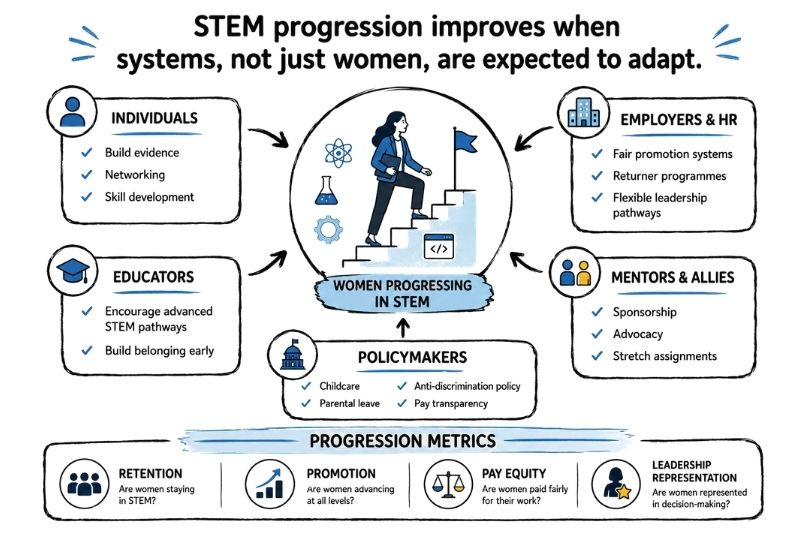
Women remain underrepresented at several decision points in STEM, yet the practical fixes are often more concrete than the problem sounds. In engineering terms, creating opportunities for women works less like a slogan and more like a system design task. You identify where progress stalls, then assign the right intervention to the right actor.
That matters because no single group can change outcomes alone. A woman can strengthen her evidence for promotion. A manager can redesign who gets stretch work. A policymaker can reduce the career penalty attached to caregiving. Progress accelerates when these actions line up.
For individuals
Career growth in STEM often depends on visible proof, not private effort. If your work is hard to see, it is harder to reward.
Build visible evidence of competence
Keep a running record of outputs and outcomes. Include project summaries, code contributions, publications, process improvements, presentations, patents, lab protocols, client results, or experiments that saved time or reduced error.
A simple structure helps:
- Problem: What needed to be solved
- Action: What you did
- Result: What changed
- Skill: What this shows you can do
This turns scattered work into promotion evidence. It also makes interviews, appraisals, grant applications, and pay discussions easier.
Treat networks as career infrastructure
Networks work like research equipment or computing access. You may not think about them every day, but they shape what becomes possible.
Useful contacts include peers in your specialty, people one level ahead, experts in adjacent fields, and senior colleagues who understand how hiring and promotion decisions are made. Ask precise questions. Offer useful information in return. Keep the relationship active before you need support.
Learn how progression actually works
Many women in STEM are told to work hard. Fewer are taught how advancement is judged.
Study the mechanics:
- Promotion criteria: what the organisation says it rewards
- Stretch work: which assignments lead to visibility and trust
- Decision forums: who discusses advancement behind closed doors
- Pay timing: when salary reviews happen and what evidence carries weight
This is one reason mentoring alone often falls short in STEM careers. Advice helps, but career momentum usually depends on access to information, opportunity, and advocacy.
For employers and HR teams
Employers shape the rules of the game. That gives them the strongest ability to convert broad commitments on women’s advancement into daily professional reality.
Design for fairness at each decision point
Bias in STEM organisations often enters through ordinary routines. Job descriptions ask for experience that is not required. Managers choose the same profiles for high-visibility projects. Performance reviews reward confidence in one group and call it aggression in another.
Audit the process step by step. Review who applies, who gets shortlisted, who receives technical leadership assignments, who gets rated as high potential, and who returns and stays after leave. This approach works like debugging software. You do not fix the whole system at once. You find the failure point and correct it.
Create real return pathways
Career breaks do not erase technical ability, but they can interrupt confidence, currency, and access. Good re-entry design closes that gap.
Research highlighted in the SCWREN summary points to the value of STEM-specific returners' programmes. For employers, the lesson is practical. A structured route back into technical work performs better than asking returning women to restart without support.
Strong return pathways usually include:
- Technical refreshers: updated tools, methods, software, or regulatory changes
- A named manager: one person accountable for role clarity and support
- Re-entry plans: realistic ramp-up periods for complex technical work
- Peer connection: a cohort or community reduces isolation
- Clear conversion: a direct path into permanent, meaningful roles
Make flexibility compatible with advancement
Flexible work should not function as a side track. If women can work flexibly only by giving up technical leadership, client ownership, or promotion prospects, the policy solves one problem while creating another.
The better model is simple. Keep high-value work, leadership opportunities, and promotion criteria open to flexible workers. Measure outcomes, not desk time.
For mentors and allies
Support changes careers when it changes access.
A mentor can explain how a field works. A sponsor goes further and uses influence to open doors. Women in STEM often receive encouragement without getting nominated for the assignments that build authority.
Useful ally actions include:
- Name strong work in decision-making meetings
- Recommend women for visible technical projects
- Interrupt bias when expertise is ignored or interrupted
- Share practical knowledge about pay, promotion, and organisational politics
- Resist shielding early-career women from demanding work that builds credibility
Morale matters. Access matters more.
For policymakers and educators
Policy and education shape the pipeline before recruitment begins and after hiring ends. That makes them central to any serious framework for women’s advancement in STEM.
Educators can widen participation by paying attention to who gets encouraged into advanced maths, computing, engineering, and lab-based study. They can also examine feedback patterns. Students often form their sense of belonging from repeated small signals about who is seen as naturally technical.
Policymakers can reduce structural friction through pay transparency rules, fair parental leave design, anti-discrimination enforcement, affordable childcare, scholarships, re-entry funding, and procurement standards that reward inclusive employers. These are not abstract ideals. They affect whether women enter STEM, remain in it, and reach positions where they can shape research, products, and policy in return.
Key strategies by stakeholder
| Stakeholder | Key strategy | Example action |
|---|---|---|
| Individuals | Build proof of value | Keep a documented portfolio of projects, outcomes, and technical skills |
| Employers and HR | Create structured re-entry routes | Launch a returners programme with technical refreshers and a clear path into permanent roles |
| Mentors and allies | Move from advice to advocacy | Recommend women for stretch assignments and promotion discussions |
| Policymakers | Reduce structural friction | Support rules and funding that improve pay transparency, parental support, and return-to-work access |
| Educators | Strengthen early belonging | Encourage girls and women into advanced technical pathways and visible project work |
How to Measure the Impact of Empowerment
McKinsey, UNESCO, and national labour datasets have made one pattern hard to ignore. Entry numbers can improve while advancement stalls. In STEM, that means a company may recruit more women, sponsor visible events, and still fail to change who gets promoted, paid well, and trusted with high-stakes technical work.
If you want a practical way to measure progress, use a pipeline analogy. Counting how many women enter STEM is like checking how much water reaches the top of a system. It matters, but it does not show where pressure drops, where flow slows, or where leaks keep senior roles out of reach. Good measurement looks at movement through the whole system.
Use advancement metrics, not just participation metrics
Participation tells you who is present. Advancement shows who is building career momentum.
A useful scorecard for STEM employers includes:
- Promotion rates by level: Do women move from junior to mid-level, and from mid-level to senior technical roles, at comparable rates?
- Representation in technical leadership: How many women lead engineering teams, principal research tracks, product architecture, or major grant-funded work?
- Pay gaps by function and seniority: Where are differences concentrated, and do they widen at promotion points?
- Return and retention after parental leave: Who comes back, who stays for 12 months or more, and who is shifted onto lower-growth work?
- Access to stretch assignments: Who gets patent-facing projects, client-facing technical leadership, field deployments, or budget ownership?
- Attrition by career stage: At what point do women leave fastest, and from which teams or functions?
The point is simple. A hiring gain means little if progression slows two years later.
This matters for individuals too. Early-career women in STEM often hear broad advice such as “build confidence” or “find a mentor.” Those can help, but measurement should stay tied to career outcomes. Track which skills you have added, which projects show measurable impact, who can speak credibly about your work, how your compensation changes, and whether your scope is increasing. The goal is evidence of advancement, not vague busyness.
Measure the quality of opportunity
Two women can hold the same job title and have very different futures.
One may maintain legacy systems with low visibility. Another may lead an AI deployment, present to executives, and manage a cross-functional build. The title matches. The opportunity does not. That is why serious measurement goes beyond headcount and asks who controls resources, who gets visible technical problems, and who is trusted in moments that shape a promotion case.
For organisations, useful questions include:
- Who speaks at internal technical reviews and external conferences?
- Who supervises researchers, interns, or junior engineers?
- Who manages budgets, roadmaps, or regulated product decisions?
- Who is named on high-value publications, patents, or major releases?
- Who gets sponsorship from senior leaders, not only mentoring?
That last distinction matters. Advice helps people improve. Sponsorship helps them advance. A fuller explanation appears in this piece on why mentoring alone does not fix progression gaps in STEM.
Check whether progress is felt as well as seen
Numbers show patterns. Experience explains them.
If women are promoted less often, pulse surveys, stay interviews, and exit interviews can help identify why. Are performance standards unclear? Are stretch assignments assigned informally? Do women receive more cautionary feedback and fewer growth signals? In STEM settings, small differences in access to technical credibility can compound over time, especially in research groups, product teams, and engineering organisations where reputation drives opportunity.
For policymakers and funders, the same principle applies at system level. Count participation, then examine progression into faculty roles, principal investigator positions, licensing activity, startup leadership, and public R&D decision-making. That is where broad equality goals meet daily professional life.
One question cuts through almost every glossy report.
Are women entering STEM, but not advancing within it?
Building a Future Where All Women Thrive in STEM
Women continue to enter STEM with strong ambition and proven ability, yet many still face slower progression than their peers. Closing that gap requires more than goodwill. It requires a system that develops talent, recognises contribution, rewards fairly, and keeps experienced women in the field.
A useful way to understand this is to compare STEM careers to an engineering pipeline. If pressure drops at several joints, the problem is rarely the source. The system needs better design. In practice, that means turning a broad idea into daily conditions women can use: clear advancement criteria, real access to high-value work, visible sponsorship, fair pay, re-entry routes after career breaks, and workplaces where technical credibility is not rationed.
That is why women’s progress needs to be practical. It means agency over career choices, access to opportunity, fair treatment in evaluation and pay, and influence over decisions that shape research, products, and institutions. The idea matters most when it changes what happens on the ground.
There is reason for confidence.
Organisations, educators, and funders now have a clearer view of where women are most often excluded and which interventions lead to better outcomes. Progress tends to be stronger when support is tied to career momentum, not offered as a side activity. A workshop can help someone learn. A well-designed system helps her progress.
For students and early-career professionals, that often means building a visible record of technical work, seeking sponsors as well as mentors, and joining networks that strengthen both skill and judgment. For managers, it means checking the moments where bias often surfaces: hiring, project allocation, performance reviews, promotion decisions, and return-to-work support. For policymakers and programme leaders, it means funding progression, retention, and re-entry with the same seriousness given to access.
Community still plays a central role. Career growth is often faster and more durable when women can find mentoring, practical skills support, peer connection, and inclusive job opportunities in one place. Building this kind of ecosystem, where support connects directly to opportunity, is the core mission of communities like The Women in STEM Network.
Learn what helps you advance. Build conditions that help others advance too. Then make those gains visible, repeatable, and difficult to undo.