
There is a common assumption that the further people progress in their careers, the more valuable their expertise becomes. Experience is rewarded. Knowledge commands respect. Technical excellence opens doors to promotion and greater responsibility. In science, technology, engineering and mathematics (STEM), these qualities are rightly celebrated because they underpin innovation, discovery and progress.
Yet there comes a point in almost every leadership journey when expertise alone is no longer enough.
The challenges facing organisations today are fundamentally different from those many leaders encountered even a decade ago. Decisions are made against a backdrop of rapid technological change, increasingly complex stakeholder relationships, global teams, artificial intelligence, hybrid working and constant uncertainty. Problems rarely have a single correct answer, and many require collaboration across disciplines where no one individual possesses all the knowledge needed to succeed.
Ironically, the very expertise that helped someone become successful can begin to work against them. Leaders who have spent years becoming recognised experts often feel pressure to have the answers. They become known as the person who solves problems, resolves disputes and makes decisions quickly. While these qualities remain important, they can unintentionally reduce the space for exploration, creativity and learning.
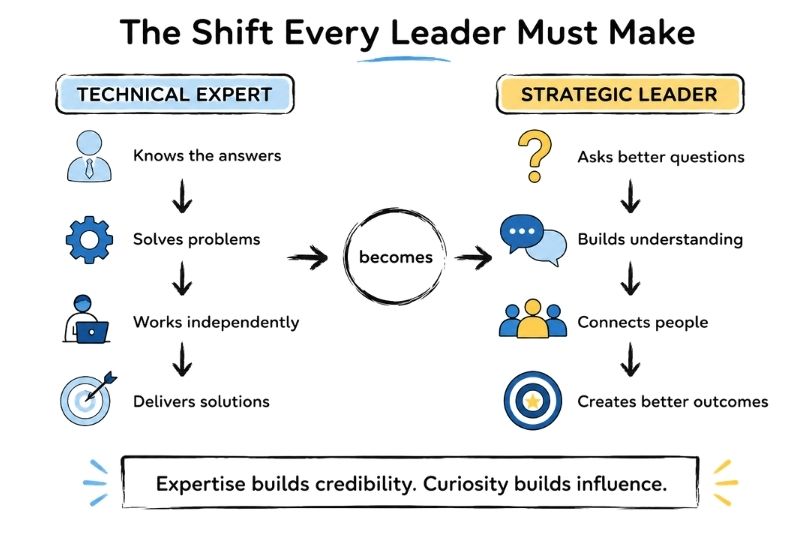
This is where strategic curiosity becomes one of the most powerful yet underrated leadership capabilities.
Curiosity is often misunderstood as a personality trait or an attribute associated with childhood. We picture curious people asking endless questions or enthusiastically exploring new ideas. In reality, strategic curiosity is something much more intentional. It is the deliberate decision to seek understanding before judgement, to remain open to possibilities before settling on conclusions and to recognise that the first explanation is not always the best one.
In an era where many organisations prize speed above all else, choosing to pause and become curious can feel counterintuitive. Yet some of the world's most effective leaders do exactly that. They recognise that slowing down at the right moment often leads to faster progress later because better questions produce better decisions.
The leadership paradox
Most professionals are promoted because they excel at doing the job in front of them. An engineer is recognised for solving technical problems. A scientist earns credibility through rigorous research. A software developer becomes known for delivering reliable solutions. Over time, these accomplishments lead to greater responsibility, larger teams and increasingly strategic roles.
The paradox is that the skills that secure promotion are not always the same skills that make someone an exceptional leader.
As responsibilities grow, leaders spend less time completing technical work themselves and more time enabling others to succeed. They influence stakeholders, build partnerships, navigate competing priorities and make decisions that affect entire organisations rather than individual projects.
Success therefore depends less on having every answer and more on creating an environment where the best answers can emerge.
This transition can be uncomfortable, particularly in STEM where professional identity is often closely tied to expertise. Many leaders worry that asking too many questions might make them appear uncertain or less competent. In reality, thoughtful questions often demonstrate confidence rather than undermine it. They show a willingness to explore complexity instead of relying solely on familiar solutions.
Some of the most respected leaders are not those who dominate conversations with answers, but those who ask questions that help everyone else think more clearly.
Why expertise can become a blind spot
Expertise is invaluable, but it also shapes how we see the world.
Psychologists have long recognised that experience influences perception. As we become more knowledgeable in a particular area, we naturally begin to recognise familiar patterns. This ability allows experts to make rapid decisions and solve problems efficiently. In many situations, this is a tremendous advantage.
However, pattern recognition has a hidden cost.
The brain becomes increasingly efficient at filtering information that appears irrelevant. We unconsciously look for evidence that supports our existing understanding while overlooking signals that challenge it. This phenomenon, known as confirmation bias, affects everyone regardless of intelligence or experience.
Leadership researchers have repeatedly shown that overconfidence and untested assumptions contribute to poor organisational decisions. History is full of examples of highly experienced teams overlooking disruptive technologies, underestimating competitors or failing to recognise changing customer expectations because they assumed the future would resemble the past.
Strategic curiosity acts as an antidote to these biases.
Curious leaders deliberately question their own assumptions. They actively seek different viewpoints, encourage constructive disagreement and remain willing to revise their thinking when presented with new evidence. Rather than treating uncertainty as a weakness, they recognise it as an invitation to learn.
This mindset becomes increasingly valuable as organisations face challenges that have no established playbook.
Curiosity is a competitive advantage
Many of the world's most innovative organisations have one characteristic in common: they encourage curiosity at every level.
Innovation rarely begins with certainty. It begins with someone asking why something is done a particular way, whether a process could be improved or if an entirely different approach might produce better results.
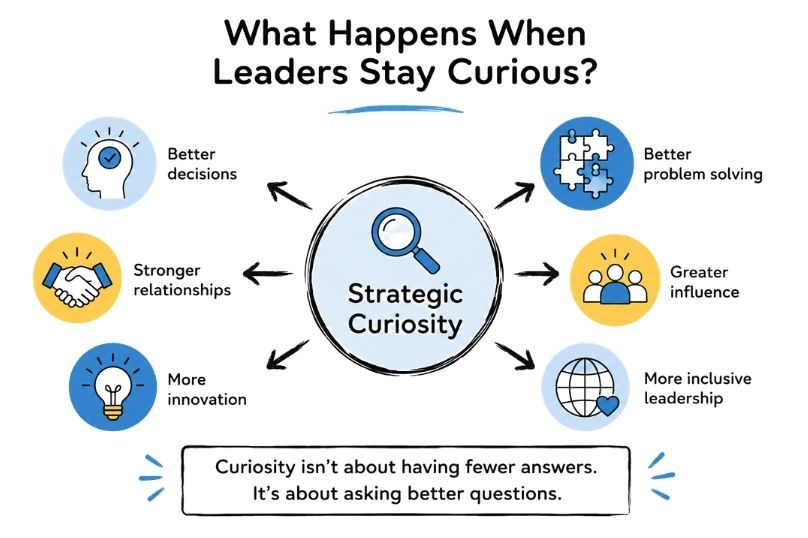
Scientific discovery itself is built upon curiosity. Every experiment begins with a question. Every breakthrough starts with a willingness to challenge accepted thinking. Engineering advances emerge because someone believes there may be a more effective solution. Technology evolves because developers continue asking what could be possible rather than accepting existing limitations.
Leadership is no different.
Organisations that consistently innovate tend to be led by people who remain intellectually curious even after decades of experience. They understand that expertise provides a foundation, but curiosity keeps that expertise relevant.
This distinction is becoming increasingly important as artificial intelligence transforms the workplace. AI can analyse enormous quantities of data, automate routine tasks and generate remarkably sophisticated outputs. What it cannot easily replicate is the uniquely human ability to ask insightful questions, interpret context, understand emotions and explore possibilities that have not yet been imagined.
As technical knowledge becomes more widely accessible, the ability to think differently may become one of the defining characteristics of outstanding leadership.
Influence begins with understanding
One of the greatest misconceptions about leadership is that influence comes from authority.
Formal authority undoubtedly carries weight, but anyone who has worked within a complex organisation knows that job titles alone rarely determine outcomes. Projects succeed because people collaborate, trust one another and commit to shared objectives. This requires influence that extends beyond organisational charts.
Curiosity plays a central role in developing that influence.
When leaders approach conversations with genuine interest rather than predetermined conclusions, they create an environment where others feel heard. Colleagues become more willing to share concerns, contribute ideas and discuss risks that might otherwise remain hidden.
This does not mean leaders avoid making decisions. Rather, they make better-informed decisions because they have taken the time to understand the perspectives of those around them.
Imagine two project leaders facing resistance from a multidisciplinary team.
The first immediately explains why the proposed approach is correct, presenting data, technical evidence and logical arguments. While the information may be accurate, team members can quickly become defensive if they feel their concerns are being dismissed.
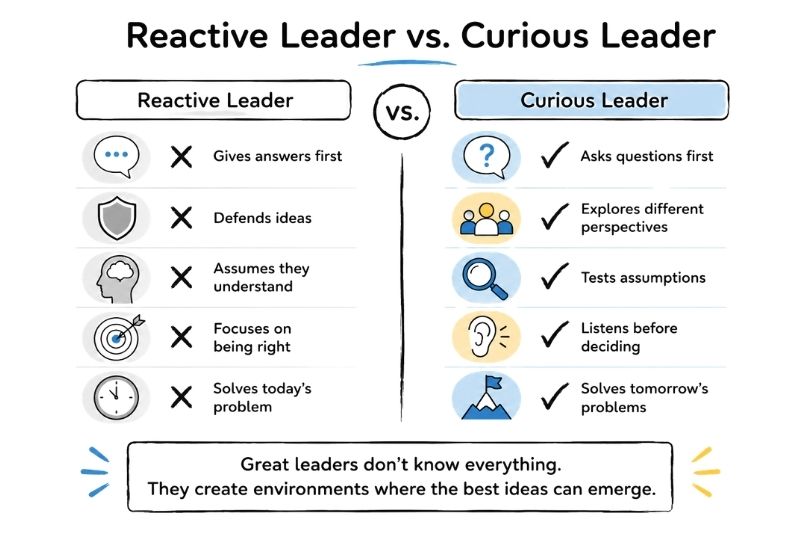
The second leader begins differently. They ask what concerns people most about the proposal. They invite alternative viewpoints and encourage discussion before presenting their own recommendations. By demonstrating curiosity first, they build trust before seeking agreement.
The technical solution may ultimately remain the same, but the quality of engagement is often dramatically different.
Influence is rarely about winning arguments. More often, it is about creating enough trust for people to move forward together.
Curiosity strengthens psychological safety
The highest-performing teams are not necessarily those with the greatest concentration of talent. Increasingly, research suggests that team performance depends heavily on whether individuals feel safe to contribute ideas, challenge assumptions and admit uncertainty without fear of embarrassment or blame.
This concept, known as psychological safety, has become one of the most extensively studied aspects of effective teamwork.
Curiosity helps create exactly this environment.
When leaders ask questions instead of making immediate judgements, they signal that different perspectives are welcome. When mistakes are explored with curiosity rather than criticism, people become more willing to discuss problems before they escalate. When uncertainty is treated as an opportunity to learn rather than a failure to know, innovation flourishes.
These behaviours are particularly important within STEM organisations, where complex projects often depend on specialists from multiple disciplines working together. Engineers, scientists, clinicians, software developers and data analysts may each view the same challenge through different professional lenses. Genuine curiosity enables these perspectives to complement rather than compete with one another.
Leaders who cultivate curiosity therefore do more than improve their own decision-making. They create cultures where learning becomes continuous, collaboration becomes stronger and innovation becomes more sustainable.
Why curiosity becomes more difficult as careers progress
If curiosity is so valuable, why do many leaders become less curious as they become more experienced?
The answer lies partly in the way successful careers are built. Experience creates confidence, and confidence enables faster decision-making. Over time, professionals develop mental shortcuts based on years of accumulated knowledge. These shortcuts are incredibly efficient and allow experts to recognise patterns that less experienced colleagues might miss. In many situations, this instinctive thinking is entirely appropriate.
The difficulty arises when leaders begin to assume that every challenge resembles one they have encountered before. Complex organisational issues often involve changing technologies, shifting markets, diverse stakeholders and evolving expectations. A solution that worked five years ago may no longer be the best approach today. The greater someone's expertise, the easier it becomes to overlook subtle changes that alter the nature of the problem.
Senior leaders also face relentless pressure on their time. Calendars become crowded with meetings, strategic decisions and competing priorities. Reflection can feel like a luxury rather than a necessity. Yet the most effective leaders deliberately create space to think. They recognise that constantly reacting to immediate demands rarely produces the highest quality decisions. Strategic curiosity requires moments of pause—time to consider alternative explanations, question assumptions and explore possibilities before taking action.
This ability to step back should not be mistaken for indecision. On the contrary, it often enables leaders to move forward with greater confidence because their decisions are grounded in deeper understanding rather than instinct alone.
From reactive leadership to reflective leadership
Many leadership challenges arise not because people lack technical ability, but because they react before they fully understand what is happening. Under pressure, it is natural to defend our ideas, justify our decisions or search immediately for solutions. Unfortunately, these reactions can narrow our thinking at precisely the moment when broader perspectives are needed.
Strategic curiosity offers a different approach.
Reflective leaders learn to notice when they are becoming reactive. Instead of immediately responding, they create a brief pause. That pause may last only a few seconds, but it provides an opportunity to ask a different question. Rather than asking, "How do I solve this?" they begin by asking, "What might I be missing?" or "What is driving this situation?"
These questions change the conversation. They encourage exploration rather than defence and often reveal information that would otherwise remain hidden. Team members who initially appeared resistant may simply have concerns that have not yet been addressed. Stakeholders who seem disengaged may be balancing competing priorities. Problems that appear technical may actually stem from communication or organisational culture.
The shift from reacting to reflecting is one of the defining characteristics of mature leadership.
Practical ways to develop strategic curiosity
Like any leadership capability, curiosity becomes stronger through consistent practice rather than occasional inspiration. The good news is that it does not require dramatic changes in behaviour. Small adjustments in everyday interactions can have a profound cumulative effect.
One of the simplest habits is to replace assumptions with questions. Before concluding that a colleague is resistant to change, ask what concerns they have. Before assuming a project has failed because of poor performance, explore the wider context. Before dismissing an unfamiliar idea, ask what problem it is trying to solve.
Another valuable practice is to seek perspectives beyond your immediate area of expertise. STEM organisations increasingly depend on multidisciplinary collaboration, yet professionals often spend most of their time interacting with people who think in similar ways. Deliberately engaging colleagues from different disciplines broadens understanding and frequently reveals opportunities that would otherwise remain invisible.
Curiosity also requires humility. The strongest leaders are comfortable acknowledging that they do not know everything. Rather than diminishing credibility, this openness often increases trust because it demonstrates confidence without arrogance. Teams are more likely to contribute ideas when leaders genuinely welcome learning from others.
Reflection is equally important. After significant meetings or projects, ask yourself which assumptions proved correct, which proved inaccurate and what you learned from the experience. Over time, this habit develops greater self-awareness and strengthens decision-making.
Curiosity beyond the workplace
Although strategic curiosity is often discussed in the context of leadership, its value extends far beyond organisational life. Curiosity strengthens relationships by encouraging genuine listening rather than simply waiting for an opportunity to respond. It improves collaboration because people feel understood rather than judged. It supports inclusion by recognising that different experiences lead to different perspectives.
In increasingly diverse workplaces, these qualities are essential. Scientific and technological innovation depends on bringing together people with different backgrounds, disciplines and ways of thinking. Curiosity enables those differences to become strengths rather than sources of conflict.
The same principle applies outside work. Whether supporting colleagues, mentoring junior professionals or navigating everyday conversations, curiosity encourages empathy. Instead of assuming we understand someone else's motivations, we become interested in discovering them. That shift often transforms relationships in ways that expertise alone never could.
The future belongs to leaders who continue learning
The workplace is changing more rapidly than at any point in recent history. Artificial intelligence, automation, global collaboration and accelerating technological advances are reshaping how organisations operate and the skills they require. Technical knowledge will always matter, but knowledge alone is becoming less of a differentiator.
What increasingly distinguishes exceptional leaders is their willingness to continue learning long after they have become experts.
Curious leaders are more adaptable because they recognise change earlier. They build stronger relationships because they seek understanding before judgement. They encourage innovation because they create environments where questions are welcomed rather than discouraged. Most importantly, they recognise that leadership is not about demonstrating how much they know; it is about helping others discover what is possible.
Perhaps this is the greatest lesson of strategic curiosity. The most effective leaders never stop asking questions. Not because they lack expertise, but because they understand that expertise grows stronger when combined with openness, humility and a genuine desire to keep learning.
In a world where certainty is increasingly rare, curiosity may be one of the most valuable leadership capabilities any of us can develop.
Further Learning
The ideas explored in this article were discussed in greater depth during a recent Women in STEM Network webinar, How Strategic Curiosity Helps Build Influence, presented by Jill Fahlgren.
The session explored how curiosity can strengthen leadership effectiveness, build influence without authority, help leaders navigate resistance and improve decision-making in high-pressure situations. Attendees also learned a practical framework for moving from reactive problem-solving to intentional curiosity, together with a simple micro-practice that can be applied immediately in everyday leadership situations.
About the speaker
Why curiosity becomes more difficult as careers progress
If curiosity is so valuable, why do many leaders become less curious as they become more experienced?
The answer lies partly in the way successful careers are built. Experience creates confidence, and confidence enables faster decision-making. Over time, professionals develop mental shortcuts based on years of accumulated knowledge. These shortcuts are incredibly efficient and allow experts to recognise patterns that less experienced colleagues might miss. In many situations, this instinctive thinking is entirely appropriate.
The difficulty arises when leaders begin to assume that every challenge resembles one they have encountered before. Complex organisational issues often involve changing technologies, shifting markets, diverse stakeholders and evolving expectations. A solution that worked five years ago may no longer be the best approach today. The greater someone's expertise, the easier it becomes to overlook subtle changes that alter the nature of the problem.
Senior leaders also face relentless pressure on their time. Calendars become crowded with meetings, strategic decisions and competing priorities. Reflection can feel like a luxury rather than a necessity. Yet the most effective leaders deliberately create space to think. They recognise that constantly reacting to immediate demands rarely produces the highest quality decisions. Strategic curiosity requires moments of pause—time to consider alternative explanations, question assumptions and explore possibilities before taking action.
This ability to step back should not be mistaken for indecision. On the contrary, it often enables leaders to move forward with greater confidence because their decisions are grounded in deeper understanding rather than instinct alone.
From reactive leadership to reflective leadership
Many leadership challenges arise not because people lack technical ability, but because they react before they fully understand what is happening. Under pressure, it is natural to defend our ideas, justify our decisions or search immediately for solutions. Unfortunately, these reactions can narrow our thinking at precisely the moment when broader perspectives are needed.
Strategic curiosity offers a different approach.
Reflective leaders learn to notice when they are becoming reactive. Instead of immediately responding, they create a brief pause. That pause may last only a few seconds, but it provides an opportunity to ask a different question. Rather than asking, "How do I solve this?" they begin by asking, "What might I be missing?" or "What is driving this situation?"
These questions change the conversation. They encourage exploration rather than defence and often reveal information that would otherwise remain hidden. Team members who initially appeared resistant may simply have concerns that have not yet been addressed. Stakeholders who seem disengaged may be balancing competing priorities. Problems that appear technical may actually stem from communication or organisational culture.
The shift from reacting to reflecting is one of the defining characteristics of mature leadership.
Practical ways to develop strategic curiosity
Like any leadership capability, curiosity becomes stronger through consistent practice rather than occasional inspiration. The good news is that it does not require dramatic changes in behaviour. Small adjustments in everyday interactions can have a profound cumulative effect.
One of the simplest habits is to replace assumptions with questions. Before concluding that a colleague is resistant to change, ask what concerns they have. Before assuming a project has failed because of poor performance, explore the wider context. Before dismissing an unfamiliar idea, ask what problem it is trying to solve.
Another valuable practice is to seek perspectives beyond your immediate area of expertise. STEM organisations increasingly depend on multidisciplinary collaboration, yet professionals often spend most of their time interacting with people who think in similar ways. Deliberately engaging colleagues from different disciplines broadens understanding and frequently reveals opportunities that would otherwise remain invisible.
Curiosity also requires humility. The strongest leaders are comfortable acknowledging that they do not know everything. Rather than diminishing credibility, this openness often increases trust because it demonstrates confidence without arrogance. Teams are more likely to contribute ideas when leaders genuinely welcome learning from others.
Reflection is equally important. After significant meetings or projects, ask yourself which assumptions proved correct, which proved inaccurate and what you learned from the experience. Over time, this habit develops greater self-awareness and strengthens decision-making.
Curiosity beyond the workplace
Although strategic curiosity is often discussed in the context of leadership, its value extends far beyond organisational life. Curiosity strengthens relationships by encouraging genuine listening rather than simply waiting for an opportunity to respond. It improves collaboration because people feel understood rather than judged. It supports inclusion by recognising that different experiences lead to different perspectives.
In increasingly diverse workplaces, these qualities are essential. Scientific and technological innovation depends on bringing together people with different backgrounds, disciplines and ways of thinking. Curiosity enables those differences to become strengths rather than sources of conflict.
The same principle applies outside work. Whether supporting colleagues, mentoring junior professionals or navigating everyday conversations, curiosity encourages empathy. Instead of assuming we understand someone else's motivations, we become interested in discovering them. That shift often transforms relationships in ways that expertise alone never could.
The future belongs to leaders who continue learning
The workplace is changing more rapidly than at any point in recent history. Artificial intelligence, automation, global collaboration and accelerating technological advances are reshaping how organisations operate and the skills they require. Technical knowledge will always matter, but knowledge alone is becoming less of a differentiator.
What increasingly distinguishes exceptional leaders is their willingness to continue learning long after they have become experts.
Curious leaders are more adaptable because they recognise change earlier. They build stronger relationships because they seek understanding before judgement. They encourage innovation because they create environments where questions are welcomed rather than discouraged. Most importantly, they recognise that leadership is not about demonstrating how much they know; it is about helping others discover what is possible.
Perhaps this is the greatest lesson of strategic curiosity. The most effective leaders never stop asking questions. Not because they lack expertise, but because they understand that expertise grows stronger when combined with openness, humility and a genuine desire to keep learning.
In a world where certainty is increasingly rare, curiosity may be one of the most valuable leadership capabilities any of us can develop.
Further Learning
The ideas explored in this article were discussed in greater depth during a recent Women in STEM Network webinar, How Strategic Curiosity Helps Build Influence, presented by Jill Fahlgren.
The session explored how curiosity can strengthen leadership effectiveness, build influence without authority, help leaders navigate resistance and improve decision-making in high-pressure situations. Attendees also learned a practical framework for moving from reactive problem-solving to intentional curiosity, together with a simple micro-practice that can be applied immediately in everyday leadership situations.
About the speaker
Jill Fahlgren is an Executive Coach and founder of The Possible Life, Inc. She partners with experienced leaders and executives navigating increasingly complex organisational challenges, helping them move beyond technical expertise to lead with greater confidence, strategic perspective and influence.
Her STEM background includes leadership roles at Accenture, technology start-ups and a non-profit organisation supporting medical research benefiting U.S. veterans. Jill holds a BA in Mathematical Methods in the Social Sciences from Northwestern University, an MBA from the Kellogg School of Management and is certified by the Hudson Institute of Coaching.
Jill specialises in leadership development, team effectiveness and strategic career management, coaching executives and senior leaders across technology, professional services and manufacturing. Central to her approach is helping leaders pause, step back from immediate pressures and become curious about what they may be missing, unlocking clearer thinking and more effective leadership.
Connect with Jill:
- LinkedIn: https://www.linkedin.com/in/jillfahlgren/
- Website: https://thepossiblelife.com/
Watch the webinar on demand
Women in STEM Network members can watch the full webinar, How Strategic Curiosity Helps Build Influence, exclusively in our growing on-demand workshop library.
Explore the library here: https://womeninstemnetwork.com/on-demand-workshops-for-women/