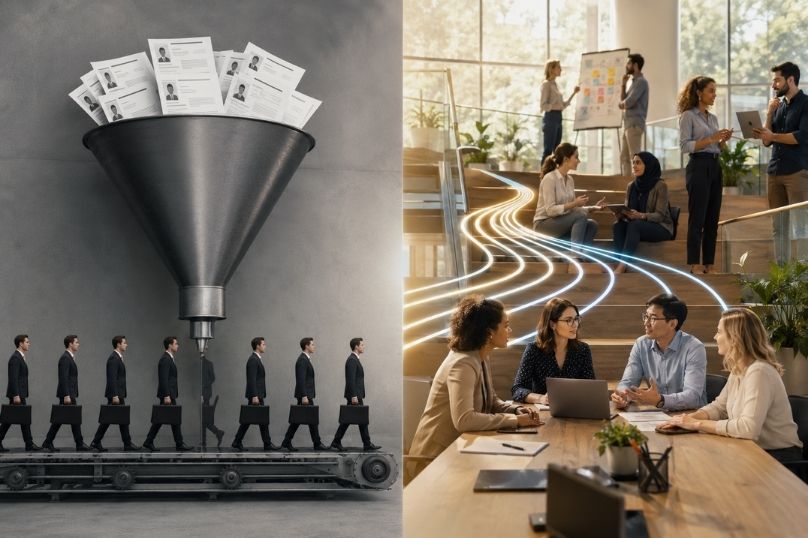
There is one word that appears in almost every conversation about women in STEM: resilience. Women are encouraged to become more resilient, more confident, more assertive, better negotiators and stronger leaders. Universities run resilience workshops. Employers offer resilience training. Mentors encourage women to persevere through setbacks and develop the mental toughness needed to succeed.
None of this advice is wrong. Resilience is undoubtedly valuable. Every successful scientist, engineer, technologist and mathematician will encounter rejection, failure and uncertainty at some point in their career. But the more we talk about resilience, the more I find myself asking a different question.
Are we trying to solve the wrong problem?
Imagine an engineer designing a bridge that repeatedly developed structural cracks under normal operating conditions. No competent engineer would conclude that the vehicles crossing it simply needed to become more resilient. The obvious response would be to redesign the bridge. But this is remarkably similar to how we often approach careers in STEM.
When talented women leave research, engineering, academia or technology, we frequently ask what they could have done differently. Should they have negotiated harder? Built more confidence? Managed their time better? Become more resilient? These are reasonable questions, but they overlook something more fundamental. Careers, like engineering systems, exist within environments. If enough highly capable people struggle within those environments, perhaps the issue is not simply individual capability. Perhaps it is system design.

For decades, success in STEM has largely been measured by acceleration. Publish more papers. Win more grants. Deliver larger projects. Lead bigger teams. Accept greater responsibility. Be permanently available. Keep moving. Acceleration undoubtedly drives innovation. But acceleration without sustainability eventually leads to failure. Every engineer understands this. Every ecologist understands it. Every systems scientist understands it. Curiously, we often forget it when discussing careers.
Perhaps it is time we stopped asking how women can survive STEM and started asking how STEM careers can become sustainable in the first place.
We've Been Trying to Fix the Wrong Problem
Much of the advice given to women in STEM focuses on improving the individual rather than improving the environment around them. Build confidence. Develop leadership skills. Learn to negotiate. Speak up more often. Network more effectively. These are important skills, and everyone benefits from developing them. However, if the same barriers continue to exist regardless of how much individuals adapt, then resilience alone will never solve the underlying issue.
We would never expect a laboratory instrument that repeatedly failed under standard operating conditions to be accepted as "good enough." We would investigate the design, identify the failure points and improve the system. But careers are treated differently.
If a workplace consistently loses experienced professionals because workloads are unsustainable, progression pathways are unclear or flexibility is absent, that is not simply an individual problem. It is evidence that something within the system deserves closer examination. The question should therefore shift from "How do we help women cope?" to "How do we build careers that people can realistically sustain over thirty or forty years?" That change in perspective is subtle, but it fundamentally alters where responsibility lies.
Sustainable Careers Are Designed, Not Endured
One of the greatest strengths of STEM is its reliance on evidence-based design. Scientists test hypotheses. Engineers optimise systems. Technologists improve performance through continuous refinement. We rarely apply the same thinking to careers. A sustainable career is not one that demands less ambition. It is one that allows ambition to continue over decades without exhausting the person pursuing it.
There will always be periods that require extraordinary effort. Completing a PhD, preparing a major grant application, leading an international project or launching a new company inevitably demands commitment beyond the ordinary. The problem arises when exceptional working practices become permanent expectations.
No biological system can continuously consume more energy than it replaces. No ecosystem can remain healthy if resources are depleted faster than they recover. Human beings are no different. Careers should therefore be designed with sustainability in mind from the outset. That means recognising that professional success depends not only on technical expertise but also on recovery, adaptability, supportive leadership and realistic expectations. The most successful careers are rarely those built on relentless intensity. They are built on consistency.

STEM Already Knows How to Build Better Systems
Perhaps the greatest irony is that STEM already possesses the tools needed to solve this challenge. Systems thinking teaches us that outcomes are rarely determined by one component in isolation. Every part of a system influences every other part. When engineers improve one section of a process, they also consider how that change affects reliability, efficiency, safety and long-term performance. They understand that optimising one element while ignoring the rest often creates new problems elsewhere. Careers work in exactly the same way.
Professional development is influenced by technical skills, organisational culture, mentoring, wellbeing, leadership, financial security, flexibility, family responsibilities and opportunity. None of these factors exists independently. Two scientists with identical qualifications may experience entirely different careers because the systems surrounding them differ. One benefits from supportive leadership, protected research time and collaborative colleagues. Another spends most of the week dealing with fragmented workloads, excessive administration and unrealistic expectations.
Talent matters.
But systems determine whether talent can flourish.
Why Goals Matter Less Than Career Systems
Most career advice focuses on goals.
Become a professor.
Gain chartership.
Lead a department.
Start a company.
Publish more papers.
Goals are important because they provide direction. However, they do not determine what happens every day. Systems do.
- A researcher who protects two hours every morning for deep thinking is following a system.
- An engineer who schedules time each month to learn emerging technologies is following a system.
- A leader who consistently mentors junior colleagues is following a system.
Small systems repeated over years often have a greater influence on career success than ambitious goals pursued inconsistently. The same principle applies to organisations. Inclusive cultures are not created through mission statements. They emerge through consistent recruitment practices, transparent promotion processes, effective mentoring and leaders who genuinely value diverse perspectives.
Systems shape behaviour far more effectively than slogans ever will.
Curiosity Is More Valuable Than Certainty
The pace of change across STEM is extraordinary. Artificial intelligence is transforming research. Biotechnology continues to evolve rapidly. Climate science influences engineering decisions. Healthcare increasingly relies on data science. Entire disciplines now overlap in ways that were unimaginable a generation ago. Technical expertise remains essential, but expertise alone is no longer enough.
The professionals who continue to thrive over long careers share another characteristic. They remain curious. They continue asking questions long after becoming experts. They read beyond their own discipline. They challenge assumptions, seek different viewpoints and remain open to learning.
Curiosity keeps careers adaptable. Confidence is valuable, but confidence without curiosity risks becoming complacency. Sustainable careers are built by professionals who never stop learning because they recognise that education does not end with a qualification.
It simply changes form.
The Best Careers Protect Capacity, Not Just Time
Most professionals manage their calendars, far fewer manage their capacity. These are not the same thing.
A diary may appear perfectly organised while the person following it becomes progressively exhausted. Meetings require concentration. Decision-making consumes mental energy. Constant interruptions reduce creativity. Emotional labour, particularly for leaders, often goes unnoticed despite demanding considerable cognitive effort. High performance depends on more than available hours. It depends on available energy.
Sleep, exercise, recovery and psychological wellbeing are often discussed as personal matters rather than professional assets, but every study of human performance demonstrates that creativity, judgement and decision-making decline when people operate under prolonged stress.
Scientists trust data. Perhaps we should pay closer attention to the data our own minds and bodies provide.
Burnout is not usually the result of one difficult week, it is the cumulative outcome of systems that continually demand more than they return.
Organisations Have a Responsibility Too
It is tempting to frame career sustainability as an individual responsibility, but organisations have an equally important role to play.
Retaining experienced professionals is not simply a wellbeing initiative. It is good business.
Replacing skilled employees is expensive. Institutional knowledge disappears when experienced staff leave. Innovation slows when diverse perspectives are lost.
Flexible working, transparent promotion criteria, inclusive leadership, mentoring programmes and psychologically safe cultures are often described as employee benefits. They are much more than that. They are investments in organisational capability.
The most forward-thinking employers increasingly understand that supporting sustainable careers improves productivity, strengthens innovation and enhances long-term performance. Creating environments where talented people can contribute throughout different stages of life should not be viewed as a concession. It should be viewed as intelligent system design.
The Future of STEM Depends on Smarter Career Systems
For many years we have invested significant effort in helping women adapt to existing career structures. We have created leadership programmes, mentoring initiatives, networking events and resilience workshops. These have delivered enormous value, and they should continue, but they should not be the end of the conversation.
The next step is more ambitious. What would happen if we designed careers with the same rigour that we design scientific experiments, engineering systems or technological platforms? What if sustainability became a design principle rather than an individual responsibility? What if success were measured not only by how quickly people progressed but also by how many talented professionals remained able to contribute twenty or thirty years later?
These are not simply questions about women, they are questions about the future of STEM itself.
Every breakthrough in science, engineering and technology depends upon people whose creativity, expertise and experience develop over many years. If those people continue leaving because the systems surrounding their careers are unsustainable, then the entire STEM community loses.
Perhaps the conversation has never really been about resilience. Perhaps it has always been about design and the encouraging thing about design is that it can always be improved.