
Leadership for women in STEM isn't about climbing a traditional, hierarchical ladder. Instead, it's a cultivated ability to influence, innovate, and inspire action within highly technical and scientific fields.
This kind of leadership isn’t defined by a job title. It's about a specific set of skills—like strategic thinking, collaborative problem-solving, and authentic communication—that drive real progress, whether you're an intern or a director. It’s also about recognising and navigating the unique landscape women in STEM face every day.
Defining Modern Leadership for Women in STEM
When we picture a 'leader', the image that often comes to mind is one of top-down, authoritative command. But for women in Science, Technology, Engineering, and Mathematics (STEM), effective leadership looks quite different. It’s far more nuanced and deeply collaborative.
It’s about steering complex projects to completion, mentoring up-and-coming talent, and championing bold new ideas from within a team—often without any official authority to do so.
In this context, modern leadership is about making an impact, not just holding a position. It's the practical skill of seeing a need, crafting a solution, and bringing others along to achieve a common goal. This might look like a junior engineer proposing a workflow that saves her team hours, or a senior researcher fostering a lab culture where everyone feels safe to ask tough questions.
A Foundation Built on Skills
At its heart, leadership is a collection of skills that anyone can build with intention. It's time to move past the outdated command-and-control models and focus on the abilities that truly create innovation and resilience in today's world. Three pillars form the foundation of this modern approach:
- Strategic Influence: This is the ability to paint a clear picture of the future and persuade stakeholders, colleagues, and team members to invest in that vision. It requires sharp communication skills and a solid grasp of what the organisation is trying to achieve.
- Collaborative Innovation: This means actively building an environment where different viewpoints are not only welcomed but woven together to solve tough problems. This is absolutely critical in STEM, where the biggest breakthroughs often happen at the intersection of different disciplines.
- Authentic Mentorship: True leadership involves guiding and developing the people around you by sharing what you know and offering genuine support. Great leaders don't just accumulate followers; they create more leaders, building a strong pipeline of future talent.
Leadership is not a zero-sum game. When employees feel valued and are treated fairly, they are more likely to thrive, and that collective success strengthens institutions, expands opportunities, and fuels impact.
Moving Beyond Systemic Hurdles
To fully grasp what leadership in women means, we also have to be honest about the unique systemic barriers that persist in many STEM fields. These challenges—from unconscious bias in who gets the high-profile projects to a stark lack of sponsorship for senior roles—have long shaped the career paths of talented women.
You can learn more about how to navigate these hurdles by understanding the new currency of women's leadership and how it affects career progression.
This guide is designed to be a practical roadmap. It’s for aspiring women leaders, their allies, and the organisations that are serious about creating real equity. We'll move from identifying the barriers to mastering the strategies needed to overcome them and, ultimately, to thrive.
The Global Landscape of Women in Leadership Roles
A look across the globe reveals a complex and often contradictory picture of women in leadership. We've made incredible strides, with more women entering professional fields like STEM than ever before. Yet, as you glance up the career ladder towards the executive and C-suite levels, the numbers tell a different story—a story of a sharp and persistent drop-off.
This isn't about getting a foot in the door; it's about the entire journey upwards. A common analogy used to describe this is the "broken rung" on the career ladder. For many talented women, the initial steps are there, but the crucial jump from a junior or mid-level role into their first management position is missing.
This initial gap is where the leadership pipeline begins to leak. It represents a systemic failure to promote women at the same rate as men early on, creating a deficit that only widens with every subsequent step. Fixing this single issue is fundamental to building a sustainable path to senior leadership for women.
A Closer Look at Global and UK Progress
Different countries have taken different routes to address this. Some European nations, for instance, have mandated board quotas to force the pace of change, while others, like the United Kingdom, have relied on voluntary, business-led targets. This variety of approaches gives us a fascinating insight into what really works.
The UK's strategy has delivered some impressive results, especially at the board level. Within the FTSE 350, women now hold 43% of board positions, a landmark achievement that puts the UK second in the G7, just behind France. This includes 60 women chairs and 192 women in senior independent director roles, which means 56% of these major firms now have a woman in this key oversight position. The full FTSE Women Leaders Review details how this was achieved without legislative quotas.
However, success in the boardroom doesn't automatically filter down into the day-to-day running of the business. The data below shows a more nuanced picture.
A Snapshot of Women in UK Leadership (FTSE Companies)
This table summarises key statistics on female representation across different leadership levels within UK FTSE companies, illustrating both achievements and areas needing improvement.
| Leadership Metric | FTSE 350 Representation | FTSE 100 Representation | FTSE 250 Representation | Context and Implication |
|---|---|---|---|---|
| Women on Boards | 42.6% | 42.1% | 43.3% | High representation, showing that targeted initiatives for board diversity have been successful. |
| Women Chairs | 60 | 17 | 43 | A significant number, but still a minority, indicating room for growth at the very top of board structures. |
| Women in Leadership | 35.3% | 35.8% | 34.7% | This includes the executive committee and their direct reports. Progress here is slower, highlighting the gap between board-level and executive-level diversity. |
While the numbers for board representation are encouraging, the slower progress in the executive pipeline (at 35.3%) underscores a critical point: a seat on the board is not the same as a seat at the executive table where daily operational power lies.
The skills required to bridge this gap often centre on influence, strategy, and people development—the core pillars of effective leadership.
This chart shows that while influencing others is often the most visible leadership skill, it's built on the essential foundations of cultivating talent and sharp strategic thinking.
The Underrepresentation in STEM C-Suites
Within STEM industries, this leadership gap becomes even more stark. Women make up a substantial part of the entry-level workforce in science, technology, engineering, and mathematics, but their presence thins out dramatically at the senior executive level. The path from a lab coat or a keyboard to the corner office is clearly filled with unique hurdles.
Globally, research consistently shows that while organisations successfully hire women into technical roles, they are not promoted into leadership at the same rate. The talent is present; the failure lies in the systems designed for advancement.
This disparity has profound consequences. When women are absent from top STEM leadership, their perspectives are missing from the very conversations that shape our future—from designing new technologies and medicines to establishing the ethical guardrails for artificial intelligence. For a deeper dive into the data, our analysis of women in STEM statistics for 2025 provides a detailed breakdown.
The global landscape sends a clear message. While we should celebrate the progress made, particularly in the boardroom, our focus must now shift to the entire leadership pipeline. The real challenge isn't just about hiring talented women; it's about systematically dismantling the barriers that hold them back. This means fixing that "broken rung," confronting bias in promotions, and building truly inclusive cultures where leadership potential is nurtured in everyone.
Navigating and Overcoming Systemic Barriers
Moving into a leadership role in STEM isn't just about mastering new skills. It's about learning to navigate a complex landscape of systemic barriers that can quietly, and often invisibly, steer your career. These aren't usually overt acts of exclusion; they are subtle biases, unwritten rules, and outdated structures woven into the very fabric of many workplace cultures, and they tend to hold women back.
The first step toward breaking down these obstacles is to recognise them for what they are. These aren't just a random assortment of hurdles. They form a distinct pattern of resistance that can stifle the growth of even the most capable and ambitious individuals. Once you see the pattern, you can shift from personal frustration to strategic action.
The Invisible Influence of Implicit Bias
We all hold unconscious attitudes or stereotypes that affect our understanding, actions, and decisions—this is implicit bias. In STEM fields, these hidden assumptions can have a profound impact on everything from who gets assigned to which project to how performance reviews are written, creating an uneven playing field.
For instance, a manager might instinctively offer a high-risk, high-reward project to a male colleague, seeing him as a natural risk-taker. At the same time, they might give a female colleague a more administrative, supportive role. This isn't malicious. It stems from deeply ingrained societal archetypes about gender. Over time, these small, biased decisions add up, giving one person a portfolio of career-defining achievements while the other builds a record of solid but less visible work.
Research consistently shows that while women are hired into technical STEM roles at near-parity with men, they are not promoted into leadership at the same rate. This confirms the talent is present; the problem lies within the systems that follow the initial hire.
Recognising this pattern is crucial. It validates the feeling many women have that, despite excellent performance, big opportunities just seem to land more easily for others. Bringing these unconscious patterns into the light—for yourself and within your organisation—is the first step in countering them. To delve deeper into these career stages, you can explore our guide on mapping the critical transition points from student to senior female leader in STEM.
Mentorship Is Advice, Sponsorship Is Advocacy
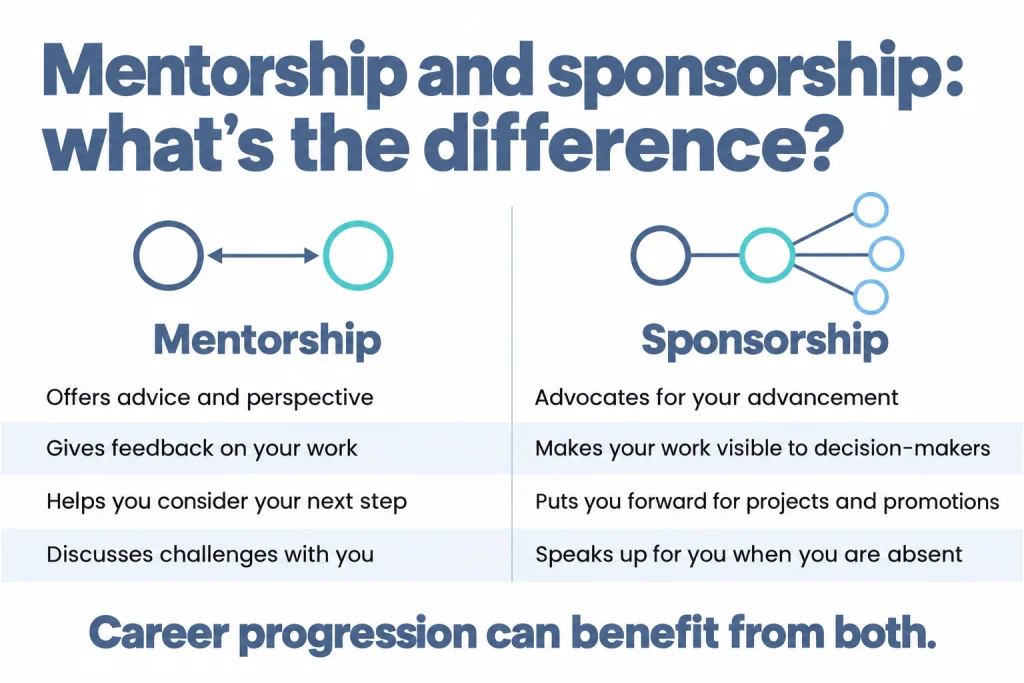
Many women are told to find a mentor, and that’s good advice. A mentor is an experienced guide who offers wisdom and helps you navigate workplace politics. But while mentorship is invaluable, it often isn't enough to secure a seat at the leadership table. The frequently missing piece of the puzzle is sponsorship.
A sponsor is a senior leader who does more than give advice; they actively use their influence and reputation to champion your advancement. Think of it this way: a mentor talks with you, but a sponsor talks about you in the rooms where the real decisions are made.
- A Mentor Provides: Guidance on your current role, feedback on your performance, and a safe space to discuss challenges. They help you build your map.
- A Sponsor Provides: Visibility for your work, nominations for promotions and high-profile projects, and advocacy when you're not there to speak for yourself. They hold the key to the next door.
The lack of sponsorship is a significant barrier to leadership in women. Men often develop these relationships more organically through informal networks. Women, on the other hand, can find themselves on the outside of these channels, making it much harder to gain the powerful backing needed for executive roles. That’s why actively seeking and cultivating relationships with potential sponsors is a critical, and very deliberate, career strategy.
The Challenge of Rigid Workplace Structures
Finally, many STEM organisations still run on structures and policies designed decades ago, often with a traditional, male-centric career path as the default. These rigid systems can inadvertently penalise women.
Opaque promotion processes are a perfect example. If the criteria for getting ahead are unclear or subjective, it opens the door for bias to creep in. In the same vein, inflexible working hours and a lack of support for caregivers can force talented women to scale back their ambitions, especially during the critical mid-career years when leadership potential is often cemented. These are not personal failings; they are organisational design flaws. Fixing them requires a fundamental shift towards transparency, flexibility, and equitable policies that support diverse career journeys and life stages.
Developing Your Authentic Leadership Style
Once we’ve acknowledged the systemic hurdles, we can shift our focus from external challenges to our own internal strengths. A crucial part of leadership for women in STEM is cultivating a style that is both effective and genuine. It’s about moving beyond the pressure to conform to outdated, often male-coded, archetypes of what a leader "should" look like.
The idea of a single ‘correct’ way to lead is, frankly, a myth. Success in STEM is driven by a rich diversity of leadership approaches, not a one-size-fits-all template. True leadership isn’t about mimicking a persona; it’s about identifying your inherent strengths and aligning them with proven leadership models. This alignment is what allows you to lead with confidence and consistency, building the kind of trust that inspires teams to do their best work.
Finding Your Leadership Blueprint
Exploring different leadership philosophies is the first step toward building your own. Instead of seeing them as rigid frameworks you must fit into, think of them as toolkits. You can draw from each one to construct an approach that feels natural to you and is right for the specific demands of a technical environment.
- Transformational Leadership: A transformational leader is like a catalyst in a chemical reaction. They don't just manage processes; they inspire and motivate teams to innovate and achieve extraordinary outcomes. They spark a fundamental change in expectations and performance.
- Collaborative Leadership: This leader acts as a hub in a complex network. In environments like research labs or software development teams, where progress depends on integrating diverse expertise, this approach accelerates discovery by ensuring information flows freely and every contribution is valued.
- Authentic Leadership: An authentic leader is like a well-calibrated instrument. They lead with transparency, guided by a strong internal moral compass and deep self-awareness. This consistency builds incredibly resilient and psychologically safe teams, because people trust that their leader’s actions will always align with their words.
Authentic leadership is not about being universally liked; it's about being consistently yourself. It requires self-reflection, open-mindedness, and an appreciation for others, which in turn fosters genuine collaboration and empathy.
Getting to grips with these styles gives you a language to define your own instincts. You can learn more about how understanding yourself is the foundation of modern leadership in our detailed article.
The Power of Authentic Presence in STEM
Authenticity is particularly potent in STEM fields, where credibility is everything. When you lead from a place of genuine conviction and expertise, your influence naturally grows. This isn’t just about what you say, but how you present yourself. To authentically project your leadership, learning to master personal branding for executives is a powerful strategy that helps align your external presence with your internal values.
Developing this presence means having the confidence to lead in a way that is true to you, even if it looks different from the leadership you have seen before. Thankfully, the progress of women into senior roles shows that diverse styles are gaining acceptance and proving their success. For example, recent UK data highlights significant advancements in female representation across major companies.
Between 2018 and 2023, the proportion of women in FTSE leadership roles saw a remarkable surge. In the FTSE 100, it climbed from 27% to 35.2%, while the FTSE 250 jumped from 30.2% to 42.1%. Across the wider FTSE 350, leadership roles held by women reached 35.3%, with board representation hitting 43%.
This progress, achieved through voluntary targets, shows that organisations are increasingly recognising the value women leaders bring. That said, gaps remain, with only 27% of FTSE 350 companies achieving the 40% female leadership target.
Ultimately, your most powerful leadership tool is your unique perspective and personality. By embracing an authentic style, you not only enhance your own effectiveness but also become a crucial role model for the next generation of women in STEM. You demonstrate that there isn’t just one path to making a significant impact—there are many.
A Practical Framework for Your Career Ascent
Knowing the obstacles is one thing; actively navigating around them is another. Let’s shift from understanding the challenges to taking decisive action. This is where we get practical, laying out a structured toolkit of proven strategies designed to put you firmly in control of your professional journey.
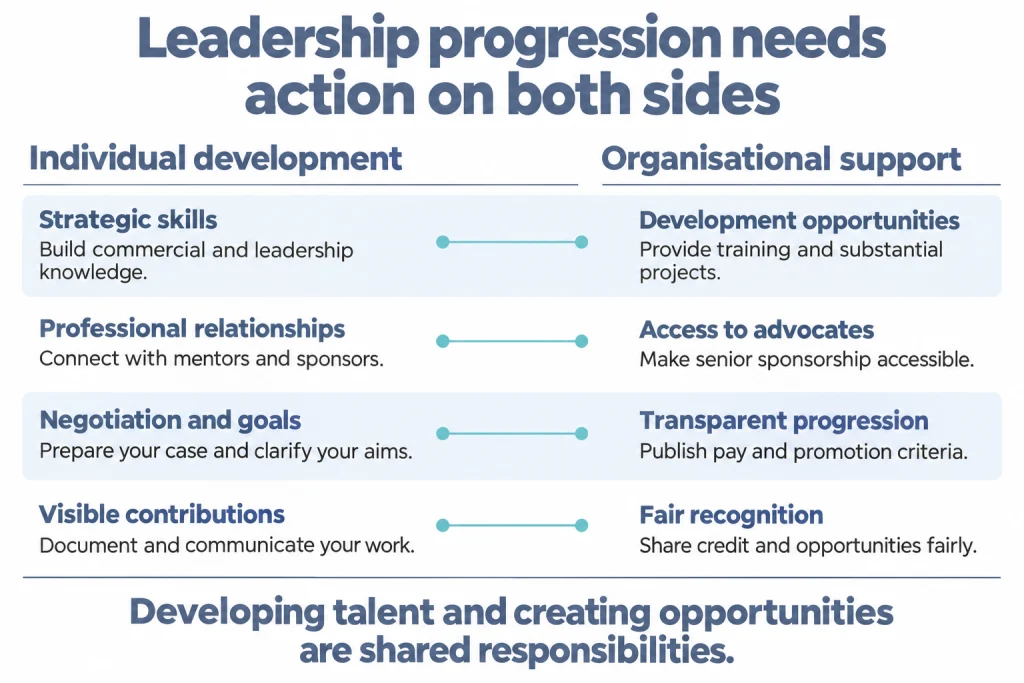
Think of what follows as your personal playbook for advancement. It’s built on four core pillars, each a critical area for growth: sharpening your strategic skills, building a powerful network, mastering negotiation, and raising your professional profile. When combined, these elements create a sustainable engine for your career progression in STEM.
Pillar 1: Cultivate Strategic Skills
While technical prowess gets you in the door in STEM, leadership demands a much broader perspective. Strategic skills are what bridge the gap between your technical work and the organisation's overarching goals, proving your value well beyond the confines of your immediate role.
Start by taking stock of your own abilities. A simple skills audit can help you see where your talents align with the company's future needs and—just as importantly—where you might have gaps to fill.
Concentrate your efforts on a few high-impact areas:
- Financial Acumen: Get comfortable with the numbers. Understanding how your projects affect the bottom line and learning the language of budgets and forecasts helps you communicate effectively with senior leadership.
- Project Management: The ability to steer complex projects to successful completion, on time and on budget, is a powerful demonstration of reliability and resourcefulness.
- Conflict Resolution: Leadership isn't always smooth sailing. Developing the skill to mediate disagreements and forge consensus is what turns workplace friction into genuine forward momentum.
For targeted training in these exact areas, exploring formal leadership development programs can provide the structure and support needed to accelerate your growth.
Pillar 2: Build an Influential Network
Your professional network is one of the most valuable assets you'll ever build. It isn't just about the number of connections you have; it’s about who knows you, respects your work, and is willing to advocate for you when you’re not in the room. This means moving beyond casual contacts to build genuine, strategic relationships with mentors, peers, and sponsors.
A robust network opens doors to information, opportunities, and support that are impossible to find on your own. It acts as an early warning system for industry shifts and gives you a platform to raise your visibility.
Your network should be a dynamic ecosystem, not a static list of names. It’s about reciprocal relationships where you both give and receive value. Nurture it with the same attention you’d give a critical project.
Begin today by mapping your current connections and identifying where you need to branch out—both inside and outside your organisation. This is a long-term investment that will pay dividends at every turn of your career.
Pillar 3: Master the Art of Negotiation
Negotiation is a fundamental leadership skill, and it applies to so much more than just salary talks. It’s about advocating for your ideas, your team, and yourself with confidence. Women who become skilled negotiators are far better positioned to secure the resources, promotions, and recognition they’ve earned.
Many of us were socialised to be agreeable, which can feel like a disadvantage at the negotiating table. The trick is to reframe the entire exercise. It’s not a confrontation; it’s a collaborative effort to solve a problem for a mutually beneficial outcome.
Go into any negotiation with a clear plan:
- Define Your Goal: Know precisely what you want and what your non-negotiables are.
- Gather Data: Facts are your best friend. Research industry salary benchmarks, typical project budgets, or whatever the topic is.
- Anticipate the Other Side: Think about their perspective and prepare thoughtful responses to potential objections.
- Practise Your Pitch: Rehearse your key points out loud. This helps you deliver them calmly and persuasively when it counts.
Pillar 4: Increase Your Professional Visibility
Doing excellent work is essential, but it’s not enough if no one knows about it. You have to ensure that key decision-makers are aware of your contributions. Increasing your professional visibility is about strategically building your reputation as a capable, go-to expert.
Actively seek opportunities that put you in the spotlight. Volunteer to lead that high-impact project, offer to present your team's findings at a company-wide meeting, or apply to speak at an industry conference. The goal is to become associated with important, successful work.
Get into the habit of documenting your achievements as they happen. Don't wait for your annual review to rack your brain for successes. Keep a running list of your accomplishments—complete with hard data and outcomes—to make your value clear and undeniable. For a detailed guide on weaving these strategies into a cohesive plan, see our article on building a https://womeninstemnetwork.com/career-development-plan/.
Building a STEM Workplace Where Everyone Can Thrive
While individual ambition and strategy are crucial, they can only go so far. A person’s success is ultimately shaped by the environment they work in. For women in STEM to truly flourish, organisations need to move past good intentions and start actively building a culture of inclusion. This isn’t just about doing the right thing; it’s a strategic necessity for driving innovation, attracting the best people, and securing the future of the business.
Creating this kind of workplace isn’t a quick fix. It requires a deep, systemic overhaul of how things are done. Every part of the employee experience, from the way a job advert is written to the criteria for a board-level promotion, needs to be re-examined. An inclusive culture doesn't happen by chance—it’s the result of deliberate, consistent, and measurable effort.
Rethinking Recruitment: From Bias to Belonging
It all starts with hiring. An inclusive workplace must be built on a foundation of equitable recruitment, but traditional hiring is often riddled with unconscious bias that favours candidates who fit a familiar mould. The solution is to introduce structured, objective practices that give everyone a fair shot.
The first step is to look critically at the entire recruitment process.
- Standardised Interview Questions: Ask every candidate the same core set of questions. This ensures you're comparing people based on their skills and experience, not just on how well you get along.
- Diverse Interview Panels: Make sure your hiring committees include people from different backgrounds, genders, and departments. This simple change helps cancel out individual biases and leads to a more balanced assessment.
- Anonymised CV Reviews: During the initial screening, remove names, graduation years, and other personal details from applications. This forces reviewers to focus purely on qualifications and stops unconscious assumptions from creeping in.
Creating Pathways for Growth Through Sponsorship
Getting talented women through the door is only half the battle; keeping them and helping them advance is where the real work begins. One of the biggest factors in career progression is sponsorship, and this is where many women find themselves at a disadvantage. Formalising sponsorship programmes is one of the most effective ways to level the playing field.
Sponsorship is more than just mentorship. A mentor offers advice, but a sponsor actively advocates for you. Organisations can create structured programmes that match high-potential women with senior leaders who are specifically tasked with championing their careers. This is how you ensure talented women get the visibility and high-level backing they need to move into leadership.
People often say the lack of women in leadership is a pipeline problem. More often than not, it’s a promotion problem. The talent is already there; the system is just failing to recognise and elevate it.
The numbers at the very top tell a stark story. In the UK, women hold just 9.4% of CEO positions in FTSE 100 companies and a mere 6.1% in the FTSE 250. This stubborn glass ceiling shows that even when women advance, the path to the highest levels of power remains incredibly difficult to navigate. These figures, which you can explore in more detail through Statista's analysis of CEO representation, confirm that deep, systemic change is needed to close the gap between middle management and the C-suite.
Designing Policies That Support Real Lives
Finally, a truly inclusive workplace understands that its employees have lives outside of work. Rigid, old-fashioned policies around working hours and parental leave often penalise women more than men, forcing them to make impossible choices between their careers and family responsibilities right at a critical stage.
Bringing in flexible arrangements, like hybrid models or adaptable hours, is a game-changer. It shows trust and benefits everyone. Just as important is offering generous, equitable parental leave for all genders. This helps normalise caregiving as a shared responsibility, chipping away at the outdated assumption that it falls solely to women. These aren't just 'nice-to-have' perks; they are fundamental structures that give everyone an equal opportunity to succeed.
Common Questions on the Path to Leadership
As you navigate your leadership journey in STEM, certain questions come up time and time again. Let’s tackle some of the most common ones with clear, straightforward advice to help you cut through the noise and focus on what truly matters for your career.
What Is the Single Most Effective Thing I Can Do to Advance?
While there are many paths forward, one of the most powerful career accelerators is securing a sponsor. A sponsor is more than a mentor; they are a senior leader who actively advocates for you, putting your name forward for promotions and high-stakes projects. You can find a sponsor by consistently delivering excellent work and building genuine relationships with senior figures, making sure they know your ambitions.
A sponsor moves beyond giving advice into the active championship of your career. This advocacy is crucial for reaching senior levels of leadership in women.
Can I Lead Without a Formal Title?
Absolutely. Leadership is about influence, not just a job title. You demonstrate it every day when you take initiative on a tough project, mentor a junior colleague, or build consensus in a difficult meeting. Start by volunteering to lead a small team project or an internal committee; it's a fantastic way to build a reputation as someone who makes things happen.
How Can Allies Best Support Their Female Colleagues?
Real allyship is about concrete, intentional action. It starts with actively listening to the experiences of your female colleagues and making sure their voices are heard. If you notice a woman's contribution being overlooked in a meeting, speak up and give her the credit she deserves. The most impactful thing you can do, however, is use your position to sponsor talented women, ensuring they get the visibility and opportunities they've earned.
Is There a 'Best' Leadership Style for Women?
There’s no one-size-fits-all answer here. The most effective leaders are, above all, authentic. Leadership styles that foster innovation and team cohesion, like the transformational and collaborative approaches, often work exceptionally well in STEM environments. The key isn’t to force yourself into a preconceived mould, but to find a style that plays to your natural strengths while meeting the needs of your team.