
Meetings are where ideas are discussed, decisions are made and professional reputations develop. But they are not always environments where everyone has an equal opportunity to contribute.
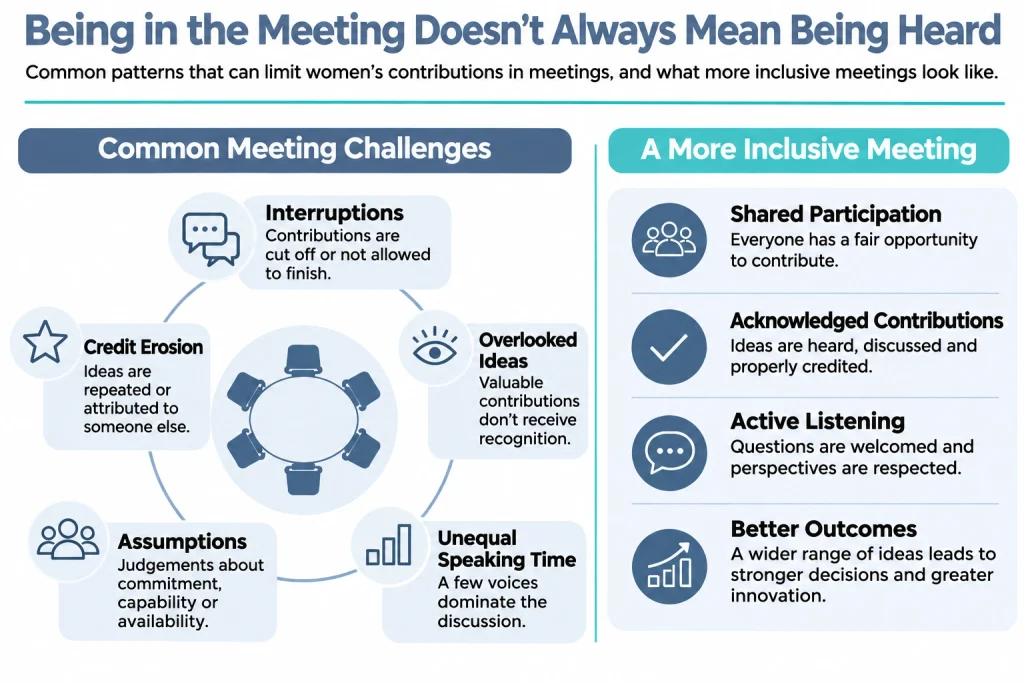
Some people are comfortable speaking up, challenging ideas and making their presence felt. Others may have just as much expertise but struggle to find the right moment to contribute. And sometimes, even when someone does speak, their ideas are overlooked, interrupted or attributed to somebody else.
These experiences are familiar to many women working in science, technology, engineering and mathematics (STEM). They raise questions about confidence in meetings, workplace communication, professional visibility and the way organisations recognise people's contributions.
At a recent Women in STEM Network workshop, business psychologist Fiona Kearns explored these challenges and shared practical approaches to navigating them.
Why Confidence in Meetings Matters for Women in STEM
Technical expertise and communication confidence are not necessarily the same thing.
Someone may be an excellent researcher, engineer, scientist or technology specialist but still find it difficult to contribute in meetings, particularly when more senior colleagues are present or when the discussion is dominated by a few individuals.
This matters because meetings influence more than the immediate decisions being made. They can affect who is recognised for their ideas, who is invited to participate in future projects and who is perceived as having leadership potential.
But should professional visibility depend on how comfortable someone feels speaking in a group?
There is a difference between having something valuable to contribute and being able to communicate that contribution in an environment where others are competing to be heard.
Understanding that difference is an important part of developing confidence at work.
Recognising and Responding to Microaggressions in the Workplace
One of the challenges discussed during the workshop was the effect of workplace microaggressions.
These can include seemingly small comments, assumptions or behaviours that undermine someone's professional standing.
A woman might be asked whether family responsibilities will interfere with her ability to manage a project. She may repeatedly be expected to organise meetings or take notes, even when those tasks have no connection to her role. Her contributions may be interrupted, dismissed or subsequently repeated by somebody else.
Individually, these incidents can appear relatively minor. Repeated over time, they may influence confidence, participation and how someone is perceived by colleagues.
Responding is not always straightforward.
Challenging every comment directly may create unnecessary conflict, particularly when the intention behind it is unclear. Ignoring repeated behaviour, on the other hand, may allow an unhelpful pattern to continue.
One approach is to ask for clarification rather than immediately becoming defensive. Questions such as "What do you mean by that?" or "Can you explain why you think that?" can encourage someone to reconsider what they have said.
In other situations, a private conversation may be more constructive.
The important distinction is between responding thoughtfully and reacting instinctively. Different situations require different approaches.
How to Speak Up and Make Your Voice Heard in Meetings
Confidence is often associated with speaking frequently or being particularly outgoing. But effective communication does not necessarily require either.
Preparation can make a considerable difference.
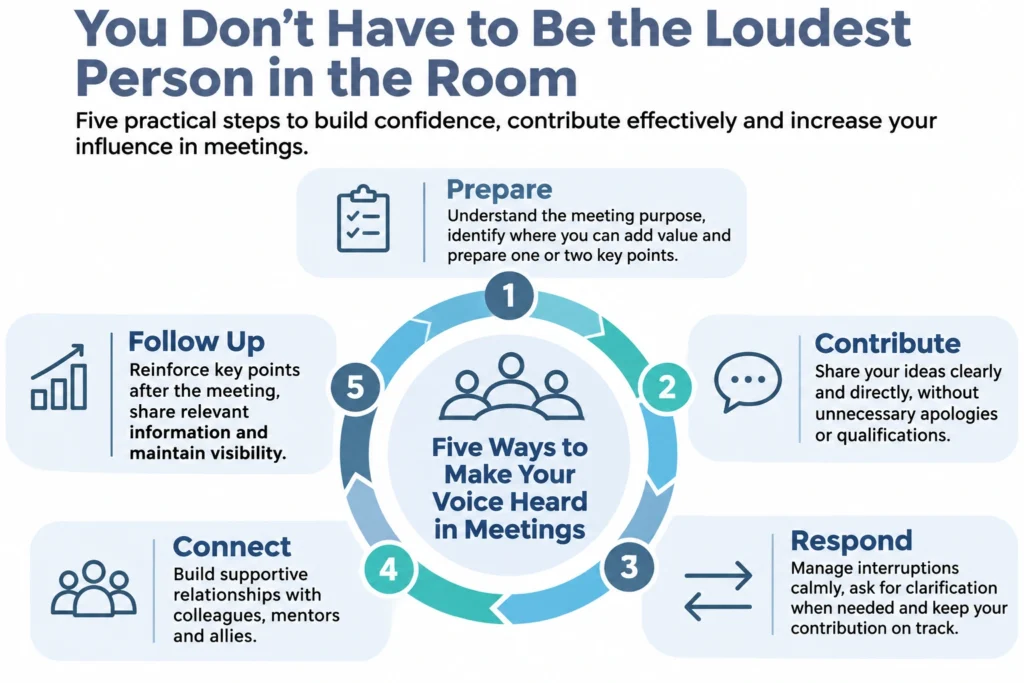
Before a meeting, it helps to understand the purpose of the discussion, identify the decisions that need to be made and consider where your expertise might contribute.
Preparing one or two questions can also provide a starting point for participation, particularly for people who find spontaneous contributions difficult.
The language we use matters as well.
Women sometimes introduce their ideas with unnecessary apologies or qualifications. Phrases such as "This might be a silly question" or "I'm probably wrong, but..." can weaken a contribution before anyone has considered its substance.
Clear, direct language allows an idea to stand on its own merits.
This does not mean becoming aggressive or dismissive of other people's opinions. It means communicating with enough confidence that others understand what is being proposed and why it deserves consideration.
Managing Interruptions and Overlooked Contributions
Being interrupted is frustrating, particularly when it happens repeatedly.
There is no single response that works in every situation. Sometimes continuing calmly until a point is finished may be effective. In other circumstances, acknowledging the interruption and asking to complete the thought may work better.
The relationship between the people involved, the culture of the organisation and the purpose of the meeting all influence what is appropriate.
There is also a role for colleagues and meeting chairs.
When somebody's idea is overlooked, another participant can bring attention back to it. When someone is repeatedly interrupted, the chair can ensure they have an opportunity to finish.
These small actions can influence whether a meeting becomes a place where people compete for attention or one where different perspectives are genuinely considered.
Perhaps confidence in meetings is not only about learning how to speak, but also about creating workplaces where people are prepared to listen.
Building Professional Visibility Without Changing Your Personality
Not everyone enjoys networking, speaking in groups or drawing attention to themselves.
That does not mean they cannot develop professional influence.
Visibility can begin with small, manageable actions: contributing one point during a meeting, asking a thoughtful question, following up on an idea afterwards or developing stronger relationships with colleagues.
Over time, these actions can help people become more comfortable participating and more confident that their contributions have value.
Professional relationships also matter. Having colleagues, mentors or peers who recognise your expertise and support your development can make difficult situations easier to navigate.
For women working in STEM, where technical achievement does not always translate automatically into leadership opportunities, these relationships can be particularly useful.
Confidence Is Not Just an Individual Responsibility
Professional development programmes often focus on what individuals should do differently.
Speak more confidently. Prepare more thoroughly. Learn to be assertive. Build stronger networks.
These are useful skills, but they are only part of the picture.
Organisations also have a responsibility to consider how their meetings operate.
Who gets invited? Who dominates the discussion? Whose ideas are acknowledged? Are quieter participants given opportunities to contribute? Do managers recognise when assumptions about gender, family responsibilities or seniority influence decisions?
An individual can develop excellent communication skills and still struggle in a workplace where those contributions are routinely dismissed.
Improving meetings therefore involves both individual development and organisational awareness.
Learning from Business Psychologist Fiona Kearns
These issues were explored in the Women in STEM Network's Mastering Meetings: Skills for Women workshop, led by Fiona Kearns, founder of Kearns Consultancy.
Fiona is a business psychologist specialising in organisational change, leadership development and workplace behaviour. She has been recognised by the Association for Business Psychology for Excellence in Behavioural Interventions, including her work on Helping Super Smart Scientists be Super Smart Leaders.
She has also developed the Strategic Confidence programme, which supports women in building confidence and developing their leadership capabilities.
Drawing on her experience in business psychology, Fiona explored practical strategies for handling microaggressions, communicating assertively, increasing visibility and managing difficult interactions in meetings.
The workshop included interactive exercises and discussion, with participants sharing their own workplace experiences and considering how they might approach similar situations differently.
You can learn more about Fiona through her LinkedIn profile or visit Kearns Consultancy.
Watch the Workshop: Finding Your Voice in Meetings
The discussion raised questions that extend beyond any single meeting or workplace.
How do we recognise expertise when it is expressed quietly? Why do some contributions receive more attention than others? And what can individuals and organisations do to ensure that meetings provide genuine opportunities for participation?
For those who would like to explore these questions further, the Women in STEM Network has published a recording and summary of Fiona's workshop.
Finding Your Voice: Confidence, Visibility and Influence in Meetings — Watch the Workshop
The session offers practical approaches to building confidence, responding to difficult situations and making professional contributions more visible.
It also invites us to consider something broader: when someone struggles to make themselves heard in a meeting, is the problem always their confidence, or should we sometimes be looking more closely at the meeting itself?